

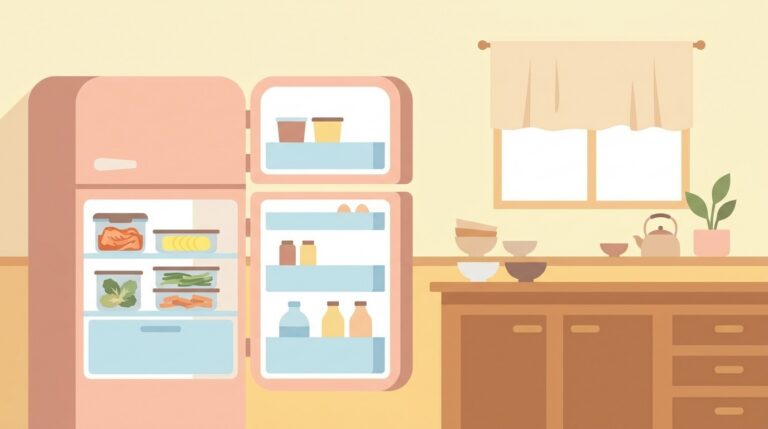
Mastering Everyday Korean: How to Say Put It in the Refrigerator
Phase 1: Empathy & Story Opening
안녕하세요! (Annyeonghaseyo!) Daily Hangul editor here! Think about this cozy scene: You’ve just finished a magical late-night K-drama marathon in your cozy Seoul Airbnb, indulging in crispy seasoned fried chicken (양념치킨 – yangnyeomchikin) and savory kimbap. But now, you are staring at half a box of leftovers. You want to save it for tomorrow, but your Korean host or roommate asks you what you want to do with the food. You freeze up—not because of the cold kitchen tiles, but because you realize you have no idea how to say the simplest daily chore: “Let’s put this in the fridge!”
Every beginner learner encounters this sudden hurdle. We memorize how to introduce ourselves and ask where the restroom is, but the moment real domestic life happens—appliances, leftovers, kitchen chores—we draw a blank! Don’t worry. This guide is built directly from real experiences of learners just like you who transitioned from textbook stiffness to effortless living in Korea. By mastering this single, essential appliance routine, you will feel completely at home in any Korean kitchen.
Phase 2: 3 Core Expressions Deep Dive
1. 냉장고에 넣어요 (Naengjanggo-e neoeoyo)
- Pronunciation: [Naeng-jang-go-e neo-eo-yo] (Think of Naeng like ‘name’ ending in ‘ng’, and neoeoyo sounding smoothly like “nuh-uh-yo”).
- Meaning: Literal: “Put [it] in the refrigerator” | Real Nuance: “Put it in the fridge” (Friendly, standard polite statement or gentle request).
- K-Culture Moment: The iconic weekend variety show where guests open giant refrigerators, and celebrity chefs immediately remind each other to put fresh ingredients away before they spoil.
- Editor’s Insight: Naengjanggo (냉장고) means refrigerator, and -e (에) marks the location “into/at.” Neoeoyo (넣어요) comes from neota (넣다), which means to put something inside an enclosed space. You will use this daily!
- Situation Spectrum: Casual: ✅ (as 냉장고에 넣어 – naengjanggo-e neoeo) | Semi-formal: ✅ (냉장고에 넣어요) | Formal: ✅ (냉장고에 넣으세요 – naengjanggo-e neouseyo)
- 🤔 Think About It: In English, we often say “chill this” or “put it away,” but Korean frequently names the appliance explicitly (냉장고에). Why do you think Korean kitchen speech is so exact about storage spaces?
2. 이거 시원하게 해 주세요 (Igeo siwonhage hae juseyo)
- Pronunciation: [Ee-geo see-won-ha-gae hae joo-sae-yo] (Siwon sounds like a refreshing breeze: “see-one”).
- Meaning: Literal: “Please make this cool/refreshing” | Real Nuance: “Could you chill this for me?” or “Please keep this cold.”
- K-Culture Moment: Handing a bottle of banana milk or Korean cider to a convenience store clerk or restaurant server when you want a chilled replacement from the back fridge.
- Editor’s Insight: The word siwonhada (시원하다) is one of Korea’s most poetic sensory words. While it literally translates to cool or cold, Koreans even say it when drinking piping-hot soup! When paired with drinks, however, it strictly means ice-cold freshness.
- Situation Spectrum: Casual: ⚠️ | Semi-formal: ✅ | Formal: ✅
- 🤔 Think About It: Notice how polite Korean softens direct commands by asking to “make it so” (해 주세요 – hae juseyo) rather than demanding an action.
3. 냉장 보관해 주세요 (Naengjang bogwanhae juseyo)
- Pronunciation: [Naeng-jang bo-gwan-hae joo-sae-yo] (Bogwan rhymes with “go-one”).
- Meaning: Literal: “Please do refrigerated storage” | Real Nuance: “Please keep this refrigerated.”
- K-Culture Moment: Picking up fresh traditional rice cakes (tteok) or handcrafted Korean bakery treats and asking the clerk how to preserve them at your accommodation.
- Editor’s Insight: Naengjang (cold storage) combined with bogwan (storage/keeping) is the standard written and service phrase. You will see it printed on every Korean grocery item packaging: “냉장 보관”!
- Situation Spectrum: Casual: 🚫 | Semi-formal: ✅ | Formal: ✅
- 🤔 Think About It: Korean separates kitchen talk into homely verbs (넣다 – put in) and precise Sino-Korean nouns (보관 – preservation). Switching between them marks your communicative maturity.
Phase 3: Textbook Korean vs. Real Korean
Situation 1: Telling your roommate to put the drinks inside the fridge
- 📖 교과서 한국어: 음료수를 냉장고에 넣으십시오. (Eumryosureul naengjanggo-e neoeusipsio. / Please place the beverages into the refrigerator.)
- 🗣️ 진짜 한국어: 음료수 냉장고에 넣어 줘. (Eumryosu naengjanggo-e neoeo jwo. / Pop the drinks in the fridge for me.)
- 💡 왜 다를까?: Textbook imperatives with -sipsio sound like an automated emergency broadcast system. Real Koreans drop grammatical particles like -reul in relaxed conversation and use the cozy ending -eojwo (do it for me).
Situation 2: Stashing food delivery leftovers
- 📖 교과서 한국어: 남은 음식을 냉장고 안에 보관하세요. (Nameun eumsigeul naengjanggo ane bogwanhaseyo. / Preserve leftover food inside the refrigerator.)
- 🗣️ 진짜 한국어: 남은 거 냉장고에 넣자! (Nameun geo naengjanggo-e neokja! / Let’s toss the leftovers in the fridge!)
- 💡 왜 다를까?: Real speakers replace the heavy noun eumsik (food) with the ultra-convenient spoken pronoun geo (thing), creating an inviting, collaborative vibe (-ja).
Phase 4: K-Culture Deep Dive & Non-Verbal Manners
4-1. Nunchi (눈치) & Fridge Gestures
In Korean culture, the refrigerator is intimate domestic territory. If you are staying with a Korean host family, a shared goshiwon (student housing), or an Airbnb with a resident host, never swing open the fridge doors casually without asking. When putting food inside:
* Two-Handed Placement: When handling side-dish containers (반찬통 – banchantong) given to you by an elder or host, hold the container with both hands before placing it inside.
* Labeling Etiquette: In shared accommodations, unlabeled items in the fridge are a silent social nightmare. Always keep a mini marker handy to write your room number or initials!
4-2. The Kimchi Refrigerator Phenomenon (김치냉장고)
Walk into almost any Korean household, and you will discover not one, but two refrigerators! Beside the tall standard fridge sits a specialized Kimchi Fridge (김치냉장고 – kimchi-naengjanggo). Why? Standard fridges cycle temperatures frequently, which ruins the delicate fermentation of kimchi. The kimchi fridge maintains a near-constant sub-zero chill that mimics traditional underground earthenware pots (onggi). If someone hands you homemade kimchi, check first before putting it into the standard fridge—they might say, “김치냉장고에 넣어요!” (Kimchi-naengjanggo-e neoeoyo!).
Phase 5: Real-Life Roleplay Scenario
Setting: 10:30 PM. The living room of a shared Hongdae guest flat. You and your Korean housemate, Minji, just finished a feast of crispy chicken and side pickled radishes.
- Minji: 치킨 진짜 배부르다! (Chikin jinjja baebureuda! / 🎭 Patting her stomach happily / That chicken was so filling!)
- Learner: 맞아요, 너무 맛있었어요! (Majayo, neomu masisseosseoyo! / 🎭 Smiling and stacking the napkins / I know, it was delicious!)
- Minji: 치킨 두 조각 남았네. 이거 어떡하지? (Chikin du jogak namanne. Igeo eotteokhaji? / 🎭 Pointing at the leftover box / Two chicken pieces left. What should we do with this?)
- Learner: 냉장고에 넣어요! (Naengjanggo-e neoeoyo! / 🎭 Picking up the chicken container / Let’s put it in the fridge!)
- Minji: 그래요! 그런데 치킨 냄새 나니까 뚜껑 잘 닫아야 해요. (Geuraeyo! Geurende chikin naemsae nanikka dtukkeong jal dadaya haeyo. / 🎭 Handing over plastic wrap / Good idea! But it smells strong, so close the lid tightly.)
- Learner: 네, 뚜껑 닫고 넣을게요. (Ne, dtukkeong datgo neoeulgeyo. / 🎭 Securing the cover carefully / Yes, I’ll close the lid and put it in.)
- Minji: 고마워요! 내일 에어프라이어에 데워 먹어요. (Gomaweoyo! Naeil eeopeuraieo-e dewo meogeoyo. / 🎭 Giving a warm thumbs up / Thanks! Let’s reheat it in the air fryer tomorrow.)
- Learner: 좋아요, 기대돼요! (Joayo, gidaedwaeyo! / 🎭 Gently sliding the box onto the middle shelf / Sounds great, I can’t wait!)
🔀 Interactive Branching Choice
Minji hands you an open bottle of Korean rice wine (막걸리 – makgeolli). What do you say?
- Option A: “막걸리도 냉장고에 넣어요!” (Makgeollido naengjanggo-e neoeoyo!)
- Option B: “막걸리는 버리십시오.” (Makgeollineun beorisipsio.)
- Option C: “냉장고 안 돼요.” (Naengjanggo an dwaeyo.)
-
Choice Feedback:
- Option A (Best!): Perfect natural communication! Adding the particle -do (also) makes you sound like a local housemate.
- Option B (Bad): Overly formal, stiff, and wasteful—Minji will look startled that you ordered her to trash good makgeolli!
- Option C (Risk): Grammatically fragmented and confusing. Minji might think the fridge is broken!
Phase 6: 10-Second Emotion Shadowing Drill
Read these out loud, observing the rhythmic pause markers (/) and capturing the native feeling:
[😊 Cheerful & Proactive]
남은 거 / 냉장고에 / 넣을게요!
(Nameun geo / naengjanggo-e / neoeulgeyo!)-
[🤔 Curious & Gentle Question]
이거 / 냉장고에 / 넣어요?
(Igeo / naengjanggo-e / neoeoyo?) -
[🥺 Caring & Helpful]
물 시원하게 / 냉장고에 / 넣어 둘게요!
(Mul siwonhage / naengjanggo-e / neoeo dulgeyo!)
Phase 7: K-Culture Mini Dictionary
- 냉장고 (Naengjanggo) | Refrigerator | The foundation of any Korean kitchen space. Combined from Sino-Korean roots: Naeng (Cold) + Jang (Storage box) + Go (Warehouse).
- 냉동실 (Naengdongsil) | Freezer | The upper or lower sub-zero compartment where Koreans keep frozen dumplings (mandu), ice bars, and sliced spring onions.
- 반찬통 (Banchan-tong) | Side-dish storage container | Ubiquitous airtight glass or plastic containers (often Lock&Lock brand) designed to lock in kimchi aromas.
- 유통기한 (Yutong-gihan) | Expiration / Shelf-life date | Crucial printed text on milk, tofu, and food packaging you must check before deciding what goes into the fridge.
Phase 8: Traveler’s Survival Kit
Top 3 Survival Phrases
- 냉장고 어디 있어요? (Naengjanggo eodi isseoyo?)
- Pronunciation: Naeng-jang-go eo-di ee-sseo-yo?
- Pro Tip: Use this when checking into your boutique pension or guesthouse room to locate mini-bars tucked inside wooden cabinets.
- 냉장고에 넣어 주세요. (Naengjanggo-e neoeo juseyo.)
- Pronunciation: Naeng-jang-go-e neo-eo joo-sae-yo.
- Pro Tip: Useful at local boutique dessert shops when asking staff to keep your cold pudding or macaron chilled while you shop nearby.
- 냉동실에 넣으면 안 돼요! (Naengdongsil-e neoeumyeon an dwaeyo!)
- Pronunciation: Naeng-dong-sil-e neo-eu-myeon an dwae-yo!
- Pro Tip: Say this when someone accidentally tries to place carbonated beverages or glass bottles into the freezer!
Editor’s Travel Note
When ordering fresh grocery items during longer Korean travels, familiarize yourself with courier delivery methods through the Naver Map navigation app. Many local food packages are shipped in eco-friendly insulated pouches packed with iced water bags; unpack them right away and transfer perishables to your fridge shelves immediately to avoid condensation damage!
Phase 9: One Step Deeper
In many Western cultures, storing food in the fridge is a solitary routine. In Korea, however, putting food into the refrigerator is an act intertwined with community and affection (정 – Jeong). Mothers pack side-dish tubs for adult children, and roommates share communal banchan shelves. When a Korean tells you, “냉장고에 넣어서 내일 꼭 챙겨 먹어” (Put it in the fridge and make sure you eat it tomorrow), they aren’t just giving appliance advice—they are expressing heartfelt love and caring for your health.
💬 Your Turn: What is the first Korean snack or food you want to stock inside your Seoul apartment fridge? Share your culinary dream in the comments below!
Phase 10: FAQ & Common Mistakes
Q: What is the difference between 냉장실 (Naengjangsil) and 냉동실 (Naengdongsil)?
A: Naengjangsil (냉장실) is the chilling compartment (fridge section, typically 2°C to 4°C), while Naengdongsil (냉동실) is the freezing section (typically -18°C). When people say 냉장고에 넣다, they usually mean the fridge compartment by default.
Q: Can I use the verb 담다 (damda) instead of 넣다 (neota)?
A: 담다 (damda) means placing or scooping items into a bowl, basket, or open container (like putting rice into a bowl). Storing items into a closed appliance like a refrigerator or microwave strictly takes 넣다 (neota).
Q: How do I ask if something belongs in the fridge or at room temperature?
A: Simply ask: “냉장 보관이에요, 실온 보관이에요?” (Naengjang bogwanieyo, siron bogwanieyo? / Is this refrigerated storage or room temperature storage?).
🚨 Common Mistakes Alert Board
- Mistake 1: Saying 냉장고에 놓아요 (Naengjanggo-e noayo).
- Correction: 놓다 means putting something on top of a flat surface. Putting food inside an appliance requires 넣다 (neota) -> 냉장고에 넣어요.
- Mistake 2: Forgetting the destination particle 에 (e).
- Correction: Do not say 냉장고 넣어요. Always preserve the directional rhythm: 냉장고에 넣어요 (Naengjanggo-e neoeoyo).
- Mistake 3: Calling the Kimchi fridge 김치 박스 (Kimchi box).
- Correction: Always call it by its proper cultural name: 김치냉장고 (Kimchi-naengjanggo).
Phase 11: Action Missions
- Bronze Mission (Solo Vocal Drill): Walk up to your refrigerator right now. Touch the door handle and say out loud three times: “냉장고에 넣어요!” (Naengjanggo-e neoeoyo!).
- Silver Mission (Social Sharing): Snap a quick photo of your favorite drink inside your fridge and post it to Instagram or Threads with the Korean caption: “시원하게 냉장고에 넣었어요!”
- Gold Mission (Real-Life Mastery): The next time you visit a Korean supermarket or restaurant, spot the phrase 냉장 보관 on an item’s packaging or politely ask the clerk if a drink can be chilled.
- 🎮 K-Culture Mission: Watch any episode of a modern K-drama (like Hospital Playlist or Business Proposal). Spot the exact moment a character puts side dishes or beverages into the fridge and listen closely for the verb 넣다!
Phase 12: Interactive Quiz Challenge
1. Situational Judgment: You want to ask your Korean host to put leftover soup into the fridge politely. Which sentence is the most natural?
* A) 냉장고를 던져요. (Naengjanggoreul deonjyeoyo.)
* B) 국 냉장고에 넣어 주세요. (Guk naengjanggo-e neoeo juseyo.)
* C) 국 냉동실에 버려요. (Guk naengdongsil-e beoryeoyo.)
2. Fill-in-the-Blank: Complete the sentence with the correct particle and verb form:
“수박을 ______ ______.” (Put the watermelon into the fridge.)
* Clue: (냉장고 + destination particle) + (put in, polite present tense)
3. True or False Cultural Fact: In Korea, Kimchi should always be placed into the top freezer drawer of a regular refrigerator to stay tasty.
👉 Click to view answers and explanations!
1. Answer: B
Explanation: 국 냉장고에 넣어 주세요 gently and politely asks to put the soup into the fridge. Option A hilariously means “Throw the refrigerator,” and Option C means “Throw away the soup in the freezer!”
2. Answer: 냉장고에 넣어요 (Naengjanggo-e neoeoyo)
Explanation: 냉장고에 sets the location “into the fridge,” and 넣어요 expresses the present polite action.
3. Answer: False
Explanation: Freezing kimchi destroys its texture and good lactic acid bacteria! It belongs in the regular fridge section or, ideally, a dedicated temperature-stable 김치냉장고 (Kimchi refrigerator).







