

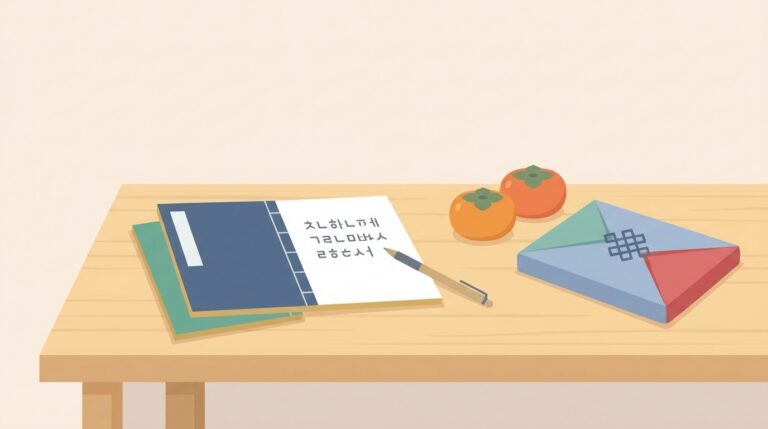
Master the Art of Chuseok Allowance: How to Give ‘Yongdon’ to Korean Parents Like a Native
Phase 1: Empathy (Story-Driven Opening)
안녕하세요! 매일한글 에디터입니다. (Hello! It’s your Daily Hangul editor!)
Picture this scene straight out of a heartfelt K-drama: You are sitting on a cozy floor mat in a warm Busan living room. The rich, savory aroma of freshly pan-fried jeon (전) and the sweet steam of songpyeon (송편) fill the air. The morning Chuseok memorial service has ended, and laughter echoes across the living room. Suddenly, your Korean partner smoothly pulls out an immaculate paper envelope from their coat, bows their head gracefully, and hands it to their mother. Her eyes tear up with proud joy.
Then your partner turns to you and whispers, “Now it’s your turn!”
Your palms instantly start sweating. If you come from a Western background, handing cash directly to your elders feels totally counterintuitive—almost offensive, like trying to pay your hosts for dinner! But in modern Korean culture, cash—specifically known as 용돈 (yongdon, allowance/pocket money)—is the undisputed #1 gift parents dream of receiving during major holidays.
Here lies the dilemma: How much do you give? What do you say so you don’t sound like a mafia boss handing over an envelope or an employer distributing end-of-year bonuses? If you hand it over carelessly with one hand, you risk committing a major cultural faux pas. Having coached hundreds of intermediate learners through their first Korean family holidays over the past decade, I’ve seen every awkward blunder possible. Today, we’re unlocking the exact words, gentle body language, and cultural mindset that will turn this nervous moment into an unforgettable bonding experience.
Phase 2: Top 3 Core Expressions Deep-Dive
1. 약소하지만 부모님 맛있는 거 사 드세요. (Yaksohajiman bumo-nim masinneun geo sa deuseyo.)
- Pronunciation: [Yak-so-ha-ji-man boo-mo-nim ma-shin-neun geo sa deu-se-yo] (Think of ‘yak’ like the Tibetan animal, ‘so’ like sewing, and ‘deu’ like the first sound in ‘dirt’.)
- Meaning: Literal: “It is small and meager, but please buy and eat something delicious, parents.” / Real Nuance: “It’s just a small token of my love, please treat yourselves to a nice meal on me.”
- K-Culture Moment: Seen in warm family slice-of-life dramas like Reply 1988 or My Unfamiliar Family, when adult children visit home with their first proper holiday bonus.
- Editor’s Insight: Koreans value modesty immensely. Even if the envelope holds a substantial amount, you always downplay it as 약소하다 (yaksohada, small/meager). Boasting about the amount will embarrass your elders!
- Situation Spectrum: Casual 🚫 | Semi-formal ⚠️ | Formal / Polite to Elders ✅
- 🤔 Think About It: In many Western cultures, downplaying a gift as “meager” might sound self-deprecating or cheap. Why does traditional Korean culture view downplaying your own generosity as the highest form of respect?
2. 항상 건강하시고 오래오래 행복하세요. (Hangsang geonganghasigo orae-orae haengbokhaseyo.)
- Pronunciation: [Hang-sang geon-gang-ha-shi-go oh-rae-oh-rae haeng-bok-ha-se-yo] (Sounds like ‘hang-song’ with a short ‘a’, ‘gun-gahng’, followed by rhythmic ‘oh-ray oh-ray’.)
- Meaning: Literal: “Always be healthy and be happy for a long, long time.” / Real Nuance: “Wishing you lasting health, long life, and endless happiness.”
- K-Culture Moment: The heartwarming climax in variety shows like I Live Alone when cast members visit their grandparents in the countryside and present holiday gifts.
- Editor’s Insight: The reduplicated adverb 오래오래 (orae-orae, for a very long time) softens the formality of the sentence and injects deep, childlike affection.
- Situation Spectrum: Casual ⚠️ | Semi-formal ✅ | Formal ✅
- 🤔 Think About It: English holiday greetings usually center on having fun (“Have a wonderful holiday!”). Why are Korean holiday greetings so heavily focused on health (건강) and longevity (장수)?
3. 키워주셔서 늘 감사드려요. (Kiwojusyeoseo neul gamsadeuryeoyo.)
- Pronunciation: [Kee-wo-joo-syeo-seo neul gahm-sa-deu-ryeo-yo] (Start with ‘key’, glide into ‘wo’ as in ‘won’, and end with the smooth honorific ‘deu-ryeo-yo’.)
- Meaning: Literal: “Because you raised me, I am always thankful.” / Real Nuance: “Thank you from the bottom of my heart for raising me.”
- K-Culture Moment: The classic tear-jerker scene during Chuseok phone calls in dramas like Hospital Playlist.
- Editor’s Insight: Using 감사드려요 (gamsadeuryeoyo) instead of 감사해요 (gamsahaeyo) uses the honorific humble verb 드리다 (deurida), honoring the immense sacrifice of parental care.
- Situation Spectrum: Casual 🚫 | Semi-formal ✅ | Formal ✅
- 🤔 Think About It: In Korean psychology, parenting is seen as an enduring debt of gratitude called 은혜 (eunhye, grace/favor). Giving an envelope isn’t transactional; it’s a symbolic repayment of this debt.
Phase 3: Textbook Korean vs. Real Korean
Situation 1: Presenting the Money Envelope
- 📖 교과서 한국어: 돈을 받으세요. (Doneul badeuseyo. / Please receive this money.)
- 🗣️ 진짜 한국어: 작은 성의예요, 어머니. (Jageun seong-uiyeyo, eomeoni. / It’s just a small token of my heart, Mother.)
- 💡 왜 다를까?: Directly mentioning “money” (돈) out loud sounds unrefined and abrasive to older Korean generations. Native speakers replace the word “cash” with abstract virtues like 성의 (seong-ui, heartfelt sincerity).
Situation 2: Encouraging Them to Spend It
- 📖 교과서 한국어: 이 돈을 쓰십시오. (I doneul sseusipsio. / Use this money.)
- 🗣️ 진짜 한국어: 두 분 좋은 데 쓰세요! (Du bun joeun de sseuseyo! / Please spend it on something nice for the two of you!)
- 💡 왜 다를까?: The imperative 쓰십시오 sounds like a military commander issuing a budget. Saying 좋은 데 쓰세요 feels warm, caring, and gently encourages self-care.
Phase 4: K-Culture Deep Dive & Non-Verbal Manners
4-1. Nunchi & Physical Gestures
- The Two-Hand Rule (두 손 예절): Never hand an envelope with one hand. Hold the envelope with both hands, thumbs positioned gently at the edges. Alternatively, hold it in your right hand while placing your left hand lightly under your right wrist or forearm.
- The Slight Bow (목례): Lower your head by 15 to 30 degrees while extending the envelope. Keep your gaze directed softly downward toward the envelope, avoiding assertive eye contact.
- Crisp Currency Only (신권 매너): Never use crumpled bills pulled from your pocket. Koreans visit banks days before Chuseok specifically to exchange worn money for brand-new, uncreased bills (신권, singwon).
4-2. The Cultural Dance: “Gejeol & Jaekwon” (The Polite Refusal)
- If you watch any Korean drama, you’ll witness this sacred ritual: When you offer the envelope, the parents will almost inevitably wave their hands and say:
> “아이구, 너도 쓸 돈 없는데 뭘 이런 걸 줘! 넣어 둬!” (Oh goodness, you barely have enough for yourself, why are you giving this! Put it away!) - Danger Zone: Do not take the envelope back and say “Okay!” This initial refusal is pure 체면 (chaemyeon, saving face). As a polite recipient, they must decline at least once or twice. Your job is to gently push it forward again: “아니에요, 꼭 받으세요!” (No, please, you must take it!). By the third attempt, they will happily tuck it away.
Phase 5: Real-Life Roleplay Scenario
- Setting: The warm dining area of Min-ho’s parents in Gyeongju. The Chuseok breakfast table has just been cleared, and sweet slices of Korean pear (배) and warm barley tea are served.
- Characters:
- Alex (You): An intermediate Korean learner visiting your partner’s family.
- Eomeoni (Mother): Warm, traditional, and thrilled to host you.
- Min-ho: Your supportive partner who is guiding you through the steps.
- Min-ho: 🎭 [Gently nudges Alex’s elbow and winks] 어머니, 알렉스가 드릴 말씀이 있대요. (Eomeoni, Alex-ga deuril malsseumi itdaeyo. / Mother, Alex has something to say to you.)
- Eomeoni: 🎭 [Smiles broadly, setting down her teacup] 그래? 우리 알렉스가? 무슨 일이야? (Geurae? Uri Alex-ga? Museun iriya? / Really? Our Alex? What is it?)
- Alex (You): 🎭 [Takes out a pastel silk envelope, holding it firmly with both hands] 어머니, 추석 명절 축하드려요. (Eomeoni, Chuseok myeongjeol chukhadeuryeoyo. / Mother, congratulations on the Chuseok holiday.)
- Alex (You): 🎭 [Bows head 20 degrees, offering the envelope] 약소하지만 아버님이랑 맛있는 거 사 드세요. (Yaksohajiman abeonimirang masinneun geo sa deuseyo. / It’s meager, but please buy and eat something delicious with Father.)
- Eomeoni: 🎭 [Eyes widen, waving both hands in surprise] 아이고! 알렉스, 학생/사회초년생인데 돈이 어디 있다고 그래! 마음만 받을게, 어서 넣어 둬! (Aigo! Alex, you barely started working, where do you have money for this! I’ll just accept your heart, put it back!)
- Alex (You): 🎭 [Gently holds the envelope forward without backing down, speaking warmly] 아니에요, 어머니. 두 분 항상 건강하시고 좋은 데 쓰세요. (Anieyo, eomeoni. Du bun hangsang geonganghasigo joeun de sseuseyo. / No, Mother. Please always stay healthy and spend it on something nice for the two of you.)
- Eomeoni: 🎭 [Accepts the envelope with both hands, patting Alex’s wrist lovingly] 아이구… 고마워서 어쩌나. 우리 알렉스 마음이 너무 예쁘네. (Aigu… gomawoseo eojjeona. Uri Alex maeumi neomu yeppeune. / Oh dear… what did I do to deserve this thanks. Our Alex has such a beautiful heart.)
- Min-ho: 🎭 [Grins proudly and thumbs up] 거봐, 어머니 엄청 좋아하시지? (Geobwa, eomeoni eomcheong joahasiji? / See? Mother loves it so much, right?)
🔀 Interactive Decision Point
Suppose Eomeoni refuses the envelope for a second time, saying: “진짜 괜찮은데!” (I really am okay!) What do you do?
- Option A: Put the envelope back into your bag and say: “네, 그럼 제가 쓸게요!” (Okay, then I will spend it!)
- Feedback [Bad]: Complete cultural emergency! It proves you were just offering out of superficial obligation.
- Option B: Gently slide the envelope beneath her tea saucer, smile warmly, and say: “저 효도하고 싶어서 준비했어요. 꼭 받아주세요!” (I prepared this because I wanted to show filial love. Please accept it!)
- Feedback [Best]: 100/100 points! Mentioning 효도 (hyodo, filial duty) makes your insistence touching, respectful, and impossible to turn down.
- Option C: Leave the cash envelope on the living room floor before stepping outside to leave.
- Feedback [Risk]: Leaving money unaddressed looks suspicious and awkward. It lacks the respectful human connection required during holidays.
Phase 6: 10-Second Emotional Shadowing Drill
Practice matching the native rhythm, pauses (/), and emotional undertones.
[🙇 겸손하고 정중하게 - Humble & Respectful]- 약소하지만 / 부모님 맛있는 거 / 사 드세요.
- (Yaksohajiman / bumo-nim masinneun geo / sa deuseyo.)
[😊 미소를 띠고 따뜻하게 - Warm & Smiling]- 항상 건강하시고 / 오래오래 / 행복하세요.
- (Hangsang geonganghasigo / orae-orae / haengbokhaseyo.)
[💖 애교 섞인 진심으로 - Playful & Sincere]- 두 분 / 좋은 데 / 꼭 쓰셔야 해요!
- (Du bun / joeun de / kkok sseusyeoya haeyo!)
Phase 7: K-Culture Mini Dictionary
- 용돈 (Yong-don) | Allowance / Pocket Money
- Usage: Unlike the English concept of giving allowance only down to children, in Korea, adult children give 용돈 up to their parents and grandparents every holiday and birthday.
- 신권 (Sin-gwon) | Brand-New Crisp Banknotes
- Usage: Presenting folded, old, or taped banknotes is frowned upon. Koreans flock to commercial banks right before major holidays to exchange old bills for 신권.
- 효도 (Hyo-do) | Filial Piety / Caring for Parents
- Usage: A cornerstone of Korean society. Used in modern slang like 효도 선물 (hyodo seonmul, a gift that fulfills filial duty) or 효도 여행 (hyodo yeohaeng, a trip paid for your parents).
- 성의 (Seong-ui) | Sincerity / Heartfelt Token
- Usage: The magic word that replaces blunt commercial terms like “cash” or “payment”. Saying 작은 성의 (jageun seong-ui) frames any financial gift as pure emotional warmth.
Phase 8: Traveler’s Survival Kit
Top 3 Survival Expressions for Chuseok
- 봉투 하나만 주시겠어요? (Bongtu hana-man jusigesseoyo?)
- Meaning: “Could you please give me one envelope?”
- Pro Tip: If you forgot an envelope, walk into any convenience store or stationary shop and ask this politely.
- 새 돈으로 바꿔 주실 수 있나요? (Sae doneuro bakkwo jusil su innayo?)
- Meaning: “Could you exchange this for new/crisp bills?”
- Pro Tip: Use this at major bank branches (like Shinhan or Hana Bank) in central districts 2–3 days before Chuseok.
- 풍성한 한가위 보내세요! (Pungseonghan hangawi bonaeseyo!)
- Meaning: “Have an abundant and fruitful Hangawi (Chuseok)!”
- Pro Tip: The ultimate seasonal greeting to text neighbors, hosts, and Korean coworkers.
Editor’s Travel Note
- Where to buy holiday envelopes: Don’t use plain postal envelopes if possible! Find beautiful traditional hanji paper envelopes with silk ties at Daiso or Artbox. Use the 네이버 지도 앱으로 다이소 매장 찾기 to locate the nearest store before holiday shutdowns begin.
- ATM Limits: Korean ATMs often experience shortages of new 50,000 KRW bills the evening before Chuseok. Withdraw your cash at least 48 hours in advance.
Phase 9: One Step Deeper (Reflective Essay)
In contemporary Western culture, financial independence often means maintaining a strict separation between individual adult finances and parental households. Giving cash to parents might feel patronizing or cold. But in Korea, the exchange of holiday yongdon represents 정 (Jeong, relational warmth) and collective survival. For decades, Korean parents sacrificed retirement savings to fund their children’s education and housing. The Chuseok envelope is not a sterile payment; it is the younger generation’s tangible promise: “You looked after me; now I am strong enough to look after you.”
💬 Your Turn: How does your home culture express gratitude to parents during holiday reunions? Do you gift cash, physical presents, or quality time? Share your family traditions in the comments below!
Phase 10: FAQ & Common Mistakes
Q: How much money is appropriate to put in the Chuseok envelope?
A: For B1 intermediate learners or young working adults, 100,000 KRW to 200,000 KRW (approx. $75–$150 USD) per parent or couple is the standard sweet spot. If you are still a university student, 50,000 KRW accompanied by a handwritten letter is considered deeply moving.
Q: Should I give the envelope to both parents together or separately?
A: If both parents are present, it is best to prepare either one shared envelope addressed to 두 분 (both of you), or two separate, identical envelopes so neither parent feels excluded.
Q: What should I write on the outside of the envelope?
A: On the front center or back flap, write a short, warm note: “늘 건강하시고 행복하세요 – [Your Name] 올림” (Always stay healthy and happy – Sincerely offered by [Your Name]).
🚨 Common Mistakes Alert
- Handing Over Cash Without an Envelope: Handing naked currency is considered extremely crude. Always use an envelope (봉투).
- Handing It One-Handed: Using your left hand or a single outstretched right hand screams arrogance. Always hold with both hands and bow slightly.
- Opening the Envelope in Front of Them: If parents give you holiday cash (sebaetdon or holiday pocket money), never open or count the money immediately. Say thank you, put it directly into your pocket, and check it later in private!
Phase 11: Action Missions
- 🥉 Bronze Mission (Solo Practice): Stand before your mirror with an envelope in both hands. Practice saying: “약소하지만 부모님 맛있는 거 사 드세요” three times with a gentle 20-degree bow.
- 🥈 Silver Mission (Social Share): Find a Korean holiday envelope online or in a shop, take a photo, and share your favorite Chuseok greeting phrase in our community forum.
- 🥇 Gold Mission (Real Life Action): If you have Korean in-laws, host parents, or Korean mentors, gift them a holiday card with a crisp coffee coupon or allowance envelope using the exact two-handed etiquette!
- 🎮 K-Culture Mission: Watch the Chuseok holiday special of any Korean reality show (like Omniscient Interfering View or My Little Old Boy) and spot the exact moment an adult child presents an envelope to their parents!
Phase 12: Interactive Quiz Challenge
1. Situation Judgment
You are handing an allowance envelope to your partner’s parents. Which action is the most culturally respectful?
* A) Giving it with your left hand while making strong, unblinking eye contact.
* B) Giving it with both hands while bowing slightly and saying: “작은 성의예요.”
* C) Leaving the envelope on their bed so they find it after you leave.
2. Fill-in-the-Blank
Complete the standard Chuseok greeting:
“항상 건강하시고 ______ 행복하세요!”
* A) 아주아주 (ajoo-ajoo)
* B) 오래오래 (orae-orae)
* C) 빨리빨리 (ppalli-ppalli)
3. Cultural True / False
- True or False: If Korean parents refuse your holiday allowance envelope the very first time, you should accept their refusal immediately and pocket the cash.
👉 Click to reveal answers & explanations!
- Correct Answer: B | Giving the envelope with both hands while offering humble words like “작은 성의예요” (It’s a small token of sincerity) displays ideal holiday etiquette.
- Correct Answer: B (오래오래) | 오래오래 means “for a very long time,” expressing heartfelt wishes for health and long life.
- Correct Answer: False | In Korean culture, initial refusal is part of the polite dance of saving face (체면). You must gently insist at least twice before they happily accept!







