

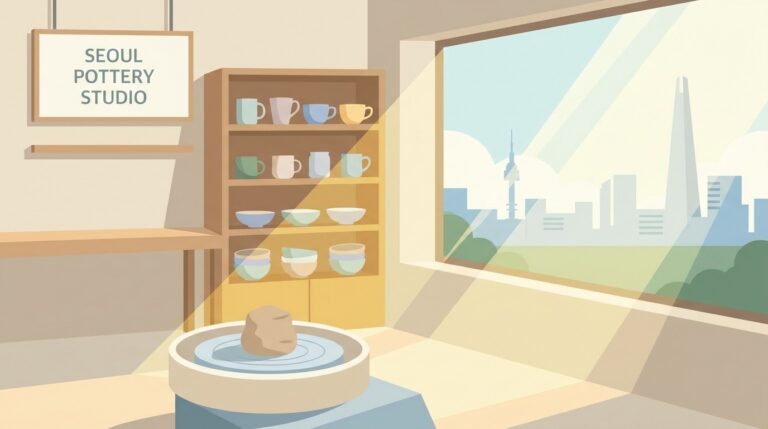
Phase 1: Empathy (Story-driven Opening)
안녕하세요! 매일한글 에디터입니다.
Picture this: You find yourself in a sunlit, aesthetic studio tucked inside a charming alleyway in Seongsu-dong. Soft indie acoustic music plays in the background, the aroma of freshly baked butter cookies fills the air, and shelves around you are stacked with handcrafted ceramics. You booked a trendy Korean “One-day class” (원데이 클래스) to experience Seoul’s creative culture firsthand. But the moment the instructor hands you a lump of spinning clay on the potter’s wheel and gently asks, “자, 이제 중심 한번 잡아볼까요?” (Now, shall we find the center?), your brain freezes. You want to ask whether you are pressing too hard, or humorously admit that your sourdough looks like a flat pancake, but all you can remember are formal textbook phrases like “이것은 잘못되었습니다” (This is incorrect).
If you have ever felt hesitant to join a creative workshop in Korea because of the language barrier, you are not alone. Many intermediate learners hit a conversational wall when stepping outside textbook dialogues into practical, hands-on environments. Based on real feedback from international students living in Seoul, this guide gives you the natural, witty, and culturally nuanced expressions you need to connect with your instructor, bond with classmates, and leave the studio with both a masterpiece and unforgettable memories.
Phase 2: Core Expressions Deep Dive
1. 손 힘을 좀 빼야 할까요? (Son himeul jom ppaeya halkkayo?)
- Pronunciation: [Son hi-meul jom ppae-ya hal-kka-yo?] (Think of saying son like family ‘son’, and him like ‘hymn’ with a soft punch: son hymn-eul jom bay-ya hal-kka-yo)
- Meaning: Literal: “Should I take some hand strength out?” / Actual Nuance: “Should I ease up on my grip / pressure?”
- K-Culture Moment: Seen in craft reality shows like I Live Alone (나 혼자 산다) whenever a celebrity visits a pottery workshop and grips the spinning clay so hard it immediately wobbles out of shape.
- Editor’s Insight: In Korean crafting (pottery, baking kneading, or even flower arranging), instructors emphasize 힘 빼기 (releasing tension). Using the soft hedge 좀 (jom – a little) makes your question sound modest and open to direction.
- Situation Spectrum: Casual: ⚠️ (Use 손 힘 좀 뺄까? with friends) | Semi-formal: ✅ (Perfect for instructors) | Formal: 🚫 (Too casual for formal lectures)
- 🤔 Think About It: In English, we often say “Am I pressing too hard?” focusing on the action. Korean phrases frequently focus on the distribution of energy (힘 – power/tension) within the body.
2. 모양이 제 생각대로 잘 안 잡혀요. (Moyangi je saenggakdaero jal an japhyeoyo.)
- Pronunciation: [Mo-yang-i je saeng-gak-dae-ro jal an ja-pyeo-yo] (Mo-yang sounds like ‘more-young’, saeng-gak like ‘sang-guck’)
- Meaning: Literal: “The shape is not getting caught according to my thoughts.” / Actual Nuance: “It’s not taking shape the way I pictured.”
- K-Culture Moment: Frequently heard on baking vlogs when someone tries to pipe macaron batter into a cute bear head, but it morphs into an unrecognizable blob.
- Editor’s Insight: 잡히다 (passive of 잡다, to hold/catch) is used here as an idiom for an aesthetic form settling into place (모양이 잡히다). It subtly places the fault on the unpredictable material rather than solely on your skills!
- Situation Spectrum: Casual: ⚠️ | Semi-formal: ✅ | Formal: ✅
- 🤔 Think About It: Notice how Korean uses passive and indirect expressions to cushion frustration, turning an awkward mistake into a gentle observation.
3. 선생님, 심폐소생술 좀 부탁드려요! (Seonsaengnim, simpyesosaengsul jom butakdeuryeoyo!)
- Pronunciation: [Seon-saeng-nim, sim-pye-so-saeng-sul jom bu-tak-deu-ryeo-yo!] (Sim-pye-so-saeng-sul flows like ‘seem-pye-so-sang-sool’)
- Meaning: Literal: “Teacher, please perform CPR on this!” / Actual Nuance: “Teacher, please rescue my ruined piece!”
- K-Culture Moment: A viral, humorous exaggeration used constantly by Korean MZ workshop attendees whenever a clay vase collapses on the wheel or cake icing slides off.
- Editor’s Insight: While 심폐소생술 literally means Cardiopulmonary Resuscitation (CPR), using it metaphorically shows great humor and humility. Instructors love this phrase because it breaks the tension instantly.
- Situation Spectrum: Casual: ✅ (with friends) | Semi-formal: ✅ (ideal for friendly class settings) | Formal: 🚫 (Do not use in medical or formal academic contexts)
- 🤔 Think About It: Korean humor often relies on dramatic medical or emergency hyperbole to express relatable failure with charm.
Phase 3: Textbook Korean vs Real Korean
Situation 1: When your craft project starts falling apart
- 📖 교과서 한국어: 이것은 망했습니까? (Igeoseun manghaesseumnikka? / Is this ruined?)
- 🗣️ 진짜 한국어: 선생님, 이거 살릴 수 있을까요? (Seonsaengnim, igeo sallil su isseulkkayo? / Teacher, do you think we can revive this?)
- 💡 왜 다를까? Asking if something is “ruined” sounds fatalistic and rigid. Native speakers ask if the piece can be 살리다 (revived/saved), which invites the teacher’s expertise with a collaborative and hopeful tone.
Situation 2: Complimenting your workshop neighbor’s freshly baked bread
- 📖 교과서 한국어: 당신이 만든 빵의 모양이 매우 훌륭합니다. (Dangsini mandeun ppang-ui moyang-i maeu hullyunghamnida. / The shape of the bread you made is very excellent.)
- 🗣️ 진짜 한국어: 와, 완전 파는 것 같아요! 금손이시네요! (Wa, wanjeon paneun geot gat-ayo! Geumson-isineyo! / Wow, this looks totally store-bought! You have golden hands!)
- 💡 왜 다를까? In Korea, saying homemade food or crafts look 파는 것 같다 (like something sold in shops) is considered the highest praise. Pair it with the slang 금손 (golden hands), and you will make instant local friends.
Phase 4: K-Culture Deep Dive & Non-verbal Manners
4-1. Nunchi (눈치) & Workshop Gestures
- The Humble Two-Hand Hold (두 손 모으기): When the instructor steps over to demonstrate on your clay wheel or piping bag, step back slightly, keep your hands lightly folded near your front, and watch attentively. Grabbing tools while they demonstrate can disrupt their flow.
- The Explosive Reaction (폭풍 리액션): Korean workshop culture runs on mutual encouragement. When the instructor fixes a wobbly edge or pulls out a golden-brown tray of financiers, deliver an appreciative “우와~ 신기해요!” (Ooh, amazing!). Enthusiastic reactions make the instructor far more invested in giving you extra personalized tips.
- Shared Cleaning Etiquette (뒷정리 매너): One-day classes usually allocate the last 10 minutes to washing spatulas or wiping clay stations. Never leave immediately after finishing your craft; proactively asking “제가 정리 도와드릴까요?” (Shall I help tidy up?) leaves a glowing impression.
4-2. Cultural Code: The One-Day Class (원데이 클래스) Phenomenon
In hyper-busy Seoul, the 원데이 클래스 is not just a leisure activity—it is a beloved form of 소확행 (small but certain happiness) and mental reset (힐링). Neighborhoods like Mangwon, Yeonnam, and Seongsu are packed with artisan ateliers where young professionals escape digital fatigue. Participants proudly snap aesthetic photos (감성 샷) with their aprons and tags to post on Instagram stories, making creative hobbies a cornerstone of modern Korean social life.
Phase 5: Real-Life Roleplay Scenario
- Setting: “Studio Clay Breeze” (도예공방 바람), a boutique pottery studio in Seongsu-dong. Afternoon sunlight streams onto wooden tables.
- Instructor: Minji (민지) – A warm, observant ceramic artist wearing a linen apron with dried clay flecks.
- Learner: Alex (알렉스) – An intermediate Korean speaker shaping a ceramic cereal bowl on the wheel.
- 민지: 알렉스 님, 지금 중심 아주 잘 잡혔어요! 이제 엄지손가락으로 안쪽을 살짝 눌러볼까요?
(Alex-nim, jigeum jungsim aju jal japhyeosseoyo! Ije eomjisongarageuro anjjogeul saljjak nulleobolkkayo?)
“Alex, you centered it wonderfully! Shall we gently press the center with your thumb now?”
🎭 Hands hovering gently over the spinning clay with an encouraging smile -
알렉스: 네! 그런데 제가 힘을 너무 주면 구멍이 뚫릴까 봐 겁나요.
(Ne! Geureonde jega himeul neomu jumyeon gumeongi ttullilkka bwa geomnayo.)
“Yes! But I’m terrified I might poke a hole through if I push too hard.”
🎭 Shoulders tensed, carefully lowering thumb into the clay -
민지: 괜찮아요. 숨을 한번 깊게 내쉬고, 손 힘을 조금만 빼보세요.
(Gwaenchanayo. Sumeul hanbeon gipge naeswigo, son himeul jogeumman ppaeboseyo.)
“It’s okay. Take a deep breath out, and ease up on your hand tension just a bit.”
🎭 Mimicking relaxing shoulders to comfort Alex -
알렉스: 아… 어? 선생님, 벽이 갑자기 한쪽으로 쏠려요! 모양이 제 생각대로 잘 안 잡혀요.
(A… eo? Seonsaengnim, byeogi gapjagi hanjjogeuro ssollyeoyo! Moyangi je saenggakdaero jal an japhyeoyo.)
“Ah… wait! Teacher, the wall is suddenly leaning to one side! It’s not taking shape the way I pictured.”
🎭 Eyes widening as the rim wobbles dangerously -
민지: 어머, 물이 조금 부족해서 말렸나 봐요! 페달에서 발 잠깐 떼실게요.
(Eomeo, muri jogeum bujokhaeseo mallyeonna bwayo! Pedareseo bal jamkkan ttesilgeyo.)
“Oh dear, it seems it dried up from lack of water! Let’s take your foot off the pedal for a second.”
🎭 Quickly picking up a damp sponge -
알렉스: 으악, 선생님! 제 밥그릇에 심폐소생술 좀 부탁드려요!
(Euak, seonsaengnim! Je bapgeureuse simpyesosaengsul jom butakdeuryeoyo!)
“Agh, Teacher! Please perform CPR on my rice bowl!”
🎭 Clasps hands together playfully in a desperate plea -
민지: (웃음) 걱정 마세요! 이 정도는 금방 살릴 수 있어요. 자, 제 손 위에 알렉스 님 손을 포개보세요.
(Kk-euseum. Geokjeong maseyo! I jeongdoneun geumbang sallil su isseoyo. Ja, je son wie Alex-nim soneul pogae-boseyo.)
“(Laughs) Don’t worry! We can easily save something like this. Here, rest your hands gently over mine.”
🎭 Expertly guiding the spinning clay back to symmetry in five seconds flat -
알렉스: 와… 순식간에 살아났네요! 선생님 역시 완전 금손이세요!
(Wa… sunsikgane saranannéyo! Seonsaengnim yeoksi wanjeon geumson-iseyo!)
“Wow… it came back to life in a split second! You truly have golden hands, Teacher!”
🎭 Clapping with genuine admiration
🔀 Interactive Decision Point
Suppose your pastry dough gets stuck entirely to the parchment paper during a baking class. What do you say to the instructor?
- Option A: “선생님, 반죽이 다 들러붙었는데 어떻게 수습할까요?” (Teacher, the dough is totally stuck; how can we manage this?)
- Option B: “이 베이킹 클래스는 레시피가 이상한 것 같아요.” (I think the recipe in this baking class is strange.)
- Option C: “망했으니까 그냥 버리고 새 반죽 주세요.” (It’s ruined, so just throw it away and give me new dough.)
Feedback:
* Option A (Best): Polite, proactive, and natural. The word 수습하다 (to clean up / fix a situation) shows advanced pragmatic nuance while inviting the teacher’s guidance.
* Option B (Bad): Places blame on the workshop and creates instant awkward tension in the room.
* Option C (Risk): Demanding fresh ingredients abruptly overlooks the collaborative learning spirit and sounds disrespectful in Korean culture.
Phase 6: 10-Second Emotion Shadowing Drill
Practice reading these out loud, pausing cleanly at / marks with the matching emotional delivery!
[🥺 안절부절못하며 - Panicked & Needy]
선생님! / 반죽이 녹아내리고 있는데 / 심폐소생술 좀 부탁드려요!
(Seonsaengnim! / Banjugi noganaerigo inneunde / simpyesosaengsul jom butakdeuryeoyo!)
“Teacher! / The dough is melting away, / please perform CPR on it!”-
[🤔 진지하게 조언을 구하며 - Thoughtful & Attentive]
제가 / 손 힘을 너무 준 것 같은데, / 힘을 좀 빼야 할까요?
(Jega / son himeul neomu jun geot gateunde, / himeul jom ppaeya halkkayo?)
“It seems / I put too much hand strength into it, / should I ease up on my grip?” -
[🤩 감탄하며 엄지 척 - Pure Amazement]
와! / 완전 파는 디저트 비주얼인데요? / 선생님 완전 금손이세요!
(Wa! / Wanjeon paneun dijeoteu bijueorindeyo? / Seonsaengnim wanjeon geumson-iseyo!)
“Wow! / It has the visual of a dessert sold in stores! / Teacher, you truly have golden hands!”
Phase 7: K-Culture Mini Dictionary
-
금손 (Geumson) [Noun]
Literal: Golden hand.
Usage: Refers to someone remarkably gifted with artisanal dexterity—bakers, painters, potters, or craft masters. Use it to flatter peers or teachers.
Example: “손재주가 좋으시네요, 완전 금손이세요!” (You have great manual skills, total gold hand!) -
똥손 (Ddongson) [Noun]
Literal: Poop hand.
Usage: The self-deprecating opposite of 금손. Used playfully to describe having zero manual dexterity or ruining DIY projects.
Example: “저는 요리만 하면 태우는 소문난 똥손이에요.” (Whenever I cook, I burn it; I’m a notorious poop-hand.) -
힐링 (Healing) [Noun/Verb]
Literal: Konglish term derived from ‘healing’.
Usage: In Korea, this describes any relaxing, soothing leisure activity that relieves daily stress and restores inner peace.
Example: “도자기 흙을 만지니까 잡생각이 사라지고 힐링돼요.” (Touching pottery clay clears my random thoughts and feels so healing.) -
사부작사부작 (Sabujak-sabujak) [Mimetic Adverb]
Literal: The gentle sound or motion of moving hands steadily on small tasks.
Usage: Describes leisurely doing crafts, knitting, baking, or light chores without rushing.
Example: “주말에 집에서 사부작사부작 쿠키 구웠어요.” (Over the weekend at home, I leisurely baked cookies.)
Phase 8: Traveler’s Survival Kit
Survival Expressions TOP 3
-
포장 꼼꼼하게 부탁드려요. (Pojang kkomkkomhage butakdeuryeoyo.)
Meaning: “Please pack this securely / carefully.”
Pro Tip: Ceramic items need drying and kiln firing, meaning studios ship them to your Korean lodging or pack them for flights. Use this when requesting protective bubble wrap. -
사진 한 장만 찍어주실 수 있나요? (Sajin han jangman jjigeojusil su innayo?)
Meaning: “Could you take a quick photo of me?”
Pro Tip: Instructors are accustomed to capturing content for their students. Ask while your hands are covered in flour or wet clay! -
가마에 구우면 색이 어떻게 변해요? (Gama-e gu-umyeon saegi eotteoke byeonhaeyo?)
Meaning: “How does the color change once it’s fired in the kiln?”
Pro Tip: Glazes look completely different before and after firing. This question shows keen engagement.
Editor’s Travel Note
- Booking Apps: Popular local class reservation apps include Somssidang and Class101. To browse classes and read student reviews, check out the Somssidang class reservation platform. If you do not have a local phone number, many atelier owners welcome direct English or Korean direct messages on Instagram.
- Studio Navigation: Studios are often hidden in residential alleys on the 2nd or basement floors. Ensure you verify the exact entrance via Naver Map app route planner.
Phase 9: “One Step Deeper” (Reflective Essay)
In many Western hobby workshops, independence is prized; you are given a workbench and encouraged to create solo with minimal intervention. However, Korean one-day classes operate on an unspoken sense of Jeong (정) and collective achievement. Instructors see your finished item as a shared reflection of mutual care, stepping in naturally to stabilize your wobbly bowl or adjust your oven temperature. Rather than feeling like your personal autonomy is interrupted, recognize this communal dynamic: in Korea, craft workshops are shared micro-communities where everyone encourages each other to leave with a creation they can feel proud of.
💬 Your Turn: If you were attending a one-day workshop in Seoul this weekend, would you try a pottery wheel or bake custom macarons? Drop your choice and the phrase you would practice first in the comments below!
Phase 10: FAQ & Common Mistakes
Q: Can I take a one-day class if my Korean is only lower-intermediate?
A: Yes! Artisans rely heavily on visual body language and physical demonstrations. As long as you know core verbs like 누르다 (to press), 돌리다 (to turn), and reactive phrases like “살려주세요” (save me!), instructors will patiently guide you through the tactile steps.
Q: Do I need to bring my own apron or tools?
A: Almost never. One-day studios in Korea supply sanitized aprons, rubber shoes, and all specialized tools. However, for pottery, it is best to trim your fingernails beforehand, as long nails will carve accidental grooves into wet clay.
Q: How long does it take to receive pottery after the class?
A: Unlike baking, where you take your pastries home immediately in aesthetic gift boxes, ceramics require drying, trimming, primary bisque firing, glazing, and secondary firing. This process takes 3 to 5 weeks. If you are a traveler leaving soon, check whether the studio offers overseas shipping via EMS before booking.
🚨 Common Mistakes Warning Board
- Saying “이거 고쳐주세요” (Fix this) aggressively.
Why it hurts: 고치다 sounds like demanding repair on a broken appliance.
Correct Action: Say “선생님, 손길 좀 부탁드려요~” (Teacher, I could use your touch here~) or “이거 살릴 수 있을까요?” (Can we revive this?). - Using “너” or calling the instructor “아줌마 / 아저씨”.
Why it hurts: Even young atelier owners must always be addressed respectfully as 선생님 (Seonsaengnim). - Staying dead silent when making a mistake.
Why it hurts: Instructors cannot guess what went wrong if you stay quiet out of shyness. Make a playful sound like “어머!” or ask for quick help before the clay collapses completely.
Phase 11: Action Mission & Engagement
- 🥉 Bronze Mission (Solo Practice): Stand in front of your mirror and practice the 10-second shadowing drill from Phase 6, paying special attention to softening your voice on “심폐소생술 좀 부탁드려요!”
- 🥈 Silver Mission (Community Sharing): Leave a comment below introducing your creative side using either 금손 or 똥손. (Example: “저는 도예는 금손인데 베이킹은 똥손이에요!”)
- 🥇 Gold Mission (Real-world Execution): Find a Korean baking or pottery video on YouTube or Instagram Reels. Leave a supportive comment in Korean: “완전 파는 것 같아요! 금손 인정합니다!”
- 🎮 K-Culture Mission: Search YouTube for “도예 브이로그” (pottery vlog) or “원데이 클래스 브이로그” and listen for how often the learners say “우와~”, “망했다!”, and “선생님!”.
Phase 12: Interactive Quiz Challenge
1. [Situational Judgment]
You are decorating a cake, and your whipped cream starts sliding off the edge. What is the most natural, charming Korean phrase to say to your instructor?
(A) 이 케이크를 즉시 교체하십시오.
(B) 선생님, 제 케이크에 심폐소생술 좀 부탁드려요!
(C) 당신의 크림이 너무 차갑습니다.
2. [Fill-in-the-Blank]
Complete the sentence to tell the teacher you want to ease up your grip:
“선생님, 제가 손 [ ]을 좀 빼야 할까요?”
3. [True / False Cultural Check]
In Korean workshop culture, telling a classmate that their cookies look “like something sold in a store” (파는 것 같아요) is considered an insult because it implies lack of originality. (True / False)
👉 Click to reveal answers & explanations!
-
Answer: (B)
Explanation: (B) uses the witty colloquial metaphor 심폐소생술 (CPR), easing tension while asking for guidance. (A) sounds like an aggressive military command, and (C) is rude and accusatory. -
Answer: 힘 (him)
Explanation: 손 힘을 빼다 means to release physical tension from your hands. -
Answer: False
Explanation: Calling someone’s craft or food 파는 것 같다 is the ultimate compliment in Korea, meaning it looks professional and aesthetically flawless!







