

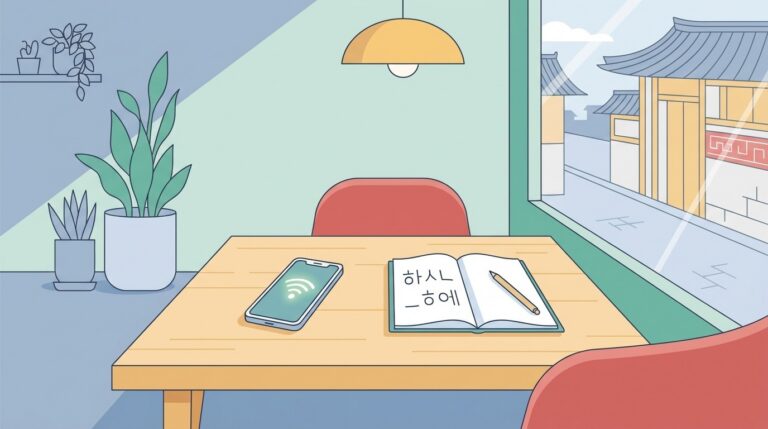
Phase 1: Empathy & Story-Driven Opening
안녕하세요! 매일한글 에디터입니다. (Hello! I’m your Daily Hangul editor.)
Picture this: You are wandering through the hip alleys of Seongsu-dong, tracking down that hidden aesthetic cafe featured in your favorite K-drama. Suddenly, your map app freezes. You check the status bar—zero bars, and a notification flashes: “Data limit reached.” Panic sets in! You spot a lovely bakery cafe, sprint inside, and order an iced Americano just to secure internet access. But staring at the cafe counter, your mind goes completely blank: How do I ask for the Wi-Fi password naturally without sounding like an automated translation bot? And how do locals complain about running out of data without sounding textbook-stiff?
If you have ever frantically searched for Wi-Fi stickers on napkin holders or feared an unexpected data bill bomb, you are not alone. As an intermediate (B2) learner, simply memorizing “와이파이 있어요?” is no longer enough. You want to speak with nuance, navigate telecom situations like a local, and handle everyday digital life in Korea effortlessly. Based on real classroom dilemmas from our Daily Hangul learners, this guide gives you the exact phrases, cultural etiquette, and conversational nuances to stay plugged in across Seoul without skipping a beat!
Phase 2: Top 3 Core Expressions (Deep Dive)
1. 와이파이 비밀번호가 어떻게 돼요? (Wai-pai bimilbeonhoga eotteoke dwaeyo?)
- Pronunciation: [Wai-pai bi-mil-beon-ho-ga eo-tteo-ke dwae-yo?] (Think of dwae-yo sounding smoothly like “dway-yo”)
- Meaning: Literal: “How does the Wi-Fi password become?” | Real Nuance: “Could you tell me what the Wi-Fi password is?”
- K-Culture Moment: You will hear this everywhere from trendy Hongdae study cafes to lively pocha tents when friends want to upload Instagram stories together.
- Editor’s Insight: In Korean polite speech, asking “어떻게 돼요?” (How is it? / What is it?) instead of “뭐예요?” (What is it?) sounds far more courteous, gentle, and considerate toward staff.
- Situation Spectrum:
- Casual (친구 사이): ⚠️ (Use “와이파이 비번 뭐야?”)
- Semi-formal (카페/식당 직원): ✅ (Perfect and most natural)
- Formal (비즈니스 미팅): ✅ (Polite enough for office meetings)
- 🤔 Think About It: Why does Korean culture favor indirect questions like “어떻게 돼요?” over direct questions like “뭐예요?” when asking for information?
2. 데이터 다 써서 그런데 핫스팟 좀 켜줄 수 있어? (De-i-teoda sseoseo geureonde hatseupat jom kyeojul su isseo?)
- Pronunciation: [De-i-teo da sseo-seo geu-reon-de hat-seu-pat jom kyeo-jul su is-seo?] (Sseo-seo sounds like “sir-saw” said quickly)
- Meaning: Literal: “I used up all my data, so in that situation, can you turn on hotspot a little bit?” | Real Nuance: “I’m fresh out of data—would you mind turning on your mobile hotspot for me?”
- K-Culture Moment: In youth dramas, a character inevitably uses this exact phrase as an excuse to sit closer to their crush on the campus lawn or subway ride.
- Editor’s Insight: The connector “~그런데” (so / because of that context) softens the request, showing that you feel slightly apologetic for leeching their mobile data.
- Situation Spectrum:
- Casual: ✅ (Ideal for friends, classmates, peers)
- Semi-formal: ⚠️ (Use “데이터를 다 써서 그런데 테더링 좀 부탁드려도 될까요?”)
- Formal: 🚫 (Avoid asking senior colleagues or clients for data tethering)
- 🤔 Think About It: How does explaining your reason (데이터 다 써서 그런데) before making a request reflect Korean interpersonal boundaries (jeong and nunchi)?
3. 데이터 요금 폭탄 맞을까 봐 무제한 요금제로 바꿨어요. (De-i-teo yogeum poktan majeulkka bwa mujehan yogeumjero bakkwosseoyo.)
- Pronunciation: [De-i-teo yo-geum pok-tan ma-jeul-kka bwa mu-je-han yo-geum-je-ro bak-kwo-sseo-yo.] (Pok-tan pops with an aspirated ‘p’ and tense ‘t’)
- Meaning: Literal: “Fearing I would get hit by a data fee bomb, I changed to an unlimited plan.” | Real Nuance: “I was terrified of an insane data bill, so I just upgraded to an unlimited plan.”
- K-Culture Moment: Comedians and webtoon protagonists often lament getting a yogeum poktan (bill bomb) after binge-watching K-dramas on LTE during long bus commutes.
- Editor’s Insight: “폭탄 맞다” (to get hit by a bomb) is an expressive idiomatic chunk used for shocking, catastrophic bills or unexpected burdens.
- Situation Spectrum:
- Casual: ✅ (Very relatable topic in daily chats)
- Semi-formal: ✅ (Great for coffee break small talk with coworkers)
- Formal: ⚠️ (In an official telecom contract context, say “초과 요금 방지를 위해”)
- 🤔 Think About It: Korean speakers frequently use dynamic physical metaphors like ‘getting hit by a bomb’ for financial shocks. What vivid metaphors do you use in your language?
Phase 3: Textbook Korean vs. Real-Life Korean
Situation 1: Checking if a place provides internet
- 📖 교과서 한국어 (Textbook): “이곳에서 인터넷 와이파이를 사용할 수 있습니까?” (I-gos-eseo inteonet wai-pai-reul sayonghal su itseumnikka? — Is one permitted to utilize internet Wi-Fi at this location?)
- 🗣️ 진짜 한국어 (Real-life): “저기요, 여기 와이파이 잘 잡혀요?” (Jeogiyo, yeogi wai-pai jal japhyeoyo? — Excuse me, does the Wi-Fi connect well here?) or “비번 영수증에 있나요?” (Bibeon yeongsujeunge innayo? — Is the password on the receipt?)
- 💡 왜 다를까?: Native speakers say Wi-Fi “잡히다” (gets caught / connects) rather than “사용하다” (to utilize). Additionally, “비밀번호” is almost universally clipped to “비번” (bi-beon) in casual spoken language.
Situation 2: Running out of mobile data
- 📖 교과서 한국어 (Textbook): “이번 달 모바일 데이터 할당량을 모두 소진했습니다.” (Ibeon dal mobail de-i-teo haldangnyang-eul modu sojinhaesseumnida. — I have completely exhausted this month’s mobile data quota.)
- 🗣️ 진짜 한국어 (Real-life): “아, 나 데이터 다 털렸어!” (A, na de-i-teo da teollyeosseo! — Ah, my data is completely wiped out!) or “데이터 다 썼어.” (De-i-teo da sseosseo.)
- 💡 왜 다를까?: “털리다” (to get emptied out / raided) is quintessential contemporary slang that vividly captures how fast monthly data vanishes when browsing YouTube Shorts or Instagram Reels.
Phase 4: K-Culture Deep Dive & Non-Verbal Manners
4-1. 눈치 (Nunchi) & Gestures: The Cafe Wi-Fi Protocol
Before you interrupt a barista making five hand-drip orders during peak afternoon rush hour, use your Nunchi (cultural situational awareness):
1. Check the Receipt First: In 90% of Korean cafes, the network name (SSID) and password (비번) are printed clearly at the very bottom of the receipt.
2. Look Around the Pickup Zone: Cafes often stick a small acrylic standee or wooden plaque displaying the Wi-Fi details near the straw and napkin station.
3. The Two-Handed Handover: If you must ask the staff to write it down or type it in, hand your phone over with both hands (or your right hand supported by your left wrist), accompanied by a slight head nod.
4-2. Cultural Code: The Ultra-Connected “Ppal-li Ppal-li” Society
South Korea boasts one of the world’s fastest digital infrastructures. You can hop on Seoul Subway Line 2 and stream 4K video uninterrupted via public carrier Wi-Fi. However, this hyper-connected ecosystem has birthed the concept of “디지털 피로감” (digital fatigue). Koreans expect immediate answers on KakaoTalk because everyone assumes you are always connected. When you run out of data or lose signal, it is treated like an urgent social emergency, hence why coffee shops treat lightning-fast Wi-Fi not as a perk, but as an absolute human necessity!
Phase 5: Real-World Roleplay Scenario
Setting: A trendy retro-style cafe in Yeonnam-dong. You are trying to download study materials on your tablet while chatting with the friendly barista/owner, Minjun.
- 민준 (Minjun): 주문하신 아이스 아메리카노 나왔습니다! (Jumunhasin a-i-seu a-me-ri-ka-no nawasseumnida! — Here is the iced Americano you ordered!)
- 🎭 Hands the cup with a warm smile.
- 알렉스 (Alex): 감사합니다! 그런데 혹시 여기 와이파이 비밀번호가 어떻게 돼요? (Gamsahamnida! Geureonde hoksi yeogi wai-pai bimilbeonhoga eotteoke dwaeyo? — Thank you! By the way, could you tell me the Wi-Fi password here?)
- 🎭 Glances around the counter curiously.
- 민준 (Minjun): 아, 영수증 하단에 적혀 있는데요, 혹시 영수증 버려드릴까요 물어봤을 때 버리셨나요? (A, yeongsujeung hadane jeokhyeo inneundeyo, hoksi yeongsujeung beoryeodeurilkkayo mureobwasseul ttae beorisyeonnayo? — Ah, it is written at the bottom of the receipt. Did you have me toss it when I asked earlier?)
- 🎭 Tilts head apologetically with a chuckling smile.
- 알렉스 (Alex): 네, 습관처럼 버려달라고 했어요. 죄송해요! (Ne, seupgwancheoreom beoryeodallago haesseoyo. Joesonghaeyo! — Yes, out of habit I told you to throw it away. I’m sorry!)
- 🎭 Scratches head with an embarrassed grin.
- 민준 (Minjun): 아니에요, 죄송할 것까지야! 여기 냅킨 꽂이에 적힌 ‘Yeonnam_5G’ 누르시고, 비번은 영어 소문자로 ‘coffee1234’ 치시면 돼요. (Anieyo, joesonghal geotkkajiya! Yeogi naepkin kkojie jeokhin ‘Yeonnam_5G’ nureusigo, bibeoneun yeong-eo somunjaro ‘coffee1234’ chisimyeon dwaeyo. — No worries, nothing to be sorry about! Tap ‘Yeonnam_5G’ written here on the napkin holder, and enter ‘coffee1234’ in lowercase letters.)
- 🎭 Taps the small sticker on the napkin holder with index finger.
- 알렉스 (Alex): 친절하게 알려주셔서 감사해요. 바로 잡히네요! (Chinjeolhage allyeojusyeoseo gamsahaeyo. Baro japhineyo! — Thank you for explaining so kindly. It connected right away!)
- 🎭 Shows the connected Wi-Fi screen with a bright expression.
- 민준 (Minjun): 다행이네요. 작업 편하게 하세요! 데이터 부족하시면 맘껏 쓰시고요. (Dahaeng-ineyo. Jageop pyeonhage haseyo! De-i-teo bujokhasimyeon mamkkeot sseusigoyo. — Glad to hear that. Make yourself comfortable while working! Feel free to use as much as you need if you’re low on data.)
- 🎭 Nods warmly and wipes down the espresso machine.
- 알렉스 (Alex): 네, 시원하게 쉬다 갈게요! (Ne, siwonhage swida galgeyo! — Thanks, I’ll relax comfortably in the cool air!)
- 🎭 Takes a refreshing sip of coffee.
🔀 Interactive Choice Point
Imagine the Wi-Fi suddenly disconnects 20 minutes later because the cafe router rebooted. What would you say to Minjun?
- Option A: “야, 와이파이 왜 꺼졌어? 당장 고쳐줘!” (Ya, wai-pai wae kkeojyeosseo? Dangjang gochyeojwo! — Hey, why did the Wi-Fi turn off? Fix it right now!)
- Option B: “사장님, 와이파이 연결이 갑자기 끊겼는데 한번 확인해 주실 수 있나요?” (Sajangnim, wai-pai yeongyeori gapjagi kkeunkyeonneunde hanbeon hwaginhae jusil su innayo? — Boss, the Wi-Fi connection suddenly dropped, could you check it once?)
- Option C: (Say nothing, silently turn on 5G, and suffer high data fees)
Feedback:
* Option A [Bad]: Extremely rude! Using banmal (informal talk) and demands will create deep awkwardness.
* Option B [Best!]: 100% natural and courteous. Addressing the owner respectfully as “사장님” and using “~끊겼는데 확인해 주실 수 있나요?” is textbook native courtesy.
* Option C [Risk]: If your data package is limited, you might face a genuine 데이터 요금 폭탄! Always politely ask.
Phase 6: 10-Second Emotional Shadowing Drill
Practice matching the rhythm (/) and feeling markers:
[🥺 아쉽고 곤란하게 - Reluctant & in a bind]- 아, / 이번 달 데이터 벌써 다 썼어… / 핫스팟 좀 켜줄래? (A, / ibeon dal de-i-teo beolsseo da sseosseo… / hatseupat jom kyeojullae?)
[😊 정중하고 상냥하게 - Polite & friendly]- 저기요, / 혹시 여기 / 와이파이 비밀번호가 어떻게 돼요? (Jeogiyo, / hoksi yeogi / wai-pai bimilbeonhoga eotteoke dwaeyo?)
[😮 안도하며 감탄하듯 - Relieved & impressed]- 와, / 비밀번호 치자마자 / 바로 잡히네요! (Wa, / bimilbeonho chijamaja / baro japhineyo!)
Phase 7: K-Culture Mini Dictionary
- 데이터 요금 폭탄 (De-i-teo yogeum poktan) | Data bill shock / bomb
- Meaning: An astronomical mobile bill caused by exceeding data limits on video streaming or roaming. Widely used in news and comedic memes.
- 알뜰폰 (Al-tteul-pon) | Budget MVNO phone / SIM plan
- Meaning: Cost-effective SIM plans offering identical coverage at half the cost. Essential vocabulary if you live in Korea on a student or working visa.
- 공공 와이파이 (Gong-gong wai-pai) | Public Wi-Fi
- Meaning: Free municipal internet networks available in parks, traditional markets, buses, and subway stations (usually named
Public WiFi Free).
- Meaning: Free municipal internet networks available in parks, traditional markets, buses, and subway stations (usually named
- 테더링 / 핫스팟 (Te-deo-ring / Hat-seu-pat) | Mobile tethering / Personal hotspot
- Meaning: Sharing phone data with tablets or laptops. Both loanwords are understood, but “핫스팟” is far more common in casual youth talk.
Phase 8: Traveler’s Survival Kit
Top 3 Survival Expressions
- “영수증에 와이파이 비밀번호 있어요?” (Yeongsujeunge wai-pai bimilbeonho isseoyo?)
- Pro Tip: Say this right as you pick up your drink to save an extra trip to the counter.
- “공공 와이파이 어떻게 연결해요?” (Gong-gong wai-pai eotteoke yeongyeolhaeyo?)
- Pro Tip: Useful at tourist information booths or metro transit centers.
- “데이터 로밍 차단해 주세요.” (De-i-teo roming chadanhae juseyo?)
- Pro Tip: Use this at the airport telecom counter to ensure you won’t incur accidental overseas carrier fees.
Editor’s Travel Note
- App Essentials: Before your trip, read our complete guide on how to navigate using Naver Map and KakaoMap apps efficiently. Google Maps has limited pedestrian walking directions in Korea due to national security data regulations!
- eSIM vs. Pocket Wi-Fi: If you travel solo, buying a prepaid Korean unlimited eSIM online is cheaper and saves you from carrying a bulky “와이파이 도시락” (Wi-Fi egg / pocket device) that needs daily recharging.
Phase 9: One Step Deeper (Reflective Essay)
Korea’s obsession with ubiquitous internet is not merely about gaming speeds; it mirrors a deeply collectivist need for constant social synchronization. In a society where digital queuing apps determine whether you get a table at a famous restaurant and KakaoTalk coordinates everything from family holidays to workplace deadlines, being “offline” is perceived as a disruption to social harmony. When Koreans share their hotspot without hesitation, it is a micro-act of modern Jeong (정, emotional bonding)—sharing life energy in digital form.
💬 Your Turn: Have you ever experienced digital panic while traveling abroad without data? How does public Wi-Fi availability in your home country compare to Korea’s cafe scene? Share your story in the comments below!
Phase 10: FAQ & Avoiding Misunderstandings
Q: Why do cafes print the Wi-Fi password on receipts instead of shouting it or posting huge banners?
A: Korean cafes prioritize interior aesthetic minimalism and speedy counter operations. Printing network credentials dynamically on transaction slips reduces clutter, guarantees that paying customers get access, and saves the barista from repeating complex strings of numbers hundreds of times a day.
Q: Is Korean public Wi-Fi in subways and buses completely safe for banking?
A: While municipal Wi-Fi networks like Public WiFi Secure provide robust WPA2 encryption, open networks named Public WiFi Free are unencrypted. For mobile banking or confidential work, locals always prefer using their personal LTE/5G network or a reliable VPN.
Q: What does it mean when a plan says ‘데이터 소진 시 3Mbps 무제한’ (Unlimited at 3Mbps upon exhaustion)?
A: This is Korea’s classic “QoS” (Quality of Service) speed throttling. You get a set bucket of high-speed data (e.g., 10GB). Once exhausted, you continue to receive unlimited data at 3Mbps without extra charges. At 3Mbps, 720p YouTube videos and KakaoTalk work fine, but HD live streaming will buffer.
🚨 흔한 실수 (Common Mistakes) Warning Board
- Mistake: Saying “인터넷 비밀번호 주세요” (Give me the internet password).
- Correct Action: Say “와이파이 비번이 뭐예요?” or “와이파이 비밀번호가 어떻게 돼요?” Koreans specifically distinguish Wi-Fi from general internet.
- Mistake: Demanding the password from staff before even placing an order.
- Correct Action: Order your food or beverage first! Wi-Fi is considered a courtesy service for paying patrons.
- Mistake: Assuming all networks named ‘KT’ or ‘SKT’ or ‘LG U+’ are free public networks.
- Correct Action: These are subscriber-only hotspots locked to customers of those specific Korean telecom giants. Look for networks with the word Public or the venue’s specific business name.
Phase 11: Action Missions & Community Engagement
- 🥉 Bronze Mission (Solo Practice): Stand in front of your mirror and practice the phrase: “와이파이 비밀번호가 어떻게 돼요?” three times with a bright, friendly smile.
- 🥈 Silver Mission (Social Sharing): Screenshot your phone’s Wi-Fi network screen. Write a sentence in Korean using “와이파이가 잘 잡혀요” (The Wi-Fi connects well) and tag
@DailyHangulin your Instagram Story! - 🥇 Gold Mission (Real-world Challenge): Visit a local Korean cafe, bakery, or Korean community hub. Instead of silently searching the walls, ask the staff for the Wi-Fi details directly in Korean!
- 🎮 K-Culture Mission: Watch one episode of a modern slice-of-life K-drama (like Hospital Playlist or Business Proposal) and spot a character checking their phone signal or asking for a hotspot!
Phase 12: Interactive Quiz Challenge
Test your intermediate smartphone mastery! Click the dropdowns below to reveal the answers.
1. Situational Judgment (상황 판단)
You are at a bustling cafe in Gangnam. Your data is off and you need the internet urgently. What is the most culturally adept first step?
* (A) Tap the barista on the shoulder while they are steaming milk.
* (B) Look at the bottom of your order receipt or check the cup pickup area.
* (C) Loudly proclaim: “와이파이를 켜주십시오!”
👉 Click to view answer & explanation
Answer: (B)
Explanation: Most Korean cafes print credentials right on the receipt to minimize customer wait times. Checking the receipt or counter display first demonstrates true Nunchi!
2. Fill-in-the-Blank (빈칸 채우기)
Complete the sentence with the natural colloquial verb for Wi-Fi connecting smoothly:
* “여기 지하라 그런지 와이파이가 잘 안 (____).” (Yeogi jihara geureonji wai-paiga jal an ____.)
* (A) 써져요
* (B) 잡혀요
* (C) 들려요
👉 Click to view answer & explanation
Answer: (B) 잡혀요
Explanation: In natural Korean, signal connection is expressed using 잡히다 (to get caught/picked up). The full sentence means: “Maybe because it’s underground, but the Wi-Fi doesn’t connect well.”
3. True or False Cultural Quiz (문화 상식)
Statement: In Korean, “데이터 요금 폭탄” literally translates to “data fee bomb,” which refers to a promotional discount event offering tons of free data.
👉 Click to view answer & explanation
Answer: FALSE!
Explanation: 요금 폭탄 (fare/bill bomb) refers to an shockingly expensive, disastrous bill that explodes your bank account—not a discount promotion!







