

Phase 1: 공감 (Opening Empathy & The High-Register Dilemma)
안녕하세요! 매일한글 에디터입니다. (Hello! I am your Daily Hangul editor.)
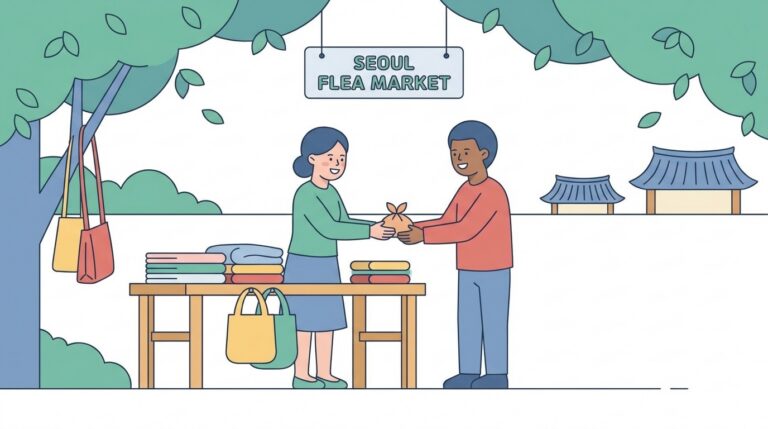
Picture this: You are standing in the sun-dappled courtyard of the Anguk branch of 아름다운가게 (The Beautiful Store), surrounded by traditional hanok eaves and vibrant racks of curated second-hand treasures. In your hands are two pristine canvas bags filled with designer knitwear and art books you carefully set aside to donate before moving flats in Seoul. You approach the registration counter, smile warmly at the elderly volunteer wearing an apron, and open your mouth to explain your intention.
Suddenly, your mind hits a wall. Do you say, “이거 버리러 왔어요” (I came to throw this away)? Absolutely not—that turns a noble social contribution into an insult, treating a beloved non-profit like a municipal waste bin. Should you say “기증을 수락하십시오” (Please accept my donation)? Now you sound like an imperial envoy from a historical K-Drama (사극).
Navigating community flea markets (나눔 장터) and philanthropic institutions in Korea requires more than just knowing vocabulary for clothes and money; it requires mastering the language of civic grace, humility, and community solidarity. At the C1 level, foreign professionals and advanced students frequently struggle with the sociolinguistic balance: expressing generous intent without sounding patronizing, and clarifying administrative details (such as donation tax deduction receipts, or 기부금 영수증) with institutional politeness.
This guide was forged from real consultations with expat donors and veteran 활동천사 (volunteer angels). By the time you finish this lesson, you will possess the nuanced expressions, non-verbal cues, and cultural intuition needed to participate effortlessly in Seoul’s vibrant sharing economy.
Phase 2: 핵심 표현 3선 심층 분석 (Core Advanced Expressions)
1. 기부 물품으로 접수 가능한지 확인해 주시겠어요? (Gibu mulpumeuro jeopsu ganeunghanji hwaginhae jusigesseoyo?)
- Pronunciation: [기부 물품으로 접쑤 가능한지 확인해 주시게써요?] (Think of ‘Gibu’ flowing softly, and articulate ‘jeop-ssu’ with crisp, polite cadence like saying ‘check-in please’ at a boutique hotel).
- Meaning: Literal: “Could you check whether this is acceptable for reception as donation goods?” | Real Nuance: “Could you kindly evaluate if these items meet your donation criteria?”
- K-Culture Moment: Heard in contemporary slice-of-life dramas like Our Blues or Run On, where characters thoughtfully declutter their lives and consult volunteers before assuming their belongings are worthy of being re-sold for charity.
- Editor’s Insight: Notice the indirect verb embedding -는지 확인해 주시겠어요? rather than the demanding 받아 주세요 (Please take this). In Korea, non-profits discard tons of unsuitable items annually at great expense. Inquiring politely acknowledges their quality-control workload and frames acceptance as a shared decision.
- Situation Spectrum:
- Casual: 🚫 (Sounds overly bureaucratic among intimate friends)
- Semi-formal: ✅ (Perfect for pop-up flea market coordinators)
- Formal: ✅ (Standard for established charity storefronts like Beautiful Store)
- 🤔 Think About It: In your home country, do people drop off items without verbal verification, or is donation treated as an interactive vetting process? How does verb modality reflect respect for non-profit labor in Korea?
2. 좋은 뜻으로 쓰였으면 해서 가져왔어요 (Joeun tteuseuro sseuyeosseumyeon haeseo gajyeowasseoyo)
- Pronunciation: [조은 뜨스로 쓰여쓰면 해서 가겨와써요 -> 조은 뜨스로 쓰여쓰면 해서 가져와써요] (Glide over ‘joeun’ like ‘Joe-un’ and gently stress ‘tteus-euro’—meaning ‘for a good purpose’).
- Meaning: Literal: “I brought this hoping it would be used with good intent.” | Real Nuance: “I brought these items hoping they can support a meaningful cause.”
- K-Culture Moment: A staple line uttered by benevolent characters visiting community welfare centers or local 바자회 (charity bazaars) to convey warmth without ostentation.
- Editor’s Insight: The phrase 좋은 뜻 (good purpose/noble meaning) captures the Korean cultural ethos of sharing goodwill (선의). Ending in -으면 해서 softens your agency, avoiding any boastful tone about your generosity.
- Situation Spectrum:
- Casual: ⚠️ (Use with neighborhood community elders)
- Semi-formal: ✅ (Ideal for flea market organizers and volunteer staff)
- Formal: ✅ (Warm, elegant opening statement when handing over goods)
- 🤔 Think About It: Notice how the speaker attributes the positive value to the future outcome (좋은 뜻으로 쓰이다) rather than their own act of giving. Why is self-effacing rhetoric valued in Korean philanthropy?
3. 수익금 전액이 취약계층 지원에 쓰인다고 들었어요 (Suikgeum jeonaegi chwiakgyecheung jiwone sseuindago deureosseoyo)
- Pronunciation: [수익끔 저내기 취약꼐층 지워네 쓰인다고 드러써요] (Emphasize ‘chwi-ak-gye-cheung’ smoothly, avoiding abrupt pauses between syllables).
- Meaning: Literal: “I heard that all proceeds are used to support vulnerable social groups.” | Real Nuance: “I understand that 100% of the sales proceeds go toward supporting underserved communities.”
- K-Culture Moment: Common in variety shows like Hangout with Yoo when cast members operate charity stalls or auction their stage outfits to fund urban social welfare programs.
- Editor’s Insight: At the C1 level, invoking policy-oriented vocabulary like 취약계층 (vulnerable/underserved demographics) and 수익금 전액 (entire proceeds) shows deep communicative competence. Asking or verifying this demonstrates genuine civic interest rather than passive curiosity.
- Situation Spectrum:
- Casual: 🚫 (Too journalistic for a casual chat)
- Semi-formal: ✅ (Excellent conversation starter with organizers at a 나눔장터)
- Formal: ✅ (Appropriate for corporate volunteer reports and press interactions)
- 🤔 Think About It: How does referencing the institutional mission of the organization elevate your status from a regular retail shopper to an informed civic participant?
Phase 3: 교과서 한국어 vs 진짜 한국어 (Textbook vs. Real-World Register)
Scenario 1: Checking if pre-loved clothing is fit for donation
- 📖 교과서 한국어 (Textbook Korean):
- 이 헌 옷들을 기증하고 싶습니다. (I want to donate these used clothes.)
- 🗣️ 진짜 한국어 (Real-World C1 Korean):
- 상태가 꽤 깨끗한 편인데, 혹시 기증 가능 품목에 해당할까요? (They are in quite clean condition; would these happen to fall under acceptable donation items?)
- 💡 왜 다를까? (Why the difference?):
- Calling your items 헌 옷 (old/worn clothes) carries an unintended nuance of rags or trash. Educated native speakers highlight the item’s condition (상태가 깨끗한 편) and defer to institutional policy using 기증 가능 품목에 해당하다 (fall under acceptable donation items).
Scenario 2: Refusing change at a neighborhood charity flea market
- 📖 교과서 한국어 (Textbook Korean):
- 거스름돈은 안 주셔도 괜찮습니다. (You do not need to give me change.)
- 🗣️ 진짜 한국어 (Real-World C1 Korean):
- 좋은 일에 쓰시는 거니까, 남은 잔돈은 기부금에 보태주세요! (Since it’s going toward a good cause, please just add the spare change to the donation fund!)
- 💡 왜 다를까? (Why the difference?):
- Simply telling someone to “keep the change” (거스름돈 됐어요) can sound dismissive or overly transactional. Saying 좋은 일에 쓰시는 거니까 기부금에 보태주세요 honors the cause and unites you with the seller in joint altruism.
Phase 4: K-Culture 딥다이브 & 비언어적 매너 (Deep-Dive & Cultural Codes)
4-1. 눈치(Nunchi) & Physical Etiquette at Donation Counters
When entering an organization like 아름다운가게 or an open-air 나눔장터 (such as the famous Ttukseom Sharing Market or Seocho Flea Market), body language matters just as much as speech:
1. The Two-Handed Handover (두 손 건네기): Always hand clothing bags or donation items over using both hands, or with your right hand supported at the forearm/elbow by your left hand. It visually expresses that you are offering something of value, not “dumping baggage.”
2. The Humble Pre-Inspection (사전 검수 태도): Never leave clothes tied up in black disposable trash bags (검은 비닐봉지). Place them in clean shopping totes or transparent bags. When the volunteer begins sorting through the items, maintain attentive eye contact, nod politely, and step back half a step to give them working space.
3. Volunteering Titles (호칭 에티켓): At Beautiful Store, volunteers are officially designated as 활동천사 (Hwaldongcheonsa, “Volunteer Angels”). While you don’t necessarily call them “천사님” in casual conversation, referring to them as 선생님 (Teacher/Elder) or 매니저님 (Manager) creates immediate rapport.
4-2. Cultural Code Analysis: The Philosophy of 나눔 (Sharing)
Koreans draw a sharp philosophical boundary between 버리다 (to discard) and 나누다 (to share). This distinction originates from traditional agrarian systems like 품앗이 (mutual labor exchange) and 두레 (communal cooperative work), where communities pooled resources to ensure collective survival.
Modern institutions like 아름다운가게, launched in 2002 as a pioneering social enterprise, transformed flea markets from perceived “poor man’s markets” into hip, eco-conscious community hubs. Today, participating in 나눔장터 is celebrated in K-dramas (e.g., Crash Landing on You, where neighbors pool goods, or Extraordinary Attorney Woo, championing ethical living) as a sophisticated statement of environmental mindfulness (업사이클링, upcycling) and communal warmth (정, Jeong).
Phase 5: 실전 롤플레이 시나리오 (Interactive Roleplay Scenario)
Setting: The donation drop-off desk at 아름다운가게 안국점 (Beautiful Store Anguk Branch) on a crisp Saturday afternoon.
Characters:
* You (Advanced Donor): A conscious Seoul resident looking to donate gently used books and apparel while requesting a donation receipt.
* 박 매니저 (Manager Park): A warm, experienced 활동천사 with silver hair, wearing the signature green apron.
- 박 매니저: 안녕하세요! 주말인데 무거운 짐 들고 오시느라 고생 많으셨어요. 기증하러 오셨나요?
(Annyeonghaseyo! Jumal-inde mugeoun jim deulgo osineura gosaeng maneusyeosseoyo. Gijeunghareo osyeonnayo?)
Hello! Thank you for hauling such heavy bags on a weekend. Are you here to make a donation?
🎭 행동 지문: 인자한 미소를 지으며 안내 데스크 위로 바구니를 당긴다. -
You: 네, 안녕하세요 선생님. 계절 바뀌면서 정리하다가, 좋은 뜻으로 쓰였으면 해서 몇 점 챙겨왔어요.
(Ne, annyeonghaseyo seonsaengnim. Gyejeol bakkwimyeonseo jeongrihadaga, joeun tteuseuro sseuyeosseumyeon haeseo myeot jeom chaenggyeowasseoyo.)
Yes, hello teacher. While doing some seasonal decluttering, I brought a few items hoping they could be put to good use.
🎭 행동 지문: 양손으로 가방 손잡이를 잡고 데스크 위에 공손히 내려놓는다. -
박 매니저: 아이고, 고맙습니다. 의류랑 도서 위주네요. 혹시 저희 기증 물품 기준에 맞는지 가볍게 같이 확인해 보실까요?
(Aigo, gomapseumnida. Uiryurang doseo wijuneyo. Hoksi jeohi gijeung mulpum gijune manneunji gabyeopge gachi hwaginhae bosilkkayo?)
Oh, thank you so much! It seems mostly apparel and books. Shall we quickly check together if they meet our donation criteria?
🎭 행동 지문: 장갑을 착용하고 정갈하게 가방을 열어 살펴본다. -
You: 네! 대부분 실착용 횟수가 적어서 상태가 꽤 깨끗한 편인데, 접수 가능한 품목인지 봐주세요.
(Ne! Daebubun silchag-yong hoessuga jeogeoseo sangtaega kkwae kkaekkeutan pyeon-inde, jeopsu ganeunghan pummoginji bwajuseyo.)
Sure! Most items were barely worn so they are in fairly pristine condition, but please check if they are eligible for reception.
🎭 행동 지문: 옷의 단추가 잘 잠겨 있는지 확인하며 한 걸음 물러서서 기다린다. -
박 매니저: 보풀도 없고 거의 새 옷 수준이네요! 도서도 밑줄이나 낙서 없이 아주 깨끗하고요. 기분 좋게 접수해 드릴게요.
(Bopuldo eopgo geoui sae ot sujuni-neyo! Doseodo mitjurina nakseo eopsi aju kkaekkeuthagoyo. Gibun joeukke jeopsuhae deurilgeyo.)
There are no lint pills and these look practically brand new! The books are also spotless without underlinings or scribbles. I’ll gladly accept them with pleasure.
🎭 행동 지문: 접수 단말기 화면을 터치하며 바코드를 준비한다. -
You: 다행이네요. 아, 그리고 혹시 이번 기부 건에 대해 연말정산용 기부금 영수증 발행도 가능할까요?
(Dahaeng-ineyo. A, geurigo hoksi ibeon gibu geone daehae yeonmaljeongsanyong gibugeum yeongsujeung balhaengdo ganeunghalkkayo?)
What a relief! Ah, and by any chance, would it be possible to issue a donation receipt for year-end tax settlement for this contribution?
🎭 행동 지문: 휴대전화 번호 입력 패드를 쳐다보며 조심스럽게 질문한다. -
박 매니저: 그럼요! 카카오톡 알림톡으로 기부 내역이 전송되니까 패드에 번호 입력해 주시면 처리가 바로 완료됩니다.
(Geureomyo! Kakaotok allimtok-euro gibu naeyeogi jeonsongdoenikka paedeue beonho ipryeokhae jusimyeon cheoriga baro wanryodoemnida.)
Of course! The donation summary will be sent directly via KakaoTalk notification, so if you enter your phone number on this keypad, it will be processed right away.
🎭 행동 지문: 번호 입력 패드를 학습자 쪽으로 친절히 돌려준다. -
You: 안내 감사드립니다! 어려운 이웃들에게 조금이나마 보탬이 되었으면 좋겠네요. 수고하세요!
(Annae gamsadeurimnida! Eoryeoun i-utdeurege jogeumina-ma botaemi doeeosseumyeon jokgenneyo. Sugohaseyo!)
Thank you for guiding me! I truly hope this provides at least a little help to neighbors in need. Have a wonderful day!
🎭 행동 지문: 목례를 정중히 한 뒤 가벼운 발걸음으로 돌아선다.
🔀 인터랙티브 분기점 (Interactive Branching Point)
Imagine Manager Park points to one leather jacket you brought and remarks: “손님, 이 재킷은 안쪽에 미세한 스크래치가 있어서 저희 매장 규정상 판매가 어려울 수도 있어요.” (Customer, this jacket has a minor scratch on the inside lining, so under our store regulations it might be difficult to sell.)
How do you respond?
- Option A: “안 보이는 부분인데 그냥 대충 팔아주시면 안 돼요? 기부하는 건데요.” (It’s not visible, can’t you just roughly sell it? I’m donating this, after all.)
- Option B: “아, 미처 확인하지 못했네요! 판매가 어려우시다면 이건 도로 가져가서 제가 직접 재활용하겠습니다.” (Ah, I failed to notice that beforehand! If it’s difficult to sell, I will gladly take it back and recycle it myself.)
- Option C: “그럼 다른 복지관에 제가 가져다줄 테니 그쪽 연락처를 알려주세요.” (Then I will take it to another welfare center, so give me their contact number.)
Feedback:
* Option A (Bad / Risk): ❌ Treating donation standards with annoyance invalidates the volunteer’s professional guidelines and projects arrogance. Beautiful Store is committed to dignity for buyers, not functioning as a clearance drop.
* Option B (Best): ✅ Shows maximum empathy, acknowledges the operational burden of non-profits, and gracefully takes personal responsibility for items that don’t pass inspection.
* Option C (Risk): ⚠️ Volunteers are busy processing dozens of donations; demanding that they act as a personal directory service for other charities creates unnecessary friction.
Phase 6: 10초 감정 섀도잉 드릴 (10-Second Emotional Shadowing Drill)
Practice these lines out loud with the designated pauses (/) and pitch inflections!
[😊 따뜻하고 진심 어린 어조로]
좋은 뜻으로 / 쓰였으면 해서 / 집에서 정성껏 챙겨왔어요.
(Joeun tteuseuro / sseuyeosseumyeon haeseo / jibeseo jeongseongkkeot chaenggyeowasseoyo.)-
[🤝 정중하면서도 조심스러운 어조로]
상태는 깨끗한 편인데, / 혹시 기증 가능 품목에 / 해당할까요?
(Sangtaeneun kkaekkeutan pyeon-inde, / hoksi gijeung ganeung pummoge / 해당halkkayo?) -
[🙏 겸손하고 보람찬 어조로]
취약계층 이웃분들께 / 조금이나마 / 작은 보탬이 되었으면 합니다.
(Chwiakgyecheung i-utbundeulkke / jogeumina-ma / jageun botaemi doeeosseumyeon hamnida.)
Phase 7: K-Culture 미니 사전 (Key Specialized Keywords)
- 활동천사 (Hwaldongcheonsa) | Activity Angel (Volunteer staff)
- Usage: The official honorary title for volunteers at Beautiful Store. Rather than calling someone 자원봉사자 (general volunteer), addressing them respectfully within their institutional framework marks you as an insider who understands the culture.
- 기부금 영수증 (Gibugeum Yeongsujeung) | Donation Tax-Deduction Receipt
- Usage: Essential for long-term residents in Korea. Registered charities issue electronic receipts linked directly to your National Tax Service (국세청 연말정산 간소화 서비스) via your Korean phone number or Alien Registration Number (외국인등록번호).
- 나눔 (Nanum) | Communal Sharing / Philanthropic Giving
- Usage: Far deeper than standard 기부 (financial donation). 나눔 implies distributing warmth, food, items, and goodwill horizontally across community members without hierarchical condescension.
- 선한 영향력 (Seonhan Yeonghyangnyeok) | Positive/Benevolent Influence
- Usage: A wildly popular cultural buzzword in K-pop fandoms and civil society. Often used when fans organize charitable flea markets or donations in honor of their favorite idol’s birthday.
Phase 8: 여행자를 위한 생존 키트 (Traveler’s & Expat Survival Kit)
서바이벌 표현 TOP 3 (Top 3 Survival Expressions)
- 이거 기부 가능한 품목 맞나요? (Igeo gibu ganeunghan pummok mannayo?)
- Pro Tip: Use this at any charity counter before unpacking your bulky bags.
- 잔돈은 좋은 일에 보태주세요. (Jandoneun joeun ire botaejuseyo.)
- Pro Tip: Use this at outdoor charity bazaars to leave small cash change behind with maximum charm.
- 기부금 영수증 처리는 어디서 하나요? (Gibugeum yeongsujeung cheorineun eodiseo hanayo?)
- Pro Tip: Use this to locate the computerized receipt desk at large-scale bazaar events.
Editor’s Travel Note: Practical Field Tips
- Location Navigation: Search for nearby stores using the 네이버 지도 앱 다운로드 (Naver Map App download) by typing “아름다운가게” or “나눔장터”. Major branches in Seoul like Anguk, Gangnam, and Dongdaemun have dedicated donation loading zones.
- Drop-off Boxes vs. Beautiful Store: Do not confuse green street collection bins (의류수거함) on residential street corners with charity donation centers! Street bins are typically operated by private recycling businesses, not public non-profits. If you want your items to directly fund community welfare programs, deliver them to an authorized non-profit storefront.
Phase 9: “한 발 더 깊이” (Cultural Essay & Reflection)
In Western traditions of philanthropy, charity is often conceptualized around individual agency—a benefactor bestowing surplus resources upon an institution. In Korean civic culture, however, the act of giving is rooted in 상부상조 (mutual aid) and 정 (Jeong). Giving is not considered an act of vertical pity; it is a horizontal re-circulation of life’s surplus within an extended civic family. When you hand over a coat at a local market, you are not merely disposing of fabric—you are sending warmth (온정) downstream, trusting that when you encounter hardship, the collective river will sustain you in return.
💬 Your Turn: Have you ever donated belongings or participated in a community flea market outside your home country? What linguistic differences did you notice when discussing charity and social welfare? Share your thoughts below!
Phase 10: FAQ & 오해 방지 (FAQ Schema & Common Pitfalls)
Q: Can foreigners receive donation receipts for year-end tax returns in Korea?
A: Yes! Foreign residents holding an Alien Registration Card (ARC) can receive official donation receipts (기부금 영수증). When donating at places like Beautiful Store, simply provide your Korean mobile number or foreign registration number registered with the National Tax Service (NTS / 국세청).
Q: What items are strictly rejected at Korean donation centers?
A: Items with severe stains, torn seams, broken electronics, opened cosmetics, used bedding/pillows, or dated textbooks with scribbles are generally rejected. Non-profits have to pay heavy municipal waste disposal fees for unsellable items, so checking guidelines online beforehand is considered good civic manners (시민 의식).
Q: Is bargaining allowed at charity flea markets (나눔장터)?
A: While playful bargaining (흥정) is standard at traditional markets like Gwangjang or Namdaemun, haggling aggressively at charity bazaars where proceeds fund vulnerable groups is seen as socially tactless (눈치 없는 행동). If you do ask for a discount, keep it lighthearted and balance it by purchasing multiple items.
🚨 흔한 실수 (Common Mistakes) 경고판
| Mistake | Why it hurts | Correct Action (C1 Level) |
|---|---|---|
| “이거 버려주세요.” (Please throw this away for me.) | Treating charity workers like garbage handlers is deeply offensive. | “기부 가능한 품목인지 검수 부탁드립니다.” (Please inspect if this is eligible for donation.) |
| Bringing unwashed, soiled garments. | Forces volunteers to spend non-profit funds on waste management. | Clean and fold garments carefully before bagging them. |
| Demanding immediate cash appraisal on the spot. | Beautiful Store conducts valuation later via tax computer networks. | Request electronic logging: “영수증 발급용 연락처 남겨드릴게요.” |
Phase 11: 액션 미션 & 참여 유도 (Action Missions)
- 🥉 Bronze Mission (Solo Practice): Record yourself practicing Expression #1 (“기부 물품으로 접수 가능한지 확인해 주시겠어요?”) three times using natural intonation and two-handed gesturing.
- 🥈 Silver Mission (Social Sharing): Find an item in your room you no longer use. Take a photo, upload it to your social media or language journal, and write a caption in Korean describing why you want to share it using -으면 해서 가져왔어요.
- 🥇 Gold Mission (Real-world Challenge): Visit an actual 아름다운가게 or local weekend 나눔장터. Deliver at least one clean item, or buy a secondhand item, and use the phrase “좋은 일에 쓰시는 거니까 잔돈은 보태주세요!”
🎮 K-Culture Mission: Watch an episode of a neighborhood-centered drama (e.g., Reply 1988 or When the Camellia Blooms) and spot scenes where neighbors exchange food or secondhand goods. Notice the humble expressions they use to describe their gifts!
Phase 12: 인터랙티브 퀴즈 챌린지 (Interactive Quiz Challenge)
Test your mastery of Korean donation etiquette!
Q1. Situational Judgment: You brought three pairs of shoes to a flea market run by a local community center. One pair has a worn-out sole. What is the most culturally adept action?
* (A) Hand them all over silently and hope the volunteer doesn’t notice.
* (B) Pre-sort them, hand over only the clean pairs, and say: “손상된 건 빼고 상태 깨끗한 것들로만 추려서 가져왔습니다.”
* (C) Complain to the volunteer that good shoes are hard to maintain.
Q2. Fill in the Blank: Complete the sentence to decline change politely at a charity stall:
* “수익금이 전액 좋은 곳에 쓰인다고 하니, 남은 잔돈은 기부금에 ( ) 주세요!”
Q3. True or False: Leaving your unwanted clothes in municipal street green bins (의류수거함) will automatically issue a donation receipt (기부금 영수증) for your Korean tax deductions.
* [True / False]
👉 Click to reveal answers & explanations!
- A1: (B). Pre-sorting and presenting only viable goods (추려서 가져왔습니다) demonstrates respect for the organization’s labor and true C1 civic mindfulness.
- A2: 보태 (from 보태다, to supplement/add to). “남은 잔돈은 기부금에 보태주세요!”
- A3: False. Street green bins (의류수거함) are generally run by commercial recyclers and cannot provide registered charity tax deductions. Official receipts require registered NGOs like 아름다운가게.







