

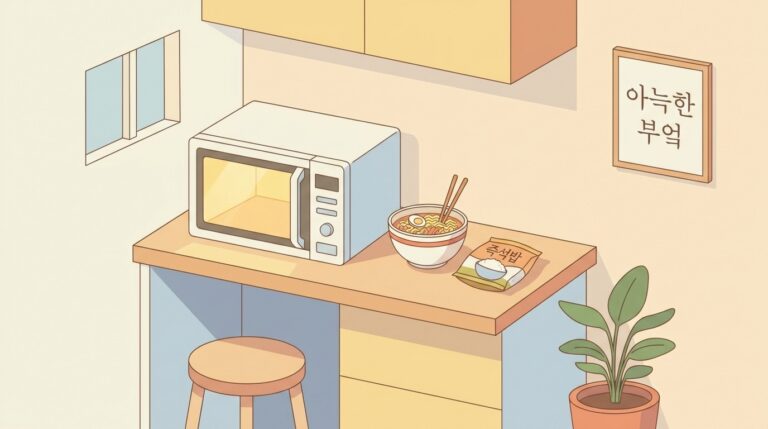
Mastering the Art of 5-Minute Korean Microwave Cooking: The Ultimate Survival Guide for Solo Living in Korea
Phase 1: 공감 (Story-Driven Opening)
안녕하세요! 매일한글 에디터입니다. (Hello! This is your Daily Hangul editor.)
Picture this: It is 10:45 PM on a freezing Thursday in Seoul. You trudge up the narrow stairs of your one-room (원룸 – studio flat) in Sinchon after a relentless 12-hour sprint of graduate seminars or corporate overtime. Your stomach growls fiercely, but the thought of paying a 5,000 KRW delivery fee for a lukewarm stew feels almost insulting. You open your mini-fridge: a sad block of tofu, leftover instant rice (Haetban – 햇반), a packet of Shin Ramyun, and a bottle of soy sauce stare back at you. Your only culinary ally is a humming 700-watt microwave sitting atop your miniature shoe rack.
Most advanced Korean learners hit an unexpected wall right here. You can debate geopolitical dynamics or historical dramas in flawless C1/C2 Korean, yet the moment you step into a convenience store or stand before your microwave, your vocabulary shrinks to elementary verbs like “데우다” (to heat). Real Korean domestic life, however, pulses with rich idiomatic expressions, culinary slang, and pragmatic shortcuts invented by generations of resilient jachwiseaeng (자취생 – students living away from family). Based on real feedback from international residents who felt disconnected from everyday Korean kitchen lingo, this guide will elevate your linguistic nuance from textbook-sterile to native-level kitchen fluency.
Phase 2: 핵심 표현 3선 심층 분석 (Top 3 Expressions Deep Dive)
1. 대충 때우다 (Daechung ttaeuda)
- Pronunciation: [Dae-chung ttae-u-da] (Think of the crisp, snap-action ttae like cracking an eggshell, followed by a relaxed u-da).
- Meaning: Literal: “To patch something up haphazardly.” / Pragmatic: “To throw together a quick, makeshift meal without fuss.”
- K-Culture Moment: You see this constantly in reality shows like I Live Alone (나 혼자 산다), when exhausted celebrities open a pouch of tuna and say: “오늘 저녁은 대충 때워야겠다” (Oneul jeonyeogeun daechung ttaewoyagetda – “I’ll just throw something together for dinner tonight”).
- Editor’s Insight: “때우다” originates from patching a hole in a roof or a bicycle tire. When applied to eating (끼니를 때우다), it highlights pragmatism over gastronomic grandeur. It implies humility and relatable weariness.
- Situation Spectrum:
- Casual: ✅ Perfect among friends, housemates, and peers.
- Semi-formal: ⚠️ Acceptable when chatting with familiar colleagues over lunch.
- Formal: 🚫 Do not say this to your professor or CEO when describing a dinner invitation.
- 🤔 Think About It: Why does Korean culture—historically so obsessed with lavish table spreads (Hanjeongsik)—embrace such an affectionate term for cutting culinary corners?
2. 꿀조합을 발굴하다 (Kkuljohabeul balgulhada)
- Pronunciation: [Kkul-jo-ha-beul bal-gul-ha-da] (Kkul sounds like a tense “cool” with a honeyed finish; bal-gul rolls like “excavate”).
- Meaning: Literal: “To excavate a honey combination.” / Pragmatic: “To discover an unbeatable, genius flavor hack/pairing.”
- K-Culture Moment: Ubiquitous on YouTube convenience store mukbangs where creators combine spicy buldak noodles, string cheese, and rice triangles (samgak gimbap) to create viral recipes.
- Editor’s Insight: At the C2 level, you should notice how “꿀” (honey) has transitioned into a productive prefix denoting effortless excellence (e.g., 꿀팁 – life hack, 꿀잠 – deep sleep). Coupling it with the archaeological verb “발굴하다” (to excavate) adds witty hyperbole to modern food hacking.
- Situation Spectrum:
- Casual: ✅ Ultra-natural in everyday culinary banter.
- Semi-formal: ✅ Widely used in food journalism and food marketing pitches.
- Formal: ⚠️ Fine in cultural presentations, but avoid in purely academic papers unless analyzing internet slang.
- 🤔 Think About It: How does the trend of “excavating” recipes reveal the hyper-creative consumer identity (Modisumer) in contemporary Korea?
3. 전자레인지로 뚝딱하다 (Jeonjareinjiro ttukttakhada)
- Pronunciation: [Jeon-ja-re-in-ji-ro ttuk-ttak-ha-da] (Ttuk-ttak mimics the crisp click-clack of a craftsman finishing a job instantly).
- Meaning: Literal: “To hammer something out with a microwave.” / Pragmatic: “To whip up a dish in a flash using the microwave.”
- K-Culture Moment: Heard on variety cooking shows like Delicious Rendezvous (맛남의 광장) when chefs demonstrate effortless home snacks.
- Editor’s Insight: “뚝딱하다” is an iconic mimetic verb expressing brisk, effortless craftsmanship. Saying “전자레인지로 뚝딱 만들었어” conveys not just speed, but culinary resourcefulness without sounding lazy.
- Situation Spectrum:
- Casual: ✅ Extremely friendly and comforting.
- Semi-formal: ✅ Natural when discussing domestic life with co-workers.
- Formal: ⚠️ Use “간편하게 조리하다” (to prepare simply) in formal speeches.
- 🤔 Think About It: Compare this onomatopoeic vitality to your native language: how do you express effortless speed in the kitchen?
Phase 3: 교과서 한국어 vs 진짜 한국어 (Textbook vs. Real Korean)
Situation 1: Telling someone you will microwave leftovers
- 📖 교과서 한국어 (Textbook):
“전자레인지에 음식을 넣고 데우겠습니다.”
(Jeonjareinjie eumsigeul neoko de-u-get-seumnida. – I will put the food in the microwave and heat it up.) - 🗣️ 진짜 한국어 (Real Native Korean):
“전자레인지에 딱 2분만 휘리릭 돌려 먹을게요.”
(Jeonjareinjie ttak i-bun-man hwiririk dollyeo meogeulgeyo. – I’ll just pop this in the microwave for two quick minutes and eat.) - 💡 Why It Differs: Natives rarely use “데우다” when referring to the mechanical act of microwaving; they use the dynamic verb “돌리다” (to spin/rotate), combined with vivid adverbials like “휘리릭” (whoosh/in a breeze).
Situation 2: Praising a genius convenience-store microwave concoction
- 📖 교과서 한국어 (Textbook):
“편의점 재료로 조합한 음식이 아주 맛있습니다.”
(Pyeon-ui-jeom jaeryoro johapan eumsigi aju masitseumnida. – The food combined from convenience store ingredients is very tasty.) - 🗣️ 진짜 한국어 (Real Native Korean):
“편의점 재료로 뚝딱한 것치고는 완전 갓성비인데요? 요물이네요.”
(Pyeon-ui-jeom jaeryoro ttukttak-han geot-chigoneun wanjeon gatseongbi-indeyo? Yomurineyo. – For something whipped up from convenience store scraps, this is an absolute god-tier bargain! It’s dangerously addictive.) - 💡 Why It Differs: C2 competence means weaving expressive contemporary slang like “갓성비” (god + cost-effectiveness) and culinary metaphors like “요물” (literally a mythical shapeshifter; colloquially, something dangerously addictive or surprisingly marvelous).
Phase 4: K-Culture 딥다이브 & 비언어적 매너 (Deep Dive & Non-Verbal Nuance)
4-1. 눈치 (Nunchi) & Kitchen Body Language
- The Earlobe Grab (귓불 잡기): When you pull a scalding hot ceramic bowl of steamed eggs (Gyeranjjim) out of the microwave without mitts, Koreans reflexively touch their cold earlobes with their burnt thumb and forefinger while exclaiming “앗, 뜨거!” (At, tteugeo!). Knowing this bodily reflex marks you as culturally integrated.
- The Splatter Nunchi (덮개 매너): In shared spaces like dorm kitchens or officetels, heating uncovered food that pops or splatters (like tomato pasta or curry) is a serious breach of etiquette. Always cover dishes loosely with a microwave-safe silicone lid or a damp paper towel. Leaving red sauce splattered inside a communal microwave shows poor nunchi.
4-2. Cultural Code Analysis: The Modisumer Phenomenon (모디슈머 문화)
Korea’s solo-dining landscape transformed radically over the past decade. A combination of single-person households (1인 가구), sky-high food inflation, and hyper-developed convenience infrastructure gave rise to the Modisumer (Modify + Consumer). Instead of merely consuming ready-made meals (dosirak), young Koreans treat convenience shelves as culinary laboratories. Recipes like Mark Jeongsik (마크정식 – spicy rice cakes, spaghetti ramen, string cheese, and Vienna sausages) demonstrate how microwave cuisine became an avenue of personal agency and subcultural community bonding.
Phase 5: 실전 롤플레이 시나리오 (Interactive Roleplay Scenario)
Setting: Midnight in a cozy Mapo-gu one-room apartment. You and your Korean neighbor Min-woo (민우), a freelance animator, are starving while working on an urgent freelance project.
- 민우: 아, 마감 치느라 진이 다 빠졌네. 냉장고에 먹을 거 뭐 없냐?
(A, magam chineura jini da ppajyeon-ne. Naengjanggo-e meogeul geo mwo eomnya?)
(Ugh, finishing that deadline completely drained my soul. Anything to eat in the fridge?)
🎭 He collapses on the sofa, clutching his rumbling stomach. -
You: 냉장고 털어보니까 햇반 하나랑 순두부, 진라면 매운맛밖에 없는데?
(Naengjanggo teoreobonikka haetban hanarang sundubu, jinramyeon maeunmatbakke eomneunde?)
(I raided the fridge, but we only have instant rice, soft tofu, and spicy Jin Ramyun.)
🎭 Holding up the random ingredients with a perplexed shrug. -
민우: 오, 대박! 그거 전자레인지로 ‘순두부 열라면’ 스타일로 뚝딱하면 꿀맛이잖아!
(O, daebak! Geugeo jeonjareinjiro ‘sundubu yeolramyeon’ seutailro ttukttakhamyeon kkulmasijanha!)
(Oh, jackpot! If we whip that up in the microwave like that viral spicy tofu ramen hack, it’ll be heavenly!)
🎭 His eyes light up as he immediately sits upright. -
You: 레인지 전용 용기에 라면 수프 반만 넣고 순두부 썰어 넣으면 되지?
(Reinji jeonyong yonggie ramyeon supeu banman neoko sundubu sseoreo neoeumyeon doeji?)
(We just put half the seasoning packet and sliced tofu into a microwave-safe container, right?)
🎭 Grabbing a glass bowl and reading the back of the ramen packet. -
민우: 계란도 하나 톡 깨서 올리고, 노른자는 포크로 콕 찔러! 안 그러면 레인지 안에서 폭발한다.
(Gyerando hana tok kkaeseo olligo, noreunjaneun pokeuro kok jjilleo! An geureomyeon reinji aneseo pokbalhanda.)
(Crack an egg on top too, and pierce the yolk with a fork! Otherwise, it’ll explode inside the microwave.)
🎭 Making a dramatic expanding gesture with his fingers. -
You: 오케이, 뚜껑 비스듬히 덮고 3분 30초 돌린다!
(Okei, ttukkeong biseudeumhi deopgo sambun samsipcho dollinda!)
(Got it. Covering it loosely and spinning it for 3 minutes and 30 seconds!)
🎭 Punching buttons on the microwave with surgical precision. -
민우: 냄새 미쳤다… 배달비 5천 원 아끼고 이 정도면 완전 갓성비 야식이지.
(Naemsae michyeotda… Baedalbi ocheon-won akkigo i jeongdomyeon wanjeon gatseongbi yasigiji.)
(This smell is insane… Saving 5,000 won on delivery fees for this? It’s a god-tier midnight snack.)
🎭 Inhaling the rising savory steam with closed eyes. -
You: 인정! 대충 때우려다가 인생 꿀조합을 발굴해 버렸네.
(Injeong! Daechung ttaewuryeodaga insaeng kkuljohabeul balgulhae beoryeonne.)
(Totally agreed! We were just trying to throw together scraps, but we unearthed the combo of a lifetime.)
🎭 Handing Min-woo a pair of wooden chopsticks with a triumphant grin.
🔀 인터랙티브 분기점 (Interactive Decision Point)
Min-woo notices that the leftover steamed rice in the fridge has turned dry and rock-hard. How do you respond?
- Option A: “버려야겠네. 굳은 밥은 전자레인지에 돌려도 맛없어.” (Beoryeoyagetne. Gudeun babeun jeonjareinjie dollyeodo maseopseo. – “We should toss it. Hard rice tastes bad even if microwaved.”)
- Feedback [Bad]: A waste of good food! Living alone in Korea requires the classic haetban revival hack. Min-woo will look at you with dismay.
- Option B: “물 살짝 뿌리고 랩 씌운 다음 1분만 돌리면 갓 지은 밥처럼 촉촉해져!” (Mul saljjak ppurigo raep ssuiun daeum ilbunman dollimyeon gat jieun bapcheoreom chokchokhaejyeo! – “Sprinkle a little water, cover it with plastic wrap, and spin it for 1 minute; it gets moist like freshly cooked rice!”)
- Feedback [Best – Native Fluency & Pragmatism]: Spot on! This demonstrates authentic culinary survival skills while employing high-level sensory vocabulary (촉촉해지다 – to become moist/fluffy; 갓 지은 밥 – freshly cooked rice).
- Option C: “전자레인지 말고 프라이팬에 기름 붓고 볶아 먹자.” (Jeonjareinji malgo peuraipaene gireum bopgo bokkka meokja. – “Forget the microwave, let’s pour oil and fry it in a frying pan.”)
- Feedback [Risk – Inconvenient]: While delicious, this defeats the whole premise of a midnight 5-minute microwave meal and creates dirty dishes that solo dwellers dread washing.
Phase 6: 10초 감정 섀도잉 드릴 (Emotional Shadowing Drill)
Practice these lines out loud. Notice the breath pauses marked by / and tune your vocal cords to the emotional tags:
[🤤 배고파서 현기증 나는 톤 / Ravenous and longing]
“냉장고에 남은 반찬으로 / 대충 때우려고 했는데 / 의외로 대박 맛있네!”
(Naengjanggo-e nameun banchaneuro / daechung ttaewuryeogo haenneunde / uioero daebak masitne!)-
[⚡ 다급하고 주의를 주는 톤 / Urgent, safety-conscious warning]
“잠깐만! / 달걀노른자 포크로 안 찌르고 돌리면 / 레인지 안에서 터진다!”
(Jamkkanman! / Dalgyalnoreunja pokeuro an jjireugo dollimyeon / reinji aneseo teojinda!) -
[😎 뿌듯하고 자부심 넘치는 톤 / Triumphant and self-satisfied]
“편의점 라면이랑 치즈만으로 / 5분 만에 뚝딱 만든 / 인생 꿀조합이야.”
(Pyeon-ui-jeom ramyeon-irang chijeuman-euro / obun mane ttukttak mandeun / insaeng kkuljohabiya.)
Phase 7: K-Culture 미니 사전 (Mini Dictionary)
- 모디슈머 (Modisumer): A portmanteau of Modify and Consumer. In Korea, it refers specifically to culinary hobbyists who reinvent standard packaged items (ramen, snacks, dumplings) using microwaves and creative mixology.
- 자취생 (Jachwiseaeng): A student or young worker living alone away from their family home. It is culturally synonymous with small kitchen spaces, extreme frugality, instant meals, and lifestyle resilience.
- 갓성비 (Gat-seong-bi): A compound of the English prefix God (갓) and Gaseongbi (가성비 – price-to-performance ratio). Used to describe an experience or meal that exceeds expectations given its low monetary cost.
- 돌리다 (Dollyeoda): Literally “to spin or rotate.” In modern Korean culinary shorthand, it has almost entirely replaced 데우다 when referring to operating a microwave, thanks to the rotating turntable inside.
Phase 8: 여행자를 위한 생존 키트 (Traveler’s Survival Kit)
Top 3 Survival Phrases for Korean Convenience Stores & Rentals
- “이거 전자레인지 전용 용기인가요?”
- Igeo jeonjareinji jeonyong yongi-ingayo?
- Pro Tip: Essential when buying takeout tubs or street food. Look for the label “전자레인지용” (Microwave-safe) or heat tolerance markers (PP material up to 120°C).
- “삼각김밥은 몇 초 정도 돌려야 맛있어요?”
- Samgakgimbabeun myeot cho jeongdo dollyeoya masisseoyo?
- Pro Tip: Store clerks will usually tell you: “10초에서 15초요!” (10 to 15 seconds! Keeping the seaweed crispy while warming the rice).
- “뚜껑 닫고 돌려도 안 터지나요?”
- Ttukkeong datgo dollyeodo an teojinayo?
- Pro Tip: Crucial for pre-packaged convenience lunchboxes (dosirak). Most convenience store lids are microwave-safe, but lifting a corner to let steam escape is best practice.
Editor’s Travel Note
When staying in Seoul long-term, download dedicated convenience store apps like the CU 편의점 포켓CU 앱 다운로드 to discover in-app inventory trackers and trending microwave combo recipes. If you ever run out of household goods late at night, utilize the 배달의민족 B마트 서비스 확인하기 for 30-minute instant ingredient deliveries straight to your studio door.
Phase 9: “한 발 더 깊이” (Cultural Philosophical Reflection)
Traditional Korean culinary culture is fundamentally communal. Historically, the family dining table (bapsang) was a sacred space of collective sharing, codified by the phrase “식구” (食口 – family, literally “mouths eating together”). However, rapid urbanization and solo living sparked the Honbap (혼밥 – solo dining) era, shifting social paradigms. Transforming a humble, solitary microwave meal into an inventive gastronomic pursuit—coining terms like kkuljohap and gatseongbi—is not merely about getting calories; it is a linguistic and cultural reclamation of solitary life, proving that eating alone in a tiny one-room can still be a joyful, dignified celebration.
💬 Your Turn: What is your ultimate comfort meal when you are completely depleted at night? How does your culture view solo dining compared to Korea? Share your thoughts below in Korean!
Phase 10: FAQ & 오해 방지 (FAQ & Common Pitfalls)
Q: Can I use “돌리다” for cooking methods other than the microwave?
A: Yes! Koreans also use “돌리다” for air fryers (에어프라이어 돌리다) and washing machines (세탁기 돌리다). However, do not use it for stovetop cooking or boiling water—for those, stick to 끓이다 (to boil) or 볶다 (to stir-fry).
Q: Is “때우다” considered impolite or rude?
A: It is not vulgar, but it does carry connotations of slapdash carelessness. Saying “교수님과 식사를 때웠어요” (I patched up a meal with my professor) sounds disrespectful because it reduces dining with an elder to an inconvenient chore. Use 식사를 함께 했습니다 instead.
Q: What is the difference between “데우다” and “조리하다” on microwave packaging?
A: 데우다 means gently re-heating already-cooked food. 조리하다 (to cook/prepare) means the raw ingredients require microwave radiation to cook thoroughly (such as microwave dumplings or raw-batter mug cakes). Pay attention to the wattage instructions: commercial convenience store microwaves are 1,000W, while standard studio units are usually 700W.
🚨 흔한 실수 (Common Mistakes) Noticeboard
- Mistake: Calling all microwave containers “그릇” (bowl).
- Correct Action: Distinguish between general dishes and 전자레인지 전용 용기 (microwave-safe container). Never put metallic takeaway bowls or aluminum foil (은박지) inside!
- Mistake: Microwaving unopened eggs or sausages without poking holes.
- Correct Action: Say to yourself: “포크로 구멍을 뽕뽕 뚫어야 해!” (I must poke holes with a fork!). Eggs and sausages explode violently under pressure.
- Mistake: Saying “전자레인지를 요리하다”.
- Correct Action: The microwave is an instrument. Always attach the instrumental particle -로: “전자레인지로 요리하다 / 전자레인지에 돌리다”.
Phase 11: 액션 미션 & 참여 유도 (Action Missions)
- 🥉 Bronze Mission (Solo Practice): Look at the items currently in your fridge or pantry. Construct three sentences out loud using 대충 때우다, 휘리릭 돌리다, and 뚝딱하다.
- 🥈 Silver Mission (Social Engagement): Visit a local Korean mart or convenience store, snap a picture of a trending ramen or ready-meal, and post it on your Instagram Story with the caption: “오늘의 갓성비 꿀조합 발굴 중!”
- 🥇 Gold Mission (Real-Life Mastery): Go to a Korean convenience store, select two items (e.g., samgak gimbap + string cheese), warm them up using the store microwave, and if asking the clerk a question, naturally ask: “이거 몇 초 정도 돌려야 제일 맛있어요?”
🎮 K-Culture Mission: Watch an episode of I Live Alone (나 혼자 산다) or a YouTube vlog by a Korean college student (자취생 브이로그). Spot at least two colloquial microwave terms discussed in this article and write them in your study journal!
Phase 12: 인터랙티브 퀴즈 챌린지 (Interactive Quiz Challenge)
1. Situation Judgment: You want to casually tell your close Korean friend that you whipped up a quick midnight microwave meal using leftover rice and eggs. Which expression sounds most authentically natural at a C2 level?
* (A) 저는 잔여 쌀밥을 가열 기계로 조리하여 식사를 완수했습니다.
* (B) 찬밥이랑 계란으로 전자레인지에 휘리릭 뚝딱해서 먹었어.
* (C) 전자레인지에게 밥을 돌리라고 명령해서 식사를 때웠어요.
2. Fill in the Blank: Complete the sentence with the appropriate contemporary culinary slang:
“이 편의점 레시피는 만 원도 안 드는데 웬만한 식당보다 맛있어. 완전 ( ______ )이야!”
* (A) 갓성비
* (B) 구식
* (C) 과소비
3. True or False: Leaving a whole egg with an intact yolk inside a microwave dish without puncturing it is totally safe as long as you wrap it in foil.
* (A) True
* (B) False
👉 Click to view Answers & Explanations
- Answer: (B)
- Explanation: Sentence (B) effortlessly weaves together colloquial terminology (찬밥, 휘리릭, 뚝딱하다) with natural informal endings (-어). (A) is unnaturally bureaucratic, while (C) grammatically anthropomorphizes the microwave.
- Answer: (A) 갓성비
- Explanation: 갓성비 describes an unbelievably high price-to-quality ratio. 구식 means outdated, and 과소비 means overspending.
- Answer: (B) False
- Explanation: This is doubly dangerous! Intact eggs will explode violently due to internal steam pressure, and aluminum foil (은박지) inside a microwave causes immediate electrical sparking and fire hazards!
- Explanation: This is doubly dangerous! Intact eggs will explode violently due to internal steam pressure, and aluminum foil (은박지) inside a microwave causes immediate electrical sparking and fire hazards!







