

Master Korean Banking: How to Ask for High-Interest Savings Products
Phase 1: 공감 (Story Opening)
안녕하세요! 매일한글 에디터입니다.
Have you ever walked into a gleaming bank branch in Yeouido or Gangnam, clutched your little printed waiting ticket (번호표) until the edges curled, and felt a tiny wave of panic when the digital chime called your number? If you love K-dramas, you’ve definitely seen that classic scene: the determined protagonist in Fight for My Way or My Liberation Notes sitting resolutely in front of a banker’s glass partition, eagerly opening a savings account to build their seed money (종잣돈). When living, studying, or working in Korea, stepping up to that counter to make your hard-earned won grow is a massive milestone! Yet, standing before the banker trying to differentiate between 예금 (yegeum) and 적금 (jeokgeum), or figuring out which promotional account delivers the sweetest interest rate, can make even dedicated intermediate learners freeze. Don’t worry! This guide is built directly on real bank floor experiences and learner feedback. Once you master these practical expressions, you won’t just get through the counter—you’ll score the best interest perks like an experienced local resident.
Phase 2: 핵심 표현 3선 심층 분석
1. 적금 이율 제일 높은 상품 추천해 주실 수 있나요? (Jeokgeum iyul jeil nopeun sangpum chucheonhae jusil su innayo?)
- Pronunciation: [Jeok-geum ee-yul je-il no-peun sang-pum choo-cheon-hae joo-sil soo een-na-yo?] (Think of jeok-gum like chewing gum, and ee-yul like the letters E-Yule)
- Meaning: Literal: “Can you recommend the installment savings product with the highest interest rate?” / Real Nuance: “What is your top-yield savings account right now?”
- K-Culture Moment: The quintessential scene in slice-of-life dramas where young wage earners march into the bank on payday to set aside their monthly earnings for personal goals.
- Editor’s Insight: In Korea, banks clearly distinguish 적금 (periodic monthly installment savings) from 예금 (a single lump-sum fixed deposit). Using 적금 이율 제일 높은 상품 directly cuts through stacks of brochures and tells the teller you want maximum yield for monthly deposits.
- Situation Spectrum: Casual 🚫 | Semi-formal ⚠️ | Formal ✅
- 🤔 Think About It: In English, we often say “high-yield savings account” regardless of deposit method. Why do you think Korean society created distinct words for recurring monthly savings (적금) versus one-time lump-sum deposits (예금)?
2. 우대금리 조건이 어떻게 되나요? (Udae-geumri jogeoni eotteoke doenayo?)
- Pronunciation: [Oo-dae geum-ni jo-geon-ee eo-tteo-ke doe-na-yo?] (Geum-ri is pronounced geum-ni due to nasalization: the ㅁ and ㄹ blend smoothly!)
- Meaning: Literal: “What are the preferential interest rate conditions?” / Real Nuance: “What bonus requirements do I need to meet to get the top advertised rate?”
- K-Culture Moment: Thrifty finance YouTubers and vloggers reviewing their monthly budgets, boasting about fulfilling extra bank missions to snag full bonus interest.
- Editor’s Insight: Korean savings accounts feature a base rate (기본금리) and a preferential rate (우대금리). The shiny 5.0% rate on the window banner almost always includes bonus hurdles—like using a debit card or setting up direct deposit.
- Situation Spectrum: Casual 🚫 | Semi-formal ⚠️ | Formal ✅
- 🤔 Think About It: Korean banks reward daily habits—such as using transit cards or step-counting apps—with interest bumps. What does this reveal about how banking integrates into everyday Korean lifestyles?
3. 자동이체 신청하면 금리가 더 붙나요? (Jadong-iche sincheonghamyeon geumriga deo bunnayo?)
- Pronunciation: [Ja-dong ee-che sin-cheong-ha-myeon geum-ri-ga deo boon-na-yo?] (Bunnayo rhymes with ‘spoon-nah-yo’ with an energetic bounce)
- Meaning: Literal: “If I apply for automatic transfer, does more interest stick?” / Real Nuance: “Do I earn a bonus interest rate if I automate my monthly deposits?”
- K-Culture Moment: Colleagues grabbing a quick iced Americano during lunch break, swapping financial tips on how setting up auto-transfers unlocked extra interest points.
- Editor’s Insight: Native speakers love the verb 붙다 (to stick/attach) when speaking of financial returns. Saying 금리가 붙다 sounds far more intuitive and native than formal textbook phrasing.
- Situation Spectrum: Casual ⚠️ | Semi-formal ✅ | Formal ✅
- 🤔 Think About It: Visualizing money growing as something “sticking” (붙다) gives interest an active, physical feel. How does your native language metaphorically describe earning interest?
Phase 3: 교과서 한국어 vs 진짜 한국어
Situation 1: Asking for the best rate at the counter
- 📖 교과서 한국어: 예금 금리가 높은 금융 상품을 개설하고 싶습니다. (Yegeum geumriga nopeun geumyung sangpumeul gaeseolhago sipsumnida. – “I wish to inaugurate a financial product with high deposit interest.”)
- 🗣️ 진짜 한국어: 요즘 이율 제일 잘 나오는 적금 뭐 있어요? (Yojeum iyul jeil jal naoneun jeokgeum mwo isseoyo? – “Which installment savings has the best rates coming out lately?”)
- 💡 왜 다를까?: Verbs like 개설하다 (to inaugurate/open an account) sound like an official contract manual. In real counter interactions, locals ask which product 잘 나오다 (yields well / turns out well) for a friendlier, natural flow.
Situation 2: Asking how to qualify for prime perks
- 📖 교과서 한국어: 우대 혜택을 획득하기 위한 자격 요건은 무엇입니까? (Udae hyetaegeul hoekdeukhagi wihan jagyeok yogeoneun mueosimnikka? – “What are the qualifying conditions to acquire preferential benefits?”)
- 🗣️ 진짜 한국어: 우대금리 다 챙기려면 뭐 해야 돼요? (Udae-geumri da chaeng-giryeomyeon mwo haeya dwaeyo? – “What do I need to do to bag all the bonus interest?”)
- 💡 왜 다를까?: The verb 챙기다 (to pack, look after, claim what is yours) reflects the savvy customer mindset of making sure no promotional perk is left on the table.
Phase 4: K-Culture 딥다이브 & 비언어적 매너
4-1. 눈치 (Nunchi) & Gestures
- The Two-Handed Document Hand-off (두 손 건네기): When submitting your Alien Registration Card (외국인등록증) or signing verification forms, always support your right forearm with your left hand or hold documents with both hands. It instantly signals manners and builds warm rapport with the clerk.
- Keypad Courtesy (핀패드 매너): When the teller prompts you to enter your 4-digit PIN (비밀번호) on the keypad, they will discreetly turn their head away. Nod slightly before and after typing; this unspoken boundary shows mutual professional respect.
- Tracking the Highlighter: Tellers communicate through their pink or yellow highlighters. When they circle figures or write down percentages, maintain your gaze directly on their pen tip rather than scanning the lobby.
4-2. 문화 코드 분석: The “Yeong-kkeul” (영끌) and “Jae-tech” (재테크) Spirit
In Korea, managing personal finances (재테크, Jae-tech) isn’t viewed as a private chore; it’s a celebrated social virtue. Young Koreans openly share “통장 쪼개기” (splitting bank accounts into spending, fixed bills, and emergency reserves) on Instagram and blogs. You will often see buzzwords like 갓생 (living an exemplary, disciplined life) tied directly to keeping up with a strict monthly 적금. Opening a one-year savings account is treated as a personal rite of self-discipline and goal achievement.
Phase 5: 실전 롤플레이 시나리오
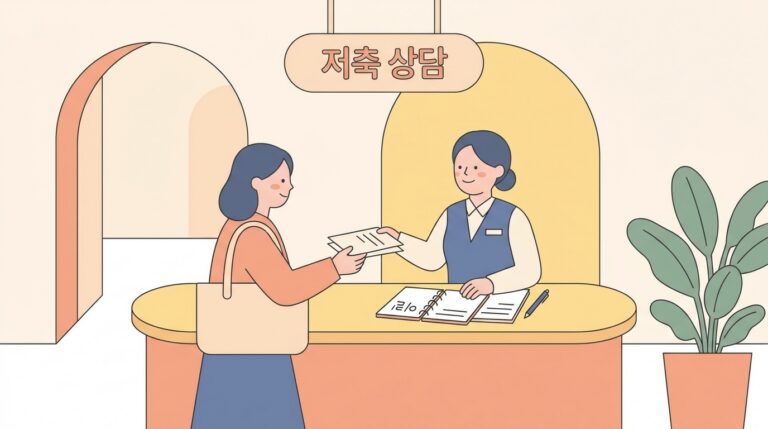
Setting: KB Kookmin Bank Sinchon Branch. Sunlight streams across sleek polished desks. Banker Lee Min-ji sits at Window #3, stamping documents with crisp precision.
- 은행원 민지: 어서 오세요! 3번 창구로 오세요. 어떤 업무 도와드릴까요? (Eoseo oseyo! Sambeon changguro oseyo. Eotteon eommu dowadeurilkkayo? – Welcome! Please come to counter 3. How can I help you today?)
🎭 미소를 지으며 번호표를 받는다. - 학습자: 안녕하세요! 적금 이율 제일 높은 상품 추천해 주실 수 있나요? (Annyeonghaseyo! Jeokgeum iyul jeil nopeun sangpum chucheonhae jusil su innayo? – Hello! Can you recommend an installment savings product with the highest interest rate?)
🎭 메모장을 손에 쥐고 정중하게 묻는다. - 은행원 민지: 네! 요즘은 1년 만기 기준 최대 연 4.5%까지 가능한 ‘KB 청년 도약 적금’이 가장 인기가 많아요. (Ne! Yojeumeun illyeon mangi gijun choedae yeon sa-jeom-o-peosenteukkaji ganeunghan ‘KB Cheongnyeon Doyak Jeokgeum’i gajang ingiga manhayo. – Yes! These days, our ‘KB Youth Leap Savings’ offering up to 4.5% annually for a 1-year maturity is our top pick.)
🎭 안내 팜플렛을 펼치며 형광펜을 든다. - 학습자: 혹시 우대금리 조건이 어떻게 되나요? (Hoksi udae-geumri jogeoni eotteoke doenayo? – By any chance, what are the conditions for preferential interest rates?)
🎭 안내서를 짚어가며 경청한다. - 은행원 민지: 기본 금리는 3.0%이고요, 급여 이체와 체크카드 실적이 있으시면 1.5% 우대금리가 붙어요. (Gibon geumrineun sam-peosenteu-igoyo, geubyeo iche-wa chekeukadeu siljeogi issusimyeon il-jeom-o-peosenteu udae-geumriga buneoyo. – The base rate is 3.0%, and if you have salary deposits and debit card usage, a 1.5% bonus interest attaches.)
🎭 계산기에 숫자를 두드려 보여준다. - 학습자: 자동이체 신청하면 금리가 더 붙나요? (Jadong-iche sincheonghamyeon geumriga deo bunnayo? – Does the interest rate increase further if I set up automatic transfer?)
🎭 두 손을 무릎 위에 모으고 확인한다. - 은행원 민지: 네, 매월 지정일에 자동이체 걸어두시면 0.2% 추가 우대 혜택을 챙기실 수 있어요! (Ne, maewol jijeong-ire jadong-iche georeodusimyeon yeong-jeom-i-peosenteu chuga udae hyetaegeul chaenggisil su isseoyo! – Yes, if you set up auto-debit on a set monthly date, you can grab an additional 0.2% bonus!)
🎭 서류의 체크박스를 짚어준다. - 학습자: 좋아요, 그 상품으로 가입하고 싶어요. (Johayo, geu sangpumeuro gaiphago sipeoyo. – Sounds great, I would like to sign up for that product.)
🎭 외국인등록증을 두 손으로 건넨다.
🔀 인터랙티브 분기점 (Interactive Choice)
Now you want to ask about penalties in case you need to withdraw your money early. What do you say?
- Choice A: 중도해지하면 이자는 어떻게 돼요? (Jungdohaejihamyeon ijaneun eotteoke dwaeyo?)
Feedback: Best! 🌟 Perfectly polite, professional, and directly addresses early termination (중도해지). - Choice B: 중간에 돈 빼면 이자 다 뺏겨요? (Junggane don ppaemyeon ija da ppaetgyeoyo?)
Feedback: Bad! 😅 Grammatically understandable, but 뺏기다 (to be robbed/deprived) sounds crude and accusatory at a bank counter. - Choice C: 지금 당장 제 돈 다 주세요! (Jigeum dangjang je don da juseyo!)
Feedback: Risk! ⚠️ This means “Give me all my money right now!” You might cause a sudden security alert!
Phase 6: 10초 감정 섀도잉 드릴
Read these aloud while mirroring the emotion and pausing at each /:
[😊 밝고 공손하게]안녕하세요! / 적금 이율 제일 높은 상품 / 추천해 주실 수 있나요? (Annyeonghaseyo! / Jeokgeum iyul jeil nopeun sangpum / chucheonhae jusil su innayo?)[🧐 꼼꼼하고 호기심 가득하게]혹시 / 우대금리 조건이 / 어떻게 되나요? (Hoksi / udae-geumri jogeoni / eotteoke doenayo?)[💡 눈치 빠르게 챙기며]자동이체 신청하면 / 금리가 더 붙나요? (Jadong-iche sincheonghamyeon / geumriga deo bunnayo?)[🤝 확신에 차서 단정하게]좋아요! / 그 상품으로 / 가입할게요. (Johayo! / Geu sangpumeuro / gaiphalgeyo.)
Phase 7: K-Culture 미니 사전
- 적금 (Jeokgeum) vs 예금 (Yegeum) | Installment Savings vs Time Deposit
적금 is depositing a set amount monthly (e.g., 300,000 KRW every month for a year). 예금 is locking away a lump sum all at once (e.g., 5,000,000 KRW for one year). - 우대금리 (Udae-geumri) | Preferential Interest Rate
Bonus interest unlocked by satisfying bank conditions, like salary transfers or mobile banking app sign-ups. - 만기 (Mangi) | Maturity Date
The promised completion date of your financial contract. A common celebratory phrase among Koreans is “적금 만기 됐어요!” (My savings account matured!). - 원리금 (Won-ri-geum) | Principal and Interest Combined
A compound term combining 원금 (principal) and 이자 (interest), representing the total payout you receive upon maturity.
Phase 8: 여행자 & 거주자를 위한 생존 키트
Top 3 Survival Phrases
- 번호표 어디서 뽑아요? (Beonhopyo eodiseo ppobayo?)
“Where do I pull a waiting number ticket?”
Pro Tip: Look for the standing kiosk right by the entrance. Tellers won’t call you without a number. - 통장 사본 좀 출력해 주세요. (Tongjang sabon jom chullyeokhae juseyo.)
“Please print a copy of my bankbook cover.”
Pro Tip: Essential for Korean employment, part-time jobs, and visa extensions. - 인터넷 뱅킹 신청하고 싶어요. (Inteonet baengking sincheonghago sipeoyo.)
“I want to apply for internet/mobile banking.”
Pro Tip: Request this during your account setup so you can manage your savings online via your smartphone.
Editor’s Travel & Living Note
For effortless banking in Korea, download the major mobile apps beforehand. Search for and install the official apps like KB 스타뱅킹 앱 다운로드 or 신한 SOL 뱅크 앱 다운로드. If you hold an Alien Registration Card, setting up digital OTPs (보안카드/모바일OTP) during your in-person visit will spare you dozens of repeat trips!
Phase 9: “한 발 더 깊이” (생각 질문)
Koreans often cite the old proverb, 티끌 모아 태산 (Even dust, when gathered, forms a great mountain). In an ultra-fast society famous for 빨리빨리 (hurry-hurry), the quiet tradition of 적금 represents a poignant contrast: delayed gratification and steady resilience. Saving money every single month is deeply linked to communal pride, family support, and preparing for life’s turning points.
💬 Your Turn: Does your culture emphasize recurring monthly savings contracts like Korea’s 적금, or do people lean towards investment apps and stock portfolios? Share your thoughts in the comments below!
Phase 10: FAQ & 오해 방지
Q: Can foreigners sign up for high-interest installment savings accounts?
A: Yes! As long as you possess a valid Alien Registration Card (ARC) or Residence Card and domestic tax residency, you can sign up for most retail installment savings products. Bring your ARC and proof of employment if available.
Q: What is the difference between 단리 (danri) and 복리 (bongni)?
A: 단리 is simple interest calculated solely on the principal, whereas 복리 is compound interest where your earned interest generates interest. High-yield products often highlight compound benefits.
Q: If I break my savings contract before maturity, do I lose my initial money?
A: No! Your principal deposit (원금) is safe in standard commercial banks under the Korean Depositor Protection Act. However, you will lose almost all the accrued interest and receive a negligible early-closure rate (중도해지 이율).
🚨 흔한 실수 (Common Mistakes) 경고판
- Mistake 1: Asking for 예금 when you actually plan to deposit money every month.
Correct Action: Ask clearly for 적금 (Jeokgeum). - Mistake 2: Assuming the advertised marquee rate (e.g., 5%) applies automatically.
Correct Action: Always inquire: 우대금리 조건이 어떻게 되나요? - Mistake 3: Forgetting to bring your physical physical ARC (외국인등록증).
Correct Action: Digital photos or passport copies are rarely accepted for account opening. Always carry your physical ARC!
Phase 11: 액션 미션 & 참여 유도
- 🥉 Bronze Mission: Practice the 10-second shadowing drill three times in front of your mirror with expressive hand gestures.
- 🥈 Silver Mission: Write down your target monthly savings amount in Korean (e.g., 한 달에 30만 원씩 적금 들기) in your planner and post it on your study Instagram tag #DailyHangul.
- 🥇 Gold Mission: Walk into your local Korean bank branch, draw a ticket, and ask the teller: 적금 이율 제일 높은 상품 추천해 주실 수 있나요?
- 🎮 K-Culture Mission: Watch an episode of a workplace K-drama (like Misaeng or Start-Up) and listen closely for the words 월급 (salary), 통장 (bankbook), or 적금 (installment savings)!
Phase 12: 인터랙티브 퀴즈 챌린지
1. Situation Judgment
You want to set aside 200,000 won every month on payday and want the highest interest. What should you tell the banker?
* A) 비과세 통장으로 환전해 주세요.
* B) 매달 넣는 적금 중에 이율 제일 높은 거 추천해 주세요.
* C) 주식 계좌로 예금 전액 이체해 주세요.
2. Fill in the Blank
“추가 이자를 받기 위한 요건을 물어볼 때: [ ________ ] 조건이 어떻게 되나요?”
3. True or False
In Korea, 예금 and 적금 refer to the exact same banking process. (True / False)
🔍 정답 및 해설 확인하기 (Click to reveal answers)
- Answer: B – Asking for 적금 with the highest rate fits recurring monthly deposits.
- Answer: 우대금리 (Preferential interest rate) – The key phrase to discover bonus yield requirements.
- Answer: False – 적금 is periodic installment deposits, while 예금 is a one-time lump-sum deposit!







