

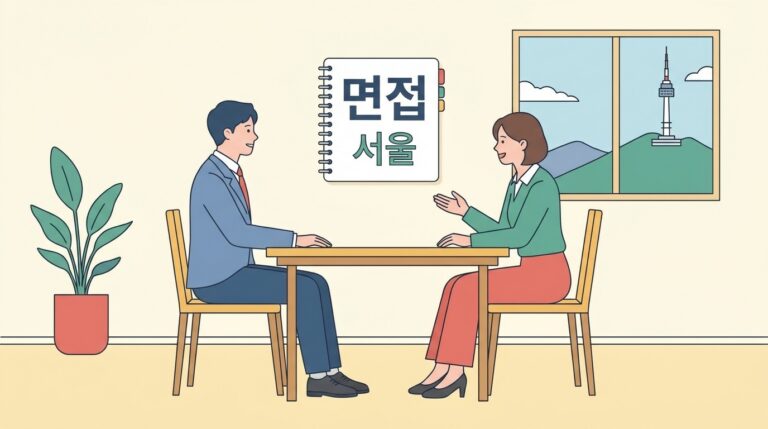
Phase 1: 공감 (스토리 몰입형 오프닝)
안녕하세요! 매일한글 에디터입니다.
Have you ever watched an episode of the hit K-drama Misaeng (Incomplete Life) or Start-Up and found yourself mesmerized by the interview room scenes? An experienced team leader leans forward, scans a resume sheet, and asks a calm yet laser-focused question that instantly reveals the candidate’s real capabilities. If you manage a team in Korea, lead cross-border recruitment, or are preparing for professional roleplays at the B2 level, stepping into the interviewer’s shoes is an empowering milestone. However, asking detailed questions based on a resume (이력서) is surprisingly tricky in Korean.
Many intermediate learners face a tough pain point here: translating English interview questions directly into Korean often sounds either like a robotic interrogation or an awkward casual chat. Phrases like Why did you do this? or Prove your achievements can sound unintentionally harsh if you miss subtle honorific structures like -시- or the tactful indirect question ending -실까요?. Drawing from over a decade of coaching expatriate executives and multinational team managers in Seoul, I have designed this guide to help you sound authoritative, respectful, and culturally astute. By mastering these expressions, you will not only evaluate candidates with professional elegance (품위) but also gain deep insight into how Korean workplaces value teamwork, resilience, and personal growth.
Phase 2: 핵심 표현 3선 심층 분석
1. 이력서에 기재된 프로젝트 경험에 대해 구체적으로 말씀해 주시겠어요? (I-ryeok-seo-e gi-jae-doen peu-ro-jek-teu gyeong-heom-e dae-hae gu-che-jeok-eu-ro mal-sseum-hae ju-si-get-eo-yo?)
- Pronunciation: [I-ryeok-seo-e gi-jae-doen peu-ro-jek-teu gyeong-heom-e dae-hae gu-che-jeok-eu-ro mal-sseum-hae ju-si-get-eo-yo?] (Think of gi-jae-doen sounding like “key-jay-doen”, meaning recorded or entered).
- Meaning: Literal: “Could you specifically speak about the project experience entered on your resume?” | Nuance: A polished, formal opening question that invites the applicant to elaborate on their portfolio without feeling put on the spot.
- K-Culture Moment: Frequently heard in corporate recruitment dramas like Search: WWW when directors probe candidate portfolios during final executive rounds.
- Editor’s Insight: The passive form 기재된 (written/listed) paired with the high-honorific request 말씀해 주시겠어요 creates a collaborative, professional dialogue rather than an interrogation.
- Situation Spectrum: Casual 🚫 | Semi-formal ⚠️ | Formal ✅
- 🤔 Think About It: In English, interviewers often say “Walk me through project X.” In Korean, using the honorific 말씀 (speech) highlights your respect for the candidate’s intellectual property and effort.
2. 이 직무를 수행하면서 겪었던 가장 큰 난관과 극복 과정을 공유해 주세요. (I jik-mu-reul su-haeng-ha-myeon-seo gyeok-eot-deon ga-jang keun nan-gwan-gwa geuk-bok gwa-jeong-eul gong-yu-hae ju-se-yo.)
- Pronunciation: [I jik-mu-reul su-haeng-ha-myeon-seo gyeok-eot-deon ga-jang keun nan-gwan-gwa geuk-bok gwa-jeong-eul gong-yu-hae ju-se-yo.] (Pronounce nan-gwan with crisp nasal resonance, sounding like “non-gwan”).
- Meaning: Literal: “Please share the biggest obstacle and overcoming process you experienced while carrying out this duty.” | Nuance: The classic behavioral interview question designed to evaluate grit, problem-solving, and resilience.
- K-Culture Moment: In reality-style audition and internship survival shows (like Good People), mentors use this exact phrase to see if applicants can maintain composure under pressure.
- Editor’s Insight: Using the compound noun 극복 과정 (overcoming process) signals that you care far more about the methodology of solving the issue than the obstacle itself.
- Situation Spectrum: Casual 🚫 | Semi-formal ⚠️ | Formal ✅
- 🤔 Think About It: Notice the choice of 공유해 주세요 (please share) over 증명해 보세요 (please prove). It frames the conversation as mutual knowledge exchange rather than cross-examination.
3. 이전 직장에서의 성과가 저희 부서에 어떻게 기여할 수 있다고 보시나요? (I-jeon jik-jang-e-seo-ui seong-gwa-ga jeo-hui bu-seo-e eo-tteo-khe gi-yeo-hal su it-da-go bo-si-na-yo?)
- Pronunciation: [I-jeon jik-jang-e-seo-ui seong-gwa-ga jeo-hui bu-seo-e eo-tteo-khe gi-yeo-hal su it-da-go bo-si-na-yo?] (The word gi-yeo sounds like “gear-yo”).
- Meaning: Literal: “How do you view that your achievements in your previous workplace can contribute to our department?” | Nuance: Probing value proposition and team synergy, asking the applicant to connect past results to future team targets.
- K-Culture Moment: Seen in tech startup dramas like Start-Up when hiring seasoned developers away from conglomerates.
- Editor’s Insight: Ending with -다고 보시나요? (Do you see/evaluate it as…?) is far more refined than -라고 생각합니까?, showing thoughtful intermediate-to-advanced managerial phrasing.
- Situation Spectrum: Casual 🚫 | Semi-formal ⚠️ | Formal ✅
- 🤔 Think About It: Why use 저희 (our humble form) instead of 우리 (our standard)? In business situations, referring to your own organization as 저희 demonstrates institutional humility and high etiquette.
Phase 3: 교과서 한국어 vs 진짜 한국어
Situation 1: Inquiring About Career Changes or Gaps
- 📖 교과서 한국어: 왜 회사를 그만두었습니까? (Wae hoe-sa-reul geu-man-du-eot-seum-ni-kka? – Why did you quit your company?)
- 🗣️ 진짜 한국어: 이번에 커리어 전환을 결심하시게 된 특별한 계기가 있으실까요? (I-beon-e keo-ri-eo jeon-hwan-eul gyeol-sim-ha-si-ge doen teuk-byeol-han gye-gi-ga it-eu-sil-kka-yo? – Was there a particular turning point that led you to decide on this career pivot?)
- 💡 왜 다를까? Asking “왜” (why) directly sounds aggressive and accusatory in a formal setting. Native interviewers soften the inquiry by focusing on 계기 (turning point / catalyst) combined with the polite double-honorific ending -으실까요?.
Situation 2: Verifying Technical Skills Listed on the Resume
- 📖 교과서 한국어: 당신은 이 프로그램을 잘 다룹니까? (Dang-sin-eun i peu-ro-geu-raem-eul jal da-rup-ni-kka? – Do you handle this program well?)
- 🗣️ 진짜 한국어: 포트폴리오에 기재된 분석 툴은 실무에서 어느 정도 수준까지 다뤄 보셨나요? (Po-teu-pol-li-o-e gi-jae-doen bun-seok tul-eun sil-mu-e-seo eo-neu jeong-do su-jun-kka-ji da-rwo bo-syeot-na-yo? – To what level have you utilized the analytical tools mentioned in your portfolio in real work environments?)
- 💡 왜 다를까? The textbook trap is using 당신 (a dangerous pronoun that sounds confrontational) and vague qualifiers like “잘”. Real business Korean specifies the domain using 실무 (practical work) and asks about scope with 어느 정도 수준까지.
Phase 4: K-Culture 딥다이브 & 비언어적 매너
4-1. 눈치(Nunchi) & Professional Body Language
As an interviewer in a Korean setting, maintaining appropriate non-verbal etiquette is just as critical as the candidate’s demeanor. Avoid continuous piercing eye contact, which can feel oppressive (위압감). Instead, establish comfortable eye contact when asking a question, shift your gaze down to their resume while they articulate initial thoughts, and gently nod (고개 끄덕임) every few seconds to signal active listening.
Keep your pen quiet. Clicking a ballpoint pen repeatedly while reviewing documents creates immense tension. Hold notes with both hands when referring to them, and avoid folding your arms across your chest, as it conveys skepticism and detachment.
4-2. Cultural Code: From “Spec-Centric” to “Competency & Culture Fit”
Korean hiring historically obsessed over “스펙 (Spec)”—standardized test scores, prestigious diplomas, and language certificates. However, modern corporate culture (especially in tech hubs like Pangyo and Gangnam) has shifted heavily toward 직무 적합성 (job competency) and 컬처 핏 (culture fit).
Interviews today follow structured behavioral frameworks similar to the STAR method (Situation, Task, Action, Result). When you ask resume questions, Korean candidates expect you to drill down into collaborative dynamics: did they achieve success alone, or did they support colleagues and communicate effectively across departments?
Phase 5: 실전 롤플레이 시나리오
Setting: A brightly lit conference room at a fast-growing Seoul tech firm overlooking Teheran-ro. You are Director Park (박 팀장), and you are interviewing Candidate Kim Min-soo (김민수) for a Senior Marketing Strategist role.
- Turn 1 (Interviewer):
김민수 지원자님, 이력서에 기재된 글로벌 론칭 프로젝트 경험에 대해 구체적으로 말씀해 주시겠어요?
(Gim Min-su ji-won-ja-nim, i-ryeok-seo-e gi-jae-doen geul-ro-beol ron-ching peu-ro-jek-teu gyeong-heom-e dae-hae gu-che-jeok-eu-ro mal-sseum-hae ju-si-get-eo-yo?)
“Mr. Min-soo Kim, could you elaborate on the global launch project experience listed on your resume?”
🎭 Looking up from the document with a calm, encouraging smile. -
Turn 2 (Candidate):
네, 작년에 동남아 시장 진출을 담당하며 현지화 마케팅 캠페인을 총괄했습니다.
(Ne, jak-nyeon-e dong-nam-a si-jang jin-chul-eul dam-dang-ha-myeo hyeon-ji-hwa ma-ke-ting kaem-pe-in-eul chong-gwal-haet-seum-ni-da.)
“Yes, last year I was in charge of entering the Southeast Asian market and oversaw localization marketing campaigns.”
🎭 Sitting upright, maintaining respectful eye contact. -
Turn 3 (Interviewer):
기재된 수치를 보니 전환율이 35% 상승했네요. 이 성과를 이끌어 내는 과정에서 가장 큰 난관은 무엇이었나요?
(Gi-jae-doen su-chi-reul bo-ni jeon-hwan-yul-i sam-sip-o-peo-sen-teu sang-seung-haet-ne-yo. I seong-gwa-reul ik-keul-eo nae-neun gwa-jeong-e-seo ga-jang keun nan-gwan-eun mu-eot-i-eot-na-yo?)
“Looking at the figures listed, the conversion rate grew by 35%. What was the biggest hurdle in driving this achievement?”
🎭 Underlining the metric on the sheet with a pen. -
Turn 4 (Candidate):
초기에 현지 파트너사와의 소통 지연으로 일정 관리에 큰 어려움이 있었습니다.
(Cho-gi-e hyeon-ji pa-teu-neo-sa-wa-ui so-tong ji-yeon-eu-ro il-jeong gwan-ri-e keun eo-ryeo-um-i it-eot-seum-ni-da.)
“Initially, there were major difficulties with schedule management due to communication delays with local partner firms.”
🎭 Explaining transparently with hands resting neatly on his lap. -
Turn 5 (Interviewer):
그 난관을 극복하기 위해 지원자님께서 직접 주도하신 구체적인 해결책은 무엇이었습니까?
(Geu nan-gwan-eul geuk-bok-ha-gi wi-hae ji-won-ja-nim-kke-seo jik-jeop ju-do-ha-sin gu-che-jeok-in hae-gyeol-chaek-eun mu-eot-i-eot-seum-ni-kka?)
“What specific solution did you personally spearhead to overcome that obstacle?”
🎭 Leaning forward slightly, demonstrating keen interest. -
Turn 6 (Candidate):
매일 아침 15분간 온라인 스크럼 미팅을 도입하고, 업무 시각화 대시보드를 공유하여 투명성을 높였습니다.
(Mae-il a-chim sip-o-bun-gan on-ra-in seu-keu-reom mi-ting-eul do-ip-ha-go, eop-mu si-gak-hwa dae-si-bo-deu-reul gong-yu-ha-yeo tu-myeong-seong-eul nop-yeot-seum-ni-da.)
“I instituted a daily 15-minute online scrum meeting and shared a work visualization dashboard to improve transparency.”
🎭 Speaking with confident and measured cadence. -
Turn 7 (Interviewer):
협업 프로세스를 잘 정착시키셨군요. 그렇다면 그 당시의 경험이 저희 팀의 신규 서비스 확장에 어떻게 기여할 수 있을까요?
(Hyeop-eop peu-ro-se-seu-reul jal jeong-chak-si-ki-syeot-gun-yo. Geu-reoh-da-myeon geu dang-si-ui gyeong-heom-i jeo-hui tim-ui sin-gyu seo-bi-seu hwak-jang-e eo-tteo-khe gi-yeo-hal su it-eul-kka-yo?)
“You integrated the collaborative process very well. In that case, how can that experience contribute to our team’s upcoming service expansion?”
🎭 Nodding approvingly while posing the concluding bridge question. -
Turn 8 (Candidate):
저희 팀이 해외 시장으로 영역을 넓힐 때 발생할 시행착오를 최소화하고, 빠른 실행력을 불어넣을 수 있습니다.
(Jeo-hui tim-i hae-oe si-jang-eu-ro yeong-yeok-eul neol-pil ttae bal-saeng-hal si-haeng-chak-o-reul choe-so-hwa-ha-go, ppa-reun sil-haeng-ryeok-eul bul-eo-neoh-eul su it-seum-ni-da.)
“I can minimize the trial-and-error when expanding overseas and inject swift execution capabilities into the team.”
🎭 Concluding with a composed, determined expression.
🔀 인터랙티브 분기점 (Choose Your Follow-up):
At this moment, how should you follow up on the candidate’s last answer?
- Option A: “말씀하신 실행력이라는 게 구체적으로 어떤 지표를 통해 검증될 수 있을까요?” (Could you tell us what specific metrics verify this execution capability?)
- Feedback (Best): Perfect B2+ business Korean. Rigorous, polite, and directly probes for data-backed verification.
- Option B: “진짜 할 수 있어요? 전 직장 사람들한테 물어봐도 됩니까?” (Can you really do it? Can I ask your previous colleagues?)
- Feedback (Bad): Sounds extremely rude and combative. Destroys the professional atmosphere instantly.
- Option C: “좋네요! 우리 팀이랑 잘 맞을 것 같아요. 합격시키면 바로 올 거죠?” (Sounds good! Seems like a great fit. If we pass you, you’ll join right away, right?)
- Feedback (Risk): Too casual and reveals evaluation bias too early, weakening your negotiation standing.
Phase 6: 10초 감정 섀도잉 드릴
Practice these lines using the emotional markers and natural breath pauses (/):
[🧐 정중하고 예리하게 - Formal, sharp, and attentive]
이력서에 기재된 / 직무 경험에 대해 / 구체적으로 말씀해 주시겠어요?
(I-ryeok-seo-e gi-jae-doen / jik-mu gyeong-heom-e dae-hae / gu-che-jeok-eu-ro mal-sseum-hae ju-si-get-eo-yo?)-
[🤝 경청하며 공감하듯 - Empathetic and engaged]
그 과정에서 겪으셨던 / 가장 큰 난관은 / 무엇이었나요?
(Geu gwa-jeong-e-seo gyeok-eu-syeot-deon / ga-jang keun nan-gwan-eun / mu-eot-i-eot-na-yo?) -
[🎯 차분하면서도 기대감을 담아 - Calm, balanced, and forward-looking]
해당 성과가 / 저희 부서의 목표 달성에 / 어떻게 기여할 수 있다고 보십니까?
(Hae-dang seong-gwa-ga / jeo-hui bu-seo-ui mok-pyo dal-seong-e / eo-tteo-khe gi-yeo-hal su it-da-go bo-sim-ni-kka?)
Phase 7: K-Culture 미니 사전 (핵심 키워드 4개)
-
경력기술서 (Gyeong-nyeok gi-sul-seo) | Detailed Work History / Portfolio Summary
- Meaning: Unlike a general resume (이력서), this document outlines specific projects, roles, tech stacks, and quantifiable outcomes achieved in previous employment.
- 직무 적합성 (Jik-mu jeok-hap-seong) | Job Competency / Role Fit
- Meaning: The degree to which an applicant’s real-world skill set matches the exact responsibilities of the vacancy.
- 컬처 핏 (Keol-cheo pit) | Culture Fit
- Meaning: Widely used in Korean corporate language to describe harmony with the company’s communication style, speed, and organizational philosophy.
- 압박 면접 (Ap-bak myeon-jeop) | Stress Interview
- Meaning: An interview format where interviewers deliberately ask difficult follow-up questions to test stress tolerance and adaptability.
Phase 8: 여행자를 위한 생존 키트 (Business Travel Edition)
서바이벌 표현 TOP 3
- 면접 장소가 몇 층에 있습니까? (Myeon-jeop jang-so-ga myeot cheung-e it-seum-ni-kka?)
- Meaning: “Which floor is the interview location on?”
- Pro Tip: Use this at the front lobby desk when arriving at corporate headquarters.
- 신분증 확인 부탁드립니다. (Sin-bun-jeung hwak-in bu-tak-deu-rim-ni-da.)
- Meaning: “Please confirm your identification.”
- Pro Tip: Essential when issuing visitor security badges in modern office towers.
- 명함 한 장 건네 드려도 되겠습니까? (Myeong-ham han jang geon-ne deu-ryeo-do doe-get-seum-ni-kka?)
- Meaning: “May I offer you a business card?”
- Pro Tip: Present your business card with both hands with your name facing the recipient.
Editor’s Travel Note
When heading to corporate meetings or interview centers in Seoul, download the 네이버 지도 앱 다운로드 to check accurate subway exit numbers and building entrances, as corporate towers often connect directly underground. Taxis can be easily hailed without language barriers using the 카카오 T 앱 다운로드. Always arrive 15 minutes early; punctuality (시간 엄수) is non-negotiable in Korean professional culture.
Phase 9: “한 발 더 깊이” (생각 질문)
In Korean corporate communication, honorifics (존댓말) do not merely signify hierarchy; they serve as an emotional buffer. When an interviewer evaluates a candidate, phrasing critical inquiries through honorific infixes (-시-) and soft interrogatives allows tough evaluation without personal antagonism. It separates the scrutiny of the work output from the dignity of the human being.
💬 Your Turn: In your home country’s work culture, how do interviewers probe difficult resume points without making candidates defensive? Does your language have subtle grammatical structures to soften this scrutiny, or do you rely entirely on vocal tone? Share your thoughts below!
Phase 10: FAQ & 오해 방지 (FAQ Schema)
Q: Can I use the pronoun 당신 (dang-sin) when addressing an interviewee?
A: Absolutely not. While textbooks list 당신 as “you,” in real spoken Korean it is either used between spouses or during heated verbal arguments. In an interview room, address the candidate respectfully by name followed by 지원자님 (e.g., 김민수 지원자님 – Candidate Min-soo Kim).
Q: Is it okay to use 반말 (informal speech) if the candidate is much younger than me?
A: No. Modern Korean hiring strictly mandates 존댓말 (formal speech) from interviewers regardless of age gaps. Maintaining honorifics reflects the professional credibility and ethical standard of your organization.
Q: What is the best way to ask for clarification if a candidate’s answer is vague?
A: Avoid saying “무슨 말인지 모르겠어요” (I don’t understand what you mean). Instead, say: “방금 말씀해 주신 내용 중 [A 부분]에 대해 조금 더 부연 설명을 부탁드려도 될까요?” (Could I ask for a bit more elaboration regarding part A of what you just mentioned?).
🚨 흔한 실수 (Common Mistakes) 경고판
- Mistake: Using “왜 회사를 그만뒀어요?” (Why did you quit?)
- Correct Action: Use “이번에 이직을 결심하시게 된 계기는 무엇인가요?”
- Mistake: Forgetting the honorific infix
-시-when asking about applicant achievements.- Correct Action: Ask “어떤 역할을 담당하셨습니까?” instead of “어떤 역할을 담당했습니까?”.
- Mistake: Asking personal family questions (marriage, parents’ jobs, age).
- Correct Action: Korean labor regulations strictly ban non-job-related personal inquiries. Keep all questions strictly tied to the resume and portfolio.
Phase 11: 액션 미션 & 참여 유도
- 🥉 Bronze Mission (Solo Shadowing): Read Expression 1 out loud 5 times using the shadowing pause marks until you can deliver it smoothly within 5 seconds.
- 🥈 Silver Mission (Social Dialogue): Leave a comment writing one resume question you would ask a candidate applying for your current job in Korean.
- 🥇 Gold Mission (Real-World Application): Roleplay the Phase 5 script with a language exchange partner or Korean colleague, swapping roles between interviewer and applicant.
- 🎮 K-Culture Mission: Watch an episode of Misaeng or Start-Up this week and spot at least two interview or reporting expressions ending in
-시겠습니까?or-셨나요?.
Phase 12: 인터랙티브 퀴즈 챌린지
Q1. [Situation Judgement] As an interviewer, you want to ask how a candidate solved a communication failure in their previous job. Which question is the most professional and culturally natural?
1. 왜 동료들이랑 싸웠어요?
2. 그 갈등 상황을 해결하기 위해 어떤 노력을 기울이셨습니까?
3. 당신의 문제 해결 능력을 여기서 증명해 보세요.
4. 갈등 생기면 퇴사할 건가요?
👉 정답 및 해설 확인하기 (Click to reveal answer)
정답: 2번
해설: 2번 uses appropriate honorifics (기울이셨습니까) and focuses constructively on the effort made to resolve the conflict (어떤 노력을 기울이다). 1번 is too casual, 3번 uses the inappropriate pronoun 당신 and commands the candidate, and 4번 is hostile.
Q2. [Fill in the Blank] Fill in the missing word:
“이력서에 _______ 프로젝트 경험에 대해 구체적으로 말씀해 주시겠어요?” (Could you elaborate on the project experience recorded on your resume?)
👉 정답 및 해설 확인하기 (Click to reveal answer)
정답: 기재된 (gi-jae-doen)
해설: 기재되다 is the formal Sino-Korean verb specifically used for data, text, or details recorded in official documents like resumes and applications.
Q3. [True / False Cultural Quiz] In modern Korean corporate interviews, it is considered normal and acceptable for an interviewer to ask a candidate why they are not married yet.
👉 정답 및 해설 확인하기 (Click to reveal answer)
정답: False
해설: Under South Korea’s Fair Hiring Procedure Act (채용절차의 공정화에 관한 법률), asking about marital status, physical appearance, hometown, or family members is illegal and subject to heavy fines. Interviews must focus purely on job competence (직무 역량).







