

Phase 1: Empathy & Story-Driven Opening
안녕하세요! 매일한글 에디터입니다. (Hello! It’s your Daily Hangul editor here.)
Imagine this classic Seoul scene: It is 8:30 AM on Line 2—the infamous green circle line dubbed Ji-ok-cheol (Hell-subway). You are tightly sandwiched near the center aisle as the automated voice announces your stop, Gangnam Station. The doors open with a chime, but a wall of passengers on the platform starts surging forward before anyone inside can even take a step. Your heart beats fast, you break into a cold sweat, and you wonder: Do I push? Do I stay silent? How do I say ‘Excuse me’ without sounding rude or aggressive?
If you have ever felt trapped by the sheer velocity of Korean rush hour, take a deep breath. You are not alone! Hundreds of intermediate learners tell us that exiting a crowded train in Korea triggers major social anxiety. Navigating Seoul’s transit system is not just about tapping your transportation card; it is about reading the unspoken flow of 내리는 사람 먼저 (Naerineun saram meonjeo – Alighting passengers first). Today, we will unpack the exact B1-level expressions, polite physical gestures, and social nuances you need to step off any train coolly, safely, and like a true local.
Phase 2: Core Expressions Deep Dive
1. 내리실게요 (Naerisilgeyo)
- Pronunciation: [Nae-ri-sil-ge-yo] (Think: “neigh-ree-seal-geh-yo”, rolling the ‘r’ lightly like the ‘tt’ in ‘butter’)
- Meaning: Literal: “(You/We) will alight” | Real Nuance: “Pardon me, I am getting off! / Coming through!”
- K-Culture Moment: You will hear this constantly in Korean slice-of-life office dramas like Misaeng (Incomplete Life) whenever exhausted salarymen slice through dense train crowds.
- Editor’s Insight: Grammatically, combining the honorific -시- with the speaker intention -ㄹ게요 is non-standard, yet it has become the gold standard of contemporary Seoul public transit courtesy. It softens the command into a shared, gentle momentum.
- Situation Spectrum: Casual (⚠️) | Semi-formal (✅) | Formal (✅)
- 🤔 Think About It: In English, we often apologize (“Excuse me, sorry!”). In Korean transit, why do people state the collective action rather than an apology?
2. 잠시만 지나갈게요 (Jamsiman jinagalgeyo)
- Pronunciation: [Jam-si-man ji-na-gal-ge-yo] (Think: “jahm-she-mahn jee-nah-gahl-geh-yo”)
- Meaning: Literal: “I will pass by for a brief moment” | Real Nuance: “Just slipping past you, excuse me for a second.”
- K-Culture Moment: Protagonists in urban romance dramas whispering this while weaving past commuters on transfer escalators.
- Editor’s Insight: 잠시만 (Jamsiman) means “just a short moment.” Using this word shrinks the social footprint of your interruption, making the person in front willingly step aside.
- Situation Spectrum: Casual (✅) | Semi-formal (✅) | Formal (✅)
- 🤔 Think About It: How does qualifying an action with “just for a moment” reduce perceived social burden in fast-paced cultures?
3. 내리는 사람 먼저예요 (Naerineun saram meonjeoyeyo)
- Pronunciation: [Nae-ri-neun sa-ram meon-jeo-ye-yo] (Think: “neigh-ree-noon sah-rahm mun-juh-yeh-yo”)
- Meaning: Literal: “It is the person getting off first” | Real Nuance: “Let people off first, please!”
- K-Culture Moment: An elderly commuter or an assertive station agent setting order when eager tourists or teenagers try to board prematurely.
- Editor’s Insight: Stating the universal rule (먼저예요 – it is first) redirects the confrontation away from personal annoyance and frames it as a shared civic standard.
- Situation Spectrum: Casual (✅) | Semi-formal (✅) | Formal (✅)
- 🤔 Think About It: Stating a societal rule neutrally avoids pointing fingers at an individual. Does your native language have a similar way of defusing public friction?
Phase 3: Textbook Korean vs. Real Korean
Situation 1: Asking someone blocking the door to move aside
- 📖 교과서 한국어 (Textbook): 비켜 주세요. (Bikyeo juseyo. – “Please move out of my way.”)
- 🗣️ 진짜 한국어 (Real Korean): 저 이번에 내려요! (Jeo ibeone naeryeoyo! – “I’m getting off at this stop!”)
- 💡 왜 다를까? (Why is it different?): 비켜 주세요 sounds commanding and borderline combative to native ears. Stating your intention with 저 이번에 내려요 prompts the person in front to move naturally without feeling scolded.
Situation 2: Stopping commuters from boarding too early
- 📖 교과서 한국어 (Textbook): 기다려 주십시오. (Gidaryeo jusipsio. – “Please wait.”)
- 🗣️ 진짜 한국어 (Real Korean): 내리고 타실게요~ (Naerigo tasilgeyo~ – “We’ll board after letting people alight~”)
- 💡 왜 다를까? (Why is it different?): 기다려 주십시오 sounds like a rigid public broadcast. Commuters use the polite cooperative ending -실게요 to maintain communal harmony in a tight space.
Phase 4: K-Culture Deep Dive & Non-Verbal Manners
4-1. 눈치 (Nunchi) & Gestures
- The Karate-Chop Hand (매너 손 – Manner Hand): Keep one hand held vertically flat in front of your chest, slightly tuck your chin, and angle your body sideways as you move forward. This body language universally translates to “Pardon me, cutting through!”
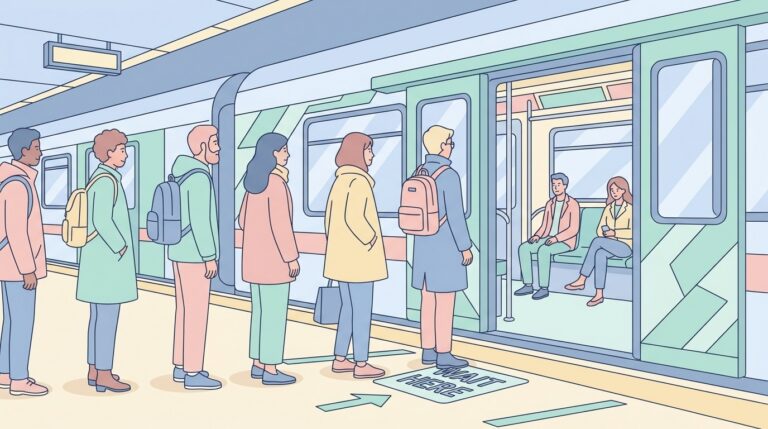
- Platform Geometry: Look at the subway platform floor. You will see inverted triangles pointing toward the doors and directional arrows pointing outward. Wait behind the side arrows, never directly in front of the center opening.
- Eye Line: Avoid fixed eye contact with people in front of the doors. Keep your eyes directed forward toward the gap to signal clear directional movement.
4-2. Cultural Code Analysis: The “Ppalli-Ppalli” Commute
Seoul’s transit network handles over 7 million passenger trips each day. The transit rhythm in K-dramas like My Liberation Notes (나의 해방일지) highlights the quiet, shared discipline of the everyday commute. Trains stop for roughly 20 to 30 seconds at major junctions. The principle of 내리는 사람 먼저 is not merely politeness—it is a functional prerequisite. Letting people out creates empty volume for boarding passengers; breaking this rhythm slows down millions of people.
Phase 5: Real-World Roleplay Scenario
Setting: Morning rush hour on Line 2 approaching Yeoksam Station. The carriage is packed. You need to get off, but a passenger named Min-woo stands right in front of the exit doors with noise-canceling headphones.
- Turn 1 (You): 🎭 (Checking the digital display, gently shifting body posture)
저기요, 혹시 이번 정거장에서 내리세요? (Jeogiyo, hoksi ibeon jeong-geojang-eseo naeriseyo? / Excuse me, by any chance are you getting off at this stop?) - Turn 2 (Min-woo): 🎭 (Taking off one earbud, looking surprised)
아, 아니요. 저는 강남역까지 가요. (A, aniyo. Jeoneun Gangnamyeok-kkaji gayo. / Ah, no. I am going until Gangnam Station.) - Turn 3 (You): 🎭 (Pointing toward the door with an apologetic smile)
아, 네! 제가 이번에 내려야 해서요. (A, ne! Jega ibeone naeryeoya haeseoyo. / Ah, okay! I need to get off at this stop.) - Turn 4 (Min-woo): 🎭 (Trying to turn sideways, but boxed in by other commuters)
네, 문 열리면 비켜드릴게요. (Ne, mun yeollimyeon bikyeodeurilgeyo. / Yes, when the door opens, I’ll step out of the way for you.) - Turn 5 [Train Chime Rings]: 🎭 (Doors open, people on the platform start surging in slightly)
- Turn 6 (You): 🎭 (Placing a flat hand at chest level, leaning forward)
죄송합니다, 내리실게요! (Joesonghapnida, naerisilgeyo! / Excuse me, coming off!) - Turn 7 (Commuters outside): 🎭 (Pausing their step, splitting to both sides of the door)
아, 네, 먼저 내리세요! (A, ne, meonjeo naeriseyo! / Ah, yes, please exit first!) - Turn 8 (You): 🎭 (Lightly nodding while exiting onto the platform)
감사합니다, 잠시만 지나갈게요. (Gamsahamnida, jamsiman jinagalgeyo. / Thank you, just stepping through.)
🔀 Interactive Choice Point
What should you do if someone on the platform steps directly into your path the moment the door opens?
* Choice A: Push past their shoulders forcefully without uttering a word.
* Feedback (Bad): High risk of verbal conflict and hostile stares. Seoul transit relies heavily on vocal softening.
* Choice B: Shout “비켜요! (Move!)” at the top of your lungs.
* Feedback (Risk): Overly aggressive. You will startle everyone in the car.
* Choice C: Raise your hand vertically at chest level and clearly say “내릴게요! (Naerilgeyo! – Exiting!)”
* Feedback (Best): Clear, assertive, polite, and universally understood.
Phase 6: 10-Second Emotional Shadowing Drill
Read these aloud, pausing at the slashes (/) and matching the emotional cues:
[🏃 Urgent yet polite]
저 / 이번 정거장에서 / 내릴게요! (Jeo / ibeon jeong-geojang-eseo / naerilgeyo!)
“I’m / getting off at / this stop!”-
[🙏 Soft and considerate]
죄송하지만 / 잠시만 / 지나가겠습니다~ (Joesonghajiman / jamsiman / jinagagessseumnida~)
“Pardon me, / but I’ll / slip through for a second~” -
[😌 Calm, firm, and civic-minded]
내리는 사람 / 먼저 / 지나갈게요~ (Naerineun saram / meonjeo / jinagalgeyo~)
“Letting the alighting passengers / pass through / first~”
Phase 7: K-Culture Mini Dictionary
- 지옥철 (Ji-ok-cheol) | Literal: “Hell-subway” | A blend of 지옥 (hell) and 지하철 (subway). Used to describe rush-hour transit on Seoul Lines 9 and 2.
- 백팩 앞으로 (Baek-paek ap-euro) | “Backpack to the front” | The civic courtesy of wearing your backpack on your chest or placing it at your feet so you do not hit passengers behind you.
- 환승 (Hwan-seung) | Transit transfer | Switching between subway lines or between buses and subways within the unified discount time window.
- 배려석 (Bae-ryeo-seok) | Consideration seating | Designated seats for the elderly, pregnant women (임산부 배려석), and disabled persons that remain vacant even in packed trains.
Phase 8: Traveler’s Survival Kit
TOP 3 Survival Phrases
- 저 내려요! (Jeo naeryeoyo!)
- Romanization: [Jeo nae-ryeo-yo]
- Pro Tip: Use this quick 3-syllable phrase when the door is already opening and you need people to part immediately.
- 먼저 내리세요. (Meonjeo naeriseyo.)
- Romanization: [Meon-jeo nae-ri-se-yo]
- Pro Tip: When you are standing on the platform, use this to wave offboarders through with a warm smile.
- 문 닫힙니다! (Mun dachimnida!)
- Romanization: [Mun da-chim-ni-da]
- Pro Tip: When you hear this announcement chime through the speakers, stop walking and wait for the next train.
Editor’s Travel Note
For frictionless transit travel, check train boarding numbers directly inside your transit apps. You can inspect car and door numbers (like Car 4-Door 2) for the quickest interchange path using the 네이버 지도 앱 다운로드. Remember: keep your phone on silent mode (진동 모드) and avoid loud speakerphone calls!
Phase 9: One Step Deeper (Cultural Reflection)
In many Western cultures, personal physical space is treated as an individual boundary that must remain untouched. In high-density Korea, however, shared public space operates on collective rhythm and mutual accommodation. True politeness on the Seoul subway is not about keeping an impossible physical distance; it is about demonstrating awareness (눈치) that others are moving with you. Giving way to those exiting before boarding is the simplest, most profound daily practice of communal empathy.
💬 Your Turn: Have you ever experienced a crowded subway in your hometown or during a trip abroad? How do commuters signal that they need to get off where you live? Leave your thoughts in the comments below!
Phase 10: FAQ & Avoiding Misunderstandings
Q: Can I just say “Excuse me” in English on the train?
A: Most Seoul commuters will understand “Excuse me,” but using natural Korean like “잠시만 지나갈게요” or “내릴게요” triggers an immediate, instinctive physical reaction, giving you a faster path to the door.
Q: Is it rude to lightly tap someone on the shoulder if they have headphones on?
A: A very gentle shoulder tap accompanied by an apologetic nod and saying “저 내려요” is completely acceptable and preferred over missing your stop or shoving past.
Q: Why do people say “내리실게요” when ‘-시-‘ is an honorific usually reserved for others?
A: This is a modern Korean spoken phenomenon called “honorific softening.” Even though it bends traditional grammar, speakers use it to make direct statements feel gentle and non-confrontational.
🚨 Common Mistakes Alert
- Standing right in the center of the platform glass door: Always queue behind the painted floor arrows to allow a clear central lane for exiting passengers.
- Shoving through without speaking: Silence followed by physical contact feels aggressive. A quick “잠시만요!” immediately turns awkward friction into polite cooperation.
- Wearing bulky backpacks on your back: Swing your bag to your front before stepping onto a crowded train car.
Phase 11: Action Mission
- 🥉 Bronze Mission (Solo): Stand in front of your mirror. Hold one hand vertically at chest level and practice repeating: “죄송합니다, 내리실게요!” 5 times with smooth intonation.
- 🥈 Silver Mission (Social): Share your favorite Korean transit etiquette tip or audio clip on your Instagram or X stories, tagging
@DailyHangul. - 🥇 Gold Mission (Real World): The next time you take a bus or train in Korea, use “저 이번에 내려요!” or “잠시만 지나갈게요” to exit with total confidence.
- 🎮 K-Culture Mission: Watch an episode of a Seoul-based workplace drama (like Misaeng or My Mister) and count how many times you spot people lining up on the platform arrows.
Phase 12: Interactive Quiz Challenge
1. Situation Quiz
You are on Line 2 approaching Hongik University Station. The train stops, and the doors slide open. Two passengers outside start stepping into the train before anyone has exited. What is the most natural, polite phrase to say?
a) 비켜!
b) 내리는 사람 먼저예요~
c) 들어오지 마십시오.
2. Fill in the Blank
Complete this natural phrase for slipping past someone in the aisle:
“죄송하지만, ________ 지나갈게요!” (Pardon me, just slipping through for a moment!)
3. True or False
True or False: On the Seoul subway platform, it is standard etiquette to stand directly in the middle of the glass sliding doors so you can grab an empty seat first.
👉 Click here to reveal the answers and explanations!
- Answer: b) 내리는 사람 먼저예요~
- Explanation: Stating the communal rule in an amicable tone gently reminds oncoming riders to let passengers off first.
- Answer: 잠시만 (Jamsiman)
- Explanation: 잠시만 softens the act of moving past someone by highlighting that the inconvenience will only last a second.
- Answer: False
- Explanation: Commuters must queue to the left and right sides of the floor markings, leaving the center clear for exiting passengers.
- Explanation: Commuters must queue to the left and right sides of the floor markings, leaving the center clear for exiting passengers.







