

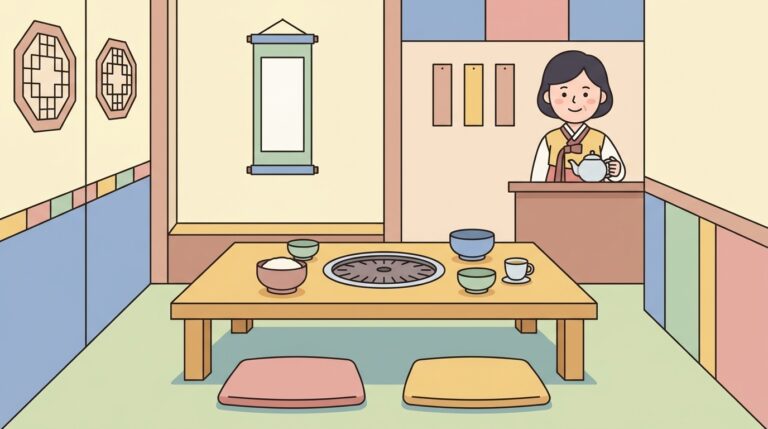
How to Call a Waiter in Korea Without Feeling Awkward: The Magic of Sajangnim and Imo
Phase 1: Empathy (Real-Life K-Dining Dilemma)
안녕하세요! This is your Daily Hangul editor and your 10-year local culture navigator.
Picture this: You are sitting in a sizzling, smoky K-BBQ joint in the heart of Seoul. The scent of caramelized pork belly fills the room, glasses are clinking, and laughter echoes across the tables. Your lettuce basket is completely empty, and you need garlic refills immediately. You want to catch a server’s eye.
Panic sets in. What do you yell?
Do you say “웨이터! (Weiteo! – Waiter!)” like in an old Western movie? Everyone at the next table might stop chewing and stare. Do you whisper “실례합니다 (Sillyehamnida – Excuse me)”? The sound will instantly vanish beneath the roar of bubbling stews and exhaust fans. We have all been there—frozen in our seats, raising our hand timidly like an anxious student in school, wondering if calling the middle-aged lady running the floor “이모 (Imo – Auntie)” sounds friendly or terribly offensive.
Over the past decade, hundreds of our intermediate learners have shared this exact dining pain point. Navigating titles in Korean dining is not just about vocabulary; it is about tuning into social warmth, hierarchy, and context. By the end of this guide, you will know exactly who to call, when to call them, and how to instantly unlock that extra, affectionate plate of complimentary side dishes.
Phase 2: Core 3 Expressions In-Depth
1. 사장님 (Sajangnim)
- Pronunciation:
[sa-jang-nim](Sounds like ‘sah-jahng-neem’; ‘sah’ as in safari, ‘jang’ as in jungle, and ‘neem’ like the tree)- Meaning: Literal: “Company President / Boss” | Real Nuance: The ultimate respectful, foolproof title for anyone working or managing a small business or restaurant.
- K-Culture Moment: Seen in nearly every workplace or food drama like Itaewon Class when patrons address Park Saeroyi or seasoned restaurant owners respectfully without knowing their exact rank.
- Editor’s Insight: You do not need to check their business registration card! Even if the person serving you is a floor manager or a part-timer in their 30s or 40s, elevating them to “Boss” flatters them and guarantees courteous service.
- Situation Spectrum: Casual ✅ | Semi-formal ✅ | Formal ✅ (Universal safe bet!)
- 🤔 Think About It: In English, calling your waiter “CEO” sounds sarcastic. Why does elevating someone’s social status in Korean culture show warmth rather than irony?
2. 이모 (Imo) / 이모님 (Imo-nim)
- Pronunciation:
[i-mo]/[i-mo-nim](Sounds like ‘ee-moh’ / ‘ee-moh-neem’; ‘ee’ as in sweet, ‘moh’ as in morning)- Meaning: Literal: “Maternal Aunt” | Real Nuance: A term of deep affection reserved exclusively for warm, middle-aged or older female staff in casual eateries.
- K-Culture Moment: In slice-of-life dramas like Hospital Playlist, the main characters sit in rustic pocha (tented street bars) shouting cheerfully, “이모, 소주 한 병 더 주세요! (Imo, soju han byeong deo juseyo! / Auntie, one more bottle of soju, please!)”.
- Editor’s Insight: Use this strictly in casual, neighborhood spots (like BBQ taverns, gukbap joints, or traditional markets). Adding -nim (
이모님) adds a layer of polite distance if you feel shy. Never use this for female staff in their 20s or in upscale dining!- Situation Spectrum: Casual ✅ | Semi-formal ⚠️ | Formal 🚫
- 🤔 Think About It: How does blurring the line between family kinship and customer service change the atmosphere of a dining room?
3. 저기요 (Jeogiyo)
- Pronunciation:
[jeo-gi-yo](Sounds like ‘juh-ghee-yoh’; ‘juh’ as in jug, ‘ghee’ as in clarified butter, ‘yoh’ as in yogurt)- Meaning: Literal: “Over there” | Real Nuance: “Excuse me (over there)!”
- K-Culture Moment: Every K-drama scene where a flustered protagonist needs the server’s attention right away without thinking about the person’s age or gender.
- Editor’s Insight: This is purely functional. While 사장님 and 이모 build emotional rapport, 저기요 is your clean, neutral tool to get someone’s attention when they are facing away from you or rushing past your table.
- Situation Spectrum: Casual ✅ | Semi-formal ✅ | Formal ⚠️
- 🤔 Think About It: Why does Korean rely on spatial words (“over there”) to address strangers instead of using personal pronouns like “you”?
Phase 3: Textbook Korean vs. Real Korean
Situation 1: Calling the floor server across a noisy room
- 📖 Textbook Korean: 웨이터님, 여기로 와 주시겠어요? (Weiteonim, yeogiro wa jusigesseoyo? / Mr. Waiter, could you please come over here?)
- 🗣️ Real Korean: 사장님, 여기 주문할게요! (Sajangnim, yeogi jumunhalke-yo! / Boss, we’re ready to order here!)
- 💡 Why is it different? Nobody uses the loanword 웨이터 (waiter) in modern Korean restaurants outside of 1980s luxury hotel restaurants. Calling someone 사장님 instantly sets a friendly, collaborative tone.
Situation 2: Asking for a free refill of side dishes (반찬)
- 📖 Textbook Korean: 반찬을 더 주실 수 있습니까? (Banchan-eul deo jusil su iss-seumnikka? / Is it possible to give me more side dishes?)
- 🗣️ Real Korean: 이모, 김치 조금만 더 주세요~ (Imo, gimchi jogeum-man deo juseyo~ / Auntie, just a little more kimchi, please~)
- 💡 Why is it different? Real Korean food culture thrives on warmth (정 – Jeong). Softening your request with 이모 and 조금만 (just a little) sounds humble and makes the server eager to heap your plate high with generous extras.
Phase 4: K-Culture Deep Dive & Non-Verbal Manners
4-1. 눈치 (Nunchi) & Gestures
Do not snap your fingers, wave your chopsticks, or hiss “pssst!” That is universally perceived as rude in Korea.
Instead, practice the “Half-Hand Raise & Eye Contact”: raise your right hand slightly (elbow resting near the table or bent at 90 degrees), lean forward slightly, and catch the server’s eye. If the room is noisy, project your voice with a bright, crisp pitch.
Pro-tip: Look at the edge of your table first! Modern Korean restaurants feature a small plastic button called a 호출벨 (hochulbel – call bell). If you see one, do not shout across the room. Simply press it once with a gentle touch. A pleasant chime (“Ding-dong!”) will sound, alerting the kitchen screen to your table number.
4-2. Cultural Code: The Kinship of “정 (Jeong)” in Food
Korea’s dining culture differs from Western transactional dining. Historically, local diners (기사식당 or neighborhood diners) were run by mothers feeding laborers and students. Calling a cook or server 이모 (Maternal Aunt) reflects the collective memory of maternal care. By invoking family terms, dining transitions from a cold financial transaction into communal nurturing.
Phase 5: Real-life Roleplay Scenario
Setting: Halmeoni Bada Galbi, an energetic, retro BBQ eatery tucked away in Euljiro, Seoul.
Characters:
* You: An intermediate Korean speaker enjoying grilled pork ribs with friends.
* Bok-sun (Auntie/Owner): A quick-witted, generous 55-year-old lady bustling between tables with charcoal grills.
- You: 🎭 (Raising your hand gently while making eye contact)
저기요, 사장님!
(Jeogiyo, sajangnim! / Excuse me, Boss!) -
Bok-sun: 🎭 (Approaching with a smile, wiping her hands on an apron)
네~ 주문하시겠어요?
(Ne~ jumunhasigesseoyo? / Yes~ would you like to order?) -
You: 🎭 (Pointing politely at the menu board)
여기 양념갈비 2인분하고 된장찌개 하나 주세요.
(Yeogi yangnyeom-galbi i-inbun-hago doenjang-jjigae hana juseyo. / Two servings of seasoned ribs and one soybean paste stew here, please.) -
Bok-sun: 🎭 (Nodding enthusiastically as she takes down notes)
알겠어요. 찌개에는 밥 하나 같이 나와요~
(Algesseoyo. Jjigae-eneun bap hana gachi nawayo~ / Got it. A bowl of rice comes with the stew~) -
You: 🎭 (Noticing an empty dipping sauce bowl ten minutes later)
이모님, 여기 양파 소스 좀 더 주실 수 있어요?
(Imo-nim, yeogi yangpa soseu jom deo jusil su isseoyo? / Auntie, could you give us a little more onion sauce here?) -
Bok-sun: 🎭 (Chuckling warmly at your friendly tone)
어머, 양파 아주 좋아하는구나! 듬뿍 갖다 줄게!
(Eomeo, yangpa aju joahaneunguna! Deumpuk gatda julge! / Oh my, you really like onions! I will bring you a generous bowl!) -
You: 🎭 (Bowing head slightly with both hands touching the table)
와, 감사합니다, 이모!
(Wa, gamsahamnida, imo! / Wow, thank you so much, Auntie!) -
Bok-sun: 🎭 (Placing an extra complimentary soda on the table)
맛있게 먹고 부족하면 또 말해~ 서비스야!
(Mas-itge meokgo bujokhamyeon tto malhae~ seobiseu-ya! / Enjoy your meal, and if you need more, just say so~ This soda is on the house!)
🔀 Interactive Decision Point
Suppose your server is a young man in his early 20s wearing a black apron. How should you get his attention?
- Choice A: Call out loudly: “이모, 여기 물 좀 주세요! (Imo, yeogi mul jom juseyo!)”
- Choice B: Raise your hand politely and say: “저기요, 여기 물 좀 부탁드려요! (Jeogiyo, yeogi mul jom butakdeuryeoyo!)”
- Choice C: Shout across the room: “야! 학생! (Ya! Haksaeng! / Hey! Student!)”
Feedback:
* Choice A (Risk): Calling a young male server 이모 (Maternal Aunt) will cause confusion and giggles across the restaurant!
* Choice B (Best!): 저기요 is gender-neutral, polite, and completely natural for younger staff or part-timers.
* Choice C (Bad!): 야 (Ya) is extremely rude and condescending. Never shout this at service staff under any circumstances.
Phase 6: 10-Second Emotion Shadowing Drill
Practice these natural cadences. The slash (/) marks a micro-pause for rhythm.
- [🙋 Confident & Polite Attention Grabbing]
저기요! / 사장님, / 여기 주문할게요!
(Jeogiyo! / Sajangnim, / yeogi jumunhalke-yo!) -
[🥺 Soft & Friendly Refill Request]
이모~ / 여기 김치 조금만 / 더 주실 수 있어요?
(Imo~ / yeogi gimchi jogeum-man / deo jusil su isseoyo?) -
[😊 Cheerful & Grateful Acknowledgment]
사장님, / 너무 맛있어요! / 잘 먹었습니다!
(Sajangnim, / neomu mas-isseoyo! / jal meogeosseumnida!)
Phase 7: K-Culture Mini Dictionary
- 사장님 (Sajangnim) | Boss / Proprietor | The gold standard honorific in commercial settings. Universally respectful when talking to business owners, taxi drivers, and shopkeepers.
- 이모 (Imo) | Auntie | Kinship term applied to middle-aged female staff in cozy eateries. Creates instant emotional warmth and invites friendly hospitality.
- 호출벨 (Hochulbel) | Table Call Bell | The electronic buzzer mounted on table corners in modern Korean eateries. Pressing this replaces vocal calling.
- 서비스 (Seobiseu) | Complimentary on-the-house item | Loanword from English “service,” but exclusively means free food or drinks given by generous owners to valued patrons.
Phase 8: Survival Kit for Travelers
Top 3 Survival Phrases
- 저기요, 주문할게요! (Jeogiyo, jumunhalke-yo!)
- Meaning: Excuse me, we are ready to order!
- Pro Tip: Keep your voice clear and crisp. Do not wait indefinitely for the server to approach your table first.
- 이모, 반찬 좀 더 주세요. (Imo, banchan jom deo juseyo.)
- Meaning: Auntie, please give us some more side dishes.
- Pro Tip: In Korea, all basic side dish refills are free! Feel free to ask, but only ask for what you can finish.
- 계산은 어디서 해요? (Gyesan-eun eodiseo haeyo?)
- Meaning: Where do we pay the bill?
- Pro Tip: In 95% of Korean casual restaurants, you do not pay at the dining table. Take your order receipt to the front register near the door.
Editor’s Travel Note
When hunting for authentic neighborhood eateries with warm 이모 owners, avoid reliance on global map apps that lack local updates. Instead, prepare by checking Naver Map app download to read authentic Korean customer reviews and discover hidden culinary gems. Remember: tipping is nonexistent in South Korea; a sincere “잘 먹었습니다! (Jal meogeosseumnida – I ate well!)” on your way out is the highest form of appreciation.
Phase 9: A Step Deeper (Reflective Essay)
In many Western cultures, dining is built around privacy and contractual boundaries; servers introduce themselves by name and maintain professional emotional distance. Korean dining, however, is an extension of the communal living room. By addressing restaurant staff as 사장님 (Boss) or 이모 (Auntie), Korean society transforms commercial spaces into networks of mutual respect and fictive kinship. Language here is not merely a tool for ordering calories—it is an instrument of 정 (Jeong), weaving temporary emotional bonds between hungry strangers.
💬 Your Turn: In your home country, how do you politely call a waiter without feeling awkward? Share your favorite dining stories in the comments below!
Phase 10: FAQ & Avoiding Misunderstandings
Q: Can I use “아줌마 (Ajumma)” instead of “이모 (Imo)”?
A: While 아줌마 (Ajumma) technically means a married middle-aged woman, it has developed a blunt, slightly dismissive connotation over recent decades. Never call your server 아줌마; it can easily offend them. Always stick to 사장님, 이모님, or 저기요.
Q: What should I call a young female server?
A: Do not use 이모. For younger staff (in their 20s or 30s), avoid guessing gendered or age-based titles altogether. Simply use 저기요! (Jeogiyo!) or press the table call bell.
Q: Can I call a male server “삼촌 (Samchon – Uncle)”?
A: While 삼촌 is occasionally used by young locals in market stalls or hip pubs, it is far less common and much trickier to pull off than 이모. For male staff, 사장님 or 저기요 is always the safer, more natural path.
🚨 Common Mistakes Warning Board
- Mistake: Snapping your fingers or whistling to call a server.
- Correct Action: Raise your hand politely at chest height and use 저기요 (Jeogiyo) or press the table bell.
- Mistake: Calling a 22-year-old university student working part-time 이모 (Imo).
- Correct Action: Use 저기요 (Jeogiyo) or 여기요 (Yeogiyo).
- Mistake: Sitting quietly for 20 minutes waiting for someone to bring you the check at the table.
- Correct Action: Pick up your clip-board bill from your table and head up to the register near the exit door.
Phase 11: Action Mission & Engagement
- 🥉 Bronze Level: Stand in front of your mirror and practice the phrase “사장님, 여기 주문할게요!” three times with a bright, friendly smile.
- 🥈 Silver Level: Share your favorite Korean comfort food on Instagram or Threads and caption it using the phrase “이모, 김치 더 주세요!”.
- 🥇 Gold Level: Visit a local Korean restaurant in your area. Without checking your phone, make eye contact with the server and confidently use 저기요 or 사장님 to order or ask for water!
- 🎮 K-Culture Mission: Watch the next episode of a K-drama set in a restaurant or pojangmacha (such as Weightlifting Fairy Kim Bok-joo or Mystic Pop-Up Bar). Listen closely and write down whether the characters shout 저기요, 사장님, or 이모!
Phase 12: Interactive Quiz Challenge
Test your real-world instincts with these three quick questions:
- Scenario Judgment: You are eating noodles at a traditional market stall run by an energetic 60-year-old woman. You want extra pickled radish. What is the warmest, most natural title to use?
- A) 웨이터 (Weiteo)
- B) 이모 (Imo)
- C) 아줌마 (Ajumma)
- D) 당신 (Dangsin)
- Fill-in-the-Blank: When you want to call a server politely across the room without referencing age or gender, you shout:
- “______, 여기 물 좀 주세요!”
- True or False: Calling a male owner 사장님 (Sajangnim) is inappropriate if his restaurant is very small and rustic.
- [ True / False ]
👉 Click to reveal answers & explanations!
-
Answer: B) 이모 (Imo)
Explanation: In traditional casual markets, 이모 is beloved and displays affectionate appreciation. 아줌마 sounds too cold and dismissive, while 당신 is inappropriate for strangers. -
Answer: 저기요 (Jeogiyo)
Explanation: 저기요 literally points “over there” and serves as the universal, polite “excuse me” for all restaurant scenarios. -
Answer: False
Explanation: In Korean culture, calling someone 사장님 (Boss/President) is flattering and respectful, regardless of whether they manage a multi-story BBQ palace or a tiny two-table noodle shop!







