

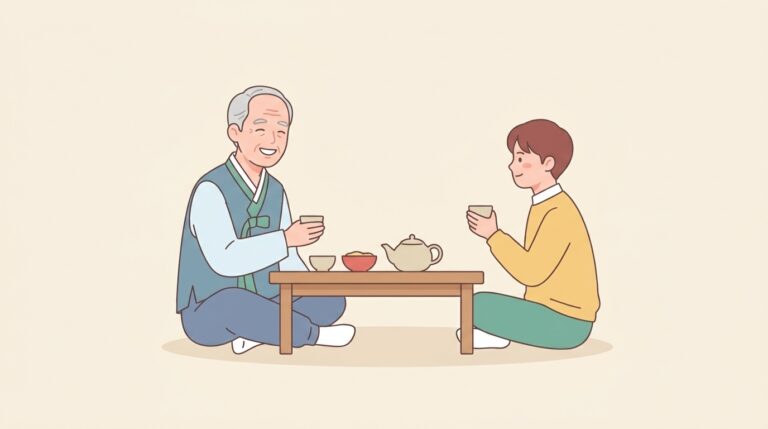
Phase 1: 공감 (Story-Driven Opening)
안녕하세요! 매일한글 에디터입니다.
Imagine this: You are spending Chuseok or a cozy weekend at your Korean friend’s home. The smell of savory jeon (pan-fried pancakes) fills the kitchen, and suddenly, their grandfather walks into the living room with warm, twinkling eyes. You smile brightly, bow, and confidently say the sentence you practiced all week from your basic vocabulary app: “할아버지, 밥 먹었어요?” (Harabeoji, bap meogeosseoyo? / Grandfather, did you eat rice?)
Instant freeze. Your friend’s eyes widen in silent panic, while Grandpa chuckles kindly to break the tension. You meant to be polite—after all, you added -yo at the end! But here is the secret most textbooks fail to warn you about: in Korean, simply adding -yo to everyday words is not always enough when speaking to the most respected pillars of the family. Korean has a special, elevated tier of honorific vocabulary specifically reserved for elders like grandparents.
Don’t worry—you are definitely not the first learner to mix this up! Every single beginner stumbles into the confusing maze of Korean honorifics (jondaetmal). This guide is built directly on real feedback and the most common “oops!” moments from hundreds of global learners just like you. By the end of this fun, friendly lesson, you’ll know exactly how to speak to Korean grandparents with natural confidence, warmth, and heartwarming politeness.
Phase 2: 핵심 표현 3선 심층 분석 (Top 3 Essential Expressions)
1. 진지 드셨어요? (Jinji deusyeosseoyo?)
- Pronunciation: [Jin-ji deu-syeo-ss-eo-yo?] (Think of “jin” like “gin” in a drink, and “ji” like “jeep” without the p; “deu” sounds like the first syllable of “dirt” without the r sound!)
- Meaning: Literal: “Did you have noble meal?” | Real Nuance: “Grandfather, have you eaten? / How was your meal?”
- K-Culture Moment: Seen in nearly every family K-Drama (like Reply 1988 or Once Again), where grandchildren greet their elders in the morning or upon returning from school.
- Editor’s Insight: For friends, food is 밥 (bap) and eating is 먹다 (meokda). But for elders, 밥 magically elevates to 진지 (jinji), and 먹다 becomes the respectful 드시다 (deusida). Using 진지 proves you truly understand Korean culture!
- Situation Spectrum: Casual 🚫 | Semi-formal ⚠️ | Formal & Elders ✅
- 🤔 Think About It: In English, we show respect by tone of voice. In Korean, the entire word changes! How does shifting an entire noun transform the way you show empathy to your elders?
2. 안녕히 주무셨어요? (Annyeonghi jumusyeosseoyo?)
- Pronunciation: [An-nyeong-hi ju-mu-syeo-ss-eo-yo?] (Flow smoothly: “ju-mu” sounds like “judo” and “music” combined!)
- Meaning: Literal: “Did you sleep in peace?” | Real Nuance: “Good morning, did you sleep well, Grandfather?”
- K-Culture Moment: Every morning in traditional Korean households, young family members bow lightly while greeting the oldest family member with this warm line.
- Editor’s Insight: Never say “잘 잤어요?” (Jal jasseoyo?) to a grandfather! The verb 자다 (jada / to sleep) changes to 주무시다 (jumusida). Pair this with a gentle 30-degree bow, and you will instantly earn grandparent praise.
- Situation Spectrum: Casual 🚫 | Semi-formal ⚠️ | Formal & Elders ✅
- 🤔 Think About It: Notice the root word 안녕 (peace/health). Why do you think Korean morning greetings center on asking if the night was peaceful?
3. 편찮으신 데는 없으세요? (Pyeonchaneusin deneun eopseuseyo?)
- Pronunciation: [Pyeon-chan-eu-sin de-neun eop-seu-se-yo?] (The “pyeon” sounds like “pure” blended with “fun”!)
- Meaning: Literal: “Is there no place feeling uncomfortable?” | Real Nuance: “How is your health feeling today? Are you feeling well?”
- K-Culture Moment: When adult grandchildren visit their ancestral hometowns (sigol) during holidays and check on their grandfather’s aching knees or overall health.
- Editor’s Insight: Rather than using the basic word 아프다 (apeuda / to hurt), Koreans use 편찮으시다 (pyeonchaneusida) for elders. It shows deep care and tenderness without sounding alarming.
- Situation Spectrum: Casual 🚫 | Semi-formal ⚠️ | Formal & Elders ✅
- 🤔 Think About It: Showing concern for an elder’s physical well-being is the ultimate love language in Korea. What is the equivalent greeting in your culture?
Phase 3: 교과서 한국어 vs 진짜 한국어 (Textbook vs. Real Korean)
Situation 1: Calling Grandfather to the dinner table
- 📖 교과서 한국어 (Textbook Korean): “할아버지, 식사를 하십시오.” (Harabeoji, siksareul hasipsio. / Grandfather, please conduct your dining.)
- 🗣️ 진짜 한국어 (Real Native Korean): “할아버지, 진지 드세요!” (Harabeoji, jinji deuseyo! / Grandfather, dinner is ready, please come eat!)
- 💡 Why is it different? The textbook phrasing sounds like an announcement made over an airport loudspeaker in the 1980s. Real families use warm, affectionate honorifics ending in -seyo rather than militaristic -sipsio.
Situation 2: Asking if Grandfather heard what you said
- 📖 교과서 한국어 (Textbook Korean): “제 말을 들었습니까?” (Je mareul deureotseumnikka? / Did you hear my words?)
- 🗣️ 진짜 한국어 (Real Native Korean): “할아버지, 제 말씀 들리세요?” (Harabeoji, je malsseum deulliseyo? / Grandfather, can you hear me okay?)
- 💡 Why is it different? Saying 제 말 (je mal) can feel blunt. In Korean, your own speech or an elder’s speech becomes 말씀 (malsseum) to soften the delivery, and asking if it sounds (들리세요) is much more polite than asking if they listened (들었습니까).
Phase 4: K-Culture 딥다이브 & 비언어적 매너 (Culture Deep Dive & Etiquette)
4-1. 눈치 (Nunchi) & Essential Gestures
Speaking the right words is only half the battle. Your body language must match your honorifics!
* Two Hands Rule (두 손 사용): Whenever you hand a cup of water, a snack, or a gift to Grandfather, always support your right forearm or wrist with your left hand, or hold the item with both hands. Handing something with one casual hand instantly cancels out polite words!
* Eye Contact & Angles: Never stare directly into an elder’s eyes unblinkingly—it can feel confrontational. Soften your gaze slightly toward their chin or upper collarbone, and tilt your upper torso forward in an attentive, respectful posture.
* Drinking Etiquette: If Grandfather offers you a sip of traditional tea or a beverage, turn your head slightly away from him while taking the drink.
4-2. The “Sigol Grandparent” Culture in K-Media
In shows like Hometown Cha-Cha-Cha or Our Blues, you notice how the entire community respects elderly village elders. Grandparents in Korea hold an honored social status as carriers of wisdom and resilience. When you address a grandfather using honorifics, you aren’t just following strict grammar; you are warmly acknowledging his lifelong contribution to his family.
Phase 5: 실전 롤플레이 시나리오 (Real-Life Roleplay Scenario)
Setting: It’s Sunday morning at a traditional tiled house (Hanok) in Jeonju. The sunlight streams onto the polished wooden floor. Grandfather (할아버지) sits on a cushion reading a morning paper.
Characters:
* You: Friendly international student visiting for the weekend.
* 할아버지 (Grandfather): Warm-hearted 78-year-old grandfather who loves traditional herbal tea.
Turn 1
할아버지 (Grandfather): 🎭 Folds his newspaper and looks up with a gentle smile.
“일찍 일어났구나. 어젯밤에 방은 안 추웠니?”
(Iljjik ireonatguna. Eojetbame bangeun an chuwonni?)
“You woke up early! Was the room not too cold last night?”
Turn 2
You: 🎭 Bowing slightly at a 30-degree angle with hands neatly clasped.
“네, 할아버지! 안녕히 주무셨어요? 방이 정말 따뜻했어요.”
(Ne, harabeoji! Annyeonghi jumusyeosseoyo? Bangi jeongmal ttatteuthaesseoyo.)
“Yes, Grandfather! Did you sleep peacefully? The room was very warm.”
Turn 3
할아버지 (Grandfather): 🎭 Nods approvingly, delighted by your greeting.
“그래, 푹 잤다니 다행이구나. 아침 생각은 좀 있니?”
(Geurae, puk jatdani dahaeng-iguna. Achim saenggakeun jom inni?)
“Good, I’m glad you slept deeply. Do you have any appetite for breakfast?”
Turn 4
You: 🎭 Smiling warmly while helping place tea cups onto the low table.
“네! 할아버지, 진지 드실 시간이에요. 제가 차 먼저 드릴게요.”
(Ne! Harabeoji, jinji deusil siganieyo. Jega cha meonjeo deurilgeyo.)
“Yes! Grandfather, it’s time for breakfast. Let me pour your tea first.”
Turn 5
할아버지 (Grandfather): 🎭 Touches his waist lightly with a quiet groan.
“아이고, 비가 오려나 허리가 조금 쑤시는구나.”
(Aigo, biga oryeona heoriga jogeum ssusineunguna.)
“Aigo, looks like rain is coming, my lower back is aching a bit.”
Turn 6
You: 🎭 Showing empathetic concern, stepping forward.
“할아버지, 많이 편찮으세요? 따뜻한 물 한 잔 더 가져다 드릴까요?”
(Harabeoji, mani pyeonchaneuseyo? Ttatteutan mul han jan deo gajyeoda deurilkkayo?)
“Grandfather, are you feeling very unwell? Shall I bring you another cup of warm water?”
Turn 7
할아버지 (Grandfather): 🎭 Chuckles warmly and pats your hand.
“아니다, 마음이 참 곱구나. 고맙다.”
(Anida, maeumi cham gopguna. Gomapda.)
“No, you have such a kind heart. Thank you.”
Turn 8
You: 🎭 Holding the teacup with both hands and placing it gently before him.
“별말씀을요, 할아버지. 맛있게 드세요!”
(Byeolmalsseumeullyo, harabeoji. Masitge deuseyo!)
“Don’t mention it, Grandfather. Please enjoy!”
🔀 Interactive Decision Point!
Grandfather reaches for a heavy kettle across the low wooden table. What do you do and say?
- Choice A: “내가 할게! 줘!” (Naega halge! Jwo! / I’ll do it! Give it to me!)
- Choice B: “할아버지, 제가 들겠습니다. 진지 드세요.” (Harabeoji, jega deulgetseumnida. Jinji deuseyo. / Grandfather, I will carry it. Please enjoy your meal.)
- Choice C: “소인이 받들어 모시겠사옵니다!” (Soin-i batdeureo mosigetssaopnida! / Your humble subject shall serve thee!)
Feedback:
* Choice A (Bad 🚫): This uses casual banmal! Even with good intentions, saying “줘!” sounds disrespectful to an elder.
* Choice B (Best ✅): Perfect! You used the humble subject pronoun 제가 (jega) and polite honorific phrasing. Grandfather will be beaming with pride.
* Choice C (Risk ⚠️): You sound like an extra in a Joseon Dynasty historical drama (sageuk)! While funny, it might confuse everyone at the breakfast table.
Phase 6: 10초 감정 섀도잉 드릴 (10-Second Emotion Shadowing Drill)
Practice these aloud! Pay attention to the pauses (/) and tap into the specific emotion indicator.
[😊 Warm and Respectful]
“할아버지, / 안녕히 / 주무셨어요?”
(Harabeoji, / annyeonghi / jumusyeosseoyo?)-
[🍱 Caring and Cheerful]
“진지 / 아직 안 드셨으면, / 같이 드세요!”
(Jinji / ajik an deusyeosseumyeon, / gachi deuseyo!) -
[🥺 Tender and Empathetic]
“할아버지, / 어디 / 편찮으신 데는 / 없으세요?”
(Harabeoji, / eodi / pyeonchaneusin deneun / eopseuseyo?) -
[🙏 Grateful and Modest]
“칭찬해 주셔서 / 감사해요, / 할아버지!”
(Chingchanhae jusyeoseo / gamsahaeyo, / harabeoji!)
Phase 7: K-Culture 미니 사전 (Mini Dictionary: 4 Essential Elder Words)
- 진지 (Jinji) | Elevated noun for Rice/Meal
Replaces regular 밥 (bap). Always use when asking an elder if they have eaten or when inviting them to breakfast/lunch/dinner. - 주무시다 (Jumusida) | Honorific verb for Sleep
Replaces regular 자다 (jada). Combine with 안녕히 (peacefully) for the classic good night and good morning greetings. - 연세 (Yeonse) | Honorific noun for Age
Replaces 나이 (nai). When respectfully asking an elder’s age, ask “연세가 어떻게 되세요?” (Yeonsega eotteoke doeseyo?) instead of “몇 살이에요?”. - 말씀 (Malsseum) | Honorific/Humble noun for Words/Speech
Can elevate an elder’s words (할아버지 말씀) or humbly downplay your own words (제 말씀).
Phase 8: 여행자를 위한 생존 키트 (Traveler’s Elder Etiquette Survival Kit)
Top 3 Survival Expressions for Interacting with Senior Citizens in Korea
- “먼저 앉으세요.” (Meonjeo anjeuseyo.)
Pro Tip: Use this on the Seoul subway when offering your seat to an elderly passenger. It means “Please sit first.” - “제가 도와드릴까요?” (Jega dowadeurilkkayo?)
Pro Tip: Use this if you see an elder carrying heavy grocery bags up subway stairs. It means “May I help you?” - “건강하세요!” (Geonganghaseyo!)
Pro Tip: The golden parting greeting when leaving a traditional shop or bidding farewell to an elder: “Please stay healthy!”
Editor’s Travel Note: Subway Courtesy & Transit Apps
When traveling on public transit in Korea, remember that the seats marked for the elderly at both ends of each train car are kept empty even if the train is completely crowded. Before boarding public transit, download the official navigation tools using this 네이버 지도 앱 다운로드 안내 (Naver Map App Download Guide) to find quiet routes and accessible elevators for traveling with older family members.
Phase 9: “한 발 더 깊이” (Food for Thought: Humanity & Honorifics)
Honorifics in the Korean language are not simply cold grammatical hurdles designed to test non-native speakers. Rather, they are linguistic mirrors reflecting centuries of communal care. When you swap 밥 for 진지, you are actively stepping outside of your own ego to carve out an elevated verbal space of honor for the person standing in front of you. It is a daily practice of empathy woven into everyday vowels and consonants.
💬 Your Turn: Does your native language have special ways to address grandparents or elders? Share your cultural traditions in the comments below!
Phase 10: FAQ & 오해 방지 (FAQ & Common Mistakes)
Q: What should I do if I accidentally say “밥 먹었어요?” to a Korean grandfather?
A: Don’t panic! Simply correct yourself with a gentle bow: “죄송합니다, 진지 드셨어요?” (Joesonghamnida, jinji deusyeosseoyo?). Korean elders adore international learners who make an effort and will smile at your earnestness.
Q: Can I use “진지 드셨어요?” to my boss at the office?
A: It’s technically grammatically respectful, but 진지 is usually reserved for true elders (grandparents, senior citizens aged 65+). For a corporate boss in their 40s or 50s, say “식사하셨어요?” (Siksahasyeosseoyo?) instead.
Q: Can I call an elderly man on the street “할아버지”?
A: Yes! If they are of grandparent age, addressing them as “할아버지” (Harabeoji) or an elderly woman as “할머니” (Halmeoni) is common, friendly, and affectionate in Korean society.
🚨 Common Mistakes Warning Board
| Mistake | Why it hurts | Correct Action |
|---|---|---|
| Saying “잘 잤어요?” to Grandfather | Too casual; treats an elder like a college roommate | Say “안녕히 주무셨어요?” (Annyeonghi jumusyeosseoyo?) |
| Handing tea with only one hand | Perceived as dismissive or lazy | Hold the cup with both hands or support your right wrist |
| Using “나이” to ask Grandfather’s age | Sounds blunt and overly direct | Ask “연세가 어떻게 되세요?” (Yeonsega eotteoke doeseyo?) |
Phase 11: 액션 미션 & 참여 유도 (Action Missions)
- 🥉 Bronze Mission (Solo Practice): Stand in front of your mirror and practice saying “할아버지, 진지 드셨어요?” three times with a genuine smile and a gentle bow.
- 🥈 Silver Mission (Social Share): Record your voice saying “안녕히 주무셨어요?” on your Instagram story or study journal and tag
@DailyHangulfor personalized pronunciation feedback! - 🥇 Gold Mission (Real Life): Next time you visit a traditional Korean market or restaurant run by elderly shopkeepers, greet them with “안녕하세요, 건강하세요!”.
- 🎮 K-Culture Treasure Hunt: Watch one episode of a slice-of-life K-Drama (like Hospital Playlist or Our Blues). Catch the exact moment a younger character hands something to an elder using two hands and comment with the timestamp below!
Phase 12: 인터랙티브 퀴즈 챌린지 (Interactive Quiz Challenge)
Q1. [Situation Judgement] You walk into the kitchen at 8:00 AM and see your homestay grandfather brewing barley tea. What is the most natural greeting?
1. 할아버지, 잘 잤니? (Harabeoji, jal janni?)
2. 할아버지, 안녕히 주무셨어요? (Harabeoji, annyeonghi jumusyeosseoyo?)
3. 할아버지, 밥 먹으러 가자. (Harabeoji, bap meogeureo gaja.)
Q2. [Fill-in-the-Blank] Complete the sentence with the respectful term for meal:
* “할아버지, _____ 드실 시간이에요.” (Harabeoji, _____ deusil siganieyo.)
Q3. [True or False] When pouring a drink for Grandfather, it is acceptable to use only your right hand as long as you say “감사합니다”. (True / False)
👉 Click to reveal answers & explanations!
- Q1 Answer: 2. “안녕히 주무셨어요?” is the gold-standard respectful morning greeting for grandparents.
- Q2 Answer: 진지 (Jinji). For grandparents, regular 밥 (bap) changes to the elevated noun 진지.
- Q3 Answer: False! Physical etiquette matters just as much as speech. Always support your arm or use both hands when serving an elder.






