

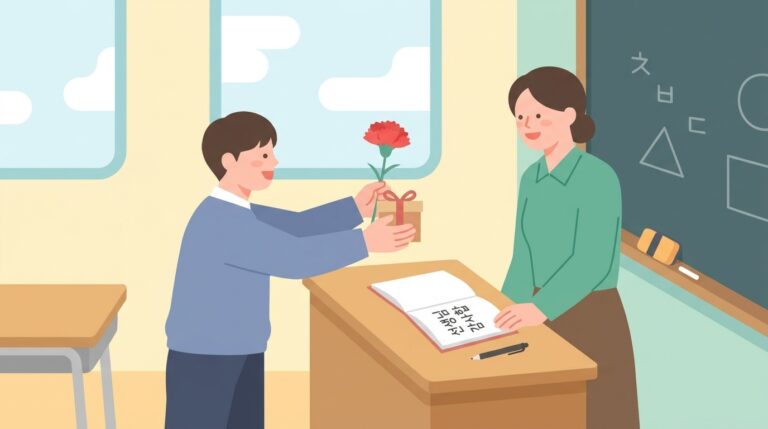
Phase 1: 공감 (Story-Driven Opening)
안녕하세요! 매일한글 에디터입니다. Have you ever stood in front of a stationery shelf in Seoul, clutching a red carnation flower and wondering, “What on earth do I say to my Korean teacher without sounding awkward or too casual?” You are definitely not alone. In K-Dramas like Crash Landing on You or Hospital Playlist, you often see warm moments where characters exchange gifts with deep bowing, two hands, and bashful smiles. But in real life, Teacher’s Day in Korea (스승의 날 – May 15) can feel like an etiquette minefield for beginners.
Many of our absolute beginner students at Daily Hangul ask: “Can I buy a fancy perfume? Do I just say ‘Gamsahamnida’?” Don’t worry! Gifting in Korea isn’t about expensive items; it’s about the warmth of your heart and showing sincere respect through natural language and polite manners. Today, we will unlock the sweetest, easiest beginner phrases and cultural tips so you can express your gratitude like a confident local.
Phase 2: 핵심 표현 3선 심층 분석 (Core Expressions Deep Dive)
1. 선생님, 감사합니다! (Seonsaengnim, gamsahamnida!)
- Pronunciation: [Seon-saeng-nim, gahm-sah-hahm-nee-dah] (Sounds like “Sun-sang-neem, gahm-sah-hahm-nee-dah”)
- Meaning: Literal: “Teacher, thank you!” | Nuance: The most heartfelt, golden standard way to say thank you to any instructor.
- K-Culture Moment: You hear this in nearly every high school drama when students surprise their favorite teacher with a chalkboard message and a cake.
- Editor’s Insight: Always attach 님 (nim) to 선생 (seonsaeng). Calling your teacher just “선생” sounds rude. The suffix “-nim” shows respect and honor.
- Situation Spectrum: Casual: 🚫 | Semi-formal: ⚠️ | Formal: ✅
- 🤔 Think About It: In English, we call teachers “Mr. Smith” or “Ms. Jane.” Why does Korean use the title “선생님” as both a job title and a direct form of address?
2. 작은 선물이에요. (Jageun seonmul-ieyo.)
- Pronunciation: [Jah-geun seon-mool-ee-eh-yo] (Sounds like “Jah-goon sun-mool-ee-eh-yo”)
- Meaning: Literal: “It is a small gift.” | Nuance: “Here is a humble token of my appreciation; please don’t feel burdened!”
- K-Culture Moment: A common scene in office dramas where a junior shyly hands a warm canned coffee or hand cream to their mentor.
- Editor’s Insight: Korean etiquette prizes modesty. Even if you spent hours picking out the best gift box, downplaying it as “작은 (small)” protects the receiver from feeling awkward or indebted.
- Situation Spectrum: Casual: ⚠️ | Semi-formal: ✅ | Formal: ✅
- 🤔 Think About It: Why is it considered polite in Korea to call your gift “small” rather than bragging about how special or expensive it is?
3. 항상 감사드려요. (Hangsang gamsadeuryeoyo.)
- Pronunciation: [Hahng-sahng gahm-sah-deu-ryeo-yo] (Sounds like “Hahng-sahng gahm-sah-doo-ryuh-yo”)
- Meaning: Literal: “I always offer my thanks.” | Nuance: “Thank you always for your continuous support and teaching.”
- K-Culture Moment: Written inside handwritten greeting cards or said by idols to their vocal/dance coaches during year-end ceremonies.
- Editor’s Insight: 항상 (hangsang) means “always,” and 감사드려요 (gamsadeuryeoyo) uses the humble verb form 드리다 (deurida) to humbly present your gratitude upwards.
- Situation Spectrum: Casual: 🚫 | Semi-formal: ✅ | Formal: ✅
- 🤔 Think About It: How does saying “always grateful” build a warmer ongoing relationship compared to just saying “thank you” once?
Phase 3: 교과서 한국어 vs 진짜 한국어 (Textbook vs Real Korean)
Situation 1: Presenting your gift
- 📖 교과서 한국어: 이것을 받으십시오. (Igeoseul badeusipsio. / Please accept this object.)
- 🗣️ 진짜 한국어: 선생님, 이거 받으세요! (Seonsaengnim, igeo badeuseyo! / Teacher, please take this!)
- 💡 왜 다를까?: “받으십시오” sounds like an ancient king’s command in a historical drama! Real modern speakers use the polite, friendly ending -세요 (-seyo) with warm eye contact.
Situation 2: Expressing your sincere feelings
- 📖 교과서 한국어: 스승의 은혜에 깊이 감사드립니다. (Seuseung-ui eunhye-e gipi gamsadeurimnida. / I deeply thank you for the teacher’s benevolence.)
- 🗣️ 진짜 한국어: 선생님, 늘 감사해요! (Seonsaengnim, neul gamsahaeyo! / Teacher, thank you always!)
- 💡 왜 다를까?: While the textbook line is sung in formal school anthems, saying it in person sounds overly theatrical. “늘 감사해요” is sweet, natural, and memorable.
Phase 4: K-Culture 딥다이브 & 비언어적 매너 (Culture Deep Dive & Non-Verbal Manners)
4-1. 눈치 (Nunchi) & Body Gestures
- Two Hands Are Mandatory (두 손): When handing your gift or card, hold it with both hands. If one hand is holding the gift, place your other hand lightly under your wrist or forearm. Handing things with one single hand looks dismissive!
- The Sincere 15-Degree Bow: Don’t just stand upright. Slightly bow your head and shoulders (about 15 degrees) as you hand over the item.
- Soft Eye Contact: Look at your teacher with a warm smile, bow briefly, then gently raise your eyes. Avoid an intense, unblinking stare.
4-2. Culture Code: Carnations & The Anti-Graft Law (김영란법)
In Korea, 스승의 날 (May 15) is symbolized by red carnations (카네이션). However, you should know about the Kim Young-ran Act (김영란법): public school teachers and university professors are legally prohibited from accepting valuable gifts! Because of this law, lavish presents can cause legal headaches. What do Korean teachers cherish most? A single red carnation, a cup of coffee, or—best of all—a sincere handwritten letter (손편지)!
Phase 5: 실전 롤플레이 시나리오 (Real-Life Roleplay Scenario)
Setting: A quiet Korean language institute (어학당) classroom in Sinchon, Seoul. Sunlight streams onto the wooden desks. Teacher Min-ji is packing up her lesson materials.
Character: Min-ji Seonsaengnim (민지 선생님) – Warm, encouraging tutor with kind eyes.
- You: 선생님, 수업 끝났어요? (Seonsaengnim, sueop kkeutnasseyo?) – [Teacher, is class finished?]
🎭 Hands hidden behind your back with a shy smile - Min-ji: 네! 오늘 공부하느라 수고 많았어요. (Ne! Oneul gongbuhaneura sugo manasseoyo.) – [Yes! Great job studying today.]
🎭 Smiling warmly while closing her textbook - You: 선생님, 잠시만요! 작은 선물이에요. (Seonsaengnim, jamsimanyo! Jageun seonmul-ieyo.) – [Teacher, just a moment! It’s a small gift.]
🎭 Bringing out a small paper bag holding it with both hands - Min-ji: 어머, 정말요? 이런 거 안 주셔도 되는데! (Eomeo, jeongmalyo? Ireon geo an jusyeodo doeneunde!) – [Oh my, really? You really didn’t need to give me this!]
🎭 Surprised look, placing one hand over her chest - You: 스승의 날이잖아요. 이거 받으세요! (Seuseung-ui narijanayo. Igeo badeuseyo!) – [It’s Teacher’s Day, you know. Please take this!]
🎭 Offering the bag forward with a gentle bow - Min-ji: 와, 예쁜 텀블러네요! 정말 고마워요. (Wa, yeppeun teombeulleoneyo! Jeongmal gomawoyo.) – [Wow, what a pretty tumbler! Thank you so much.]
🎭 Taking the bag with both hands and beaming with joy - You: 항상 잘 가르쳐 주셔서 감사해요. (Hangsang jal gareuchyeo jusyeoseo gamsahaeyo.) – [Thank you always for teaching me so well.]
🎭 Looking proud and happy - Min-ji: 감동이에요. 앞으로도 우리 열심히 공부해요! (Gamdong-ieyo. Apeurodo uri yeolsimhi gongbuhaeyo!) – [I’m so touched. Let’s keep studying hard together!]
🎭 Giving you an encouraging double thumbs-up
🔀 인터랙티브 분기점 (Interactive Choice Point)
When Teacher Min-ji says, “You really didn’t need to give me this!” (이런 거 안 주셔도 되는데!), how should you respond?
- Choice A: “비싸니까 꼭 쓰세요!” (Bissanikka kkok sseuseyo! / It was expensive, so make sure to use it!)
- Result (Bad): 🚫 Mentioning the price makes the teacher feel burdened (부담) and creates uncomfortable tension!
- Choice B: “별거 아니에요. 약소해요.” (Byeolgeo anieyo. Yaksoshaeyo. / It’s really nothing. It’s very humble.)
- Result (Risk): ⚠️ Grammatically correct, but “약소해요” sounds like an elderly businessman talking. A bit stiff for A1 learners.
- Choice C: “제 마음이에요. 맛있게 드세요/잘 쓰세요!” (Je maeum-ieyo. Mas-itge deuseyo/Jal sseuseyo! / It’s my heart. Please enjoy it!)
- Result (Best): ✅ Perfect! “제 마음이에요” (It’s a piece of my heart) melts every Korean teacher’s heart instantly.
Phase 6: 10초 감정 섀도잉 드릴 (10-Second Emotion Shadowing Drill)
Practice these three lines out loud! Follow the rhythm pauses (/) and mirror the emotion.
[🌸 Shy but proud]
선생님, / 작은 선물이에요. / 받아주세요!
(Seonsaengnim, / jageun seonmul-ieyo. / bada-juseyo!)
“Teacher, / it’s a small gift. / Please accept it!”-
[😊 Pure warmth and respect]
항상 / 잘 가르쳐 주셔서 / 정말 감사해요.
(Hangsang / jal gareuchyeo jusyeoseo / jeongmal gamsahaeyo.)
“Thank you / so much / for always teaching me well.” -
[💖 Sincere and heartfelt]
제 마음이에요. / 선생님, 사랑해요!
(Je maeum-ieyo. / Seonsaengnim, saranghaeyo!)
“It’s from my heart. / Teacher, I love you!”
Phase 7: K-Culture 미니 사전 (Mini Dictionary)
- 스승의 날 (Seuseung-ui nal) | Teacher’s Day (May 15th)
- Everyday Use: The national celebration honoring educators, established on King Sejong the Great’s birthday!
- 카네이션 (Kaneisyeon) | Carnation Flower
- Everyday Use: The customary red flower given to both parents (Parents’ Day, May 8) and teachers (May 15).
- 손편지 (Son-pyeonji) | Handwritten letter
- Everyday Use: Handwritten notes in pretty stationery cards are considered 100x more valuable than expensive bought gifts.
- 부담 (Budam) | Burden / Pressure
- Everyday Use: In Korean social life, giving something too grand creates “부담” because the receiver feels obligated to return something equally grand.
Phase 8: 여행자를 위한 생존 키트 (Survival Kit for Visitors & Students)
서바이벌 표현 TOP 3 (Survival Phrases)
- 선물 포장해 주세요. (Seonmul pojang-hae juseyo.) – “Please gift-wrap this.”
- Pro Tip: Department stores and bakeries will ask: “선물용이세요?” (Is this a gift?). Just say: “네, 포장해 주세요!”
- 메시지 카드 있어요? (Meseji kadeu isseoyo?) – “Do you have a message card?”
- Pro Tip: Pop into any stationery shop to grab a 1,000 KRW mini-card to tuck inside your bag.
- 추천해 주실 수 있어요? (Chucheon-hae jusil su isseoyo?) – “Could you recommend something?”
- Pro Tip: When in a tea shop like Osulloc or a bakery, use this to find the most popular gift set.
Editor’s Travel Note 💡
If you want to buy an affordable, culturally appropriate gift for your Korean tutor, visit 다이소 매장 찾기 for charming carnation brooches and thank-you cards. If you study online, use KakaoTalk’s gift feature (카카오톡 선물하기) to send a simple 5,000 KRW iced Americano coupon!
Phase 9: “한 발 더 깊이” (Thinking Question)
In traditional Korean culture, there is an old saying: “군사부일체 (Gun-sa-bu-il-che),” meaning the king, the teacher, and one’s parents hold equal respect. While modern Korea is much more relaxed and democratic, teachers are still viewed not just as service providers, but as personal life mentors. Because of this, exchanging gifts is less of a commercial transaction and more of a reciprocal bond of gratitude (정 – Jeong).
💬 Your Turn: How do people in your home country express gratitude to teachers? Do you celebrate a Teacher’s Day with gifts, or do you prefer simple words? Share your story in the comments below!
Phase 10: FAQ & 오해 방지 (FAQ & Common Mistakes)
Q: Can I give money or a gift card to my Korean teacher?
A: Avoid giving cash envelopes! Giving raw cash to an educator can feel overly transactional and, in many schools, breaches anti-graft ethics. Instead, stick to a handwritten card, tea, cookies, or a warm cup of coffee.
Q: Is Teacher’s Day a national public holiday in Korea?
A: No, Teacher’s Day (May 15) is an official commemorative day, but schools and businesses remain open. In fact, many classrooms hold mini surprise parties right before the first morning class begins!
Q: What should I write inside a Teacher’s Day card as a beginner?
A: Keep it short and sweet! Write: “선생님, 감사합니다. 건강하세요!” (Teacher, thank you. Please stay healthy!). This is natural, polite, and deeply touching.
🚨 흔한 실수 (Common Mistakes) 경고판
- Calling your teacher by their first name: Calling your teacher “민지야” or “민지 씨” is a major social blunder. Always say “민지 선생님” or simply “선생님”.
- Handing gifts with one single hand: Even if you say the sweetest words, one-handed delivery gives an impression of arrogance. Always support your arm with both hands!
- Overthinking the gift value: Spending 100,000 KRW on luxury perfume will only stress out your teacher. A sincere 2,000 KRW note and a sweet snack is the gold standard.
Phase 11: 액션 미션 & 참여 유도 (Action Missions)
- 🥉 Bronze Mission (Solo): Stand in front of your mirror, hold a book with both hands, bow 15 degrees, and say: “선생님, 작은 선물이에요!” 3 times.
- 🥈 Silver Mission (Social): Write a one-line Korean thank-you note in your notebook (“선생님 늘 감사합니다!”), snap a photo, and post it to Instagram or your study tracker.
- 🥇 Gold Mission (Real Life): On your next lesson or May 15, surprise your Korean tutor with a digital coffee voucher or card and say: “선생님, 제 마음이에요!”
🎮 K-Culture Mission: Watch any school-themed K-drama (like Reply 1997 or True Beauty). Watch how students address their teachers when walking into the faculty room!
Phase 12: 인터랙티브 퀴즈 챌린지 (Interactive Quiz Challenge)
1. Situation Quiz:
You prepared a box of cookies for your teacher. As you hand it over, what should you do with your hands?
* A) Put one hand casually in your pocket.
* B) Hold the box with both hands and slightly bow your head.
* C) Toss it playfully onto the teacher’s desk.
2. Fill-in-the-Blank:
선생님, 이거 ________! (Teacher, please accept this!)
* A) 먹어라 (meogeora)
* B) 받으세요 (badeuseyo)
* C) 가세요 (gaseyo)
3. True or False:
Korean teachers expect expensive branded gifts like designer bags on Teacher’s Day.
* [ True / False ]
👉 Click here to check your answers and explanations!
- Answer: B – In Korean etiquette, using both hands is the golden rule of respect!
- Answer: B (받으세요) – “받으세요” is the polite request form for “please take/accept this.”
- Answer: False – Expensive gifts burden teachers due to the Kim Young-ran anti-corruption law. Modest gifts and sincere handwritten notes (손편지) are preferred!







