

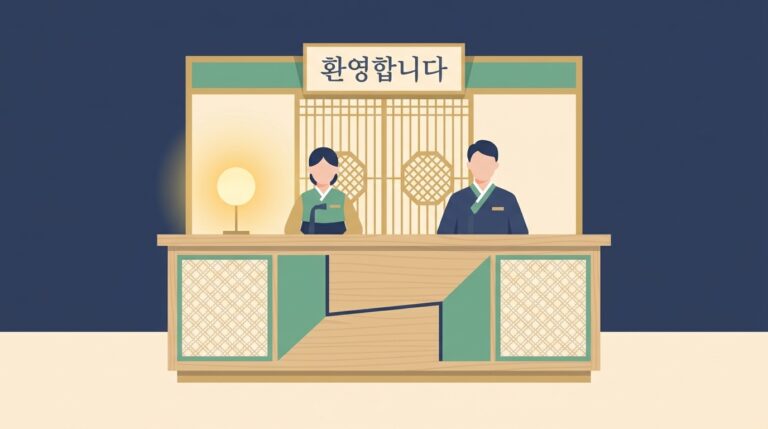
Decoding Korean Hospitality: How True Service Mind Shapes High-End Travel in Korea
Phase 1: Empathy (Story Immersion Opening)
안녕하세요! 매일한글 에디터입니다. (Hello! This is your Daily Hangul editor.)
If you have ever watched the K-drama King the Land or stepped into a Michelin-starred hanok dining lounge in Bukchon, you have likely sensed something uncanny about high-end Korean hospitality. It is not merely polite; it is anticipatory, almost psychic. The staff bows at a crisp 45-degree angle, holds credit cards with both hands as if offering sacred relics, and delivers sentences layered with so many nested honorific suffixes that even advanced learners can freeze mid-sentence.
Many of our C1 learners tell us: “I know all the standard grammar rules, but when Korean luxury concierges or flight attendants speak to me, their words feel like an entirely different dialect of Korean!” That is because Korea’s hospitality industry relies on a deep-seated cultural ethos known as 서비스 마인드 (Service Mind)—a philosophy rooted in utmost deference (geuk-jon-ching), profound situational intuition (nunchi), and an unwavering devotion (jeongseong) to guest comfort. Today’s guide will decode these high-level linguistic nuances, giving you the cultural keys to navigate, appreciate, and communicate within Korea’s luxury tourism ecosystem effortlessly.
Phase 2: Top 3 Core Expressions (In-Depth Analysis)
1. 편히 쉬어가실 수 있도록 정성을 다해 모시겠습니다 (Pyeonhi swieogasul su itdorok jeongseongeul dahae mosigessseumnida)
- Pronunciation: [Pyeon-hee she-eo-ga-sheel soo eet-do-rok jeong-seong-eul da-hae mo-she-get-seum-nee-da] (Think of ‘Pyeonhi’ like ‘pyun-he’, gliding smoothly into ‘mosigessseumnida’ like a gentle river.)
- Meaning: Literal: “I will serve you with all my sincere devotion so that you can rest comfortably.” / Nuanced: “Consider our establishment entirely at your disposal; your complete peace of mind is our highest duty.”
- K-Culture Moment: The iconic welcome line spoken by luxury hotel hoteliers or traditional ryokan/hanok hosts as they guide VIP guests into their private pavilions.
- Editor’s Insight: Notice the humble verb 모시다 (mosida) instead of 안내하다 (annaehada) or 돌보다 (dolboda). Combining it with 정성을 다해 (with all one’s heart and devotion) immediately elevates the service relationship from a commercial transaction to an honorable guest-host bond.
- Situation Spectrum: Casual 🚫 | Semi-formal ⚠️ | Formal ✅
- 🤔 Think About It: In Western hospitality, equality between server and customer is often preserved with friendly banter. Why does high-end Korean culture view extreme linguistic humility not as subservience, but as the pinnacle of professional elegance?
2. 불편하신 점은 없으셨습니까? (Bulpyeonhasin jeomeun eopseosyeossseumnikka?)
- Pronunciation: [Bool-pyeon-ha-shin jeom-eun eop-seo-syeot-seum-nee-kka?] (Resembles a soft, rising query: ‘Bool-pyun-ha-sheen’ followed by a crisp ‘eop-seo-syeot-seum-nee-kka’.)
- Meaning: Literal: “Were there any uncomfortable points?” / Nuanced: “Did everything meet your standards, or is there any subtle discomfort we should rectify immediately?”
- K-Culture Moment: Addressed to guests upon checkout in luxury properties or during mid-meal check-ins at fine dining venues.
- Editor’s Insight: Rather than asking “Was everything good?” (좋으셨어요?), Korean hospitality reflexively inquires about discomfort (불편). This reflects the proactive duty to eradicate even the slightest inconvenience before the guest feels forced to complain.
- Situation Spectrum: Casual 🚫 | Semi-formal ⚠️ | Formal ✅
- 🤔 Think About It: How does phrasing a feedback inquiry around ‘preventing discomfort’ alter the guest’s willingness to share candid, constructive feedback?
3. 세심하게 살펴드리지 못해 송구합니다 (Sesimhage salpyeodeuriji motae songguhamnida)
- Pronunciation: [Se-shim-ha-ge sal-pyeo-deu-ree-jee mo-tae song-goo-ham-nee-da] (The word ‘song-goo’ resonates in the back of the throat like an earnest bow.)
- Meaning: Literal: “I feel deep remorse for not having looked after you with minute detail.” / Nuanced: “I sincerely apologize for overlooking this subtle detail; you deserved our full attention.”
- K-Culture Moment: Spoken by high-ranking concierges or managers when resolving a service hiccup, such as a delayed luggage delivery or a booking misunderstanding.
- Editor’s Insight: 송구합니다 (songguhamnida) is leagues above 죄송합니다 (joesonghamnida) in gravitas. It comes from historical court speech expressing genuine humility. Using 세심하게 살펴드리다 (to watch over meticulously) shows the staff takes full accountability for lacking nunchi.
- Situation Spectrum: Casual 🚫 | Semi-formal 🚫 | Formal ✅
- 🤔 Think About It: In your culture, does an apology imply legal or financial liability? Notice how in Korea, emotional restoration (weon-sang-bok-gu) comes first through heartfelt vocabulary.
Phase 3: Textbook Korean vs. Real-World Korean
Situation A: Offering assistance at an upscale service desk
- 📖 교과서 한국어 (Textbook): 무엇을 도와드릴까요? (Mueoseul dowadeurilkkayo? – “What can I help you with?”)
- 🗣️ 진짜 한국어 (Real-World High-End): 어떤 점을 더 편안하게 챙겨드릴까요? (Eotteon jeomeul deo pyeon-an-hage chaenggyeodeurilkkayo? – “In what manner may we look after your comfort further?”)
- 💡 왜 다를까? (Why the difference?): While 도와드릴까요 is grammatically sound, it frames the guest as someone in need of generic “help.” Top-tier hospitality prefers verbs like 챙겨드리다 (to meticulously attend to / take care of), implying anticipatory pampering.
Situation B: Acknowledging a guest’s waiting time
- 📖 교과서 한국어 (Textbook): 오래 기다렸습니다. 죄송합니다. (Orae gidaryeosseumnida. Joesonghamnida. – “You waited long. I am sorry.”)
- 🗣️ 진짜 한국어 (Real-World High-End): 귀한 시간 내어 기다려 주셔서 진심으로 감사드립니다. (Gwihan sigan naeeo gidaryeo jusyeoseo jinsimeuro gamsadeurimnida. – “Thank you wholeheartedly for dedicating your precious time to wait for us.”)
- 💡 왜 다를까? (Why the difference?): Professional customer service reframes unavoidable delays positively. By honoring the guest’s time as 귀한 시간 (precious time), the encounter transforms from an operational failure into a mutual gesture of respect.
Phase 4: K-Culture Deep Dive & Non-Verbal Etiquette
4-1. 눈치 (Nunchi) & Non-Verbal Gestures
In Korean hospitality, language accounts for only half of the message. The non-verbal choreography—grounded in gongson-han jase (humble posture)—is vital:
* The Two-Handed Handover: Never hand over a room key, passport, or credit card with one hand. Always support your right wrist or forearm with your left hand, or hold the object symmetrically with both hands with a slight torso bow.
* The Deferential Gaze (시선 처리): Direct, unblinking eye contact in Korean service contexts can feel confrontational. Experienced professionals direct their gaze toward the guest’s tie knot or collarbone, raising their eyes respectfully when speaking.
* Step-Back Farewell: When exiting a private dining room (room-ssik), staff rarely turn their backs immediately. They take one step backward before rotating their body.
4-2. Cultural Code Analysis: The Drama vs. Reality of “사물존칭” (Object Honorifics)
If you watch hotel K-dramas like Hotel Del Luna or modern corporate tourism series, you will hear staff say phrases like:
“커피 나오셨습니다” (The coffee has arrived / The coffee is honored)
“이 상품은 품절이십니다” (This product is out of stock / The item is honored)
Linguistically, this is grammatically incorrect—known as 사물존칭 (honoring inanimate objects). The National Institute of Korean Language consistently advises against it because inanimate objects cannot receive the honorific infix -시- (-si-). However, within Korea’s hyper-competitive tourism and service industry, staff fear that omitting -시- might make them sound blunt or cold to discerning guests. Understanding this tension is a hallmark of C1 mastery: know why it happens, recognize it instantly, but avoid using it yourself when speaking.
Phase 5: Real-World Roleplay Scenario
Setting: The concierge lounge of Suhrak Pavilion, a boutique heritage hotel in Gyeongju.
Characters:
* 민준 (Min-jun): The lead concierge, polished and intuitive.
* Elena (You): An experienced traveler seeking an exclusive sunrise tour of Bulguksa temple.
민준: 안녕하십니까, 엘레나 고객님. 오늘 여정은 피곤하지 않으셨습니까?
(Annyeonghasimnikka, Elena gogaeknim. Oneul yeojeongeun pigonhaji aneosyeosseumnikka?)
“Good afternoon, Ms. Elena. Was your journey today comfortable and not overly tiring?”
🎭 Gently clasping hands in front and bowing slightly
Elena: 네, 기차 안이 쾌적해서 편안히 잘 왔어요. 매니저님 배려 덕분이에요.
(Ne, gicha ani kwoejeokhaeseo pyeon-an-hi jal wasseoyo. Maenijeonim baeryeo deokbunieyo.)
“Yes, the train was pleasant and comfortable. It’s thanks to your thoughtful arrangements, Manager.”
🎭 Offering a warm, appreciative smile
민준: 다행입니다. 요청하셨던 불국사 일출 프라이빗 투어는 준비를 마쳐 두었습니다.
(Dahaeng-imnida. Yocheonghasyeotdeon Bulguksa ilchul peuraibit tueoneun junbireul machyeo dueosseumnida.)
“That is wonderful to hear. We have finalized all arrangements for the private sunrise tour of Bulguksa that you requested.”
🎭 Presenting the itinerary printed on traditional Hanji paper with both hands
Elena: 와, 정말 신경 써 주셨네요. 혹시 아침 일찍 이동할 때 차내 다도(茶道) 준비도 가능할까요?
(Wa, jeongmal singyeong sseo jusyeonneyo. Hoksi achim iljjik idonghal ttae chanae dado junbido ganeunghalkkayo?)
“Wow, you paid such close attention. Would it be possible to arrange a tea tasting setup inside the vehicle during the early morning drive?”
🎭 Inquiring with a modest, gentle head tilt
민준: 고객님의 기대를 온전히 헤아려 미리 보온 다기 세트를 차량에 구비해 두었습니다.
(Gogaeknim-ui gidaereul onjeonhi he-aryeo miri boon dagi seteureul charyang-e gubihae dueosseumnida.)
“Anticipating your refined taste, we have already prepared an insulated tea-ware set inside the car.”
🎭 Nodding with calm assurance
Elena: 역시 기대를 저버리지 않으시네요. 세심한 환대에 감사드립니다.
(Yeoksi gidaereul jeobeoriji aneushineyyo. Sesimhan hwandae-e gamsadeurimnida.)
“As expected, you never fail to impress. Thank you sincerely for your exquisite hospitality.”
🎭 Giving an affirming nod
민준: 과찬이십니다. 머무시는 동안 작은 불편도 없으시도록 정성을 다하겠습니다.
(Gwachan-isipnida. Meomusineun dongan jageun bulpyeondo eopseusidorok jeongseongeul dahagessseumnida.)
“You flatter me. We will pour our utmost devotion into making sure not even the smallest inconvenience occurs during your stay.”
🎭 Lowering eyes slightly in humble appreciation
Elena: 덕분에 아주 뜻깊은 경주 여행이 될 것 같아요. 내일 새벽에 뵙겠습니다.
(Deokbune aju tteutgipeun Gyeongju yeohaengi doel geot gatayo. Naeil saebyeoge boepgetseumnida.)
“Thanks to you, this Gyeongju trip will be deeply memorable. I will see you early tomorrow morning.”
🔀 Interactive Decision Point
Suppose Min-jun informs you that the sunrise path is temporarily blocked due to light rain, offering a substitute monk-led meditation session inside the historic temple pavilion instead. How do you respond?
- Option A: “비 때문에 일출을 못 보면 예약한 의미가 없잖아요. 환불해 주세요.”
(Since I can’t see the sunrise due to rain, there’s no point. Just refund me.) - Option B: “뜻밖의 날씨지만, 대안으로 마련해 주신 명상 프로그램도 무척 뜻깊을 것 같네요. 그렇게 진행해 주세요.”
(The weather is unexpected, but the substitute meditation program you arranged sounds deeply meaningful. Let’s proceed with that.) - Option C: “비가 오는데 그냥 일출 보러 가면 안 되나요? 제가 알아서 조심할게요.”
(Even if it rains, can’t we just go for sunrise? I’ll be careful on my own.)
Analysis:
* Option A (Bad): While consumer rights are legitimate, this blunt response dismisses the host’s proactive solution-seeking and disregards emotional reciprocity (jeong).
* Option B (Best): Demonstrates high emotional intelligence and C1 fluency. It acknowledges the uncontrollable situation (뜻밖의 날씨) while honoring the staff’s anticipatory problem-solving (대안으로 마련해 주신).
* Option C (Risk): Creates extreme discomfort (난감함) for Korean hospitality staff whose primary duty is keeping guests safe from harm. They will feel distressed saying “no” directly.
Phase 6: 10-Second Emotional Shadowing Drill
Practice speaking like an intuitive, refined speaker. Notice pauses marked by / and tune into the emotional intention:
[🙇 정중하고 깊은 감사를 담아 - Courteous and deeply appreciative]
“세심하게 / 살펴봐 주신 덕분에 / 더없이 편안한 여정이었습니다.”
(Sesimhage / salpyeobwa jusin deokbune / deoeopsi pyeon-an-han yeojeong-ieosseumnida.)
“Thanks to your meticulous care, my journey was immensely comfortable.”-
[🤝 정중하게 양해를 구하며 - Gracefully seeking understanding]
“번거로우시겠지만 / 변경된 일정으로 / 다시 한번 확인해 주실 수 있겠습니까?”
(Beon-georousigetjiman / byeon-gyeongdoen iljeong-euro / dasi hanbeon hwaginhae jusil su itgesseumnikka?)
“It might be cumbersome, but could you please verify the modified schedule once more?” -
[😊 신뢰와 만족감을 표현하며 - Expressing serene trust and delight]
“기대를 뛰어넘는 환대 덕에 / 잊지 못할 추억을 / 안고 갑니다.”
(Gidaereul ttwieoneomneun hwandae deoge / ijji mothal chueogeul / ango gamnida.)
“Thanks to hospitality that exceeded my expectations, I leave with unforgettable memories.”
Phase 7: K-Culture Mini Dictionary
-
정성 (Jeongseong)
Translation: Heartfelt devotion, sincerity, and meticulous dedication.
Usage: The invisible ingredient in Korean hospitality. When a concierge remembers your preferred tea temperature or handwritten welcome card, that is jeongseong in action. -
대접 (Daejeop)
Translation: Treating or hosting someone with honor and bounty.
Usage: Distinct from mere commercial service; 대접을 받다 means to feel treated like an esteemed houseguest. -
환대 (Hwandae)
Translation: Warm hospitality; gracious reception.
Usage: Used in formal or literary contexts to praise an institution’s service culture (e.g., 따뜻한 환대에 감사드립니다). -
배려 (Baeryeo)
Translation: Considerate forethought; caring accommodation.
Usage: Commending an employee or business for quietly resolving an issue before you even asked.
Phase 8: Survival Kit for Travelers
Top 3 Advanced Etiquette Phrases
-
배려해 주신 덕분에 편안히 머물다 갑니다.
(Baeryeohae jusin deokbune pyeon-an-hi meomulda gamnida.)
Pro Tip: Leave this handwritten note on your hotel desk or room table upon checkout. Staff cherish these notes deeply. -
혹시 실례가 되지 않는다면, 추천해 주실 만한 곳이 있으신지요?
(Hoksi sillyega doeji anneundamyeon, chucheonhae jusil manhan gosi itsusinji-yo?)
Pro Tip: A refined way to ask high-end concierges for authentic hidden culinary gems. -
번거롭게 해 드려 송구하지만, 한 번 더 부탁드리겠습니다.
(Beon-georopge hae deuryeo songguhajiman, han beon deo butakdeurigessseumnida.)
Pro Tip: Use this when requesting an additional service (like extra ice or ironing), showing recognition of the staff’s labor.
Editor’s Travel Note
- Zero Tipping Culture: Tipping does not exist in Korea! Attempting to leave cash on tables or desks often confuses staff, who may run after you to return it. If you want to show immense gratitude, leave a handwritten note or write a glowing review mentioning their specific name.
- Essential Digital Concierge: Download the CatchTable reservation app for fine dining to secure seats at luxury establishments with automated notifications, and use the Naver Map navigation tool to check verified visitor reviews before arrival.
Phase 9: “One Step Deeper” (Humanities Reflection Essay)
In traditional Korean culture, hospitality is not governed by capitalist contracts, but by the philosophy of 손님 접대 (hosting guests) rooted in neo-Confucian ideals and communal warmth (jeong). A stranger arriving at a village house was historically treated to the family’s best meal because their presence was viewed as a blessing that reflects the host’s moral dignity. While the modern service industry has inherited Western corporate efficiency, this ancient moral duty remains palpably alive beneath the surface: servers do not simply provide labor; they present their company’s collective honor.
💬 Your Turn: In your home country, what is considered the ultimate sign of good hospitality? Is it friendly equality, prompt efficiency, or invisible pampering? Share your perspective in the comments below!
Phase 10: FAQ & Common Mistakes
Q: Why do Korean hotel concierges avoid saying a straight “No” (아니요)?
A: Direct negation creates interpersonal friction (bur-hyeop-hwa-eum). Instead of “That’s impossible,” Korean hospitality professionals soften refusal with roundabout phrasing like: “죄송하지만 그 부분은 진행이 조금 어려울 것 같습니다” (I am sorry, but that part appears somewhat difficult to proceed with). At a C1 level, interpret “어려울 것 같습니다” (It seems difficult) as a definitive polite “No.”
Q: Is it rude to address hotel or restaurant staff as “여기요!” (Yeogiyo)?
A: In casual BBQ restaurants or student pubs, 여기요 or 저기요 is completely normal. However, in luxury hotels, fine dining venues, and boutique pensions, shouting 여기요 is considered uncouth. Instead, gently raise one finger, make subtle eye contact, or address them as 매니저님 (Manager) or 직원분 (Staff member).
Q: How should I respond when staff bow deeply upon my arrival?
A: Do not bow down 90 degrees like a monk; that flips the social dynamic unnecessarily! A slight, polite 15-degree nod with an appreciative smile or a soft “안녕하세요” is the perfect cultural equilibrium.
🚨 Common Mistakes Warning Board
- Mistake: Using 반말 (informal language) with service staff because they are younger than you.
Correct Action: Always maintain 존댓말 (polite language). Respect in Korean hospitality is strictly mutual. - Mistake: Offering tipping cash to concierges or bellhops.
Correct Action: Avoid cash tips. Offer verbal thanks (감사합니다) or praise them in official surveys. - Mistake: Demanding compensation aggressively when a minor service hiccup occurs.
Correct Action: Express your concern calmly through emotional reframing (“기대를 많이 했는데 조금 아쉽네요”). Korean managers will move mountains to fix it once the emotional bridge is restored.
Phase 11: Action Missions
- 🥉 Bronze Mission (Solo Practice): Stand before a mirror and shadow the checkout appreciation sentence: “세심하게 배려해 주신 덕분에 편안히 쉬어갑니다.” Focus on maintaining a relaxed, warm vocal tone with a slight nod.
- 🥈 Silver Mission (Social Share): Share this post on your Instagram Story or X with your favorite Korean hospitality word (정성, 배려, or 환대) and tag
@DailyHangul. - 🥇 Gold Mission (Real-World Application): During your next trip to Korea, leave a short handwritten Korean note on your hotel desk for the housekeeping or concierge team thanking them for their 정성.
🎮 K-Culture Mission: Watch an episode of a luxury travel documentary or K-drama set in a hotel (King the Land, Hotel Del Luna). Count how many times the staff use the deferential phrasing -드리겠습니다 instead of standard -하겠습니다!
Phase 12: Interactive Quiz Challenge
1. Situational Judgment
You are checking out of an upscale hanok stay. The host asks: “불편하신 점은 없으셨습니까?” You had a wonderful time without any issues. What is the most refined response?
* (A) 네, 하나도 안 불편했어요. 깎아주세요.
* (B) 덕분에 머무는 내내 더없이 편안했습니다. 세심한 배려에 감사드립니다.
* (C) 네, 없었습니다. 다음 손님 받으세요.
2. Fill in the Blank
Complete the sentence used by luxury service staff to indicate that they will attend to your request with heartfelt dedication:
* “고객님께서 편안히 쉬실 수 있도록 ________을(를) 다해 모시겠습니다.”
3. True / False Cultural Check
- Statement: In Korea, if a hotel employee says “그 부분은 현재로서는 조금 어려우실 수 있습니다”, it means there is still a 90% chance your request will be approved if you argue persistently.
🔍 Click here to reveal Answers & Detailed Explanations
-
Answer: (B)
Explanation: (B) gracefully mirrors their inquiry about discomfort by acknowledging their 세심한 배려 (meticulous consideration), reflecting advanced communicative competence. (A) and (C) are blunt and socially jarring. -
Answer: 정성 (Jeongseong)
Explanation: 정성을 다해 (with all one’s heart and devotion) is the defining phrase of Korean hospitality mindset. -
Answer: False
Explanation: In Korean service pragmatics, 어려울 수 있습니다 (It may be difficult) is an indirect, polite refusal. Persistently pushing against this is considered poor etiquette (진상 behavior).







