

The Secrets Behind Korea’s Luxury Craze: Mastering the ‘Open Run’ Slang and Shopping Culture
Phase 1: 공감 (Story-driven Opening)
안녕하세요! 매일한글 에디터입니다. (Hello! This is your Daily Hangul editor.)
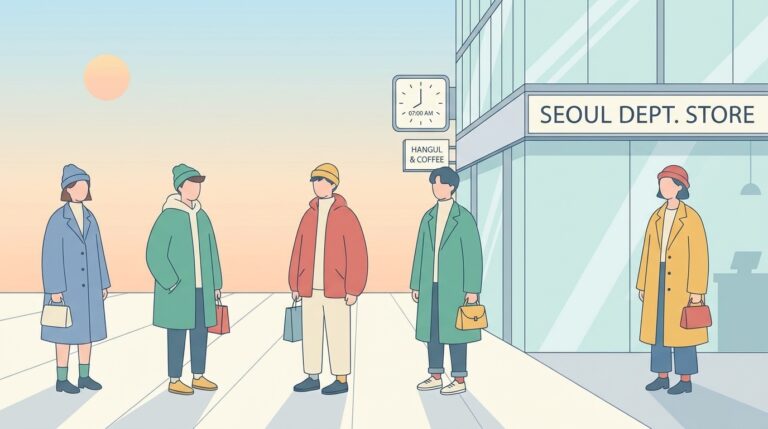
Picture this: It is 6:30 AM on a freezing Tuesday morning in Seoul. The subways have barely started buzzing, yet outside the grand neoclassical facade of the Shinsegae Department Store in Myeongdong, dozens of people are already bundled in floor-length puffer coats (long paddings). Some sit on portable folding chairs, clutching piping-hot convenience store coffees, while others tap furiously on their phones. Are they queuing for idol concert tickets? Nope. They are preparing to sprint for a limited-edition Chanel flap bag or a rare Rolex Submariner. Welcome to the world of the Korean 오픈런 (Open Run).
If you have followed K-dramas like Queen of Tears or Celebrity, or scrolled through Seoul streetwear accounts, you already know South Korea’s relationship with luxury fashion is unmatched. In fact, Morgan Stanley reported that South Koreans are among the world’s biggest spenders per capita on luxury personal goods. But as an intermediate (B2) Korean learner, walking into this world can feel intimidating. Standard textbooks teach you formal market transactions like “얼마예요?” (How much is it?) or “이것을 보여주세요” (Please show me this), but they never teach you how to ask if the waiting queue is capped, how to celebrate securing a coveted item with your Korean friends, or the nuanced social etiquette of high-end department store culture.
This guide was born out of real feedback from learners who felt lost when their Korean coworkers casually bragged about an “오픈런 득템” (open run score) over lunch. By the end of this lesson, you will master the cultural codes, slang, and polite interactions needed to navigate Seoul’s most competitive fashion scenes like a savvy local insider.
Phase 2: 핵심 표현 3선 심층 분석 (Core Expressions Deep Dive)
1. 오픈런 뛰다 (Opeun-reon ttwida)
- Pronunciation: [O-peun-reon ttwi-da] (Think of the English words ‘Open Run’ pronounced with crisp Korean syllable blocks, followed by ‘twi’ like the first syllable of ‘twist’ with a double t snap).
- Meaning: Literal: To run the open run | Actual Nuance: To wake up at dawn and camp out in front of a department store or trendy pop-up to rush in the moment doors unlock.
- K-Culture Moment: Seen in lifestyle vlogs and dramas where characters wake up at 5:00 AM to snag exclusive luxury handbags, bridal watch sets, or viral bakery pastries before inventory sells out within minutes.
- Editor’s Insight: Notice the verb 뛰다 (to run)! Koreans do not just do (하다) an open run; they run (뛰다) it, emphasizing the athletic stamina and competitive hustle required.
- Situation Spectrum: Casual: ✅ | Semi-formal: ⚠️ | Formal: 🚫
- 🤔 Think About It: Why does Korean culture frame shopping as an athletic pursuit (뛰다)? What does this say about the collective speed culture (빨리빨리) entering consumer life?
2. 플렉스하다 (Peul-laek-seu-ha-da)
- Pronunciation: [Peul-laek-seu-ha-da] (Sounds like ‘flex-ha-da’, where ‘flex’ gets an extra vowel bounce: peul-leks).
- Meaning: Literal: To flex | Actual Nuance: To splurge boldly on high-end luxury goods or treat someone extravagantly to show off success and reward oneself.
- K-Culture Moment: Popularized by Korean hip-hop artists (like Yumdda) on shows like Show Me The Money, and now ubiquitous across YouTube haul videos where creators unbox designer bags with the title “월급 전부 플렉스했습니다” (I flexed my entire monthly paycheck).
- Editor’s Insight: While Western hip-hop slang uses ‘flex’ to mean showing off muscle or wealth, Koreans use 플렉스하다 specifically as a verb for the act of spending big money with confidence, often framed as self-reward (나를 위한 선물).
- Situation Spectrum: Casual: ✅ | Semi-formal: ⚠️ | Formal: 🚫
- 🤔 Think About It: Does flexing carry a boastful negative connotation in your native language, or is it seen as celebrated self-reward as it often is among young Koreans?
3. 득템하다 (Deuk-tem-ha-da)
- Pronunciation: [Deuk-tem-ha-da] (Pronounce ‘deuk’ like ‘duck’ with a tighter, flat lips sound /ɯ/, and ‘tem’ like ‘item’ minus the ‘i’).
- Meaning: Literal: To obtain an item | Actual Nuance: To successfully score a rare, discounted, or highly sought-after product after effort or good luck.
- K-Culture Moment: Born from gaming terminology (picking up rare loot), this word migrated into daily fashion vocabulary. Shoppers post on Instagram: “오늘 오픈런 성공해서 드디어 득템!” (Succeeded in my open run today and finally scored!).
- Editor’s Insight: You cannot 득템 everyday items like toilet paper or milk. It is strictly reserved for items that require persistence, patience, or stroke of luck.
- Situation Spectrum: Casual: ✅ | Semi-formal: ✅ | Formal: 🚫
- 🤔 Think About It: How did video game vocabulary permeate mainstream Korean shopping culture? Does your language borrow gaming slang for real-world achievements?
Phase 3: 교과서 한국어 vs 진짜 한국어 (Textbook vs. Real Korean)
Situation 1: Explaining you are waking up early to wait in line for a store
- 📖 교과서 한국어: 내일 백화점에서 물건을 일찍 사려고 문 열기 전에 줄을 설 거예요. (Naeil baekhwajeom-eseo mulgeon-eul iljjik saryeogo mun yeolgi jeone jur-eul seol geoyeyo. / Tomorrow, I will stand in line before the door opens to buy goods early at the department store.)
- 🗣️ 진짜 한국어: 내일 샤넬 오픈런 뛰러 가요. 번호표 잘 받아야 할 텐데요. (Naeil Syaneol opeun-reon ttwireo gayo. Beonhopyo jal badaya hal tendeyo. / I’m running the Chanel open run tomorrow. Really hope I get a good waiting ticket number.)
- 💡 왜 다를까? Native speakers condense the lengthy descriptive clause into the single dynamic compound phrase 오픈런 뛰다 and immediately focus on the logistical hurdle: the digital queue ticket (번호표).
Situation 2: Talking about treating yourself to an expensive designer item
- 📖 교과서 한국어: 제 자신을 위해 아주 비싼 명품 가방을 샀습니다. 돈을 많이 썼어요. (Je jasin-eul wihae aju bissan myeongpum gabang-eul satseumnida. Don-eul mani sseosseoyo. / I bought a very expensive luxury bag for myself. I spent a lot of money.)
- 🗣️ 진짜 한국어: 이번에 큰맘 먹고 가방 하나 플렉스했어! 완전 득템이야. (Ibeone keunmam meokgo gabang hana peullaekseuhaesseo! Wanjeon deuktem-iya. / I bit the bullet and flexed on a bag this time! It’s such a score.)
- 💡 왜 다를까? Using idiomatic intermediate structures like 큰맘 먹고 (making a big resolution/biting the bullet) and verbs like 플렉스하다 conveys the emotional emotional weight and joy of the purchase far better than sterile textbook grammar.
Phase 4: K-Culture 딥다이브 & 비언어적 매너 (Deep Dive & Non-Verbal Manners)
4-1. 눈치 (Nunchi) & Queueing Etiquette
Korean open-run culture operates on strict unspoken social contracts:
* The Tablet Check-in Decorum: Department stores do not let people bum-rush the escalators anymore. Around 9:30 AM or 10:00 AM, security staff set up a tablet kiosk for digital queues (often via systems like KakaoTalk or Catch Table). When your turn arrives, input your Korean phone number smoothly without hovering or peering over other people’s screens—give the person in front a respectable 1-meter radius of personal space.
* The Discreet Appraisal (눈치 싸움): While standing in line, look around subtly. Eye contact should be casual, never glaring. Fellow shoppers will glance discreetly at each other’s outerwear and sneakers to assess who is an experienced reseller (리셀러) versus an individual collector. Keep a composed, neutral expression.
* Inside the Boutique: Luxury boutique associates (often referred to as 셀러 or 매니저님) value polite, understated composure. Greet them with a slight 15-degree bow rather than an overly loud “안녕하세요!”. Avoid touching delicate leather displays without asking permission first (“혹시 직접 들어봐도 될까요?” – May I try holding this?).
4-2. Cultural Code Analysis: The Psychology of Luxury in Korea
Why is luxury consumption so prevalent in South Korea? Sociologists point to two main dynamics: 사회적 인정 (Social Proof & Recognition) and 자기 보상 (Self-Reward Culture).
In high-density urban environments like Seoul, visible fashion indicators signal personal diligence and taste. For younger generations (MZ generation), skyrocketing housing prices historically led many to pivot toward achievable immediate gratification: buying one exquisite luxury item that lasts decades rather than saving tiny increments for out-of-reach real estate. Added to this is the 희소성 (scarcity) marketing favored by top heritage houses, transforming limited runs into thrilling social quests.
Phase 5: 실전 롤플레이 시나리오 (Interactive Roleplay Scenario)
Setting: Outside the main branch of a luxury department store in Sogong-dong, Seoul at 7:45 AM. The temperature is brisk. You are sitting on a portable stool next to Minji, a seasoned fashion enthusiast holding a steaming tumbler.
- Turn 1 (Minji): 혹시 오늘 어떤 제품 보러 오셨어요? 요즘 클래식 라인 입고 거의 안 되던데요.
(Hoksi oneul eotteon jepum boreo osyeosseoyo? Yojeum keullaesik rain ipgo geoui an doedeondeyo.)
“By any chance, what item are you here to see today? They’ve barely had any classic line stock lately.”
🎭 Minji pulls down her fleece scarf slightly and asks with curious, friendly eyes. -
Turn 2 (You): 저도 클래식 플랩 백 보러 왔어요. 처음이라 조금 떨리네요.
(Jeodo keullaesik peullaep baek boreo wasseoyo. Cheoeum-ira jogeum tteollineyo.)
“I came to see the classic flap bag too. It’s my first time, so I’m a bit nervous.”
🎭 You give an honest, slightly bashful smile while rubbing your hands together for warmth. -
Turn 3 (Minji): 첫 오픈런이시구나! 그래도 오늘 평일이라 대기 30번 안에는 무조건 들 것 같아요.
(Cheot opeun-reon-isiguna! Geuraedo oneul pyeong-ir-ira daegi samsip-beon ane-neun mujogeon deul geot gat-ayo.)
“Ah, your first open run! Still, since it’s a weekday today, you’ll definitely be in the top 30 waiting list.”
🎭 Minji checks her smartwatch and nods reassuringly. -
Turn 4 (You): 30번 안에 들면 제가 원하는 가방 득템할 수 있을까요?
(Samsip-beon ane deulmyeon jega wonhaneun gabang deuktemhal su isseulkkayo?)
“If I get inside the top 30, do you think I’ll be able to score the bag I want?”
🎭 You tilt your head, genuinely seeking her veteran advice. -
Turn 5 (Minji): 운이 좋으면 가능해요! 보통 오전에 물량 없어도 오후에 깜짝 입고되는 경우도 있거든요.
(Un-i joeumyeon ganeunghaeyo! Botong ojeone mullyang eopseodo ohue kkamjjak ipgodoeneun gyeong-udo itgeodeunyo.)
“If luck is on your side, yes! Even if there’s no stock in the morning, sometimes surprise afternoon restocks happen.”
🎭 She leans in and whispers like sharing a top-secret tip. -
Turn 6 (You): 와, 그런 꿀팁이 있었네요! 오늘 꼭 성공해서 제대로 플렉스해보고 싶어요.
(Wa, geureon kkultib-i isseotneyo! Oneul kkok seonggonghaeseo jedaero peullaekseuhaebogo sipeoyo.)
“Wow, what a great insider tip! I really want to succeed today and properly flex.”
🎭 You nod enthusiastically, clenching your fist gently with excitement. -
Turn 7 (Minji): 직원이 태블릿 들고 나오네요. 휴대폰 번호 준비하세요!
(Jigwon-i taebeullit deulgo naoneyo. Hyudae-pon beonho junbihaseyo!)
“The staff member is coming out with the tablet. Get your phone number ready!”
🎭 She stands up quickly and smooths down her coat. -
Turn 8 (You): 네, 알려주셔서 감사해요! 민지 씨도 오늘 꼭 원하시는 거 득템하세요!
(Ne, allyeojusyeoseo gamsahaeyo! Minji ssido oneul kkok wonhasineun geo deuktemhaseyo!)
“Yes, thank you for letting me know! I hope you score what you want today too, Minji!”
🎭 You quickly bring up your phone keypad and smile warmly.
🔀 Interactive Choice Point:
The store security guard approaches you with the tablet. How do you respond?
* Option A: “저기요! 저 1번으로 들어가게 해 주시면 안 돼요?” (Excuse me! Can’t you let me go in as number 1?)
* Option B: “안녕하세요. 대기 등록 지금 하면 알림톡으로 연락 오나요?” (Hello. If I register on the waitlist now, will I receive a KakaoTalk notification?)
* Option C: (Silently grab the tablet out of his hands and type your number quickly without looking at him.)
Feedback:
* Option A [Bad]: Demanding special treatment violates strict Korean queue etiquette and causes unnecessary tension (갑질/진상 behavior).
* Option B [Best]: Polite, natural, and checks the essential operational mechanism (알림톡 – notification talk) with perfect intermediate honorifics.
* Option C [Risk]: Snatching an item from service personnel in Korea is perceived as deeply rude and disrespectful. Always wait for them to hand it over or turn the screen toward you.
Phase 6: 10초 감정 섀도잉 드릴 (10-Second Shadowing Drill)
Practice these high-frequency emotional utterances out loud. Notice the rhythm slashes (/) indicating micro-pauses.
- Sentence 1 [🔥 비장하고 결의에 찬 목소리로 – Solemn & Determined]:
새벽 6시부터 / 줄 섰으니까, / 오늘은 진짜 / 무조건 득템한다!
(Saebyeok yeoseot-si-buteo / jul seosseunicca, / oneur-eun jinjja / mujogeon deuktemhanda!)
“Since I’ve queued up since 6 AM, / today I am definitely / scoring this item no matter what!” -
Sentence 2 [🤩 감격스럽고 흥분해서 – Ecstatic & Overjoyed]:
드디어 구했어! / 나 이번 달 월급 / 전부 플렉스했다!
(Deudieo guhaesseo! / Na ibeon dal wolgeup / jeonbu peullaekseuhaetda!)
“I finally got it! / I just flexed / my entire monthly paycheck!” -
Sentence 3 [🥺 아쉽고 씁쓸하게 – Disappointed & Bittersweet]:
내 바로 앞에서 / 물량이 다 빠져서 / 결국 헛걸음했잖아.
(Nae baro ap-eseo / mullyang-i da ppajyeoseo / gyeolguk heotgeoreumhaetjana.)
“The stock ran out right in front of me, / so I ended up making a trip for nothing.”
Phase 7: K-Culture 미니 사전 (Core Fashion Keywords)
-
오픈런 (Opeun-reon) | Open Run
Originally referring to running into department stores at opening time to buy luxury bags, it has broadened into any intense consumer rush, including vintage pop-ups, limited sneaker drops, and trendy dessert spots like London Bagel Museum. -
리셀러 (Ri-sel-leo) / 피 (Pi – Premium) | Reseller / Resale Premium
Individuals who purchase scarce luxury goods with the explicit intent of flipping them online for a profit. The markup fee is referred to as 피 (short for 프리미엄 / premium, e.g., “피 50만 원 붙여서 팔았어” – I sold it with a 500,000 KRW premium attached). -
웨이팅 등록 (Wei-ting deung-nok) | Waiting List Registration
The electronic queuing system used across department store boutiques and popular restaurants. You enter your Korean mobile number to receive automated queue status updates. -
품절대란 (Pum-jeol-dae-ran) | Sold-out Frenzy / Shortage Crisis
A compound of 품절 (sold out) and 대란 (great disturbance/upheaval). Used when a specific designer piece, cosmetics shade, or shoe model disappears from store shelves nationwide due to viral social media trends.
Phase 8: 여행자를 위한 생존 키트 (Traveler’s Survival Kit)
Survival Phrases TOP 3
- “혹시 대기 등록 마감됐나요?”
(Hoksi daegi deungnok magam-dwaenna-yo?)
Pro Tip: Use this when arriving after 11:00 AM. Many popular luxury houses cap the daily waiting list early in the morning. - “이 제품 디스플레이 상품 말고 새 상품으로 있나요?”
(I jepum diseupeullei sangpum malgo sae sangpum-euro innayo?)
Pro Tip: Essential for luxury buyers. It asks whether they have a brand-new, factory-sealed piece in the back stockroom rather than the display model. - “텍스 리펀 영수증 같이 끊어주세요.”
(Tekseu ripeon yeongsujeung gachi kkeun-eojuseyo.)
Pro Tip: For foreign travelers, high-end department stores can process on-site VAT tax refunds directly or give you custom airport claim receipts.
Editor’s Travel Note
- Queue Locations: At Shinsegae Department Store Main Branch (Myeongdong), open runners line up outside the First Bank (SC제일은행) building entrance gate facing Hoehyeon station. At Lotte Department Store Main Branch, line up along the Euljiro 1-ga station underground escalator exit or main front gate.
- Essential Digital Tool: Download the 네이버 지도 앱 (Naver Map App) to pinpoint the exact department store exterior entrances before dawn, as subway station underground passages often remain locked until regular operating hours.
- Payment Rules: Luxury brands in Korea strictly enforce that the name on the credit card must match your passport exactly during high-ticket checkouts.
Phase 9: “한 발 더 깊이” (A Step Deeper)
In many Western cultures, extreme queueing for commercial goods might be labeled as pure consumerism. However, in contemporary South Korea, the open run phenomenon intersects with the collective experience of 트렌드 동질감 (trend solidarity) and digital agility. Navigating apps, calculating inventory drops, and securing coveted fashion items is celebrated as personal resourcefulness (생활력 and 스마트한 소비). It reflects a society where staying ahead of the curve is both an aesthetic passion and an art form.
💬 Your Turn: Would you ever wake up at 5:00 AM to do an 오픈런 for your dream fashion item in Seoul, or do you prefer calm, casual shopping? Drop your thoughts in the comments below!
Phase 10: FAQ & 오해 방지 (FAQ & Common Mistakes)
Q: Can foreign tourists join the morning open-run queue without a Korean phone number?
A: It depends on the store. Most luxury brands use tablet queue systems linked to KakaoTalk, which require an active 010 Korean phone number (obtainable via local eSIM/SIM cards). However, some flagship stores allow tourists to register using an international email address or will hand out physical paper numbers. Always ask security staff: “외국인인데 이메일로 대기 등록 가능한가요?” (I’m a foreigner, can I register using email?).
Q: Is open running considered rude or looked down upon in Korea?
A: Not at all! While there is public debate about speculative resellers (되팔이), regular individuals queuing for personal milestone gifts (such as wedding gifts known as 예물) is considered completely normal, understandable, and even admirable dedication.
Q: Does having a low queue number guarantee I can buy whatever I want?
A: Unfortunately, no. Boutique inventory fluctuates daily without notice. Even if you are number 5 in line, if the store only received two bags of that specific style that morning, it will sell out before your turn. Store associates call this “재고 운” (inventory luck).
🚨 흔한 실수 (Common Mistakes) TOP 3
- Mistake: Using “플렉스” (Flex) in formal or professional business meetings.
Correct Action: Use 과감한 투자 (bold investment) or 적극적인 소비 (proactive consumption). Save 플렉스하다 strictly for friends and peers. - Mistake: Assuming you can leave the queue line for hours before tablet registration opens.
Correct Action: If you leave your physical spot before official tablet check-in begins, fellow runners will not save your place. You must maintain physical presence. - Mistake: Using the informal verb 사다 (to buy) when asking high-end sales associates to prepare an item.
Correct Action: Use polite phrasing: “이걸로 구매할게요” (I will purchase this one) or “포장 부탁드려요” (Please gift-wrap it).
Phase 11: 액션 미션 & 참여 유도 (Action Missions)
- 🥉 Bronze Mission (Solo Shadowing): Read the Phase 6 shadowing drill 3 times aloud, mimicking the urgent, exciting cadence of a real shopper.
- 🥈 Silver Mission (Social Application): When you treat yourself to something nice this week (even a fancy dessert!), take a photo and caption it on Instagram or your study journal: “오늘 나를 위해 소소하게 플렉스했다!” (Flexed in a modest way for myself today!).
- 🥇 Gold Mission (Real-World Challenge): Next time you visit a department store or trendy cafe in Korea, confidently ask the staff: “혹시 지금 대기 등록 가능한가요?” (Is waitlist registration available right now?).
- 🎮 K-Culture Mission: Watch an episode of a fashion-oriented K-drama or a YouTube Seoul Vlog and spot whether characters use 득템 or 플렉스 when showing off their recent purchases.
Phase 12: 인터랙티브 퀴즈 챌린지 (Interactive Quiz Challenge)
Test your mastery of Korean luxury shopping culture!
1. Situational Judgment:
Your Korean friend just spent 3 hours in line at Apgujeong and successfully bought an ultra-rare designer card wallet that was sold out everywhere. What is the most natural, supportive intermediate reaction?
(A) 왜 그렇게 돈을 낭비했어?
(B) 와, 진짜 힘들었겠다! 완전 득템했네, 축하해!
(C) 다음에는 문 열기 전에 가지 마세요.
2. Fill in the Blank:
“내일 아침 일찍 백화점 문 열자마자 달려갈 거야. 나 드디어 첫 _________ 뛰어봐!”
3. True or False:
In Korean culture, the word 플렉스하다 can only be used when buying houses and cars, and cannot be used for designer clothing or bags. (True / False)
👉 Click to reveal answers & explanations!
-
Answer: (B)
Explanation: Acknowledging their effort and congratulating them with “완전 득템했네!” matches the exact supportive peer nuance in modern Korean consumer culture. (A) is critical, and (C) uses stiff formal speech inappropriately with a friend. -
Answer: 오픈런 (Open Run)
Explanation: The matching verb phrase is 오픈런을 뛰다 (to run an open run). -
Answer: False
Explanation: 플렉스하다 is frequently used for designer bags, watches, shoes, high-end dining, or even modest splurges for oneself!







