

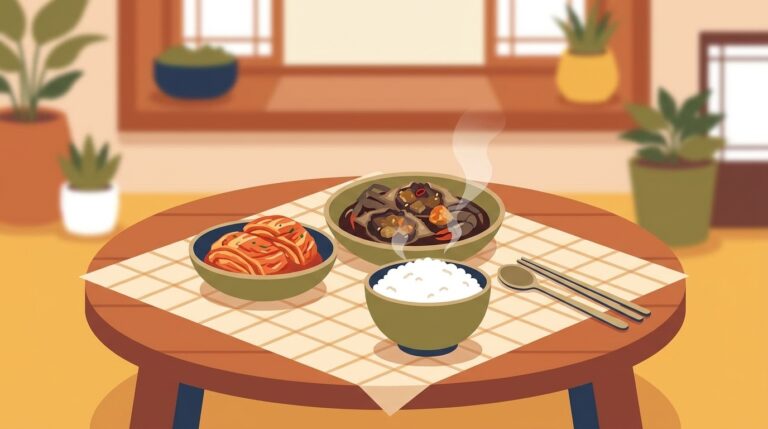
The Ultimate Guide to Korean Banchan: Why Koreans Call Delicious Food a ‘Rice Thief’
Phase 1: Empathy (A Thief at the Dinner Table?)
안녕하세요! 매일한글 에디터입니다. (Hello! I’m your Daily Hangul editor!)
Picture this: You are sitting at a bustling traditional restaurant in Mapo, Seoul. The table is so heavily laden with small ceramic plates—crispy seasoned seaweed, fermented kimchi, pickled perilla leaves, and a glistening plate of soy sauce marinated crab (간장게장, Ganjang gejang)—that you can barely see the wood beneath. You take a bite of the crab, scoop up a generous spoonful of warm white rice, and let out a happy sigh. Suddenly, your Korean dining buddy slams their chopsticks down playfully and exclaims: “와, 이거 진짜 완전 밥도둑이다!” (Wa, igeo jinjja wanjeon bap-doduk-ida!)
You freeze mid-chew. “Thief? Did someone steal our food? Is someone robbing the restaurant?!”
If you have ever felt puzzled by Korean food idioms, you are not alone. As an intermediate (B2) learner, navigating the world of Korean dining is where classroom vocabulary often clashes with the reality of dining tables. In Korea, food isn’t merely sustenance; it is a shared emotional language. Understanding concepts like Bap-doduk (“Rice Thief”) will instantly transform you from a confused tourist into a cherished dining companion who truly “gets” Korean table culture. This guide is crafted directly from our classroom feedback and ten years of navigating local Korean alleys to give you authentic, insider fluency.
Phase 2: Core Expressions (Top 3 Deep Dive)
1. 밥도둑 (Bap-doduk)
- Pronunciation: [Bap-do-duk] (Think of saying bap like “bop”, followed by doe-dook with a crisp ending).
- Meaning: Literal: “Rice thief” | Actual Nuance: A side dish so savory, rich, and delicious that your bowl of steamed rice vanishes before you even notice.
- K-Culture Moment: Seen in nearly every mukbang on YouTube or variety shows like I Live Alone (나 혼자 산다) whenever a cast member breaks open a crab shell, mixes warm rice inside, and devours it in seconds.
- Editor’s Insight: While Western compliments focus on the dish itself (“This steak is amazing”), Korean compliments often measure excellence by how much rice the dish compels you to eat. Calling a dish a 밥도둑 is the highest culinary praise you can offer.
- Situation Spectrum: Casual ✅ | Semi-formal ✅ | Formal ⚠️ (Appropriate in casual or friendly social dinners, but avoid using it in strictly ceremonial or stiff corporate boardrooms).
- 🤔 Think About It: In your culture, do you praise food based on how fast you finish a staple carb, or do you focus solely on taste adjectives?
2. 입맛을 돋우다 (Im-maseul doduda)
- Pronunciation: [Im-ma-seul do-du-da] (Sounds like eem-ma-sul followed by doe-doo-da).
- Meaning: Literal: “To raise/elevate one’s taste” | Actual Nuance: To stimulate or whet one’s appetite, especially when you feel lethargic or have lost your hunger.
- K-Culture Moment: Frequently heard in historical K-dramas (사극) when the royal physician prepares tangy seasonal side dishes like dongchimi (radish water kimchi) for an ailing monarch.
- Editor’s Insight: Koreans value the rhythm of seasonal eating. Tangy, salty, or fermented banchan are specifically engineered to “wake up” dormant appetites during hot summers or bitter winters.
- Situation Spectrum: Casual ✅ | Semi-formal ✅ | Formal ✅ (A universally polite, natural phrase across all settings).
- 🤔 Think About It: How does your native language describe the sensory trigger that kickstarts hunger before a heavy meal?
3. 밥 한 공기 뚝딱 (Bap han gonggi ttukttak)
- Pronunciation: [Bap han gong-gi ttuk-ttak] (The onomatopoeia ttuk-ttak mimics doing something effortlessly in a flash).
- Meaning: Literal: “Clattering down a bowl of rice in a flash” | Actual Nuance: Polishing off an entire bowl of rice effortlessly because the banchan was so tasty.
- K-Culture Moment: Used by warm mothers in family dramas when happily watching their children or sons-in-law eat enthusiastically at the kitchen table.
- Editor’s Insight: Ttukttak (뚝딱) represents quick, seamless action. When paired with food, it paints a vivid mental picture of an empty, scraped-clean stainless-steel bowl.
- Situation Spectrum: Casual ✅ | Semi-formal ✅ | Formal 🚫 (Too colloquial for formal speeches, ideal for casual meals).
- 🤔 Think About It: Why does Korean have so many sound-symbolic adverbs (uiseongeo/uitaeeo) tied directly to eating habits?
Phase 3: Textbook Korean vs. Real Korean
Situation 1: Complimenting an exceptionally delicious side dish
- 📖 교과서 한국어 (Textbook): 이 반찬은 밥과 아주 잘 어울려요. (I banchan-eun bap-gwa aju jal eoullyeoyo. / “This side dish pairs very well with rice.”)
- 🗣️ 진짜 한국어 (Real-World): 이거 완전 밥도둑인데요? 한 공기 더 시켜야겠어요! (Igeo wanjeon bap-doduk-indeyo? Han gonggi deo sikyeoyagesseoyo! / “This is a total rice thief! I’m definitely going to need another bowl!”)
- 💡 왜 다를까? (Why the difference?): While the textbook sentence is grammatically pristine, native speakers prefer emotional hyperbole. Labeling a dish a “rice thief” and declaring a need for a second bowl demonstrates pure gastronomic joy.
Situation 2: Asking the restaurant owner for more side dishes
- 📖 교과서 한국어 (Textbook): 반찬을 더 주실 수 있나요? (Banchan-eul deo jusil su innayo? / “Could you give me more side dishes?”)
- 🗣️ 진짜 한국어 (Real-World): 사장님, 여기 깍두기 리필 좀 부탁드려요! (Sajangnim, yeogi kkakdugi ripil jom butakdeuryeoyo! / “Boss, could we get a refill on the radish kimchi here, please?”)
- 💡 왜 다를까? (Why the difference?): In real Korean eateries, addressing the host respectfully as Sajangnim (or Imo-nim) and using the ubiquitous loanword ripil (리필 / refill) sounds far more natural, warm, and idiomatic.
Phase 4: K-Culture Deep Dive & Non-Verbal Manners
4-1. 눈치 (Nunchi) & Table Etiquette: Handling the Feast
When faced with dozens of banchan and a prized dish like Ganjang gejang, subtle social rules apply:
1. The Sacred Crab Shell (Gettakji 게딱지): In a group setting, never greedily grab the crab carapace without offering it around first. The shell contains concentrated crab roe and liver—the absolute prime spot to spoon in rice. Offering it to an elder or a guest shows supreme dining nunchi.
2. Utensil Division of Labor: Remember your Korean dining posture: the spoon is dedicated strictly to rice and soup, while chopsticks (jeotgarak) are reserved for banchan. Never plant your chopsticks vertically into your rice bowl, as this mimics ancestral memorial rites (제사).
4-2. Cultural Code: The Philosophy of Banchan & Free Refills
Why are banchan complimentary and refillable in Korea? Historically, Korean meals were measured by the number of side dishes (cheop, 첩) served alongside grain. A generous host never lets an empty side dish linger; refilling banchan without charging extra is an embodiment of 정 (Jeong)—the Korean concept of deep, unconditional community affection. When an owner brings you a fresh mountain of side dishes without asking, they are extending warmth, not just food.
Phase 5: Real-World Roleplay Scenario
Setting: You (Alex) are dining at a famous 40-year-old Gejang specialty restaurant in Ahyeon-dong with the friendly restaurant owner (Imo-nim).
- 이모님: 삼촌, 주문하신 간장게장 백반 나왔어. 반찬 부족하면 편하게 말해! (Samchon, jumunhasin ganjang-gejang baekban nawasseo. Banchan bujokhamyeon pyeonhage malhae!)
- 🎭 Placing a huge ceramic tray loaded with 10 vibrant banchan dishes and glistening blue crabs on the table.
- Translation: “Dear, here is your soy sauce crab set meal. Let me know comfortably if you run low on side dishes!”
- Alex: 와, 상다리가 부러지겠어요! 잘 먹겠습니다, 이모님! (Wa, sang-dariga bureojigesseoyo! Jal meokgetseumnida, imo-nim!)
- 🎭 Admiring the banquet with wide eyes and clapping hands together in anticipation.
- Translation: “Wow, the table legs are about to break from all this food! Thank you for the meal, Auntie!”
- 이모님: 게딱지에 밥 비벼 먹어봤어? 그게 진짜배기야. (Gettakjie bap bibyeo meogeobwasseo? Geuge jinjjabaegiya.)
- 🎭 Pointing with a proud smile at the dark, roe-filled crab shell.
- Translation: “Have you tried mixing rice in the crab shell? That’s the real deal.”
- Alex: 아, 이렇게 밥을 넣고 슥슥 비비면 되나요? (A, ireoke babeul neoko seukseuk bibimyeon doenayo?)
- 🎭 Carefully scooping two spoonfuls of warm rice right into the shell and stirring with a spoon.
- Translation: “Ah, do I just put the rice in like this and mix it up?”
- 이모님: 옳지! 참기름이랑 김가루도 살짝 넣어봐. 기가 막혀. (Olchi! Chamgireum-irang gimgarudo saljjak neoeobwa. Giga makhyeo.)
- 🎭 Handing over a small bottle of roasted sesame oil with an encouraging nod.
- Translation: “That’s it! Drizzle a bit of sesame oil and crushed seaweed too. It’s out of this world.”
- Alex: (한 입 먹고) 으음! 이모님, 이거 진짜 소문대로 완전 밥도둑인데요?! 벌써 다 먹었어요! ((Han ip meokgo) Eueum! Imo-nim, igeo jinjja somundaero wanjeon bap-doduk-indeyo?! Beolsseo da meogeosseoyo!)
- 🎭 Taking a bite, closing eyes in ecstasy, and gesturing toward the half-emptied rice bowl.
- Translation: “(Taking a bite) Mmm! Auntie, just like the rumors say, this is an absolute rice thief! I’ve already polished off half of it!”
- 이모님: 호호, 입에 맞아서 다행이네! 밥 한 공기 더 줄까? (Hoho, ibe majaseo dahaeng-ine! Bap han gonggi deo julkka?)
- 🎭 Laughing merrily and tapping Alex’s shoulder affectionately.
- Translation: “Haha, I’m so glad it suits your taste! Shall I bring you another bowl of rice?”
- Alex: 네! 밥 한 공기 추가해 주시고요, 이 어묵볶음도 리필 부탁드려요! (Ne! Bap han gonggi chugahae jusigoyo, i eomuk-bokkeumdo ripil butakdeuryeoyo!)
- 🎭 Holding up one finger politely with a cheerful, respectful grin.
- Translation: “Yes, please! One extra bowl of rice, and could we get a refill on this stir-fried fish cake too?”
🔀 Interactive Decision Point
After clearing your first bowl in record time, the owner asks if you enjoyed the meal. How do you respond?
- Option A: “반찬이 짜서 밥을 많이 먹을 수밖에 없었어요.” (Banchan-i jjaseo babeul mani meogeul subakke eopseosseoyo. – “The side dishes were so salty that I had no choice but to eat lots of rice.”)
- Outcome: BAD 🚫. Even if crab marinade is naturally salty, stating this directly implies the food was poorly seasoned and offends the owner’s pride.
- Option B: “너무 맛있어서 밥 한 공기 금방 뚝딱 비웠어요. 완전 밥도둑이에요!” (Neomu masisseoseo bap han gonggi geumbang ttukttak biwosseoyo. Wanjeon bap-doduk-ieyo! – “It was so delicious that I cleared a whole bowl in a flash. An absolute rice thief!”)
- Outcome: BEST ✅. You perfectly utilize native culinary idioms and validate the cook’s skills. Expect an extra side dish or soda on the house!
- Option C: “이모, 도둑 잡으세요! 제 밥이 사라졌어요.” (Imo, doduk jabeuseyo! Je babi sarajyeosseoyo. – “Auntie, catch the thief! My rice disappeared.”)
- Outcome: RISK ⚠️. While humorous, overly literal English-style dad jokes might cause brief confusion unless delivered with flawless charisma and expressive facial acting.
Phase 6: 10-Second Emotional Shadowing Drill
Practice these lines aloud, honoring the pause markers (/) and capturing the native rhythm:
- [🤤 군침을 삼키며 / Drooling with anticipation]
- “이 간장게장, / 냄새부터 / 완전 밥도둑 각인데?”
- I ganjang-gejang, / naemsaebuteo / wanjeon bap-doduk gak-inde?
- (“This soy sauce crab… judging by the smell alone, it’s destined to be a total rice thief!”)
- [🤩 눈을 동그랗게 뜨고 감탄하며 / Eyes wide with genuine awe]
- “와… / 게딱지에 밥 비비니까 / 한 공기 뚝딱이에요!”
- Wa… / gettakjie bap bibinikka / han gonggi ttukttak-ieyo!
- (“Wow… mixing rice into the crab shell made a whole bowl disappear in a flash!”)
- [😊 애교 섞인 정중함으로 / Polite, warm, and friendly]
- “사장님, / 이 반찬 너무 맛있어서 그런데 / 조금만 더 주실 수 있나요?”
- Sajangnim, / i banchan neomu masisseoseo geureonde / jogeumman deo jusil su innayo?
- (“Boss, this banchan is just so delicious… could we possibly get a little bit more?”)
Phase 7: K-Culture Mini Dictionary
- 밥도둑 (Bap-doduk) | Noun | The Rice Thief
- Culinary slang applied to savory, salty, or fermented Korean dishes (like raw marinated crab, braised mackerel, seasoned perilla leaves, or braised quail eggs) that stimulate rapid consumption of steamed rice.
- 반찬 리필 (Banchan Ripil) | Noun phrase | Side Dish Refill
- The cultural standard in Korean dining establishments where patrons may request complimentary top-ups of side dishes. Often handled via self-service stations (셀프 코너) in modern eateries.
- 게딱지 (Gettakji) | Noun | Crab Carapace / Upper Shell
- The hard top shell of a crab. In Korean cuisine, it is celebrated as an edible vessel for mixing rice with rich roe, innards, and seasoned soy sauce.
- 정(情) (Jeong) | Noun | Deep Bonding / Warm-Hearted Affection
- The invisible social glue of Korea. At restaurants, it manifests as generous complimentary refills, friendly banter from the waitstaff, and occasional freebies (서비스).
Phase 8: Traveler’s Survival Kit
Top 3 Survival Phrases
- “반찬 리필은 셀프인가요?” (Banchan ripil-eun selpeu-ingayo?)
- Pro Tip: Look around for a sign saying 셀프 바 (Self Bar) or 추가 반찬은 셀프. If you spot one, help yourself using the communal tongs rather than calling the staff.
- “게딱지에 비벼 먹을 김가루 좀 주실 수 있나요?” (Gettakjie bibyeo meogeul gimgaru jom jusil su innayo?)
- Pro Tip: Adding shredded seaweed (gimgaru) and sesame oil to crab shell rice is how local connoisseurs unlock maximum umami.
- “공깃밥 하나 더 추가해 주세요!” (Gonggitbap hana deo chugahae juseyo!)
- Pro Tip: Steamed rice served in a standard stainless steel lidded bowl is called Gonggitbap. It usually costs 1,000 to 2,000 KRW.
Editor’s Travel Note
When venturing out to renowned specialty dining alleys like the Sinsa-dong Crab Alley (신사동 간장게장 골목) or Mapo Galbi street, do not rely on standard international maps which frequently feature outdated operating hours. Check local crowd reviews and real-time waiting queues by downloading the 네이버 지도 앱 다운로드. Remember that many traditional places feature a table buzzer (call bell); press it once crisply rather than waving your hands frantically.
Phase 9: “One Step Deeper” (Reflective Essay)
In Western culinary theory, a dish is frequently evaluated as an autonomous solo performance—the protein stands center-stage, adorned subtly by starch or sauce. Korean dining, however, is fundamentally orchestral. Steamed white rice (Bap) is an empty, neutral canvas, deliberate in its humility. Banchan dishes, meanwhile, are pungent, intense, salty, and fermented; on their own, they might overpower the palate. It is only in their collision that harmony is reached.
Calling a side dish a “thief” playfully acknowledges this codependency: without the rice, the banchan has no victim; without the banchan, the rice remains solitary. Food here is not merely consumed—it is negotiated between elements, and shared among people.
💬 Your Turn: Have you ever experienced a food in Korea—or anywhere in the world—that made your staple carbs disappear before you realized it? Share your ultimate “rice thief” in the comments below!
Phase 10: FAQ & Mistake Prevention
Q: Can any delicious Korean dish be called a 밥도둑? Can I call Korean Fried Chicken or Tteokbokki a 밥도둑?
A: Not quite! 밥도둑 specifically requires a direct dynamic with steamed white rice. While Korean Fried Chicken is delicious, it is paired with beer or pickled radishes, not rice. Reserve bap-doduk for intensely seasoned side dishes, stews (찌개), or braised dishes (조림) that scream for spoonfuls of rice.
Q: Is it rude to ask for multiple banchan refills?
A: Not at all! Most casual Korean restaurant owners take pride when customers ask for refills—it proves the side dish is delicious. However, common courtesy dictates finishing what you request without wasting food, and refraining from asking for unlimited refills on exceptionally expensive specialty banchan like raw oysters or meat patties unless prompted.
Q: What should I do if a restaurant has a “Self-Bar” for banchan?
A: When you see a designated refrigerator station marked 셀프 코너 (Self Corner), take your empty banchan dish up to the bar and serve yourself using the designated tongs for each dish. Never cross-contaminate tongs between kimchi and non-spicy dishes!
🚨 Common Mistakes (흔한 실수)
- Calling Sweet Desserts or Snacks a 밥도둑
- Incorrect: “이 붕어빵 완전 밥도둑이다!” (This carp bread is a total rice thief!)
- Correct Action: Use bap-doduk exclusively for savory dishes meant to be eaten alongside rice. For snacks, say: “손이 자꾸 가요!” (I can’t stop reaching for it!).
- Lifting the Rice Bowl to Your Mouth
- Incorrect: Holding the stainless steel rice bowl in your hand like one might in Japan or China.
- Correct Action: Keep the rice bowl flat on the table and lift the food to your mouth using your metal spoon.
- Using Chopsticks to Eat Soup or Plain Rice
- Incorrect: Struggling to shovel plain rice with thin metal chopsticks.
- Correct Action: Use the long spoon (Sutgarak) for rice and broths, reserving chopsticks for gripping banchan.
Phase 11: Action Mission & Engagement
- 🥉 Bronze Mission (Solo Mastery): Practice saying “완전 밥도둑인데요?” (Wanjeon bap-doduk-indeyo?) 5 times in front of the mirror with an appreciative, joyful expression.
- 🥈 Silver Mission (Social Sharing): Snap a photo of your next meal (whether home-cooked or at a Korean restaurant) and post it on your Instagram Story or X with the caption: “오늘의 밥도둑 🍚🥢 #DailyHangul #BanchanLife”.
- 🥇 Gold Mission (Real-World Execution): Next time you visit a Korean restaurant, address the server with “사장님, 여기 [반찬 이름] 리필 좀 부탁드려요!” and tell them the dish is a true bap-doduk.
- 🎮 K-Culture Mission: Watch an episode of a Korean food variety show like Delicious Guys (맛있는 녀석들) or Baek Jong-won’s Alley Restaurant. Listen closely for how many times the hosts describe a salty or fermented banchan as a bap-doduk!
Phase 12: Interactive Quiz Challenge
Test your intermediate dining fluency below!
Q1. Situational Judgment:
You are dining with your Korean exchange friend’s parents. The mother serves a home-cooked batch of seasoned raw crab (Yangnyeom gejang). Which compliment sounds most culturally astute and natural?
* (A) “이 게는 비타민이 아주 풍부해 보여요.”
* (B) “어머니, 게장이 너무 맛있어서 밥 한 공기 벌써 뚝딱했어요! 완전 밥도둑이에요.”
* (C) “이 음식은 짠맛이 강해서 물을 많이 마셔야겠어요.”
👉 Click to reveal Answer & Explanation
- Correct Answer: (B)
- Explanation: Option (B) demonstrates intermediate emotional fluency by combining two iconic dining expressions: ttukttak (뚝딱, finished in a flash) and bap-doduk (밥도둑, rice thief). Option (A) sounds robotic and textbook-like, while Option (C) is culturally insensitive.
Q2. Fill in the Blank:
Complete the sentence using the appropriate colloquial expression:
* “간장게장 국물에 밥을 비볐더니 밥 두 공기를 눈 깜짝할 사이에 ________ 비웠어요.”
* (A) 뚝딱 (Ttukttak)
* (B) 엉금엉금 (Eonggeum-eonggeum)
* (C) 조마조마 (Jomajoma)
👉 Click to reveal Answer & Explanation
- Correct Answer: (A) 뚝딱
- Explanation: Ttukttak (뚝딱) signifies doing or finishing something swiftly and effortlessly. Eonggeum-eonggeum means crawling slowly like a turtle, and jomajoma means feeling anxious or nervous.
Q3. Cultural True or False:
* Statement: In Korea, asking for a refill of standard banchan like kimchi, bean sprouts, or fish cakes is generally considered bad dining etiquette because restaurants lose money on them.
* [ ] True
* [ ] False
👉 Click to reveal Answer & Explanation
- Correct Answer: False
- Explanation: Standard banchan refills are an integral part of Korean culinary hospitality (Jeong). Asking politely for refills signals that you are savoring their food, provided you eat what you request.







