

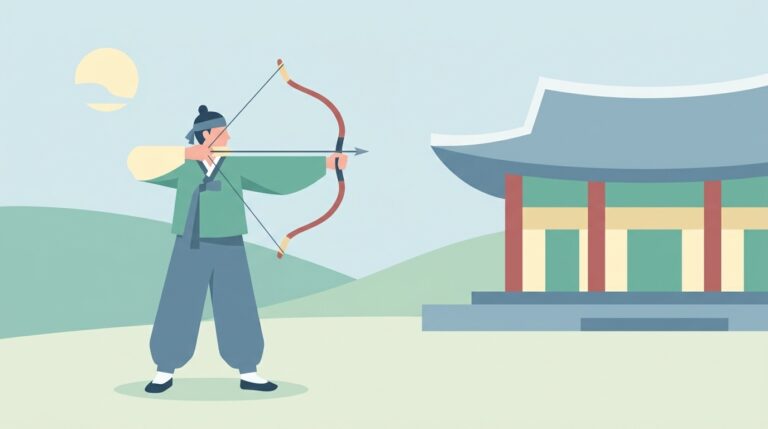
Mastering the Athlete’s Mindset: Advanced Korean Expressions for Mental Toughness
Phase 1: Empathy (Story Opening)
안녕하세요! 매일한글 에디터입니다. Have you ever watched a Korean national archer during an Olympic gold-medal shoot-off? While the entire stadium holds its breath and international commentators whisper with racing pulses, the Korean archer’s biometric monitor displays a resting heart rate of seventy beats per minute. Or maybe you were captivated by fencing prodigy Na Hee-do in the hit drama Twenty-Five Twenty-One, watching her reset her breathing after an unfair referee call. Korean athletes are globally renowned for their unyielding mental composure, a quality often dissected across variety shows, sports documentaries, and corporate team-building retreats in Seoul.
Yet, when advanced learners face high-pressure moments—whether delivering an executive pitch in Gangnam or taking the top-tier TOPIK II exam—they often default to elementary phrases like “긴장하지 마세요 (Ginjanghaji maseyo – Don’t be nervous)” or “열심히 하세요 (Yeolsimhi haseyo – Work hard).” These expressions fail to capture the nuanced psychological grit prized in professional Korean society. Today, drawing from over a decade of coaching foreign professionals and high-performance performers, we will unlock C1-level expressions used by elite athletes to master their mindset under fire.
Phase 2: Core Expressions Deep Dive
1. 멘탈을 다잡다 (Mentaleul dajapda)
- Pronunciation: [Men-tal-eul dah-jap-dah] (Think of saying men-tall with a crisp, snappy dah-jahp-dah where the lips press firmly on the final p sound).
- Meaning: Literal: “To grab and hold one’s mental back together.” | Real Nuance: To pull oneself together, regain psychological equilibrium, and steady a wobbling composure before spiraling.
- K-Culture Moment: Seen frequently in sports dramas like Stove League or Weightlifting Fairy Kim Bok-joo when an athlete makes a devastating blunder in the first half and the veteran captain grabs their shoulders in the locker room.
- Editor’s Insight: While Western psychology speaks of “centering oneself,” Koreans conceptualize mental (멘탈) almost as an elastic object that can slip through your fingers if you don’t deliberately squeeze and gather it (다잡다).
- Situation Spectrum: Casual ✅ | Semi-formal ✅ | Formal ✅
- 🤔 Think About It: Why does Korean treat mental state as something tangible to be gathered and held, rather than an abstract cloud of emotions?
2. 평정심을 유지하다 (Pyeongjeongsimeul yujihada)
- Pronunciation: [Pyeong-jeong-sim-eul yoo-ji-hah-dah] (Sounds like pyung-jung-seem flowing smoothly into yoo-jee-hah-dah).
- Meaning: Literal: “To maintain a calm and balanced heart-mind.” | Real Nuance: To sustain unflappable equanimity and serenity in the middle of chaos or intense external provocation.
- K-Culture Moment: Sportscasters routinely use this phrase when analyzing legendary figure skater Yuna Kim performing an immaculate triple axel despite hostile crowd noises or wardrobe malfunctions.
- Editor’s Insight: Pyeongjeongsim (平靜心) carries Sino-Korean philosophical weight. It is not merely cold indifference; it is the deliberate cultivation of a calm lake surface that refuses to ripple under the wind.
- Situation Spectrum: Casual ⚠️ | Semi-formal ✅ | Formal ✅
- 🤔 Think About It: In your mother tongue, does composure imply hiding your feelings, or actively silencing inner turmoil as 평정심 does?
3. 심기일전하다 (Simgi-iljeonhada)
- Pronunciation: [Sim-gi-il-jeon-hah-dah] (Glide from seem-gee directly into eel-juhn-hah-dah with an energetic upward cadence).
- Meaning: Literal: “To completely invert and renew one’s inner mental state.” | Real Nuance: To turn over a new psychological leaf, brush off previous failure, and reset one’s determination with renewed vigor.
- K-Culture Moment: Quoted in post-game press conferences by football star Son Heung-min after a stinging defeat, signaling to the nation that the team has fundamentally recalibrated its focus.
- Editor’s Insight: Unlike simply “trying again” (다시 하다), 심기일전하다 (心機一轉) acknowledges past catastrophe but refuses to carry its residual negative energy into the next round.
- Situation Spectrum: Casual 🚫 | Semi-formal ✅ | Formal ✅
- 🤔 Think About It: How does switching your vocabulary from “I’ll try again” to “I am resetting my core mental state” alter your personal accountability?
Phase 3: Textbook Korean vs. Real Korean
Situation 1: Calming a Teammate Before a High-Stakes Penalty Kick
- 📖 교과서 한국어: 너무 긴장하지 말고 편하게 하세요. (Neomu ginjanghaji malgo pyeonhage haseyo. – Please do not be too nervous and do it comfortably.)
- 🗣️ 진짜 한국어: 멘탈 흔들리지 말고 평소 하던 루틴대로 가자! (Mental heundeulliji malgo pyeongso hadeon rutindaero gaja! – Don’t let your mental waver; stick right to your regular routine!)
- 💡 왜 다를까? In high-pressure athletics, telling someone to “relax comfortably” sounds unrealistic and dismissive. Native speakers validate the stakes while anchoring focus onto tangible behavioral mechanics (루틴).
Situation 2: Addressing the Board After a Failed Product Launch
- 📖 교과서 한국어: 다음 경기에서는 더 열심히 노력하겠습니다. (Daeum gyeonggieseoneun deo yeolsimhi noryeokhagessumnida. – In the next match, I will make more effort.)
- 🗣️ 진짜 한국어: 지난 실책에 연연하지 않고, 심기일전하여 승리로 보답하겠습니다. (Jinan silchaek-e yeon-yeonhaji anko, simgi-iljeonhayeo seungniro bodaphagessumnida. – Rather than dwelling on past errors, we will reset our mental core and repay your trust with victory.)
- 💡 왜 다를까? C1-level professionals substitute plain effort (열심히 노력) with sophisticated four-character idioms (심기일전) and decisive balance markers (연연하지 않고), projecting executive maturity.
Phase 4: K-Culture Deep Dive & Non-Verbal Manners
4-1. 눈치 (Nunchi) & Sports Body Language
In Korean sports culture, physical gestures during mental resets convey profound social respect. When an athlete catches their breath after a coach’s blistering critique, making defiant eye contact or scoffing is taboo. Instead, athletes practice 눈맞춤과 고개 끄덕임 (Nunmatchumgwa gogae kkeudeog-im – measured eye contact followed by a firm, subtle nod). Watch archery master Kim Je-deok: right after explosive cheers, his shoulders drop instantly, eyes soften into deep focus, and his chin slightly lowers. This sudden physical stillness signals to teammates that emotional adrenaline has been converted into laser precision.
4-2. The Cultural Architecture of “Mental” (멘탈)
In contemporary South Korea, the English loanword “mental” has evolved far beyond its Western medical root. It functions as a quantifiable stamina bar. You will hear people classified as 멘탈 갑 (Mental Gap – supreme mental giant) or lamented as 유리멘탈 (Yuri-mental – glass mindset that shatters under stress). This cultural obsession stems from Korea’s high-density competitive environment (무한 경쟁), where physical training is assumed to be maximized across all contenders; the only competitive edge left is whether your psychological armor can withstand the furnace of public scrutiny.
Phase 5: Real-Life Roleplay Scenario
Setting: National Training Center (진천선수촌) Archer’s Range. Cold dawn mist, absolute silence punctuated only by arrows thudding into distant straw targets.
Characters:
* Coach Min-jun (민준 코치): Stern, 50-something veteran coach known for producing world champions.
* Learner (당신): An elite athlete struggling with sudden target panic during Olympic trials.
민준 코치: 방금 쏜 세 발, 전부 8점 구역으로 빠졌어. 손끝이 떨리던데?
(Bang-geum sson se bal, jeonbu paljeom gu-yeok-euro ppajyeosseo. Sonkkeut-i tteollideonde?)
"Those last three arrows all drifted into the 8-ring. Your fingertips were trembling."
🎭 [팔짱을 낀 채 매서운 눈빛으로 과녁을 가리킨다]

당신: 죄송합니다, 코치님. 결승전이라는 압박감 때문에 호흡이 흔들렸습니다.
(Joesonghamnida, kochinim. Gyeolseungjeon-iraneun apbakgam ttaemune hoheub-i heundeullyeossumnida.)
"I apologize, Coach. The pressure of the finals disrupted my breathing rhythm."
🎭 [활을 내리고 숨을 고르며 고개를 정중히 숙인다]

민준 코치: 기술의 문제가 아니야. 네 마음이 점수판에 먼저 가 있잖아.
(Gisul-ui munjega aniya. Ne ma-eum-i jeomsupane meonjeo ga itjanha.)
"It isn't a mechanical flaw. Your mind ran ahead to the scoreboard."
🎭 [한 걸음 다가와 선수의 어깨를 묵직하게 짚는다]

당신: 네, 맞습니다. 과녁 중앙을 보면서도 실수를 두려워하고 있었습니다.
(Ne, matseumnida. Gwanyeok jung-ang-eul bomyeonseodo silsu-reul duryeowohago isseossumnida.)
"You are right, sir. Even while staring at the center, I was secretly terrified of making a mistake."
🎭 [자신의 실수를 솔직하게 시인하며 시선을 모은다]

민준 코치: 관중의 함성도, 상대 선수의 10점도 지워라. 지금 여기서 네가 통제할 수 있는 게 뭐지?
(Gwanjung-ui hamseongdo, sangdae seonsu-ui sipjeomdo jiwora. Jigeum yeogiseo nega tongjehalsu inneun ge mwoji?)
"Erase the crowd's roar, and erase your opponent's 10-point shots. Right now, what can you actually control here?"
🎭 [선수의 눈을 뚫어지게 응시하며]

당신: 오직 저의 호흡과 시위의 장력뿐입니다.
(Ojik jeo-ui hoheubgwa siwi-ui jangnyeokppun-imnida.)
"Only my own breath and the tension of my bowstring."
🎭 [양발을 단단히 디디며 호흡을 아랫배로 내린다]

민준 코치: 바로 그거야. 잡념을 버리고 다시 멘탈을 다잡아 봐.
(Baro geugeoya. Jamnyeom-eul beorigo dasi mentaleul dajaba bwa.)
"Precisely that. Cast away intrusive thoughts and steady your mental once more."
🎭 [가볍게 등을 토닥이며 물러선다]

당신: 네! 심기일전해서 평정심을 유지하며 마지막 발을 당기겠습니다.
(Ne! Simgi-iljeonhaeseo pyeongjeongsimeul yujihamyeo majimak bal-eul danggigessumnida.)
"Yes, Coach! I will reset my core resolve, hold my equanimity, and draw this final arrow."
🎭 [단호한 표정으로 활을 들어 올리며 정면을 겨눈다]
🔀 Interactive Decision Point
After Coach Min-jun challenges your concentration, how do you respond to demonstrate elite C1 composure?
- Option A: “코치님, 솔직히 너무 불안해서 오늘은 그만 쏘고 쉬겠습니다.” (Coach, honestly I’m too anxious, so I’ll stop shooting and rest today.)
- Feedback (Bad): While vulnerability is okay in therapy, in high-performance sports culture, this shows an immediate collapse of fighting spirit (투지 부족) without attempting self-regulation.
- Option B: “제가 무조건 10점을 쏴서 코치님께 증명해 보이겠습니다!” (I will unconditionally hit a 10 and prove it to you!)
- Feedback (Risk): Overly aggressive outcome-oriented speech (결과 집착). It exposes that you are still obsessed with the score rather than mental discipline.
- Option C: “조급했던 마음을 비우고, 저만의 루틴에 집중하여 평정심을 되찾겠습니다.” (I will empty my rushed heart, focus on my individual routine, and reclaim my equanimity.)
- Feedback (Best): Perfect C1 delivery. It acknowledges inner distraction, highlights internal agency, and uses mature psychological vocabulary.
Phase 6: 10-Second Emotion Shadowing Drill
Read aloud along the slash marks (/), mimicking the professional athletic intonation:
[🔥 단호하고 비장하게 - Resolute & Steely]
점수에 흔들리지 말고 / 내 호흡에 집중해서 / 멘탈을 다잡자.
(Jeomsue heundeulliji malgo / nae hoheube jipjunghaeseo / mentaleul dajapja.)
Do not waver at the score / focus on my breath / and gather my mental together.-
[🧘 깊고 차분하게 - Deeply Centered & Serene]
어떤 돌발 상황에서도 / 평정심을 유지하는 것이 / 진짜 실력이다.
(Eotteon dolbal sanghwang-eseodo / pyeongjeongsimeul yujihaneun geosi / jinjja sillyeogida.)
Maintaining equanimity / no matter the sudden crisis / is the hallmark of true capability. -
[⚡ 결연한 의지로 - With Rejuvenated Determination]
지난 세트는 끝났다 / 심기일전해서 / 판을 뒤집어보자!
(Jinan seteuneun kkeutnatda / simgi-iljeonhaeseo / paneul dwijib-eoboja!)
The past set is over / let us reset our mental state / and overturn the board!
Phase 7: K-Culture Mini Dictionary
- 중꺾마 (Jung-kkeok-ma)
Full form: 중요한 것은 꺾이지 않는 마음 (Jung-yohan geoseun kkeokk-iji anneun ma-eum). Born during the 2022 League of Legends World Championship run of underdog Deft (Kim Hyuk-kyu), this viral idiom means “What matters most is an unbreakable heart.” It is now ubiquitous across Korean business, sports, and life coaching. - 멘탈 갑 (Mental Gap)
The English word “mental” combined with 갑 (denoting the superior party in a contract). It defines a person with an impenetrable fortress of psychological resilience who remains completely unfazed by online trolls, harsh critics, or high-pressure stakes. - 마인드컨트롤 (Mind-control)
Konglish at its finest. Unlike the sinister English connotation of brainwashing someone else, in Korean sports it exclusively refers to deliberate self-regulation, meditation, and psychological centering exercises. - 포커페이스 (Poker Face / Pyeongjeongsim-ui pyojeong)
Used extensively in Korean combat and precision sports. It describes an intentional, neutral expression meant to deny opponents any hint of fatigue, frustration, or fear.
Phase 8: Survival Kit for High-Stress Moments
Top 3 Survival Expressions
- 페이스 잃지 마세요. (Pe-i-seu ilchi maseyo.)
Romanization: [Pay-ee-seu eel-chee mah-say-yoh]
Pro Tip: Konglish phrase for “Don’t lose your pace/rhythm.” Essential when someone is panicking under a tight deadline. - 결과에 연연하지 마세요. (Gyeolgwawa-e yeon-yeonhaji maseyo.)
Romanization: [Gyuhl-gwah-ay yuhn-yuhn-hah-jee mah-say-yoh]
Pro Tip: Means “Don’t dwell obsessively on the outcome.” Instantly lowers existential dread. - 차분하게 하나씩 풀어갑시다. (Chabunhage hanassik pureogapsida.)
Romanization: [Chah-boon-hah-gay hah-nah-ssheek poo-ruh-gahp-shee-dah]
Pro Tip: “Let’s solve things calmly, one by one.” Excellent leadership line in corporate crises.
Editor’s Travel & Performance Note
If you are traveling to Seoul for a high-stakes marathon, esports tournament, or business presentation, managing logistical stress is half the mental battle. Ensure you download the 네이버 지도 앱 다운로드 to navigate complicated metro transfers with real-time train congestion data, and utilize the 카카오 T 택시 앱 다운로드 so you never risk missing call-times due to language barriers on the street. Carry a reloadable Climate Card (기후동행카드) for seamless transit throughout greater Seoul.
Phase 9: A Step Deeper (Reflection Question)
In Western athletic psychology, individualism often frames mental toughness as personal mastery, self-actualization, or asserting one’s dominance over competitors. In contrast, the Korean sporting mindset is deeply interwoven with communal responsibility (책임감) and collective spirit (투혼 – fighting spirit). An athlete managing their emotions is rarely doing it just for solitary glory; they steady their hands so as not to betray the sweat of their teammates, coaches, and supporters. This communal anchor can be a heavy burden—sometimes sparking intense performance anxiety—but when harnessed through phrases like 심기일전, it becomes an extraordinary engine of collective resilience.
💬 Your Turn: How does your home culture conceptualize mental strength under pressure? Is it seen as emotional detachment, fierce aggression, or communal duty? Share your thoughts below in Korean or English!
Phase 10: FAQ & Common Mistakes
Q: Can I use “멘탈 다잡다” in a formal business meeting?
A: Yes! While 멘탈 originated as slang/loanword, phrases like “팀의 멘탈을 다잡고 프로젝트에 임하겠습니다” are now accepted in modern corporate settings. For ultra-traditional executive boardrooms, however, prefer “심기일전하여 (with renewed determination)” or “자세를 가다듬고 (straightening our posture/focus).”
Q: Is “마인드컨트롤” considered negative in Korea?
A: Not at all. As highlighted in Phase 7, Koreans use it purely to mean self-soothing, visualization, and mental composure drills. You can proudly say, “시합 전에 마인드컨트롤을 하고 있어요 (I am doing mind-control/centering before the match).”
Q: What is the difference between “정신 차리다” and “멘탈을 다잡다”?
A: “정신 차리다 (Jeongsin charida)” is broader and often implies waking up from drowsiness, recovering from shock, or stopping foolish behavior. “멘탈을 다잡다” specifically focuses on psychological resilience, anxiety regulation, and emotional fortitude under pressure.
🚨 Common Mistakes Warning Board
- ❌ Mistake 1: Saying “마인드를 잡으세요” to mean “pull yourself together.”
Correct Action: Say “멘탈을 다잡으세요.” In Korean, 마인드 usually refers to one’s general attitude or philosophy (e.g., 프로 마인드 – professional mindset), whereas 멘탈 refers to emotional durability. - ❌ Mistake 2: Using “심기일전하세요” to someone in deep clinical grief.
Correct Action: 심기일전 is for competitive challenges, setbacks, and ambitions. For personal grief or trauma, use warm condolences like “마음 잘 추스르세요 (Take good care of your heart/grief).” - ❌ Mistake 3: Pronouncing “평정심” with flat English phonetics as “pyeong-jung-sim.”
Correct Action: Ensure the nasal ng (ㅇ) sounds are resonating in your nasal cavity, and snap the final m (ㅁ) clean shut.
Phase 11: Action Missions
- 🥉 Bronze Mission (Self-Practice): Look in the mirror before starting a challenging task today. Tap your sternum twice and state firmly: “흔들리지 말고, 멘탈 다잡자!”
- 🥈 Silver Mission (Social Learning): Share a post or story on Instagram/Threads about a personal hurdle you overcame this week, tagging it with
#중꺾마and#심기일전. - 🥇 Gold Mission (Real-World Application): The next time a Korean coworker or study partner expresses anxiety about a presentation or exam, skip the basic “힘내세요” and tell them: “지금까지 연습한 루틴을 믿고, 평정심만 유지하세요!”
- 🎮 K-Culture Media Mission: Watch the classic sports variety show A Clean Sweep (최강야구) or a clip of the Korean National Archery Team. Listen carefully for when the commentators scream that a player has achieved a 멘탈 갑 moment!
Phase 12: Interactive Quiz Challenge
1. Situational Judgment:
Your colleague just flubbed a major presentation in front of an overseas client. They are looking pale and dejected. Which phrase offers the most empowering, C1-level reassurance?
* A) 멘붕 왔네요. 축하해요.
* B) 이미 지난 일이니 연연하지 말고, 다음 미팅에서 심기일전합시다.
* C) 그냥 잊어버리고 술이나 마시러 가요.
2. Fill in the Blank:
“어떤 압박 속에서도 흔들리지 않는 마음의 고요함을 일컬어 __________(을/를) 유지한다고 한다.”
* A) 평정심
* B) 징크스
* C) 승부욕
3. True or False Cultural Insight:
In Korean athletic psychology, the loanword phrase “마인드컨트롤 (Mind-control)” carries a negative connotation of manipulating someone else’s thoughts against their will. (True / False)
👉 Click to view Answers & Explanations
- Answer: B | Explaining that one shouldn’t dwell (연연하지 말고) and suggesting a mental reboot (심기일전합시다) offers high-level empathy and constructive forward momentum. (A is sarcastic; C is colloquial avoidance).
- Answer: A (평정심) | 평정심 (平靜心) specifically means the inner serenity and equanimity maintained amidst external chaos.
- Answer: False | In South Korea, 마인드컨트롤 is a completely benign and positive term referring exclusively to personal self-regulation, mindfulness, and pre-game meditation.







