

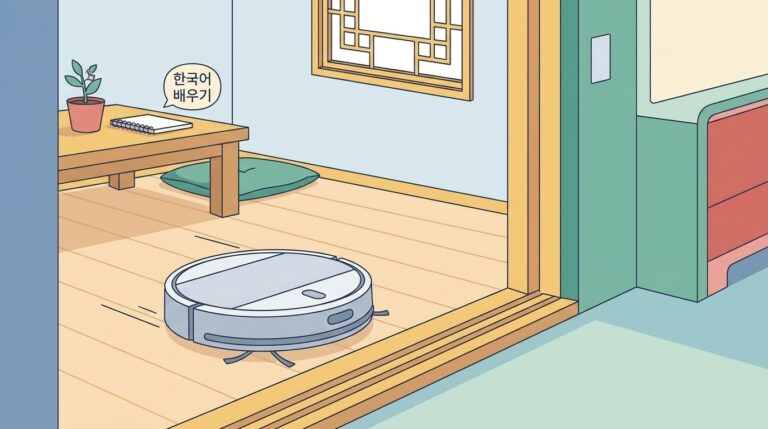
Why Koreans Call Their Robot Vacuum Auntie: Mastering Home Tech & Door Sills
Phase 1: 공감 (Story-Immersive Opening)
안녕하세요! 매일한글 에디터입니다.
Picture this: You are invited to a stylish, newly renovated officetel in Mapo-gu for a housewarming party (집들이 – jip-deu-ri). The living room is bathed in warm ambient lighting, modern aesthetic ceramics line the shelves, and there is a faint scent of hinoki wood in the air. Suddenly, a sleek, disc-shaped machine glides out from under the sofa, humming with robotic diligence. Just as you are about to admire the cutting-edge tech, the device hits the 1.5-centimeter wooden door sill between the living room and the kitchen. The wheels spin uselessly, lifting off the ground like an overturned turtle. Your Korean host dashes over, clasps their hands in genuine sympathy, and exclaims:
“아이고, 우리 이모님 또 문턱에 걸려서 허우적거리시네!” (Aigo, uri imonim tto munteoge geollyeoseo heoujeokgeorisine! – “Oh dear, our Auntie got caught on the threshold and is flailing again!”)
Wait, Auntie? Why did an educated, tech-savvy Seoulite just address a piece of automated plastic and LiDAR sensors as their maternal aunt (이모님), while attaching the highest-grade subject honorific (-시-) to its mechanical breakdown? And why does every Korean online interior forum dedicate endless threads to the existential architectural dilemma of the 문턱 (door threshold)?
For advanced Korean learners aiming for the C2 stratosphere, the domestic sphere is a linguistic treasure trove. Cleaning is no longer a checklist of chore vocabulary; it is a profound intersection of Confucian kinship ethics, collective historical memory of floor-bound heating (온돌), and the relentless hyper-convenience of contemporary Korean smart homes. Based on feedback from hundreds of advanced learners who felt alienated by textbook domestic terms like 진공청소기로 바닥을 청소하다, this guide will immerse you in the living, breathing colloquial reality of modern Korean domestic bliss.
Phase 2: 핵심 표현 3선 심층 분석 (Deep Dive into 3 Core Expressions)
1. 이모님을 모시다 / 들이다 (I-mo-nim-eul mo-si-da / deu-ri-da)
- Pronunciation: [I-mo-nim-eul mo-si-da] (Intuitive flow: “ee-mo-neem-ool moh-she-dah” — pronounce ‘mo-si-da’ with a delicate reverence, like gently ushering a respected elder into an armchair)
- Meaning: Literal: “To escort/serve one’s maternal aunt.” vs. Real Nuance: To purchase, welcome, and rely entirely upon a premium robotic appliance (especially a robotic vacuum) that liberates the household from exhausting physical labor.
- K-Culture Moment: On the reality show I Live Alone (나 혼자 산다), a celebrity collapses onto the couch after a grueling schedule, watches their flagship all-in-one vacuum begin its cycle, and whispers toward the ceiling: “이모님 안 모셨으면 어쩔 뻔했냐…” (What on earth would I have done if I hadn’t brought in Auntie…).
- Editor’s Insight: At the C2 level, observe the syntactic selection of the honorific transitive verb 모시다 (to escort/host a superior) rather than the transactional 사다 (to buy). By personifying the appliance as 이모님 (traditionally affectionate term for a domestic helper or maternal aunt), native speakers express humorous yet deeply sincere emotional dependence.
- Situation Spectrum: Casual: ✅ | Semi-formal: ✅ | Formal: ⚠️ (Acceptable in lifestyle journalism or corporate marketing copy, but not in academic engineering manuals)
- 🤔 Think About It: Why does Korean culture so effortlessly anthropomorphize inanimate home machinery into familial relations, whereas Western languages typically treat smart appliances as neutral, subordinate automated tools?
2. 문턱을 넘다 (Mun-teok-eul neom-da)
- Pronunciation: [Mun-teo-geul neom-da] (Intuitive flow: “moon-tuck-ool num-dah” — crisp plosive on ‘teok’ followed by a rounded ‘neom’)
- Meaning: Literal: “To cross over a raised door sill.” vs. Real Nuance: In domestic engineering, it denotes a vacuum’s mechanical suspension navigating floor elevations. Idiomatically, it means surmounting a critical threshold, a high barrier of entry, or an ordeal.
- K-Culture Moment: Architecture and home-improvement YouTube channels reviewing flagship appliances test them across varying floor heights, asking dramatic questions like: “과연 2cm 문턱의 벽을 넘을 수 있을 것인가?” (Will it truly conquer the formidable wall of a 2-centimeter threshold?).
- Editor’s Insight: Traditional Korean homes (한옥) and older apartments constructed through the 1990s possess distinct raised wooden thresholds (문지방) separating rooms to block drafts and seal 온돌 warmth. Modern robot vacuum owners obsess over whether their model can clear this architectural legacy without human rescue.
- Situation Spectrum: Casual: ✅ | Semi-formal: ✅ | Formal: ✅
- 🤔 Think About It: In your native culture, what architectural features serve as metaphors for social or psychological obstacles?
3. 삶의 질이 수직 상승하다 (Salm-ui ji-ri su-jik sang-seung-ha-da)
- Pronunciation: [Sal-mui ji-ri su-jik sang-seung-ha-da] (Intuitive flow: “sahl-mee jee-ree soo-jeek sahng-seung-hah-dah” — deliver with buoyant, rising intonation)
- Meaning: Literal: “The quality of life undergoes a vertical ascent.” vs. Real Nuance: An exponential, life-altering breakthrough in personal comfort, mental peace, and leisure time caused by eliminating a daily friction point.
- K-Culture Moment: On interior styling apps like Today’s House (오늘의집), user testimonials universally conclude: “로봇청소기 들이고 나서 퇴근 후 삶의 질이 수직 상승했습니다.” (Ever since welcoming the robot vacuum, my post-work quality of life has skyrocketed vertically).
- Editor’s Insight: Advanced discourse utilizes spatial-mathematical idioms like 수직 상승 (vertical rise) to express hyperbolic emotional transformation. It sounds dramatically more refined and contemporary than merely saying “아주 편해졌어요” (It became very convenient).
- Situation Spectrum: Casual: ✅ | Semi-formal: ✅ | Formal: ✅
- 🤔 Think About It: Does your culture measure domestic happiness through hours of labor saved, or through the moral virtue of manual effort?
Phase 3: 교과서 한국어 vs 진짜 한국어 (Textbook vs. Real-World Korean)
Situation 1: Recommending a robotic appliance to an exhausted friend
- 📖 교과서 한국어 (Textbook Style):
“로봇 청소기를 사면 바닥 청소를 대신해 주기 때문에 시간을 절약할 수 있습니다.”
(Robot cheong-so-gi-reul sa-myeon ba-dak cheong-so-reul dae-sin-hae ju-gi ttae-mun-e si-gan-eul jeol-yak-hal su it-seum-ni-da. – “If you purchase a robot cleaner, you can save time because it cleans the floor for you.”) - 🗣️ 진짜 한국어 (Real-World C2 Fluency):
“속는 셈 치고 이모님 한 번 들여봐. 매일 퇴근길 발걸음부터 달라져.”
(Sok-neun sem chi-go i-mo-nim han beon deu-ryeo-bwa. Mae-il toe-geun-gil bal-geol-eum-bu-teo dal-la-jyeo. – “Just take a leap of faith and bring an Auntie home. The very step of your evening commute will feel totally different.”) - 💡 왜 다를까? (Why the Difference?):
Textbook formulations focus on sterile utility (구입하다, 절약하다). Real-world C2 colloquial speech leans into experiential idioms like 속는 셈 치고 (“giving it the benefit of the doubt / taking a leap of faith”) and evocative sensory manifestations of relief (퇴근길 발걸음).
Situation 2: Explaining why your robot vacuum stopped working in an older flat
- 📖 교과서 한국어 (Textbook Style):
“방 문턱의 높이가 높아서 청소기가 이동하지 못하고 멈췄습니다.”
(Bang mun-teok-ui no-pi-ga no-pa-seo cheong-so-gi-ga i-dong-ha-ji mot-ha-go meom-chwot-seum-ni-da. – “Because the room threshold was high, the cleaner could not move and stopped.”) - 🗣️ 진짜 한국어 (Real-World C2 Fluency):
“구옥이라 문턱 단차가 워낙 심해서, 이모님이 넘어가질 못하고 턱에 걸려 버벅거리시네.”
(Gu-og-i-ra mun-teok dan-cha-ga wo-nak sim-hae-seo, i-mo-nim-i neom-eo-ga-jil mot-ha-go teog-e geol-lyeo beo-beok-geo-ri-si-ne. – “Since it’s an older building, the threshold elevation gap is severe, so Auntie can’t get over it and keeps stuttering stuck on the ledge.”) - 💡 왜 다를까? (Why the Difference?):
Native fluency demonstrates situational vocabulary such as 구옥 (vintage house/older construction) and 단차 (step difference/elevation gap), fused with expressive mimetic verbs like 버벅거리다 (to stutter, hitch, struggle clumsily) and ironic honorific agreement (-시-).
Phase 4: K-Culture 딥다이브 & 비언어적 매너 (Deep-Dive & Cultural Etiquette)
4-1. 눈치 (Nunchi) & Spatial Mannerisms
In traditional Korean culture, the threshold (문턱 or 문지방) is spiritually liminal space. An ancient superstition dictates: “문지방을 밟으면 복(福)이 달아난다” (If you step on the threshold, your good fortune escapes). While younger generations don’t believe in household spirits, this spatial taboo persists bodily: Koreans rarely step directly down on wooden sills; they step over them.
When visiting a Korean friend’s home where a robot vacuum is roaming:
* Floor Clear Nunchi: Keep your socks clear of loose charging cables and slippers. If you see the robot approaching, gently lift your feet or reposition your slippers onto a shoe mat. Stepping in front of a working robot vacuum while the host is proudly demonstrating its LiDAR precision displays a distinct lack of 눈치 (situational awareness).
* Acknowledging the Appliance: If the host affectionately speaks to or about their 이모님, validate it with a warm laugh and gentle nods. Do not coldly dismiss it as “just an appliance” (그냥 기계잖아); you are engaging in an intimate ritual of shared modern relief.
4-2. Cultural Code: “The Holy Trinity of Aunties” (3대 이모님)
In Korean socio-cultural discourse, the meteoric rise of the dual-income household (맞벌이 부부) collided with intense professional workloads. Traditional Confucian standards of immaculate cleanliness—particularly the back-breaking daily chore of damp floor wiping (물걸레질)—created severe marital stress.
Enter the modern pantheon of home automation, codified in pop culture and advertising as the 3대 이모님 (The Three Honored Aunties):
1. 로봇청소기 (Robot Vacuum): Emancipates the lower back from sweeping and damp mopping.
2. 식기세척기 (Dishwasher): Resolves post-dinner exhaustion and prevents kitchen sink spats.
3. 의류건조기 (Tumble Dryer): Liberates living rooms from humidity and drying racks (빨래 건조대).
To speak of these devices in Korea is to discuss self-care, preservation of marital peace, and modern emancipation from domestic drudgery.
Phase 5: 실전 롤플레이 시나리오 (Interactive Roleplay Scenario)
Setting: A sunlit brunch café in Yeonnam-dong. You are catching up with Min-ji (민지), a stylish interior designer living in a charmingly renovated 1980s brick villa (빨간 벽돌 빌라).
[Scene Start]

Turn 1 (민지):
"너 이번에 이사한 빌라, 인테리어는 거의 다 끝났어? 완전 기대된다!"
(Neo i-beon-e i-sa-han bil-la, in-te-ri-eo-neun geo-ui da kkeun-nat-eo? Wan-jeon gi-dae-doen-da!)
"Did you finish most of the interior work for the villa you moved into? I'm so excited!"
🎭 [민지는 커피잔을 내려놓으며 반짝이는 눈빛으로 턱을 괸다.]

Turn 2 (You):
"도배랑 장판은 싹 새로 했는데, 문제는 방마다 문턱이 2cm 넘게 솟아 있어서 골치 아파."
(Do-bae-rang jang-pan-eun ssak sae-ro haet-neun-de, mun-je-neun bang-ma-da mun-teok-i i-sen-ti neom-ge sot-a it-seo-seo gol-chi a-pa.)
"I redid all the wallpaper and linoleum, but the issue is the door sills in every room stick up over 2cm, which is a massive headache."
🎭 [미간을 살짝 찌푸리며 손가락으로 2cm 두께를 가늠해 보인다.]

Turn 3 (민지):
"아, 구옥 특유의 그 높은 문턱! 그럼 이번에 로봇 청소기 이모님 모시려던 계획은 어떻게 되는 거야?"
(A, gu-ok teuk-yu-ui geu no-peun mun-teok! Geu-reom i-beon-e ro-bot cheong-so-gi i-mo-nim mo-si-ryeo-deon gye-hoek-eun eo-tteo-ke doe-neun geo-ya?)
"Ah, that classic vintage-house high threshold! Then what happens to your plan of bringing an Auntie robot vacuum home?"
🎭 [안타까운 표정으로 가볍게 한숨을 내쉰다.]

Turn 4 (You):
"안 그래도 매일 퇴근하고 물걸레질할 생각 하니까 벌써부터 허리가 끊어질 것 같아."
(An geu-rae-do mae-il toe-geun-ha-go mul-geol-le-jil-hal saeng-gak ha-ni-kka beol-sseo-bu-teo heo-ri-ga kkeun-eo-jil geot gat-a.)
"Seriously, just thinking about damp-mopping by hand every night after work makes my back ache already."
🎭 [허리에 손을 얹으며 절박한 표정을 짓는다.]

Turn 5 (민지):
"요즘 나오는 플래그십 모델들은 2cm 단차는 거뜬히 넘는 섀시 리프팅 기능이 있던데, 알아봤어?"
(Yo-jeum na-o-neun peul-lae-geu-sip mo-del-deul-eun i-sen-ti dan-cha-neun geo-tteun-hi neom-neun syae-si ri-peu-ting gi-neung-i it-deon-de, al-a-bwat-eo?)
"Flagship models coming out lately have chassis-lifting features that clear a 2cm elevation effortlessly; have you looked into them?"
🎭 [스마트폰을 꺼내 최신 가전 리뷰 화면을 보여주며 묻는다.]

Turn 6 (You):
"진짜? 문턱 때문에 이모님 모시는 건 아예 포기하고 있었는데, 당장 찾아봐야겠다."
(Jin-jja? Mun-teok ttae-mun-e i-mo-nim mo-si-neun geon a-ye po-gi-ha-go it-eot-neun-de, dang-jang cha-ja-bwa-ya-get-da.)
"Really? I had completely given up on welcoming an Auntie because of the sills; I need to look that up right now."
🎭 [놀란 눈으로 스마트폰 화면에 시선을 고정한다.]

Turn 7 (민지):
"만약 높이가 애매하면, 인터넷에서 실리콘 문턱 경사로 주문해서 깔아두면 감쪽같아."
(Man-yak no-pi-ga ae-mae-ha-myeon, in-teo-net-e-seo sil-li-kon mun-teok gyeong-sa-ro ju-mun-hae-seo kkal-a-du-myeon gam-jjok-gat-a.)
"If the height is borderline, you can order a silicone threshold ramp online and set it down; it works like a charm."
🎭 [손바닥을 비스듬히 기울여 경사로 형태를 흉내 낸다.]

Turn 8 (You):
"경사로까지 설치해서라도 꼭 모셔와야겠네. 나도 드디어 삶의 질 수직 상승 맛 좀 보자!"
(Gyeong-sa-ro-kka-ji seol-chi-hae-seo-ra-do kkok mo-syeo-wa-ya-get-ne. Na-do deu-di-eo salm-ui jil su-jik sang-seung mat jom bo-ja!)
"Even if I have to install ramps, I'm definitely bringing her home. Let me finally taste that vertical quality-of-life skyrocket!"
🎭 [결의에 찬 주먹을 쥐며 활짝 웃는다.]

[Scene End]
🔀 인터랙티브 분기점 (Interactive Choice)
Min-ji offers you one final piece of strategic advice. Which decision will you choose for your vintage flat?
- Option A: “그냥 문턱 목공 공사 불러서 싹 갈아내고 평평하게 만들래. 그게 근본적인 해결책이잖아.”
- Outcome (Best Strategy – Linguistic & Cultural Mastery): Flawless Native Nuance. You recognized that 문턱 철거 (threshold demolition/grinding) is the gold standard of modern Korean renovations. Min-ji nods vigorously: “역시 큰 그림을 볼 줄 아네! 문턱 밀어버리면 로봇청소기는 물론이고 집도 훨씬 넓어 보여!” (You know how to see the big picture! If you grind away the thresholds, not only will the vacuum roam freely, but the house will also look much more spacious!)
- Option B: “기계 하나 쓰자고 경사로까지 사? 그냥 내가 청소기 들어서 방마다 옮겨다 놓지 뭐.”
- Outcome (Bad Strategy – Self-Defeating Irony): Pragmatic Failure. Moving the robot by hand contradicts the entire philosophical essence of the 이모님. Min-ji laughs incredulously: “그럴 거면 비싼 돈 주고 왜 모셔? 네가 이모님의 수발을 들고 있네!” (Why pay premium money to welcome her if you’re doing that? You’d be acting as Auntie’s butler!)
- Option C: “다 필요 없고 물걸레 기능 없는 제일 저렴한 기본 모델로 타협할래.”
- Outcome (Risk Strategy – The Damp Mop Pitfall): Cultural Mismatch. In Korea, dry sweeping without damp mopping (물걸레질) leaves micro-dust on hard ondol floors. Min-ji warns: “한국 바닥은 걸레질 안 하면 끈적거려서 무조건 후회해. 신중하게 다시 생각해 봐!” (Korean floors get sticky without wet mopping; you will 100% regret it. Reconsider carefully!).
Phase 6: 10초 감정 섀도잉 드릴 (10-Second Emotional Shadowing Drill)
Master these three sentences using native cadence markers (/) and internal emotional intentionality:
- Drill 1: [🤩 확신에 찬 어조로 동반자에게 강력 추천하듯이 – Confident & Evangelizing]
“진짜 속는 셈 치고 / 이모님 한 번 모셔봐. / 삶의 질이 수직 상승한다니까?”
(Jin-jja sok-neun sem chi-go / i-mo-nim han beon mo-syeo-bwa. / Salm-ui ji-ri su-jik sang-seung-han-da-ni-kka?)
“Take a leap of faith / bring an Auntie home just once. / I’m telling you, your quality of life will literally skyrocket!” -
Drill 2: [😅 헛웃음 치며 애정 어린 체념을 담아 – Affectionately Resigned Chuckle]
“우리 집 문턱이 워낙 높아서 / 이모님이 또 턱에 걸려 버벅거리시네.”
(U-ri jip mun-teok-i wo-nak no-pa-seo / i-mo-nim-i tto teog-e geol-lyeo beo-beok-geo-ri-si-ne.)
“Our door sills are just so unusually high / our Auntie got caught on the threshold and is stuttering again.” -
Drill 3: [😌 온갖 집안일에서 해방된 자의 평화로운 감탄 – Serene Liberation]
“퇴근하고 문 열었을 때 / 맨발에 닿는 뽀송뽀송한 바닥 감촉… / 이게 바로 행복이지.”
(Toe-geun-ha-go mun yeor-eot-seul ttae / maen-bar-e da-neun ppo-song-ppo-song-han ba-dak gam-chok… / I-ge ba-ro haeng-bok-i-ji.)
“When I open the front door after work / the crisp, powdery texture of the floor against my bare feet… / this is what true happiness is.”
Phase 7: K-Culture 미니 사전 (Mini Cultural Dictionary)
- 삼대 이모님 (Sam-dae I-mo-nim)
- Definition: The “Holy Trinity of Household Aunties” — robot vacuum, automatic dishwasher, and clothes dryer.
- Real-world Usage: Dominates wedding gift registries (혼수 리스트) and newlywed apartment discussions as non-negotiable mental health preservation.
- 문턱 단차 / 문턱 경사로 (Mun-teok Dan-cha / Mun-teok Gyeong-sa-ro)
- Definition: The elevation step difference of a door sill / A ramp made of rubber or silicone to smooth the gap.
- Real-world Usage: Essential e-commerce search keywords when living in vintage apartments (구옥 빌라) to allow automated vacuums cross-room mobility.
- 물걸레 세척·열풍 건조 (Mul-geol-le Se-cheok · Yeol-pung Geon-jo)
- Definition: Auto mop washing and hot-air drying base stations.
- Real-world Usage: The definitive benchmark for high-end Korean models; without hot-air drying, wet mops develop a sour mildew stench (걸레 쉰내) in humid Korean summers.
- 맵핑 (Maep-ping – Mapping)
- Definition: The smart LiDAR scanning of an apartment’s room configuration.
- Real-world Usage: Used colloquially when pets or visitors obstruct floor plans: “우리 강아지가 돌아다녀서 맵핑이 꼬였어” (Our puppy roamed around, so the mapping got tangled).
Phase 8: 여행자 & 거주자를 위한 생존 키트 (Survival Kit for Expats & Nomads)
Top 3 Survival Expressions
-
Survival 1 (At an Electronics Mega-Store):
“이 모델 문턱 등반 높이가 몇 센티까지 가능한가요?”
(I mo-del mun-teok deung-ban no-pi-ga myeot sen-ti-kka-ji ga-neung-han-ga-yo?)
*Pro Tip: Ask this at Electro Mart or Hi-Mart; sales specialists will quote precise millimeter clearances (e.g., “최대 20mm까지 등반 가능합니다”). -
Survival 2 (Negotiating Villa Leases with a Landlord):
“혹시 입주 전에 방문 문턱 제거 공사나 샌딩을 진행해도 될까요?”
(Hok-si ip-ju jeon-e bang-mun mun-teok je-geo gong-sa-na saen-ding-eul jin-haeng-hae-do doel-kka-yo?)
*Pro Tip: In vintage rentals, landlords may allow sill leveling if it enhances property value, provided you ask before lease signing. -
Survival 3 (Troubleshooting Maintenance Online):
“청소기가 특정 구역 문턱에서 헛돌면서 낙하 방지 센서 오류가 뜹니다.”
(Cheong-so-gi-ga teuk-jeong gu-yeok mun-teog-e-seo heot-dol-myeon-seo nak-ha bang-ji sen-seo o-ryu-ga tteum-ni-da.)
*Pro Tip: Crucial for customer service app chat inquiries when your robot gets stranded over dark thresholds.
Editor’s Domestic Note
If you are hunting for appliance parts or sill-ramps in Seoul, don’t rely on generic global maps. Use the 네이버 지도 앱 다운로드 to locate specialized interior hardware hardware stores (철물점) in districts like Euljiro-4-ga, where you can buy custom-cut silicone ramps for a fraction of department store prices.
Phase 9: “한 발 더 깊이” (Stepping Deeper: Cultural Essay)
Language is never socially neutral. The Korean propensity to address domestic machinery through kinship honorifics (이모님) reflects a profound linguistic animism rooted in communal survival. Historically, domestic labor in Korean households was intense, physical, and intergenerational—undertaken communally by women of the family sitting on the heated 구들 floor. By elevating a mechanical disk to an 이모님, modern Koreans resolve the residual moral guilt associated with “neglecting” manual domestic perfection. The machine is not an exploited servant; she is a cherished, honored member of the extended family who protects our time and sanity. When we say 이모님, we are celebrating our freedom from fatigue.
💬 Your Turn: What household chore exhausts you the most after a long day? Have you ever given a name or human persona to an appliance in your home? Share your thoughts below in Korean!
Phase 10: FAQ & 오해 방지 (FAQ & Common Mistakes)
Q: Can I use the term ‘이모님’ when speaking formally in a professional business presentation about home electronics?
A: In formal technical presentations, stick to objective industry terminology such as 로봇 청소기 (robotic vacuum cleaner) or 스마트 홈 청소 솔루션 (smart home cleaning solution). However, in advertising, marketing copywriting, or trend presentations, 로봇청소기 이모님 is widely accepted as a cultural buzzword reflecting consumer affection.
Q: Is it considered rude to refer to actual human cleaning professionals as ‘이모님’?
A: Calling a domestic helper 이모님 was long considered affectionate and polite compared to older, outdated terms like 파출부. However, the modern industry standard is moving toward professional honorific titles like 가사관리사님 (domestic manager) or 매니저님 (manager). When hiring through official Korean platforms (like Miso or Dalsomi), use 매니저님 or 관리사님 to show professional respect.
Q: Why do Korean robot cleaners emphasize damp mopping (물걸레) so much more than Western vacuums?
A: Korean homes are strictly barefoot cultures heated by radiant floor systems (온돌). Dust does not stay suspended in carpets; it bonds with human skin oils on vinyl, tile, and wood. Without damp wiping (걸레질), barefoot walking feels tacky (끈적거림). Hence, a robot without a mop is considered only half an appliance in Korea.
🚨 Common Mistakes (흔한 실수 TOP 3)
- Treating ‘이모님’ without subject honorifics in humorous banter:
- Wrong: 우리 이모님이 턱에 걸려 넘어졌어. (Lacks the ironic honorific flavor)
- Correct Action: 우리 이모님이 턱에 걸려 버벅거리시네. (Adding -시- elevates the joke to natural C2 native wit).
- Confusing ‘문턱’ (door threshold) with ‘계단’ (stair step):
- Wrong: 방 사이에 작은 계단이 있어요. (Awkward for sills under 3cm)
- Correct Action: 방 사이에 문턱 단차가 있어요. (Precise architectural term for sill elevation gaps).
- Using ‘사다’ when boasting about your new lifestyle upgrade:
- Wrong: 나 드디어 로봇 청소기 샀어. (Flat, transactional)
- Correct Action: 나 드디어 집에 이모님 모셨잖아. (Vibrant, culturally attuned).
Phase 11: 액션 미션 & 참여 유도 (Action Missions)
- 🥉 Bronze Mission (Solo Shadowing):
Record yourself delivering Drill 1 from Phase 6 with explosive enthusiasm, paying special attention to the pause after 속는 셈 치고. - 🥈 Silver Mission (Community Engagement):
Find a Korean interior vlog on YouTube using the search keyword 랜선 집들이 (virtual housewarming). In the comment section, leave a supportive comment in Korean complimenting their home and asking if their robot handles the door sills: “인테리어 너무 깔끔해요! 혹시 문턱 단차는 어떻게 해결하셨는지 궁금합니다.” - 🥇 Gold Mission (Real-World Test):
Visit a local Korean retail electronics floor (or an online shopping forum like 뽐뿌 or 오늘의집) and engage a sales clerk or forum post using the phrase: “2cm 문턱 등반 가능한 모델로 추천해 주실 수 있나요?”
🎮 K-Culture Media Mission: Next time you watch an episode of 나 혼자 산다 (I Live Alone) or 신박한 정리 (The House Detox), listen closely for the exact moment the cast refers to an appliance as 이모님. Note their tone and facial expressions!
Phase 12: 인터랙티브 퀴즈 챌린지 (Interactive Quiz Challenge)
Q1. Situational Judgment: Your Korean colleague looks exhausted and complains about domestic chores: “매일 야근하고 집 가면 바닥 닦을 기운도 없어요.” What is the most culturally savvy and empathetic C2 response?
– A) “빨리 자는 것이 건강에 좋습니다.”
– B) “속는 셈 치고 이모님 한 번 들여보세요. 삶의 질이 수직 상승해요.”
– C) “진공청소기의 사용 빈도를 주 1회로 줄이세요.”
– D) “가사관리사를 법적으로 고용하십시오.”
Q2. Fill-in-the-Blank: Choose the correct pair of words to complete this authentic apartment renovation statement:
“우리 집은 워낙 90년대 ( ) 빌라라서 방마다 ( )이/가 높아 로봇 청소기가 넘어가질 못해요.”
– A) 신축 — 베란다
– B) 구옥 — 문턱
– C) 오피스텔 — 대문
– D) 타운하우스 — 마루
Q3. Cultural True/False:
True or False: In modern Korean socio-cultural slang, ‘3대 이모님’ refers to your mother’s three eldest biological sisters who come to visit during Chuseok.
👉 Click here to reveal Answers & In-depth Explanations
- Q1 Answer: B
Explanation: Option B uses the vibrant cultural metaphor 이모님을 들이다 and the expressive idiom 삶의 질이 수직 상승하다. Option A and C sound patronizing or overly literal, while Option D is bizarrely formal and cold. - Q2 Answer: B (구옥 — 문턱)
Explanation: 구옥 refers to vintage, older residential architecture, which typically features prominent wooden door sills (문턱). 신축 (new builds) generally feature barrier-free flat thresholds (무문턱). - Q3 Answer: False
Explanation: 3대 이모님 is the affectionate moniker for the three essential modern labor-saving appliances: the robot cleaner, the dishwasher, and the clothes dryer!






