

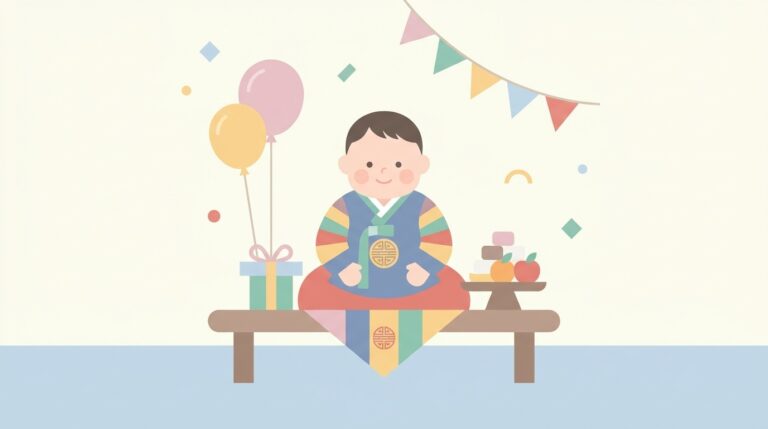
When the Baby Cries at a Korean First Birthday Party: How to React Like a True Local Friend
Phase 1: Empathy (Opening)
안녕하세요! 매일한글 에디터입니다. (Hello! It’s your Daily Hangul editor.)
Picture this: You are attending a lavish first birthday celebration—a 돌잔치 (Doljanchi)—at a boutique hotel in Seoul for your Korean coworker’s baby. The room is decorated with pastel peonies, towers of celebratory rice cakes, and shimmering brass tableware. The one-year-old star of the day is dressed in an intricate, vibrant silk 한복 (hanbok) with a tiny traditional hat. Everyone is holding their breath in anticipation of the 돌잡이 (Doljabi)—the climax of the party where the baby chooses an item predicting their future career.
Suddenly, the bright camera flashes pop, the microphone echoes, and… WAAAHHH!
The baby scrunches up their red face and bursts into uncontrollable, heart-wrenching sobs. The room falls dead silent. The young parents turn pale with panic, desperately rocking the squirming infant while the MC’s smile freezes. You find yourself sitting in the second row, wide-eyed, completely frozen. Do I look away? Should I try to play peek-a-boo? What do I say in Korean so I don’t look completely indifferent or accidentally offensive?
If you have ever felt your stomach drop during an unexpected social freeze in Korea, you are not alone! Over the past decade, dozens of our intermediate learners have confessed: “I knew textbook congratulations, but when the baby cried, my brain short-circuited.” Today, we are turning that panic into your moment to shine. Armed with our authentic, field-tested B1 guide, you will learn the exact empathetic words, body language, and cultural instincts native Koreans use to melt the tension and support the parents with poise.
Phase 2: Core Expressions Deep Dive
Here are three essential B1-level expressions native speakers use whenever a baby gets overwhelmed at a family event.
1. 아이구, 졸린가 봐요. (Aigu, jollin-ga bwayo.)
- Pronunciation: [A-i-gu, jol-lin-ga bwa-yo] (“Eye-goo” sounds just like a soothing sigh of “Oh dear!”, while “jol-lin-ga” rolls smoothly off the tongue like “jolly-n-ga”).
- Meaning: Literal: “Oh dear, it seems they are sleepy.” / Actual Nuance: “Oh sweetheart, this big party must be exhausting for you! (To parents: You’re doing fine, don’t feel embarrassed!)”
- K-Culture Moment: You will hear this exact line constantly on family reality programs like 슈퍼맨이 돌아왔다 (The Return of Superman) whenever celebrity toddlers get fussy under the hot studio lights.
- Editor’s Insight: This phrase is psychological gold. By attributing the tears to a natural physical need (sleepiness) rather than bad behavior, you instantly take the guilt and pressure off the sweating parents.
- Situation Spectrum: Casual ⚠️ | Semi-formal (Polite) ✅ | Formal ✅
- 🤔 Think About It: In many Western gatherings, guests might politely look away to give the family privacy. Why do Korean gatherings prefer to vocalize gentle, communal excuses for the child’s discomfort?
2. 낯설어서 울 수도 있죠. (Natseoreoseo ul su-do itjyo.)
- Pronunciation: [Nat-seor-eo-seo ul su-do it-jyo] (“Nat-seol” sounds like the English words “nut-soul”, ending with a comforting downward pitch on “itjyo”).
- Meaning: Literal: “Because it’s unfamiliar, they might cry.” / Actual Nuance: “With all these strange faces and noise, of course they’re overwhelmed. It’s totally normal!”
- K-Culture Moment: In K-dramas featuring big family reunions, a warm, observant aunt or friend always steps forward with this line when a young mother begins apologizing for her crying infant.
- Editor’s Insight: The grammar pattern
-ㄹ 수도 있죠(It can certainly happen / It’s entirely possible) is a powerful intermediate tool for normalizing stressful situations and extending grace.- Situation Spectrum: Casual ⚠️ | Semi-formal ✅ | Formal ✅
- 🤔 Think About It: How does verbally acknowledging the baby’s fear (낯설다) show emotional validation rather than dismissing the child’s reaction?
3. 천천히 해도 괜찮아요. (Cheoncheonhi haedo gwaenchanayo.)
- Pronunciation: [Cheon-cheon-hi hae-do gwaen-chan-a-yo] (“Cheon-cheon” rhymes with “chun-chun”, spoken with a calm, rhythmic lilt).
- Meaning: Literal: “Even if you do it slowly, it is okay.” / Actual Nuance: “Please, take your time! Nobody is rushing you; we are all happy to wait.”
- K-Culture Moment: Often murmured by considerate guests or the MC when a Doljabi ceremony has to pause so the parents can feed or soothe the baby backstage.
- Editor’s Insight: Korea is famous for its fast-paced 빨리빨리 (ppalli-ppalli) culture. Saying 천천히 해도 괜찮아요 deliberately breaks that urgency, providing a safe pocket of patience.
- Situation Spectrum: Casual ⚠️ | Semi-formal ✅ | Formal ✅
- 🤔 Think About It: When does giving someone permission to slow down feel like the ultimate form of hospitality in your culture?
Phase 3: Textbook Korean vs. Real Korean
Let’s see how stiff grammar contrasts with warm, natural everyday Korean when a baby cries.
Situation 1: Comforting flustered parents
- 📖 교과서 한국어 (Textbook):
“아기가 울고 있으니 달래십시오.” (Agiga ulgo isseuni dallaesipsio.) — The baby is crying, so please soothe it. - 🗣️ 진짜 한국어 (Real-life Korean):
“아이구, 옷이 불편한가 봐요! 천천히 안아주세요.” (Aigu, osi bulpyeonhan-ga bwayo! Cheoncheonhi anajuseyo.) — Oh dear, the hanbok might be uncomfortable! Take your time holding them. - 💡 왜 다를까? (Why is it different?):
The textbook version sounds cold, clinical, and almost like an order issued by security. Real-life Korean shifts focus away from the crying itself onto an external culprit (the scratchy, stiff silk costume) and adds gentle reassurance.
Situation 2: Reacting to the awkward pause in the ceremony
- 📖 교과서 한국어 (Textbook):
“우리는 순서를 기다릴 수 있습니다.” (Urineun sunseoreul gidaril su itseumnida.) — We are capable of waiting for the order of events. - 🗣️ 진짜 한국어 (Real-life Korean):
“괜찮아요, 천천히 하셔도 돼요!” (Gwaenchanayo, cheoncheonhi hasyeodo dwaeyo!) — It’s all good, take all the time you need! - 💡 왜 다를까? (Why is it different?):
Textbook declarations sound like automated public address announcements. The natural ending-셔도 돼요conveys personal warmth and collective consent from the audience.
Phase 4: K-Culture Deep Dive & Non-Verbal Manners
4-1. 눈치 (Nunchi) & Gestures
When a baby screams at a Korean event, your non-verbal communication speaks louder than words:
* The Soft Nod (끄덕끄덕): Do not stare wide-eyed at the crying baby. That adds intense scrutiny. Instead, catch the flustered parents’ eyes, tilt your head slightly with a gentle smile, and nod reassuringly.
* Hands Off Policy: Never rush forward to touch, carry, or pat the baby unless the parents explicitly hand the baby to you. At one year old, Korean babies go through extreme 낯가림 (stranger anxiety), especially when surrounded by unfamiliar faces.
* The Supportive Distance Clap: If the MC makes a lighthearted joke to break the ice, clap softly along with the crowd to warm up the room atmosphere (분위기 띄우기).
4-2. Cultural Code Analysis: The Weight of Doljanchi
Why are the parents so anxious? Historically in Korea, high infant mortality meant that surviving your first 365 days was a miraculous victory. The whole village would celebrate 돌잔치 with special foods like 백설기 (white rice cake representing purity and long life) and 수수팥떡 (red bean rice cakes warding off bad spirits).
Today, parents spend months booking venues, hiring photographers, and renting expensive family hanbok sets. When the baby starts wailing right before the grand photo or the Doljabi, the parents feel like their months of meticulous preparation are falling apart in front of colleagues and in-laws. Your warm reassurance is literally rescuing their mental state!
Phase 5: Real Role-play Scenario
Setting: A sunlit banquet room at a hotel in Yeouido. Coworker Min-ho and his wife Su-jin are holding their son, Do-hyun. Do-hyun suddenly bursts into tears as the photographer prepares the group photo. You (Alex) are standing nearby.
- 수진 (Su-jin):
“어떡해… 도현아, 왜 그래? 손님들 다 기다리시는데… 죄송해요, 여러분.”
(Eotteokhae… Dohyeona, wae geurae? Sonnimdeul da gidarisineunde… Joesonghaeyo, yeoreobun.)
🎭 행동: 아기를 안고 어쩔 줄 몰라 하며 이마에 땀을 닦는다.
(“Oh no… Do-hyun, what’s wrong? Everyone is waiting… I am so sorry, everyone.”) -
알렉스 (Alex):
“아이구, 도현이가 오늘 많이 피곤한가 봐요.”
(Aigu, Dohyeon-iga oneul mani pigonhan-ga bwayo.)
🎭 행동: 따뜻한 눈빛으로 미소를 지으며 고개를 끄덕인다.
(“Oh dear, Do-hyun must be so tired today.”) -
민호 (Min-ho):
“아침부터 옷 갈아입고 사진 찍느라 스트레스를 받았나 봐요. 정말 당황스럽네요.”
(Achimbuteo ot gara-ipgo sajin jjingneura seuteureseureul badanna bwayo. Jeongmal danghwangseureopneyo.)
🎭 행동: 아기의 등을 토닥이며 미안한 표정으로 하객들을 본다.
(“He must be stressed from changing clothes and taking photos since early morning. I’m so embarrassed.”) -
알렉스 (Alex):
“낯설고 시끄러우니까 당연히 울 수도 있죠!”
(Natseolgo sikkeureounikka dang-yeonhi ul su-do itjyo!)
🎭 행동: 손을 가볍게 내저으며 안심하라는 손짓을 한다.
(“It’s unfamiliar and loud, so of course he might cry!”) -
사회자 (MC):
“우리 주인공 도현 왕자님이 목청이 아주 우렁차네요! 크게 될 인물입니다! 잠시 쉬어갈까요?”
(Uri ju-ingong Dohyeon wangjanimi mokcheongi aju ureongchanaeyo! Keuge doel inmurimnida! Jamsi swieogalkkayo?)
🎭 행동: 마이크를 쥐고 박수를 유도하며 유쾌하게 웃는다.
(“Our star Prince Do-hyun has such a powerful set of lungs! He’s destined for greatness! Shall we take a short break?”) -
수진 (Su-jin):
“다들 기다리시는데 시간 지체해서 정말 죄송해요…”
(Dadeul gidarisineunde sigan jichehaeseo jeongmal joesonghaeyo…)
🎭 행동: 두 손을 모으고 하객들에게 허리를 숙인다.
(“I’m so sorry for taking up your time when you’re all waiting…”) -
알렉스 (Alex):
[Interactive Decision Point: Choose your response below!] -
민호 (Min-ho):
“알렉스 씨 덕분에 마음이 정말 편해졌어요. 고마워요!”
(Alex-ssi deokbune ma-eumi jeongmal pyeonhaejyeoseoyo. Gomawoyo!)
🎭 행동: 깊은 안도의 한숨을 내쉬며 진심으로 미소 짓는다.
(“Thanks to you Alex, I feel so much more at ease. Thank you!”)
🔀 Interactive Branching Point
What should Alex say at turn 7?
- Choice A: “빨리 안 울게 장난감 줘보세요.” (Quickly give him a toy so he stops crying.)
- Feedback (Bad): 🚫 Too commanding and intrusive. It puts the blame back on the parents’ soothing skills.
- Choice B:
[아무 말도 안 하고 스마트폰만 바라본다](Say nothing and just stare silently at your smartphone.)- Feedback (Risk): ⚠️ While safe, it leaves an awkward chill in the air and misses a golden opportunity to deepen your friendship.
- Choice C: “천천히 안아주고 오세요. 저희는 사진 천천히 찍어도 괜찮아요!” (Take your time comforting him. We are completely fine taking photos later!)
- Feedback (Best): ✅ Perfect score! This directly relieves their schedule anxiety, validates their parental role, and showcases sophisticated B1 social manners.
Phase 6: 10-Second Emotion Shadowing Drill
Practice reading these out loud. The / represents a natural breath pause.
[🥺 다정하고 안쓰럽게 - Warmly & sympathetically]
“아이구, / 옷이 조금 / 답답했나 봐요.”
(Aigu, / osi jogeum / dabdabhaenna bwayo.)
“Oh sweetie, / the outfit must have felt / a little suffocating.”-
[😊 편안하고 안심시키며 - Relaxed & reassuringly]
“천천히 하셔도 돼요, / 저희 다 / 괜찮아요!”
(Cheoncheonhi hasyeodo dwaeyo, / jeohi da / gwaenchanayo!)
“You can take your time, / all of us / are totally fine!” -
[🥰 사랑스럽게 아기를 보며 - Adoringly looking at the baby]
“도현아~ / 울어도 / 사진은 멋지게 나올 거야!”
(Dohyeona~ / ureodo / sajineun meotjige na-ol geoya!)
“Do-hyun-ah~ / Even if you cry, / your photos will turn out amazing!”
Phase 7: K-Culture Mini Dictionary
- 돌잡이 (Doljabi)
Literal/Cultural Meaning: The highlight ritual of a first birthday party where the baby is placed in front of various symbolic items (pencil for scholar/intellectual, thread for long life, money for wealth, gavel for judge/lawyer). Whichever item the baby grabs first predicts their fortune. - 낯가림 (Natgarim)
Literal/Cultural Meaning: Stranger anxiety or shyness around unfamiliar people. Koreans say “아기가 낯을 가려요” (The baby is shy around strangers) to excuse crying. - 달래다 (Dallaeda)
Literal/Cultural Meaning: To soothe, pacify, or calm someone down (especially a crying child or an upset friend). Used often as “천천히 달래고 오세요” (Take your time soothing them). - 축의금 봉투 (Chug-uigeum Bongtu)
Literal/Cultural Meaning: The formal white congratulatory cash envelope given at weddings and Doljanchi. Guests write their name vertically on the back left and a congratulatory message on the front.
Phase 8: Survival Kit for Travelers
TOP 3 Survival Phrases for Doljanchi
- 첫 생일 진심으로 축하해요!
(Cheot saeng-il jinsimeuro chukahaeyo!)
Pro Tip: Say this with a slight bow when handing over your gift or cash envelope at the welcome reception table. - 사진 찍어 드릴까요?
(Sajin jjigeo deurilkkayo?)
Pro Tip: Parents are often running around greeting elders. Offering to take casual phone snaps while the professional photographer rests makes you an instant hero. - 천천히 달래고 오세요!
(Cheoncheonhi dallaego oseyo!)
Pro Tip: When the baby cries and parents head to the nursing room, deliver this phrase with a warm smile.
Editor’s Travel Note
- Locating the Venue: Many Doljanchi take place in specialized party halls like Festa, hotel banquet rooms, or traditional Korean restaurants (한정식집). Foreign map apps often mislabel banquet rooms inside subway stations. Make sure you use the 네이버 지도 앱 다운로드 to find exact floor levels and hall names.
- Cash Preparation: The standard cash gift (축의금) for a colleague’s Doljanchi is 50,000 to 100,000 KRW. Use crisp new bills from an ATM and place them into the blank envelopes provided at the party reception counter.
Phase 9: A Step Deeper (Cultural Reflection)
In Western individualist contexts, a crying infant in public can trigger an anxious feeling of “public nuisance,” prompting parents to quickly isolate themselves. In Korean culture, however, child-rearing is deeply rooted in the concept of 우리 (Uri – “Our / We”). An ancient Korean saying reminds us that “It takes an entire village to raise a single child”. When a baby cries at a Doljanchi, the guests do not see an awkward interruption; they see our baby navigating their very first communal challenge. By offering comforting words, you step into that village.
💬 Your Turn: Have you ever experienced a moment at a foreign cultural gathering where an unexpected mishap happened? How did people respond compared to Korea? Share your story in the comments below!
Phase 10: FAQ & Common Mistakes
Q: What should I do if the baby reaches out toward me or looks at me while crying?
A: Do not immediately pick up the baby! Maintain a gentle, non-threatening distance, smile warmly, and make soft sounds or a playful wave (까꿍 – peek-a-boo). Let the parents decide whether hand-holding is appropriate.
Q: Can I use casual banmal (반말) to the baby?
A: Yes! You can address the baby in friendly banmal (e.g., “울지 마~ 착하지!” – Don’t cry~ sweet baby!). However, always speak to the parents in polite honorifics (존댓말).
Q: Is it rude if I laugh when the baby cries during Doljabi?
A: Gentle, affectionate chuckles (아유 귀여워~) are completely fine and actually help lighten the mood! Just avoid loud, mocking laughter or pointing pointing aggressively.
🚨 Common Mistakes (흔한 실수) 경고판
- Mistake: Reaching out your hands to grab the baby from the mother’s arms.
Correct Action: Keep your hands relaxed in front of you. Never separate a distressed Korean baby from their parent. - Mistake: Saying “조용히 하세요” (Please be quiet) or “울지 마세요” to the parents.
Correct Action: Never tell parents to silence a child; instead, validate the situation with “울 수도 있죠” (Of course they can cry). - Mistake: Freezing and staring intently at the floor.
Correct Action: Acknowledge the moment with warm eye contact and a gentle nod toward the parents.
Phase 11: Action Mission & K-Culture Challenge
- 🥉 Bronze Mission (Solo): Stand in front of the mirror, put on a reassuring smile, and repeat the 3 shadowing sentences from Phase 6 three times with expressive pauses.
- 🥈 Silver Mission (Community): Record a 5-second voice note of yourself saying “아이구, 졸린가 봐요! 천천히 하셔도 돼요!” and tag @DailyHangul on your Instagram story.
- 🥇 Gold Mission (Real World): Next time you see a colleague or friend with a fussy toddler or pet, use the grammar pattern -ㄴ가 봐요 to kindly soften the situation.
- 🎮 K-Culture Mission: Search YouTube for “돌잔치 돌잡이 아기 울음” (Doljanchi Doljabi baby crying). Watch 1 clip and observe how the host uses humor to calm the atmosphere!
Phase 12: Interactive Quiz Challenge
1. Situation Judgment
You are standing in the crowd. The baby is wailing while the family tries to cut the cake. The mother looks over at you with a guilty face. What is the most culturally empathetic response?
* (A) “시끄러우니까 빨리 케이크 자르세요.”
* (B) “괜찮아요, 아기가 피곤한가 봐요. 천천히 하세요!”
* (C) “제가 아기 안아줄 테니까 케이크 자르세요.”
🔍 Click to view Answer & Explanation
Correct Answer: (B)
Explanation: Option (B) reassures the mother, explains the tears naturally, and removes the pressure of time. Option (A) is rude, and Option (C) risks triggering stranger anxiety (낯가림).
2. Fill in the Blank
Complete the sentence using the grammar that relieves parental stress:
“사람이 많고 ________ 울 수도 있죠.” (Because it’s unfamiliar, they might cry.)
* Hint: Stem of ‘unfamiliar’ is 낯설다.
🔍 Click to view Answer & Explanation
Correct Answer: 낯설어서 (Natseoreoseo)
Explanation: 낯설다 (unfamiliar) + -어서 (cause/reason) = 낯설어서 (“Because it is unfamiliar”).
3. True / False Cultural Etiquette
Statement: “At a Korean Doljanchi, if a baby cries, it is considered a bad omen for the child’s future.”
🔍 Click to view Answer & Explanation
Correct Answer: False!
Explanation: In fact, MCs and elders often jokingly praise a crying baby by saying their loud cry proves they have strong energy, vitality, and a great future ahead (목청이 좋아서 크게 될 아이)!







