

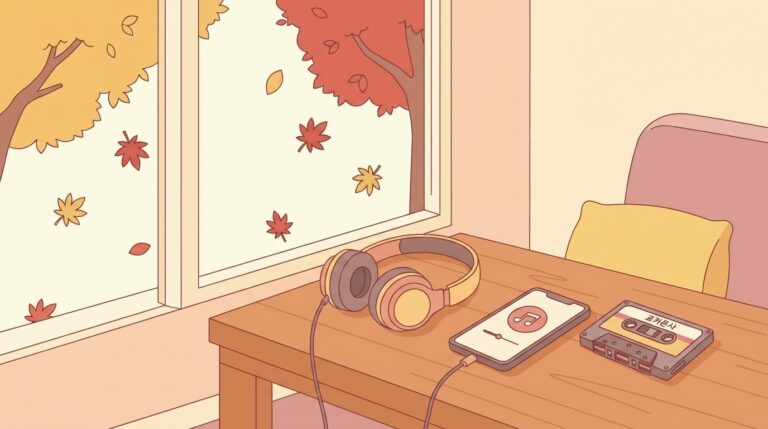
Phase 1: Empathy (Story-Driven Opening)
안녕하세요! 매일한글 에디터입니다.
It is 1:30 AM on a quiet Tuesday night. You just finished the season finale of your favorite K-drama. The screen fades to black, the emotional bridge of the lead ballad swells, and you are sitting on your sofa clutching a throw pillow, completely shattered. The next morning on your commute, you pull out your phone, plug in your earbuds, and press repeat on that exact theme song for the forty-seventh time. Your eyes tear up on the subway just hearing the opening piano chords.
We have all been there. You desperately want to tell your Korean friends, tweet your thoughts, or leave a heartfelt comment under the official YouTube music video. But when you try to assemble the sentence, your brain serves up the stiff textbook phrase: “음악이 좋습니다” (The music is good). It sounds like a lukewarm grade-school review rather than the deep, heart-wrenching emotional connection you actually feel.
As a Korean language educator who has guided hundreds of intermediate learners through the rabbit hole of Hallyu culture, I know how frustrating it feels when your genuine passion gets lost in mechanical vocabulary. In this guide, you will master the authentic expressions native speakers use when they cannot stop playing a drama soundtrack on repeat. Let us take your Korean conversation from textbook-flat to emotionally resonant.
Phase 2: Core 3 Expressions Deep Dive
1. OST가 너무 좋아서 무한 반복 중이에요
- Pronunciation: [OST-ga neomu joaseo muhan banbok jung-ieyo] (Sound metaphor: Imagine saying “moo-hahn ban-boke joong-ee-yeo” smoothly, like an infinite loop gently rolling off your tongue).
- Meaning: Literal: “Because the OST is so good, I am in the middle of infinite repetition.” / Actual Nuance: “This OST is so good I have it on infinite repeat!”
- K-Culture Moment: You will see this exact phrase dominating the comments on Melon and YouTube whenever a blockbuster romance drama drops its emotional climax track.
- Editor’s Insight: “무한 반복” (muhan banbok) literally translates to “infinite repetition.” Using “~중이에요” (-jung-ieyo, in the middle of doing something) shows an ongoing action that you cannot pull yourself away from.
- Situation Spectrum: Casual ✅ | Semi-formal ✅ | Formal ⚠️
- 🤔 Think About It: Why do Koreans prefer saying “infinite repeat” instead of simply “listening a lot”? What does this say about the passionate, all-or-nothing emotional investment in K-drama fandoms?
2. 노래 들을 때마다 드라마 장면이 떠올라요
- Pronunciation: [Norae deureul ttaemada drama jangmyeoni tteoollayo] (Sound metaphor: “Ttae-ma-da” sounds crisp and rhythmic, like clockwork clicking every time the track plays).
- Meaning: Literal: “Every time I listen to the song, drama scenes float up.” / Actual Nuance: “Every single time I hear this song, scenes from the drama flash before my eyes.”
- K-Culture Moment: Said over iced Americanos when discussing how an emotional scene in a fantasy romance was completely elevated by its background score.
- Editor’s Insight: The verb “떠오르다” (tteooreuda) combines “to float” (tteuda) and “to rise” (oreuda). Instead of mechanically “remembering” (기억하다), visual memories naturally float up to the surface of your mind.
- Situation Spectrum: Casual ✅ | Semi-formal ✅ | Formal ✅
- 🤔 Think About It: In English, we often say “It reminds me of the scene,” making the listener the subject. In Korean, the scenes float up on their own. How does this reflect the sensory, immersive perspective of Korean speech?
3. 완전 띵곡이에요! 제 인생 OST예요
- Pronunciation: [Wanjeon tting-gog-ieyo! Je insaeng OST-yeyo] (Sound metaphor: “Tting” sounds like a crisp lightbulb pinging on in your head).
- Meaning: Literal: “It’s a total tting-gok! It’s my life OST.” / Actual Nuance: “It’s an absolute masterpiece! This is the soundtrack of my life.”
- K-Culture Moment: Widely used on Twitter/X, Instagram Stories, and community boards like Instiz when sharing music player screenshots with lyrics highlighted.
- Editor’s Insight: “띵곡” (tting-gok) is beloved internet slang born from visual similarity: in Hangeul typography, the syllable “명” (myeong, meaning famous/masterpiece) looks remarkably like “띵” (tting). Pairing it with “인생 [Noun]” crowns it as the single best piece you have ever encountered.
- Situation Spectrum: Casual ✅ | Semi-formal ✅ | Formal 🚫
- 🤔 Think About It: How does creative visual wordplay like “명곡 -> 띵곡” show the flexible, youthful evolution of modern written Korean?
Phase 3: Textbook Korean vs. Real Korean
Situation 1: Telling someone you are streaming a song non-stop
- 📖 교과서 한국어 (Textbook): 이 음악을 자주 듣습니다. (I listen to this music often.)
- 🗣️ 진짜 한국어 (Real-world): 이 노래 지금 스밍 돌리고 있어요! (I norae jigeum seuming dolligo isseoyo! / I’m streaming this on loop right now!)
- 💡 왜 다를까?: While “자주 듣습니다” is grammatically correct, real fans use “스밍” (short for streaming) paired with the vivid action verb “돌리다” (to spin/run on repeat). It captures active, modern music-listening culture.
Situation 2: Expressing deep, tear-jerking emotion from a ballad
- 📖 교과서 한국어 (Textbook): 이 노래는 매우 감동적입니다. (This song is very touching.)
- 🗣️ 진짜 한국어 (Real-world): 첫 소절 듣자마자 눈물버튼 눌렸잖아요. (Cheot sojeol deutjamaja nunmul-beoteon nullyeotjanhayo! / The second the first line started, my tear button was pressed!)
- 💡 왜 다를까?: “감동적입니다” feels like a formal lecture critique. Real Korean speakers describe their physical emotional reactions with dynamic metaphors like “눈물버튼” (tear button).
Phase 4: K-Culture Deep Dive & Non-verbal Manners
4-1. 눈치 (Nunchi) & Gestures
When discussing music and dramas in Korea, posture and physical gestures carry immense emotional weight:
* The Chest Tap: When saying a song touches you, gently place your right hand over your sternum or left chest and nod slowly. It visually demonstrates that the lyrics struck your heart.
* Earbud Sharing Etiquette: If you want a Korean friend to hear the soundtrack, do not just hold a speaker up to their ear. Gently offer one side of your wired earphones or a single wireless earbud with two hands, asking: “한번 들어보실래요?” (Would you like to give it a listen?).
* Eye-closing Reverence: When a favorite OST plays in a cafe or store, native speakers often close their eyes slightly for a brief second and say, “아, 이 노래…” (Ah, this song…). Doing this shows high cultural sensitivity and shared sentimental appreciation.
4-2. Cultural Code Analysis: The Power of Drama OSTs
In many Western markets, drama soundtracks are background scores or licensed pop tracks. In South Korea, OST production is an independent powerhouse industry. Top-tier vocalists like Gummy, Punch, and Paul Kim are crowned “OST Royalty” (OST 퀸/킹). An OST release can top digital charts like Melon ahead of major idol comebacks, earning the title “음원 깡패” (chart gangster). When a drama hits massive viewership, its soundtrack becomes the collective emotional memory of the entire nation for that season.
Phase 5: Real-Life Roleplay Scenario
Setting: A cozy cafe near Hongik University Station in Seoul. You are sitting with Minho (민호), a Korean university classmate who noticed you listening intently to your headphones.
- 민호: 뭐 듣고 있어요? 엄청 집중해서 듣고 있네요?
(Mwo deutgo isseoyo? Eomcheong jipjunghaeseo deutgo itneyo?)
What are you listening to? You’re listening with so much focus!
🎭 Tilted head, curious smile, pointing gently toward your earbuds. -
You: 아, 이거요? 지난주에 끝난 드라마 OST인데, 너무 좋아서 무한 반복 중이에요!
(A, igeoyo? Jinanju-e kkeunnan drama OST-inde, neomu joaseo muhan banbok jung-ieyo!)
Oh, this? It’s the OST from that drama that ended last week. It’s so good I’m on infinite repeat!
🎭 Smiling proudly, showing your phone screen. -
민호: 아, 그 드라마! 저도 그거 본방사수 했잖아요. 혹시 그 메인 발라드 트랙 맞아요?
(A, geu drama! Jeodo geugeo bonbangsasu haetjanhayo. Hoksi geu mein balladeu teuraek majayo?)
Ah, that drama! I watched the live broadcasts religiously too! Is it that main ballad track?
🎭 Widening eyes in excitement, leaning forward. -
You: 맞아요! 노래 들을 때마다 드라마 마지막 장면이 자꾸 떠올라요.
(Majayo! Norae deureul ttaemada drama majimak jangmyeoni jakku tteoollayo.)
Exactly! Every time I listen to this song, that final drama scene keeps floating into my mind.
🎭 Placing hand lightly on chest, speaking with nostalgic warmth. -
민호: 맞아요, 남주가 비 맞으면서 고백할 때 나온 그 노래죠? 완전 소름 돋았는데!
(Majayo, namjuga bi majeumyeonseo gobaekhal ttae naon geu noraejo? Wanjeon soreum dodatneunde!)
Right, the song that played when the male lead confessed in the rain, right? I got total goosebumps!
🎭 Lightly rubbing forearm to show goosebumps. -
You: 진짜 완전 띵곡이에요. 제 인생 OST로 등극했어요.
(Jinjja wanjeon tting-gog-ieyo. Je insaeng OST-ro deunggeukhaesseoyo.)
Seriously, an absolute masterpiece. It has been crowned the OST of my life.
🎭 Nodding decisively with conviction. -
민호: 인정! 도입부 피아노 반주 나오는 순간 바로 눈물 나더라고요.
(Injeong! Doipbu piano banju naoneun sungan baro nunmul nadeoragoyo.)
Agreed! The moment the opening piano melody played, tears came instantly.
🎭 Giving a firm thumbs-up. -
You: 그래서 요즘 온종일 이 노래만 스밍 돌리고 있잖아요. 질리지가 않아요!
(Geuraeseo yojeum onjong-il i noraeman seuming dolligo itjanhayo. Jillijiga anayo!)
That’s why these days I’m streaming only this song all day long. I never get sick of it!
🎭 Laughing warmly while handing him one earbud to listen along.
🔀 Interactive Branch Point: How would you react if Minho recommends another OST from the same drama?
- Option A: “그 노래도 플레이리스트에 바로 추가할게요! 취향이 저랑 진짜 잘 맞네요.” (I’ll add that track to my playlist right now! Our tastes match so well.)
- Feedback (Best): Perfect! It expresses immediate enthusiasm, builds friendly rapport, and uses natural conversational terms like “플레이리스트에 추가하다” (add to playlist).
- Option B: “네, 나중에 시간이 나면 한번 들어볼 수도 있겠습니다.” (Yes, if I have time later, I might consider listening to it.)
- Feedback (Bad): Way too distant and excessively formal for a casual coffee chat. It sounds like an evasive rejection in a business meeting.
- Option C: “그 노래 별로던데요? 이 노래가 훨씬 낫죠.” (That song wasn’t great though? This song is way better.)
- Feedback (Risk): A bit too blunt! In Korean conversational etiquette, bluntly dismissing someone’s recommendation can halt the warm mood. Even if it’s not your favorite, soften it first with “그 노래도 좋지만…” (That one is nice too, but…).
Phase 6: 10-Second Emotional Shadowing Drill
Read these lines aloud, pausing where the slash marks (/) appear and channeling the emotional stage direction:
[😊 Excitingly & Proudly]
OST가 너무 좋아서 / 하루 종일 / 무한 반복 중이에요!
(OST-ga neomu joaseo / haru jong-il / muhan banbok jung-ieyo!)
The OST is so good / all day long / I have it on infinite repeat!-
[🥺 Nostalgically with Heartfelt Emotion]
노래 첫 소절만 들어도 / 그 슬픈 장면이 / 자꾸 떠올라요…
(Norae cheot sojeolman deureodo / geu seulpeun jangmyeoni / jakku tteoollayo…)
Even hearing just the first verse of the song / that sad scene / keeps floating back to me… -
[🔥 Passionately & Decisively]
이건 진짜 평생 소장각이에요! / 완전 역대급 띵곡이에요.
(Igeon jinjja pyeongsaeng sojang-gak-ieyo! / Wanjeon yeokdaegeup tting-gog-ieyo.)
This is worth keeping for life! / An absolute all-time legendary masterpiece.
Phase 7: K-Culture Mini Dictionary
- 띵곡 (Tting-gok): [Noun] An undeniable masterpiece or instant classic song. Used universally across music streaming comment sections and social media.
- 과몰입 (Gwamorip): [Noun] Hyperfixation or extreme emotional over-immersion in a drama storyline or character relationship. Ex: “저 아직도 그 드라마 과몰입 상태예요” (I am still over-immersed in that drama).
- 눈물버튼 (Nunmul-beoteon): [Noun] Literal “tear button”; a specific song, phrase, or scene that instantly induces crying no matter how many times you experience it.
- 스밍 (Seuming): [Noun/Verb root] Slang abbreviation for “streaming” (음원 스트리밍). Typically paired with “돌리다” (to run on repeat) to show loyal support for an artist’s digital chart performance.
Phase 8: Traveler’s Survival Kit
Survival Expressions TOP 3
- 이 노래 제목이 뭐예요? (I norae jemogi mwoyeyo? / What is the title of this song?)
- Pro Tip: Use this in independent cafes in Ikseon-dong or Yeonnam-dong when an acoustic drama cover catches your ear.
- 혹시 매장에 나오는 OST 앨범 있나요? (Hoksi maejange naoneun OST aelbeom innayo? / Do you happen to have the OST album playing in the store?)
- Pro Tip: Essential when exploring record shops or bookstore entertainment sections like Kyobo Hottracks.
- 플레이리스트 공유해 주실 수 있어요? (Peurilliseuteu gongyuhye jusil su isseoyo? / Could you share your playlist?)
- Pro Tip: A smooth, friendly way to connect with Korean friends when you discover you share identical music tastes.
Editor’s Travel Note
If you want to experience the drama OST atmosphere in real life, visit the vinyl bars and music cafes in Euljiro (often called “Hipjiro”) or Hapjeong. Before you go, make sure you complete your 네이버 지도 앱 다운로드 (Naver Map app download) to easily locate hidden 2nd-floor vintage listening cafes. You can also search terms like 드라마 과몰입 OST 플레이리스트 on YouTube Korea to find curated mixes that locals listen to while studying or working.
Phase 9: “One Step Deeper” (Cultural Reflection)
In Korean culture, popular songs are rarely consumed as solitary audio files; they are deeply communal vessels of shared sentiment. A drama OST merges the melancholic Korean concept of Jeong (정, deep emotional bonding) with collective narrative memory. When an OST plays in a subway station convenience store months after a series has wrapped, complete strangers feel an unspoken mutual bond of nostalgia. By learning how to talk about these soundtracks naturally, you are not merely memorizing vocabulary—you are stepping directly into the communal emotional frequency of modern Korea.
💬 Your Turn: What is that one K-drama OST track that you still cannot stop listening to? Try commenting below using the phrase: [드라마 제목] OST가 너무 좋아서 무한 반복 중이에요!
Phase 10: FAQ & Avoiding Misunderstandings
Q: Can I use the slang “띵곡” in a polite work setting?
A: No, keep “띵곡” for casual or peer conversations. In a formal work or professional setting, use the proper standard term “명곡” (Myeong-gok, masterpiece/classic song), as in: “정말 훌륭한 명곡인 것 같습니다” (It seems to be a truly wonderful classic).
Q: What is the grammatical difference between “계속 듣고 있어요” and “무한 반복 중이에요”?
A: “계속 듣고 있어요” is standard Korean meaning “I am continuously listening.” “무한 반복 중이에요” is more vivid and trendy, explicitly highlighting the loop aspect (“infinite repeat”), which conveys your enthusiastic fandom much more effectively.
Q: Is “OST” pronounced letter by letter in Korean?
A: Yes! Native Korean speakers pronounce it directly as the English letters: “오-에스-티” (O-S-T). You do not need to translate it into “사운드트랙” (soundtrack) in daily conversation.
🚨 Common Mistakes Warning Board
- Relying only on “좋아요” (It’s good): Saying only “노래가 좋아요” fails to convey genuine intermediate-level passion. Correction: Upgrade to “완전 띵곡이에요” or “무한 반복 중이에요”.
- Misplacing “떠오르다” with people: Do not use “장면이 생각나다” robotically every time. Use “떠오르다” when vivid images emerge spontaneously.
- Overusing ultra-formal endings (-ㅂ니다) with peers: Saying “이 노래를 반복하여 청취합니다” makes you sound like an instruction manual. Stick to friendly semi-formal “-아/어요” endings like “무한 반복 중이에요”.
Phase 11: Action Mission & Engagement
- Bronze Mission (Solo Practice): Take a screenshot of your current music player showing your favorite Korean track. Practice saying aloud three times:
이 노래 너무 좋아서 무한 반복 중이에요! - Silver Mission (Social Connection): Find the official YouTube music video of your favorite K-drama OST. Leave a comment in Korean:
노래 들을 때마다 드라마 명장면이 떠올라요. 진짜 인생 OST! - Gold Mission (Real-world Chat): During your next Korean language exchange or cafe chat, ask your partner:
혹시 요즘 무한 반복하는 인생 띵곡 있어요?(Do you have an all-time masterpiece song you are looping these days?).
🎮 K-Culture Mission: Open Melon, Spotify, or YouTube Music. Type in the name of the last Korean drama you enjoyed followed by “OST”. Find one song title you don’t know yet, listen to the intro, and check if the comment section contains the word “눈물버튼” or “과몰입”!
Phase 12: Interactive Quiz Challenge
Test your knowledge with these 3 quick checks!
- Situational Judgment: You want to tell your Korean language exchange partner that a drama song makes you instantly emotional and cry every time. Which expression is the most natural?
- A) 이 노래는 슬픈 데이터입니다.
- B) 이 노래 완전 제 눈물버튼이에요.
- C) 이 노래를 들으면 눈을 세척합니다.
- Fill in the Blank: Complete this sentence to say scenes from the drama keep popping up in your mind:
- “노래 들을 때마다 드라마 장면이 자꾸 ______.”
- A) 떠올라요
- B) 내려가요
- C) 사라져요
- True / False Cultural Check: The slang word “띵곡” is an offensive word and should never be used on Korean social media. (True / False)
👉 Click to reveal answers & explanations!
-
Answer: B (이 노래 완전 제 눈물버튼이에요.)
Explanation: “눈물버튼” is the native metaphorical expression for something that immediately turns on the waterworks. Option A and C are unnatural, literal translations. -
Answer: A (떠올라요)
Explanation: “떠오르다” means memories or scenes naturally surface or float up in your mind. “내려가요” means to go down, and “사라져요” means to disappear. -
Answer: False
Explanation: “띵곡” is an affectionate, positive internet slang word meaning “masterpiece” or “great song.” It is celebrated across online communities and music platforms!







