

Phase 1: 공감 (Story Immersion Opening)
안녕하세요! 매일한글 에디터입니다.
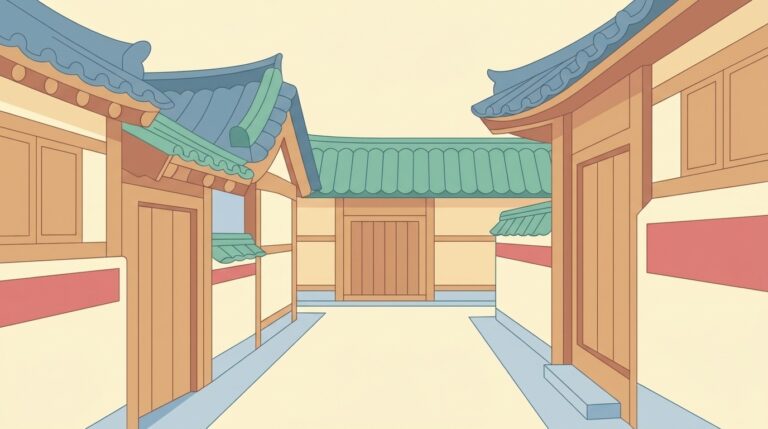
Picture this: You are standing in the middle of Bukchon or Jeonju Hanok Village. You are wearing an elegant hanbok, the morning breeze gently flutters your ribbons, and you look just like the lead in a historical K-Drama like Mr. Queen or The King’s Affection. You want to take that perfect Instagram photo in front of a stunning wooden gate, or step into a cozy 100-year-old traditional teahouse for a cup of warm omija-cha.
Suddenly, anxiety kicks in. You notice small signs that say ‘Quiet, please’ because real families actually live behind those wooden gates. You step toward a wooden floor (maru) and freeze—Wait, do I take my shoes off here? Can I step on this wooden ledge? What if I say something rude to the elderly owner? You end up whispering in English or awkwardly tiptoeing away, missing out on warm Korean hospitality.
Don’t worry! Every single Korean learner goes through this exact moment of hesitation. In fact, our Daily Hangul learners often tell us that Hanok villages were where they felt most self-conscious about Korean etiquette. This guide is crafted directly from those real student experiences. By the end of this quick lesson, you’ll know exactly what to say, how to move with effortless respect (nunchi), and how to enjoy historic Hanok villages with true confidence!
Phase 2: 핵심 표현 3선 심층 분석 (Core Expressions Deep Dive)
Here are 3 must-know A2 expressions that will turn your Hanok tour from stressful to smooth and delightful:
1. 사진 좀 찍어 주실 수 있나요? (Sajin jom jjigeo jusil su innayo?)
- Pronunciation: [Sah-jin jom jji-geo joo-sheel soo een-nah-yo?] (Think of ‘jom’ sounding like a soft ‘ch-um’, adding that magic touch of politeness.)
- Meaning: Literal: “Can you please take a photo?” / Real Nuance: “Excuse me, would you mind helping me snap a quick picture?”
- K-Culture Moment: Just like when travelers ask friendly passersby in K-Dramas to take a memorable snap under the curved tile eaves (giwa).
- Editor’s Insight: The tiny word 좀 (jom) translates literally to “a little,” but in Korean, it works like fairy dust to soften any request. Without it, asking directly sounds a bit demanding!
- Situation Spectrum: Casual: 🚫 | Semi-formal: ✅ | Formal: ✅
- 🤔 Think About It: In English, we often say “Could you do me a favor?” before asking. Why do you think Korean uses the shrinking word 좀 (a little) to show politeness?
2. 조용히 해야 해요? (Joyonghi haeya haeyo?)
- Pronunciation: [Joh-yong-hee hae-yah hae-yo?] (The ‘h’ in ‘hee’ is light and breathy, like an exhale.)
- Meaning: Literal: “Must one do quietly?” / Real Nuance: “Should we keep our voices down here?”
- K-Culture Moment: Used when entering residential alleys in Bukchon where local grandmothers hang out laundry while tourists stroll past.
- Editor’s Insight: Combining the adverb 조용히 (quietly) with the A2 grammar structure -아/어야 해요 (must/should do) is the clearest way to ask about local house rules without feeling embarrassed.
- Situation Spectrum: Casual: ⚠️ | Semi-formal: ✅ | Formal: ✅
- 🤔 Think About It: Many Hanok villages in Korea are active residential neighborhoods, not open-air theme parks. How does this awareness change the way we travel?
3. 신발을 벗어야 하나요? (Sinbareul beoseoya hanayo?)
- Pronunciation: [Sheen-bah-reul buh-suh-yah hah-nah-yo?] (Pronounce ‘beo’ like the ‘bu’ in ‘butter’.)
- Meaning: Literal: “Do I have to take off shoes?” / Real Nuance: “Do I need to take my shoes off before coming in?”
- K-Culture Moment: Stepping up onto the raised wooden floor (maru) of a Hanok cafe or traditional tea salon.
- Editor’s Insight: In Korean architecture, indoor flooring is treated as clean living space because of floor-sitting traditions. When in doubt, asking with -하나요? (-hanayo?) sounds gentle and considerate.
- Situation Spectrum: Casual: 🚫 | Semi-formal: ✅ | Formal: ✅
- 🤔 Think About It: Taking off shoes before entering a space signifies leaving the dirt of the outside world behind. Does your home culture have a similar threshold ritual?
Phase 3: 교과서 한국어 vs 진짜 한국어 (Textbook vs. Real Korean)
Let’s upgrade your textbook phrases to what real Koreans say on the street!
Situation 1: Asking if an interior courtyard is open to view
- 📖 교과서 한국어 (Textbook): 여기에 들어가도 됩니까? (Yeogie deureogada doebnikka? – “Is entering here permitted?”)
- 🗣️ 진짜 한국어 (Real Life): 저기요, 잠깐 구경해도 돼요? (Jeogiyo, jamkkan gugyeonghaedo dwaeyo? – “Excuse me, may I take a quick look inside?”)
- 💡 왜 다를까? (Why is it different?): Textbook forms with
-ㅂ니까sound like a military report or a formal speech. In real conversations, starting with a polite 저기요 (Excuse me) and using 잠깐 (briefly/a moment) makes you sound warm and humble.
Situation 2: Asking someone where to leave your footwear
- 📖 교과서 한국어 (Textbook): 신발을 어디에 놓아야 합니까? (Sinbareul eodie noaya habnikka? – “Where must the shoes be placed?”)
- 🗣️ 진짜 한국어 (Real Life): 신발 여기 두면 돼요? (Sinbal yeogi dumyeon dwaeyo? – “Can I just leave my shoes right here?”)
- 💡 왜 다를까? (Why is it different?): Everyday Korean prefers short conditional patterns like -(으)면 돼요? (is it okay if I do this?). It sounds completely natural and effortless for A2 level speakers.
Phase 4: K-Culture 딥다이브 & 비언어적 매너 (Deep Dive & Etiquette)
4-1. 눈치 (Nunchi) & Body Gestures
- Never step on the threshold (문턱 – Munteok): In traditional Hanok, the wooden bottom border of sliding doors and gates is sacred. Older generations believe stepping on it brings bad luck (stepping on one’s fortune). Step over it, never on it!
- Two-Hand Camera Handover: When handing your smartphone to a friendly local after asking for a photo, always support your right forearm or wrist with your left hand, or hold the phone with both hands. It instantly communicates deep respect without saying a single word.
- Lowered Tone in Residential Zones: Notice local residents walking their dogs? Lower your voice volume by 50%. It shows you have top-tier nunchi (cultural intuition).
4-2. Cultural Code: The Hanbok & Hanok Aesthetic
Have you noticed how characters in historical K-Dramas like Moonlight Drawn by Clouds pause before entering a pavilion? Hanok design is based on harmony with nature (pungsu-jiri / feng shui). When you wear a Hanbok and walk around a Hanok village, you are not just a tourist—you are becoming part of the landscape. Hanok teahouses often ask you to slow down, listen to dripping tea, and appreciate the courtyard garden (madang).
Phase 5: 실전 롤플레이 시나리오 (Interactive Roleplay Scenario)
Setting: You walk into a cozy Hanok teahouse in Jeonju. Sunlight filters through paper sliding doors (changhoji). An elderly teahouse master in comfortable cotton Hanbok, Master Kim, looks up with a warm smile.
- Master Kim: 어서 오세요! 신발 벗고 올라오세요. (Eoseo oseyo! Sinbal beotgo ollaoseyo.)
🎭 Smiling warmly and pointing toward the wooden floor
“Welcome! Please take off your shoes and come on up.” -
You: 안녕하세요! 신발은 여기 두면 돼요? (Annyeonghaseyo! Sinbal-eun yeogi dumyeon dwaeyo?)
🎭 Removing shoes politely and placing them neatly facing the door
“Hello! Can I leave my shoes right here?” -
Master Kim: 네, 편한 자리에 앉으세요. 날씨가 참 좋지요? (Ne, pyeonhan jarie anjeuseyo. Nalssiga cham jochiyo?)
🎭 Hands you a traditional menu on handmade mulberry paper
“Yes, please take any comfortable seat. Isn’t the weather lovely?” -
You: 네, 날씨가 정말 좋아요! 저기, 사진 좀 찍어도 돼요? (Ne, nalssiga jeongmal joayo! Jeogi, sajin jom jjigeodo dwaeyo?)
🎭 Pointing gently with an open palm toward the beautiful courtyard
“Yes, the weather is wonderful! Excuse me, is it okay if I take some photos?” -
Master Kim: 그럼요, 마당에서 마음껏 찍으세요! 다른 손님들만 배려해 주시고요. (Geureomyo, madang-eseo maeumkkeot jjigeuseyo! Dareun sonnimdeulman baeryeohae jusigoyo.)
🎭 Chuckles softly and nods
“Of course, feel free to take pictures in the courtyard! Just please be mindful of the other guests.” -
You: 네, 조용히 찍을게요! 추천 메뉴가 뭐예요? (Ne, joyonghi jjigeulgeyo! Chucheon menyuga mwoyeyo?)
🎭 Lowering voice respectfully while scanning the menu
“Understood, I’ll take them quietly! What menu item do you recommend?” -
Master Kim: 시원한 오미자차가 아주 인기가 많아요. (Siwonhan omijachaga aju ingiga manayo.)
🎭 Pointing to the pink berry tea on the board
“Our chilled five-flavor berry tea (Omija-cha) is very popular.” -
You: 좋아요! 오미자차 한 잔 주세요. (Joayo! Omijacha han jan juseyo.)
🎭 Bowing head slightly with both hands resting on the lap
“Great! One iced Omija tea, please.”
🔀 Your Interactive Branching Point!
After receiving your tea, you want Master Kim to take a photo of you sitting on the floor with your teacup. What do you do?
- Option A: Call loudly: “야! 여기 봐!” (Ya! Yeogi bwa!) while waving your phone.
- Option B: Make gentle eye contact, hold your phone with both hands, and say: “사장님, 죄송하지만 사진 한 장만 찍어 주실 수 있나요?” (Sajangnim, joesonghajiman sajin han jangman jjigeo jusil su innayo?)
- Option C: Say nothing, walk over, thrust the phone into his hand, and smile.
Feedback:
* Option A (Bad): 🚨 Yikes! ‘야’ (Hey!) is rude slang used only between intimate childhood friends. Master Kim will be shocked!
* Option B (Best!): 🌟 Perfection! Calling him 사장님 (Owner/Manager), adding 죄송하지만 (I am sorry to trouble you, but…), and asking politely will make him take the photo with total joy!
* Option C (Risk): ⚠️ While Koreans are forgiving to foreigners, handing objects abruptly without speaking can feel impersonal and uncomfortable.
Phase 6: 10초 감정 섀도잉 드릴 (10-Second Emotion Shadowing Drill)
Practice these aloud! Match the emotion tags and pause at each slash (/):
[😊 Cheerful and polite]
저기요, / 사진 좀 / 찍어 주실 수 있나요?
(Jeogiyo, / sajin jom / jjigeo jusil su innayo?)-
[🤫 Whispering with considerate Nunchi]
여기는 조용히 / 구경해야 해요. / 쉿!
(Yeogineun joyonghi / gugyeonghaeya haeyo. / Swit!) -
[🍵 Warm and humble curiosity]
신발은 / 여기에 벗고 / 들어가면 되나요?
(Sinbal-eun / yeogie beotgo / deureogamyeon doenayo?)
Phase 7: K-Culture 미니 사전 (Mini Dictionary)
- 한옥 (Hanok): Traditional Korean house built with wood, stone, earth, and tile/thatch. Built to naturally balance hot summers and freezing winters.
- 온돌 (Ondol): Korea’s unique underfloor heating system. Because the floor is warm, Koreans traditionally sit, eat, and sleep directly on the floor—explaining why shoes must come off!
- 문턱 (Munteok): The raised wooden threshold beneath traditional doors. A major cultural taboo is stepping directly on top of it.
- 마루 (Maru): The polished wide wooden floor connecting different rooms in a Hanok, serving as an open breezy living room in warm months.
Phase 8: 여행자를 위한 생존 키트 (Traveler’s Survival Kit)
Survival TOP 3 Phrases
- 사진 한 장만 찍어 주세요. (Sajin han jangman jjigeo juseyo. – “Please take just one photo for me.”)
Pro Tip: Adding 한 장만 (just one shot) makes locals happy to help because they know it won’t take 10 minutes! - 화장실이 어디예요? (Hwajangsil-i eodiyeyo? – “Where is the restroom?”)
Pro Tip: Hanok village public bathrooms are often hidden behind historical facades. Look for the sign or ask early! - 얼마예요? (Eolmayeyo? – “How much is it?”)
Pro Tip: Perfect for street food stalls selling honey hotteok or renting Hanbok hair accessories.
Editor’s Travel Note
- Navigation: Google Maps often lags in Korea’s intricate alleys. Download the [Naver Map app guide for foreign travelers] for precise alley-by-alley walking routes in Bukchon and Jeonju.
- Hanbok Discount: Did you know? Wearing Hanbok gets you free admission to the main Royal Palaces in Seoul (Gyeongbokgung, Changdeokgung, Changgyeonggung, and Deoksugung)!
- Trash Manners: You won’t find many trash cans along Hanok alleys. Always carry a small tote bag or plastic pouch in your backpack to hold your empty drinks until you find a recycling bin.
Phase 9: “한 발 더 깊이” (Deep Cultural Reflection)
Traditional Korean architecture is founded on the concept of 배려 (Baeryeo – Consideration for others) and communal harmony. Hanok walls are relatively low, and wooden doors transmit soft sounds. When modern visitors explore historic villages, we enter a living cultural ecosystem where history, tourism, and real families meet every single day. By practicing simple words like 조용히 (quietly) and watching your step around thresholds, you are actively participating in protecting this living heritage.
💬 Your Turn: Have you ever visited a traditional village or historical neighborhood where real residents still live? How do you practice respect when taking travel photos? Share your thoughts in the comments below!
Phase 10: FAQ & 오해 방지 (FAQ & Common Mistakes)
Q: Can I push open any open wooden gate in Bukchon Hanok Village to take photos?
A: No! If it does not have a clear cafe, gallery, or museum sign, it is almost certainly a private residence. Always look for commercial signage before entering.
Q: Do I need to take off my shoes inside every Hanok cafe?
A: Not all of them! Modern Hanok cafes often have Western-style tables and stone floors where you keep your shoes on. The rule of thumb: If you see elevated polished wood (maru) with floor cushions (bangseok), take off your shoes.
Q: What should I call the Hanbok rental staff or shop owner?
A: Call them 사장님 (Sajangnim)! It translates to “president/owner” and is the most respectful, polite term for shopkeepers and small business owners in Korea.
🚨 흔한 실수 (Common Mistakes) Top 3
- ❌ Mistake 1: Stepping firmly onto the door threshold (munteok) with your feet.
➡️ Correct Action: Step comfortably over the wooden beam into the room. - ❌ Mistake 2: Talking loudly on speakerphone or shouting to friends across the alley.
➡️ Correct Action: Keep your conversational tone soft and relaxed. - ❌ Mistake 3: Taking off shoes and stepping barefoot onto the dirty outdoor ground before stepping up onto the wood.
➡️ Correct Action: Step out of your shoes directly onto the elevated wooden floor or stepping stone (diddim-dol).
Phase 11: 액션 미션 & 참여 유도 (Action Missions)
- 🥉 Bronze Mission (Solo): Say the sentence “사진 좀 찍어 주실 수 있나요?” out loud 3 times in front of your mirror with a friendly smile.
- 🥈 Silver Mission (Social): Check out a picture of a Hanok on Instagram or Pinterest, and leave a Korean comment: “한옥이 정말 예뻐요! (The Hanok is really pretty!)”.
- 🥇 Gold Mission (Real Life): When you travel to Korea, rent a Hanbok and use at least two phrases from this guide at a traditional teahouse!
- 🎮 K-Culture Mission: Watch an episode of a drama like Our Beloved Summer (set partly around Bukchon) or Extraordinary Attorney Woo. Spot the traditional wooden gates and see if characters step over the door thresholds!
Phase 12: 인터랙티브 퀴즈 챌린지 (Interactive Quiz Challenge)
Test your skills before packing your bags!
1. Situational Judgment:
You want to ask an elder walking by to take a photo of your family in front of a Hanok gate. Which phrase is the most natural and polite?
(A) 야! 사진 찍어라!
(B) 저기요, 사진 좀 찍어 주실 수 있나요?
(C) 사진을 찍어야 합니다.
2. Fill-in-the-Blank:
“Can I leave my shoes here?” -> 신발 여기 ______ 돼요?
(A) 두면 (dumyeon)
(B) 먹으면 (meog-eumyeon)
(C) 자면 (jamyeon)
3. True or False:
In traditional Korean culture, stepping directly on top of the door threshold (munteok) is encouraged because it makes the wood stronger. (True / False)
👉 Click to view Answers & Explanations!
-
Answer: (B)
Explanation: Option A is rude banmal. Option C sounds like an order from a textbook. Option B uses softeners 저기요 and 좀 with the polite question ending -아/어 주실 수 있나요?. -
Answer: (A) 두면
Explanation: 두다 (duda) means to put or leave something. With -(으)면 돼요, it means “is it okay if I leave it here?”. -
Answer: False
Explanation: Stepping on the threshold is a traditional taboo linked to trampling your family’s fortune. Always step over it!







