

Phase 1: Empathy (Story-driven Opening)
안녕하세요! 매일한글 에디터입니다. (Hello! This is your Daily Hangul editor.)
Picture this: You are riding a bright blue city bus in Seoul during the evening rush hour. Neon signs from Gangnam shimmer through the windows, K-pop hums softly from the driver’s radio, and suddenly the chime rings out: “이번 정류장은 강남역입니다 (Next stop is Gangnam Station).”
Your heart instantly speeds up. The bus is packed with commuters standing shoulder-to-shoulder. Your stop is coming up in thirty seconds, but you are stuck three rows back. Where is the red bell? Has anyone pressed it yet? If you stand up now while the bus is swaying, will you fall into someone’s lap? And what if the driver doesn’t open the rear door in time?!
Take a deep breath! Every single expat, foreign student, and traveler who has ever set foot in South Korea has experienced this exact moment of transit panic. Korea’s bus system is one of the cleanest, fastest, and most efficient in the world—but its famous “빨리빨리” (hurry-hurry) pace can feel overwhelming when you are a beginner.
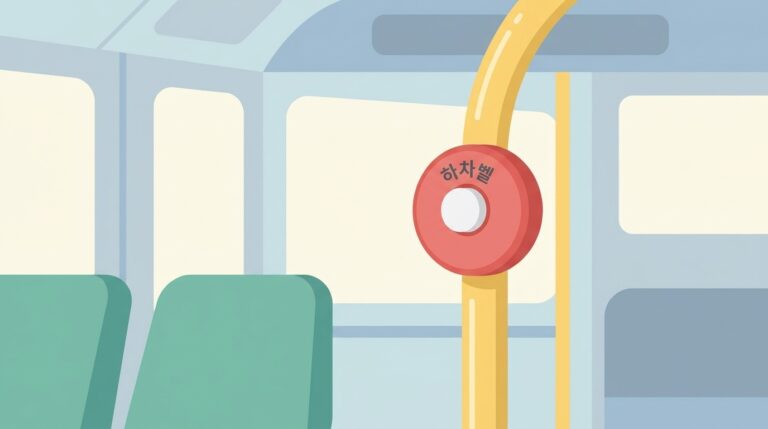
In this lesson, you will master the art of the bus bell (하차벨) and learn the exact, natural phrases locals use to step off smoothly and stress-free. Let’s make you sound like a seasoned Seoulite!
Phase 2: Core Expressions (핵심 표현 3선)
1. 이번에 내려요 (Ibeone naeryeoyo)
- Pronunciation: [I-beon-e nae-ryeo-yo] (Sounds like “E-bun-eh neh-ryuh-yo” — think of an English “bun” followed by “nay-ryuh-yo”)
- Meaning: Literal: “I get off this time” vs. Actual Nuance: “Excuse me, I’m getting off at this stop! (Please make a little room)”
- K-Culture Moment: In slice-of-life K-dramas like Our Beloved Summer, whenever characters commute on crowded buses, they gently murmur this to navigate toward the back exit.
- Editor’s Insight: In English, we usually say “Excuse me” or “Pardon me.” In Korean, stating your immediate action—“I’m getting off”—is the standard, polite way to ask people to step aside without sounding pushy.
- Situation Spectrum: Casual ⚠️ | Semi-formal ✅ | Formal ✅
- 🤔 Think About It: Why do you think Korean communication prefers stating a clear communal action (“I am getting off”) rather than just focusing on personal space (“Excuse me”)?
2. 벨 눌렀어요? (Bel nulleosseoyo?)
- Pronunciation: [Bel nul-leot-seo-yo?] (Sounds like “Bell nool-lut-saw-yo?” — like the English word “bell” + “noodle” without ‘dle’ + “saw-yo”)
- Meaning: Literal: “Did you press the bell?” vs. Actual Nuance: “Has someone already rung the stop bell?”
- K-Culture Moment: When a polite high school student in a drama wants to get off but cannot reach the button over a tall commuter, they turn and whisper this with an inquiring smile.
- Editor’s Insight: If you see the red LED “STOP” or “하차” sign glowing on the ceiling, the bell has already been pressed. But if you’re blocked from reaching the button, asking your neighbor this question naturally prompts them to press it for you!
- Situation Spectrum: Casual ⚠️ | Semi-formal ✅ | Formal ✅
- 🤔 Think About It: In many Western cities, bells ring repeatedly every time someone pulls the cord or hits a button. In Korea, once pressed, the bell chimes once and stays lit. How does this reflect the local value of quiet efficiency?
3. 저 내릴게요! (Jeo naerilgeyo!)
- Pronunciation: [Jeo nae-ril-ge-yo!] (Sounds like “Juh neh-ril-gay-yo!” — “Juh” as in ‘jug’ + “nay-ril-gay-yo”)
- Meaning: Literal: “I will step down/get off!” vs. Actual Nuance: “Wait, driver! I’m getting off right now, please keep the doors open!”
- K-Culture Moment: In comedic variety shows like Running Man, members frantically shout this toward the driver when the exit doors threaten to close before they can hop out!
- Editor’s Insight: Korean bus drivers run on precise schedules and stop briefly. If the rear exit door hasn’t opened or begins to close while you’re right there, project your voice firmly toward the front with this phrase.
- Situation Spectrum: Casual 🚫 | Semi-formal ✅ | Formal ✅
- 🤔 Think About It: The grammar ending
-(으)ㄹ게요indicates a direct promise or intention of action that directly affects the listener. It creates an instant bridge of understanding.
Phase 3: Textbook Korean vs. Real-Life Korean
Situation 1: Telling passengers you need to get off
- 📖 교과서 한국어: 저는 이번 정류장에서 하차하겠습니다. (Jeoneun ibeon jeongryujang-eseo hachahagetseumnida.) — “I shall alight at this station.”
- 🗣️ 진짜 한국어: 이번에 내려요~ (Ibeone naeryeoyo~) — “Getting off this stop~”
- 💡 왜 다를까?: “하차하다” (to alight) is formal Sino-Korean vocabulary heard in automated computer announcements. Real Koreans use the everyday native verb “내리다” (to step down) with a friendly rising tone.
Situation 2: Asking someone near the button to press it for you
- 📖 교과서 한국어: 실례지만 하차 벨을 눌러 주시겠습니까? (Sillyejiman hacha beleul nulleo jusigetseumnikka?) — “Excuse me, but would you kindly depress the stop bell?”
- 🗣️ 진짜 한국어: 죄송한데 벨 좀 눌러주세요! (Joesonghande bel jom nulleojuseyo!) — “Sorry, could you press the bell please!”
- 💡 왜 다를까?: Formal interrogatives sound unnatural in tight quarters. Using “죄송한데” (I’m sorry, but…) as a soft cushion combined with “좀” (a little / please) makes your request polite, fast, and conversational.
Phase 4: K-Culture Deep Dive & Non-Verbal Manners
4-1. 눈치 (Nunchi) & The Body Language Dance
On Korean buses, physical movement speaks louder than words:
* The Gentle Fin Gesture: When pushing through a crowded aisle toward the exit door, do NOT push people with flat hands. Instead, bring one hand vertically in front of your chest (like a swimming fin or a soft prayer hand), dip your head slightly in a quick 목례 (mokrye, neck nod), and murmur “잠시만요 (Jamsimanyo – Just a moment)” or “내려요 (Naeryeoyo)”.
* The One-Touch Rule: Never press the bell repeatedly like a video game arcade button! One clear “딩동 (Ding-dong)” is all the driver needs. Pressing it multiple times signals annoyance.
4-2. Cultural Code Analysis: The Rush vs. Safety Paradox
Official announcements on Korean transit repeatedly say: “승객 여러분의 안전을 위해 버스가 멈춘 후 일어나시기 바랍니다 (For your safety, please stand up after the bus comes to a complete stop).”
However, in practice, Korea’s vibrant 빨리빨리 (ppalli-ppalli, hurry-hurry) culture means commuters often ring the bell the moment the prior stop passes, stand up as the bus begins to decelerate, tap their transit cards on the reader, and wait right at the door. As a visitor, hold tightly onto the yellow vertical handrails (손잡이) if you move while the bus is slowing down!
Phase 5: Real-Life Roleplay Scenario
Setting: Blue Bus #273 cruising near Gwanghwamun. The bus is full. You (Alex) are trying to exit, standing near Minsu, a friendly college student wearing headphones.
- Turn 1 (Alex): 저기요, 혹시 벨 눌렀어요? (Jeogiyo, hoksi bel nulleosseoyo? / Excuse me, by any chance did you ring the bell?)
🎭 Taps arm lightly and points toward the red wall button - Turn 2 (Minsu): 아, 아직 안 눌렀어요! (A, ajik an nulleosseoyo! / Oh, not yet!)
🎭 Takes off one earbud with a surprised look - Turn 3 (Alex): 그럼 벨 좀 눌러주세요. (Geureom bel jom nulleojuseyo. / Then could you please press the bell?)
🎭 Holds grocery bag in both hands - Turn 4 (Minsu): 네, 지금 누를게요! (Ne, jigeum nureulgeyo! / Yes, I will press it right now!)
🎭 Firmly pushes the red bell — *DING-DONG!* - Turn 5 (Alex): 감사합니다! 이번에 내려요. (Gamsahamnida! Ibeone naeryeoyo. / Thank you! I am getting off this stop.)
🎭 Gives a warm polite head bow - Turn 6 (Minsu): 저도 내려요. 앞으로 먼저 가세요! (Jeodo naeryeoyo. Apeuro meonjeo gaseyo! / I’m getting off too. Please go ahead in front!)
🎭 Steps sideways to clear a path - Turn 7 (Alex): 죄송합니다, 지나갈게요. (Joesonghamnida, jinagalgeyo. / Excuse me, coming through.)
🎭 Carefully shuffles toward the rear doors - Turn 8 (Minsu): 조심해서 내리세요! (Josimhaeseo naeriseyo! / Step off safely!)
🎭 Holds overhead strap securely
🔀 Interactive Decision Point
Scenario: The bus stops at your station. The front door opens for boarding passengers, but the back exit door remains firmly shut! The driver is looking forward and hasn’t seen you. What do you do?
- Choice A: Say nothing, look down, and hope the driver remembers to open the door automatically.
- Outcome (Bad): The driver steps on the accelerator! You miss your stop and end up in another neighborhood.
- Choice B: Loudly kick or pound both fists on the glass door.
- Outcome (Risk): The driver slams the brakes in fright. Everyone stares, and you might get scolded for endangering safety.
- Choice C: Call out toward the front with a clear, firm voice: “기사님, 문 열어주세요! 저 내려요! (Gisanim, mun yeoreojuseyo! Jeo naeryeoyo! – Driver, please open the door! I’m getting off!)”
- Outcome (Best): Perfect 10/10! The driver checks the rearview mirror, shouts “네!”, pops the door open, and you step out with ease.
Phase 6: 10-Second Emotion Shadowing Drill
Practice these short survival sentences out loud, paying attention to the emotion and rhythm breaks (/):
[🚨 급하고 다급하게 - Urgent & Rushed]
저 / 이번에 내려요! / 문 열어주세요!
(Jeo / ibeone naeryeoyo! / Mun yeoreojuseyo! — “I’m / getting off this stop! / Please open the door!”)-
[😊 상냥하고 조심스럽게 - Friendly & Courteous]
실례지만 / 벨 좀 / 눌러주시겠어요?
(Sillyejiman / bel jom / nulleojusigesseoyo? — “Excuse me / could you / press the bell please?”) -
[😌 안도하며 감사하게 - Relieved & Grateful]
눌러주셔서 / 정말 / 감사해요!
(Nulleojusyeoseo / jeongmal / gamsahaeyo! — “Thank you so / much for / pressing it!”)
Phase 7: K-Culture Mini Dictionary
- 하차벨 (Hacha-bel): Stop Bell. Compound noun of 하차 (stepping down/alighting) + 벨 (bell). Located on window frames and vertical poles every 1–2 meters.
- 환승 (Hwanseung): Transit Transfer. The brilliant Korean transit system allows you up to 4 free or deeply discounted transfers between buses and subways within 30 minutes, provided you tap your card when exiting!
- 손잡이 (Sonjabi): Handrail / Grab Strap. From 손 (hand) + 잡다 (to grab). Seoul buses make tight turns; always keep one hand anchored.
- 기사님 (Gisanim): Driver / Chauffeur. Polite title formed by 기사 (driver) + 님 (revered honorific). Always address the driver as 기사님, never 아저씨 (ajeossi)!
Phase 8: Traveler’s Survival Kit
Top 3 Survival Expressions
- 1. 내려요! (Naeryeoyo!) — “Getting off!”
Pro Tip: Use this single punchy word if someone is blocking the exit stairs when the bus stops. - 2. 카드 다시 대주세요 (Kadeu dasi daejuseyo) — “Please tap your card again.”
Pro Tip: This is the automated voice you hear if you pulled your card away too fast. Hold it flat against the terminal until you hear “삐빅 (Bbi-bik)”. - 3. 기사님, 잠깐만요! (Gisanim, jamkkanmanyo!) — “Driver, just one second!”
Pro Tip: Call this out if your travel companion is stuck behind a crowd.
Editor’s Travel Note
Before stepping on any bus in Korea, make sure you have the KakaoBus app on Google Play and Apple App Store or Naver Map Navigation Guide. These apps display the exact remaining stops and even notify you when it is time to ring the bell. Remember: Always tap your card on the terminal next to the rear door before stepping down to lock in your transfer discount!
Phase 9: “One Step Deeper” (Reflective Essay)
Riding a Korean city bus is an intimate window into the collective mindset of modern Korea. Within a small moving metal box, you see the delicate balance between high-speed efficiency (빨리빨리) and quiet communal consideration (배려). Passengers anticipate each other’s moves: pressing the stop button for an elder who cannot reach, stepping sideways before being asked, and vacating seats near the door for quick exits. When you declare “이번에 내려요,” you are not interrupting someone—you are participating in a coordinated, polite social rhythm.
💬 Your Turn: Have you ever missed a bus or train stop in a foreign country because you were too nervous to speak up? What happened? Share your story in the comments below!
Phase 10: FAQ & Avoiding Misunderstandings
Q: Can I ring the bus bell multiple times if I’m worried the driver didn’t hear it?
A: No, please refrain from doing this! In Korea, one press lights up the front electronic display and rings an audio chime. Ringing it multiple times sounds impatient and can irritate the driver.
Q: Exactly when is the ideal moment to ring the bell?
A: Ring it immediately after the bus passes the stop before yours, right as the audio broadcast announces: “이번 정류장은 [Your Stop]입니다 (This stop is [Your Stop]).”
Q: Is it rude to stay seated until the bus completely stops?
A: Legally and safely, you should remain seated. However, during rush hour on crowded buses, scooting toward the aisle or standing near the exit as the bus slows down ensures you will not get trapped when doors open.
🚨 Common Mistakes (흔한 실수 TOP 3)
- Calling the driver “아저씨 (Ajeossi / Mister)”:
Correct Action: Always use the respectful term 기사님 (Gisanim). - Forgetting to tap out (하차태그) on the exit card reader:
Correct Action: Always tap your card when getting off, otherwise you will be charged the maximum distance fee on your next ride. - Physically pushing people out of the way without speaking:
Correct Action: A soft, clear “이번에 내려요 (Ibeone naeryeoyo)” works like a magic verbal key.
Phase 11: Action Missions
- 🥉 Bronze Mission: Stand in front of your mirror and practice saying: “저 이번에 내려요! (Jeo ibeone naeryeoyo!)” three times with a confident voice and a polite neck bow.
- 🥈 Silver Mission: Write down the 3 core expressions in your phone notepad or share this guide on your Instagram Stories with the tag #DailyHangulTransit.
- 🥇 Gold Mission: On your next bus trip in Korea, actively locate the nearest red 하차벨 as soon as you sit down, and be the one to press it for your stop!
- 🎮 K-Culture Mission: Watch any episode of My Liberation Notes or Extraordinary Attorney Woo. Spot the scene inside the bus and identify the red circular bell on the vertical pole!
Phase 12: Interactive Quiz Challenge
1. Situational Judgment:
You are sitting in the middle of a bus. The automated voice announces your stop. You look up and notice the red bell light on the ceiling is already glowing. What is the best action?
* A) Press another bell just to be 100% safe.
* B) Calmly prepare your transit card and move toward the exit door while saying “이번에 내려요”.
* C) Shout “벨 눌렀어요?!” at the top of your lungs.
2. Fill-in-the-Blank:
To politely ask a fellow passenger to press the bell for you, you say:
“죄송한데 벨 [_____] 눌러주세요.” (Hint: A 1-syllable word meaning ‘a little’ or ‘please’)
3. True or False:
Calling the bus driver 기사님 (Gisanim) is polite and recommended, while calling them 야 (Ya) or 아저씨 (Ajeossi) is disrespectful on public transit. (True / False)
👉 Click here to check the answers and explanations!
- 1. Answer: B. When the light is already lit, the driver has received the signal! Just prepare your belongings and transit card.
- 2. Answer: 좀 (Jom). “벨 좀 눌러주세요” is the friendliest natural formula for a quick request.
- 3. Answer: True. 기사님 shows high respect for their profession and guarantees friendlier service!







