

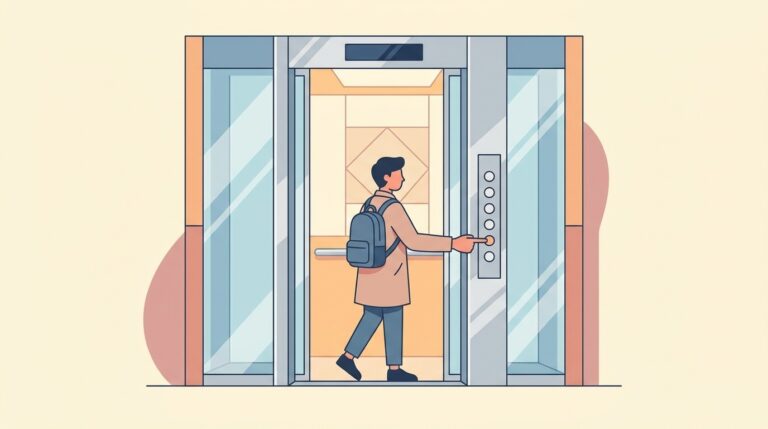
Phase 1: 공감 (Storytelling Opening)
안녕하세요! 매일한글 에디터입니다. (Hello! It’s your Daily Hangul editor here!)
Picture this: You step into a modern, glossy elevator in a high-rise office in Seoul. Before your trailing foot even hits the elevator floor, the person in front of you whips around like an Olympic sprinter and furiously taps the 닫힘 (Close) button three times in half a second. The metal doors snap shut like lightning. You stand there wondering: Did an emergency just happen? Are we running from zombies? Did I do something wrong?
Don’t worry, you didn’t do anything wrong! You just experienced your very first face-to-face encounter with Korea’s legendary 빨리빨리 (Ppalli-Ppalli, “Hurry-hurry”) culture. Over the past 10 years of mentoring international expats and travelers in Korea, I have seen so many learners freeze up in front of elevator buttons, terrified of accidentally slamming doors on neighbors or breaking some mysterious etiquette rule.
Today, we are demystifying Korean elevator culture! By the end of this guide, you will master the essential A2 phrases, navigate elevator non-verbal cues (nunchi), and understand why pressing that close button is actually viewed as a sign of consideration in modern Korean society.
Phase 2: 핵심 표현 3선 심층 분석 (Top 3 Key Expressions)
1. 먼저 타세요 (Meonjeo taseyo)
- Pronunciation: [Meon-jeo ta-se-yo] (Sounds like: Mun-jaw tah-say-yo)
- Meaning: Literal: “Ride first.” / Actual Nuance: “Please, go ahead and get on! / After you!”
- K-Culture Moment: You often see this in workplace K-dramas like Misaeng. A polite junior team member holds the elevator door open with an attentive smile while an executive steps inside.
- Editor’s Insight: The word 먼저 (meonjeo) means “first” or “ahead.” Pairing it with the polite honorific ~세요 (~seyo) creates an instant aura of warm hospitality.
- Situation Spectrum: Casual: ⚠️ | Semi-formal: ✅ | Formal: ✅
- 🤔 Think About It: In English, we usually say “After you,” focusing on stepping back. Korean focuses on inviting the other person forward (먼저 타세요). How does your language express this courtesy?
2. 몇 층 가세요? (Myeot cheung gaseyo?)
- Pronunciation: [Myeot cheung ga-se-yo?] (Sounds like: Myut-choong gah-say-yo?)
- Meaning: Literal: “Which floor are you going?” / Actual Nuance: “What floor can I press for you?”
- K-Culture Moment: When entering an apartment elevator carrying grocery bags or an iced Americano, a friendly neighbor standing near the buttons asks you this question with their finger poised above the keypad.
- Editor’s Insight: If you stand near the control panel, you are the designated “Elevator Captain.” Asking this phrase marks you as someone with fantastic social manners (nunchi).
- Situation Spectrum: Casual: 🚫 | Semi-formal: ✅ | Formal: ✅
- 🤔 Think About It: In many Western countries, reaching across someone to press your own button is normal. In Korea, letting the person closest to the panel press it prevents awkward physical contact.
3. 잠시만요! (Jamsimanyo!)
- Pronunciation: [Jam-si-man-yo!] (Sounds like: Jahm-she-mahn-yo!)
- Meaning: Literal: “Just a brief moment!” / Actual Nuance: “Hold on! / Coming through!”
- K-Culture Moment: The elevator doors are starting to slide closed, and you hear running sneakers squeaking across the marble lobby followed by a desperate cry: “잠시만요!”
- Editor’s Insight: This is the Swiss Army knife of Korean daily life. In an elevator context, it functions both as “Please hold the door!” when entering, and “Pardon me, excuse me!” when squeezing through a crowd to exit.
- Situation Spectrum: Casual: ⚠️ (drop yo with close friends) | Semi-formal: ✅ | Formal: ✅
- 🤔 Think About It: Why ask for “a moment of time” (잠시) rather than asking for physical space like “Excuse me”? In Korean culture, taking someone’s time is considered the most delicate request.
Phase 3: 교과서 한국어 vs 진짜 한국어 (Textbook vs. Real Korean)
Situation 1: Asking someone to wait while you run toward the elevator
- 📖 교과서 한국어 (Textbook): 기다려 주십시오. (Gidaryeo jusipsio.) — Please wait.
- 🗣️ 진짜 한국어 (Real-life): 잠시만요! 같이 타요! (Jamsimanyo! Gachi tayo!) — Just a second! Let me hop on too!
- 💡 왜 다를까? (Why the difference?): 기다려 주십시오 sounds like an automated public safety recording in a subway station. Native speakers use the warm, urgent, and rhythmic 잠시만요! in daily emergencies.
Situation 2: Letting an elder or neighbor exit the elevator first
- 📖 교과서 한국어 (Textbook): 먼저 내리십시오. (Meonjeo naerisipsio.) — Please disembark first.
- 🗣️ 진짜 한국어 (Real-life): 먼저 내리세요~ (Meonjeo naeriseyo~) — Go ahead, after you!
- 💡 왜 다를까? (Why the difference?): The high-formal ~십시오 creates unnecessary distance between neighbors. Using the polite ~세요 paired with a gentle voice tone creates a much friendlier community atmosphere.
Phase 4: K-Culture 딥다이브 & 비언어적 매너 (K-Culture Deep Dive)
4-1. 눈치 (Nunchi) & Gestures
- The “Elevator Captain” Rule: If you stand next to the buttons, you inherit the duty of operating the door. Keep your hand near the 열림 (Open) button whenever people are getting on or off.
- The 15-Degree Head Nod: You don’t need a deep 90-degree bow inside a cramped elevator. A quick 15-degree head nod while holding the door conveys perfect etiquette.
- Eye Contact Etiquette: Prolonged direct eye contact inside an elevator can feel confrontational. Koreans typically look at the floor indicator display or look down at their phones to give fellow riders personal privacy.
4-2. 문화 코드 분석 (Culture Code: The Origin of Ppalli-Ppalli)
Why are the 닫힘 (Close) buttons in Korean elevators always faded, scratched, or visibly dented? Korea rebuilt its entire infrastructure and economy within just a few decades following the Korean War. Speed became synonymous with productivity, survival, and modernization.
In modern Korea, pressing the close button is rarely about impatience toward individuals. Rather, it is a shared social agreement: “I value your time, and you value mine. Let’s keep moving forward together without wasting precious seconds!”
Phase 5: 실전 롤플레이 시나리오 (Interactive Roleplay Scenario)
Setting: 8:45 AM. You are in the ground floor elevator of your apartment complex in Seoul, heading out to Korean language class. A friendly neighbor named Min-jun (민준) dashes toward the closing doors with an iced coffee in hand.
- Turn 1 (Min-jun):
[🏃 숨을 헐떡이며 달려오며]잠시만요! 문 좀 잡아주세요! (Jamsimanyo! Mun jom jabajuseyo! / Wait a moment! Please hold the door!) - Turn 2 (You):
[🚪 열림 버튼을 재빨리 누르며]네, 천천히 타세요! (Ne, cheoncheonhi taseyo! / Yes, take your time getting on!) - Turn 3 (Min-jun):
[😌 안도하며 고개를 숙인다]휴, 정말 감사합니다! (Hyu, jeongmal gamsahamnida! / Phew, thank you so much!) - Turn 4 (You):
[😊 버튼 패널 앞에 서서 미소 짓는다]아니에요. 몇 층 가세요? (Anieyo. Myeot cheung gaseyo? / Not at all. Which floor are you going to?) - Turn 5 (Min-jun):
[☕ 커피를 들고 버튼을 가리키며]저 지하 1층 가요! (Jeo jiha il-cheung gayo! / I’m going to Basement 1!) - Turn 6 (You):
[🔘 B1 버튼과 닫힘 버튼을 누르며]네, 눌렀어요. (Ne, nulleosseoyo. / Got it, I pressed it.) - Turn 7 (Min-jun):
[🙏 문이 열리자 가볍게 목례하며]먼저 내릴게요. 좋은 하루 보내세요! (Meonjeo naerilgeyo. Joeun haru bonaeseyo! / I’ll get off first. Have a wonderful day!) - Turn 8 (You):
[👋 미소로 인사하며]네, 좋은 하루 되세요! (Ne, joeun haru doeseyo! / Yes, have a great day too!)
🔀 Your Interactive Decision Point!
Min-jun runs toward the elevator, and you are standing by the buttons. What do you do?
- Option A: Press the 열림 (Open) button and say: “천천히 타세요!” (Cheoncheonhi taseyo!)
- Option B: Watch him running, panic, and stare at your phone screen while the doors close.
- Option C: Wave loudly and shout: “야! 빨리 뛰어!” (Ya! Ppalli ttwieo!)
Feedback:
* Option A (Best): 🌟 100/100 points! You demonstrated top-tier nunchi, politeness, and calm control of the situation.
* Option B (Bad): ❌ 10/100 points! You will likely face an awkward encounter in the hallway later. If someone is approaching within 3 steps, holding the door is customary.
* Option C (Risk): ⚠️ 20/100 points! 야! is informal slang used only with childhood friends. Shouting this at a neighbor will leave them completely stunned!
Phase 6: 10초 감정 섀도잉 드릴 (10-Second Emotion Shadowing)
Read these aloud, pausing at the slash (/) and channeling the target emotion:
[🏃 급하지만 정중하게 - Urgent yet polite]- 잠시만요! / 같이 타요! (Jamsimanyo! / Gachi tayo!)
- Just a second! / Let me get on too!
[😊 상냥하고 배려 넘치게 - Warm and considerate]- 먼저 타세요! / 몇 층 가세요? (Meonjeo taseyo! / Myeot cheung gaseyo?)
- Please get in first! / Which floor are you going to?
[🙏 감사하고 깔끔하게 - Grateful and concise]- 감사합니다, / 먼저 내릴게요! (Gamsahamnida, / meonjeo naerilgeyo!)
- Thank you, / I will get off first!
Phase 7: K-Culture 미니 사전 (Mini Dictionary)
- 빨리빨리 (Ppalli-ppalli)
- Translation: Hurry-hurry; fast-paced mindset.
- Usage: Describes Korea’s efficiency-oriented culture, from same-day grocery delivery to rapid transit.
- 닫힘 (Dathim) vs. 열림 (Yeollim)
- Translation: Close (닫힘) vs. Open (열림).
- Usage: Found on all Korean elevator buttons. Quick tip: 닫힘 has the consonant ㄷ (looks closed like a box), while 열림 starts with ㅇ (open like an entryway)!
- 눈치 (Nunchi)
- Translation: Situational awareness; social tact.
- Usage: Anticipating other people’s needs before they speak—like hitting the door button when you see someone approaching.
- 엘리베이터 버튼 맨 (Elevator Button Man)
- Translation: The unofficial elevator operator/captain.
- Usage: Slang for the passenger standing closest to the keypad who coordinates opening, closing, and floor buttons for everyone.
Phase 8: 여행자를 위한 생존 키트 (Traveler’s Survival Kit)
TOP 3 Survival Phrases
- 몇 층이에요? (Myeot cheung-ieyo?)
- Pronunciation: [Myut cheung ee-yay-yo?]
- Pro Tip: Shorter, simple A2 version of 몇 층 가세요?. Perfect when an elder gets in behind you.
- 내릴게요! (Naerilgeyo!)
- Pronunciation: [Nae-ril-ge-yo!]
- Pro Tip: Say this firmly when the elevator is crowded and you need people to make a pathway for you.
- 죄송합니다 (Joesonghamnida)
- Pronunciation: [Jway-song-hahm-nee-dah]
- Pro Tip: Use this if you accidentally brush past someone or bump their backpack.
Editor’s Travel Note
- Tetraphobia Alert (The Letter ‘F’): Don’t be confused if an elevator keypad goes 1, 2, 3, F, 5! The Sino-Korean word for four (사, Sa) sounds identical to the Chinese character for death (死). Many buildings label the 4th floor as F.
- Essential Mobility Apps: To navigate Korean transit and high-rise landmarks seamlessly, use the 네이버 지도 앱 다운로드 (Naver Map app download) and 카카오 T 앱 다운로드 (Kakao T app download). Both provide floor guides for subway exits and major complexes!
Phase 9: “한 발 더 깊이” (A Step Deeper)
At first glance, seeing someone immediately mash the elevator door button might look like impatience or coldness. But when you look beneath the surface of Korean society, 빨리빨리 is deeply rooted in mutual consideration (배려, baeryeo). By expediting the elevator cycle, you save 5 seconds for the 10 people sharing the ride with you. Speed is a gift of time given to the collective community.
💬 Your Turn: In your home country, is it considered rude or normal to press the elevator close button when other passengers are present? Share your culture in the comments below!
Phase 10: FAQ & 오해 방지 (FAQ & Common Mistakes)
Q: Is pressing the close button immediately considered rude in Korea?
A: Not at all! In fact, if nobody else is rushing toward the doors, passengers actually expect someone near the keypad to press the 닫힘 (Close) button so everyone can reach their destination faster. Leaving doors open unnecessarily is viewed as inefficient.
Q: What if an elevator is completely full?
A: When the elevator beeps or rings an alarm due to weight limits (정원 초과, jeongwon chogwa), the last person who stepped in is expected to step out politely with a quiet “먼저 가세요” (Please go ahead).
Q: Why do people step out of the elevator at intermediate floors when they aren’t at their destination?
A: If an elevator is packed and someone from the back row needs to exit, the passengers in front step out into the hallway completely to clear the exit path, holding the exterior door open with their hand before stepping back inside.
🚨 Common Mistakes Alert!
- Mistake: Mixing up 열림 (Open) and 닫힘 (Close) in a panic, trapping someone’s arm!
- Correct Action: Memorize that 열림 has 2 syllables and starts with an open circle (ㅇ).
- Mistake: Using 반말 (informal speech) like “몇 층 가?” to strangers.
- Correct Action: Always end your verbs with the polite honorific ~세요 (몇 층 가세요?).
- Mistake: Standing directly in the center of the doorway while looking down at your phone.
- Correct Action: Step to the side wall so exiting passengers have a clear runway.
Phase 11: 액션 미션 & 참여 유도 (Action Missions)
- 🥉 Bronze Mission (Solo Practice): Stand in front of your mirror and practice saying: “잠시만요! 몇 층 가세요?” 5 times with a gentle smile and head nod.
- 🥈 Silver Mission (Social Connection): Leave a comment under our latest Instagram post using the phrase “먼저 내리세요!”.
- 🥇 Gold Mission (Real Life Execution): The next time you ride an elevator in Korea or with a Korean speaker, volunteer as the “Button Captain” and ask: “몇 층 가세요?”.
- 🎮 K-Culture Mission: Watch the first episode of any workplace K-drama (like King the Land or Start-Up) and count how many times characters operate elevator doors in a rush!
Phase 12: 인터랙티브 퀴즈 챌린지 (Interactive Quiz Challenge)
1. Situational Judgment:
You step into an elevator on the 1st floor. An elderly neighbor steps in behind you holding heavy groceries. What is the most natural, polite phrase to say?
* A) 몇 층 가? (Myeot cheung ga?)
* B) 먼저 내리십시오. (Meonjeo naerisipsio.)
* C) 몇 층 가세요? (Myeot cheung gaseyo?)
* D) 닫힐게요! (Dathilgeyo!)
2. Fill-in-the-Blank:
When you are running toward the elevator before the door closes, shout:
* “_______! 문 좀 잡아주세요!” (Just a second! Please hold the door!)
3. True or False:
In Korea, elevators often use the English letter ‘F’ instead of the number 4 because the number 4 sounds like the word for death. (True / False)
👉 Click here to reveal the answers and explanations!
- Answer: C) 몇 층 가세요?
- Explanation: Option A is informal (banmal), Option B is for exiting, and Option D is unnatural. Option C is the perfect polite everyday sentence.
- Answer: 잠시만요 (Jamsimanyo)
- Explanation: 잠시만요 is the universal emergency phrase to request a brief pause.
- Answer: True
- Explanation: Due to tetraphobia, the number 4 (사) is often replaced with ‘F’ in apartments and commercial buildings throughout South Korea.
- Explanation: Due to tetraphobia, the number 4 (사) is often replaced with ‘F’ in apartments and commercial buildings throughout South Korea.







