

안녕하세요! 매일한글 에디터입니다.
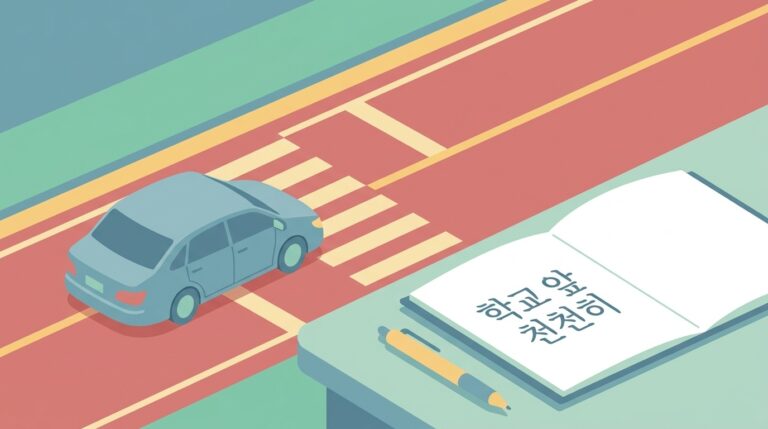
Imagine cruising through a scenic neighborhood in Seoul on a crisp Tuesday afternoon. Your navigation chime softens, and suddenly the asphalt beneath your wheels turns a vibrant, unmistakable brick-red. Large yellow numerals painted across the asphalt scream “30,” overhead gantries bristle with multi-directional surveillance cameras, and the digital speedometer on your windshield begins flashing a stark warning. You have officially entered a School Zone (어린이 보호구역). For anyone holding a steering wheel in South Korea, this is not merely a request to slow down; it is a high-stakes legal tightrope.
Since the enactment of the landmark “Minsik Law” (민식이법) in March 2020—spawned by the tragic loss of nine-year-old Kim Min-sik—the legal ramifications for vehicular accidents involving children in these zones have been ratcheted up to extraordinary levels. Drivers who cause injury face severe mandatory minimums, sparking nationwide controversy among commuters, delivery drivers, and legal scholars alike. For expatriates and advanced Korean learners, this is where language shifts from casual textbook pleasantries to serious societal discourse. In this masterclass, we will explore the nuanced lexicon, socio-legal tensions, and non-verbal driving etiquette required to navigate this heated topic like a true insider.
Phase 2: Core Expressions for High-Stakes Driving Debates
1. 과실 비율을 따지다 (Gwasil bi-yureul ttajida)
- Pronunciation: [Gwa-sil bi-yul-eul tta-ji-da] (Think: “Gwa” like ‘guava’, “sil” like ‘silver’, “bi-yul” like ‘bee-yule’, “ttaji” with an emphatic double-t snap)
- Meaning: Literal: “To calculate the fault percentage” / Nuanced: To scrutinize and negotiate legal liability and comparative negligence between parties involved in a collision.
- K-Culture Moment: You will hear this phrase constantly on the viral legal YouTube channel Han Moon-chul TV (한문철 TV), where former prosecutor and traffic attorney Han Moon-chul dissects vehicular dashcam footage to determine whether a driver had an unavoidable blind spot.
- Editor’s Insight: In Korean civil law and auto insurance, responsibility is rarely a binary 100-to-0 outcome. Drivers meticulously debate whether an accident was an unavoidable force majeure (불가항력) or if the driver failed their standard duty of care (주의의무). Saying this demonstrates sophisticated grasp of Korean administrative reality.
- Situation Spectrum: Casual: ✅ | Semi-formal: ✅ | Formal: ✅
- 🤔 Think About It: How does your home country evaluate pedestrian-vehicle fault? In Korea, the moral and legal baseline almost unilaterally prioritizes the pedestrian, especially inside school zones.
2. 가중처벌을 받다 (Gajung-cheobeoreul batda)
- Pronunciation: [Ga-jung-cheo-beol-eul bat-da] (Phonetic flow: “Ga-joong” like the martial art, “chuh-bull”, “baht-da”)
- Meaning: Literal: “To receive aggravated punishment” / Nuanced: To be subject to legally enhanced statutory penalties beyond standard sentencing guidelines due to specific statutory conditions.
- K-Culture Moment: Featured prominently in hard-hitting legal K-Dramas like Juvenile Justice (소년심판) and news broadcasts debating the Act on the Aggravated Punishment of Specific Crimes (특정범죄 가중처벌 등에 관한 법률).
- Editor’s Insight: Under the Minsik Act, if a driver causes fatal injury to a child inside a designated zone with even partial negligence, the statutory minimum is three years imprisonment up to life. The word “가중” (aggravation/weighting) is crucial when analyzing Korean criminal policy debates.
- Situation Spectrum: Casual: ⚠️ | Semi-formal: ✅ | Formal: ✅
- 🤔 Think About It: Does imposing severe mandatory minimums deter crime, or does it infringe on the legal doctrine of proportionality (비례의 원칙)?
3. 억울함을 호소하다 (Eogul-hameul hosohada)
- Pronunciation: [Eo-gul-ham-eul ho-so-ha-da] (Pronounce: “Uh-gool” with a soft gutteral ‘uh’, “hahm”, “ho-so-hah-dah”)
- Meaning: Literal: “To appeal one’s feeling of injustice” / Nuanced: To passionately protest an unfair accusation or plead innocence against perceived systemic entrapment.
- K-Culture Moment: Used by blue-collar taxi drivers, everyday motorists, and online communities (such as Bobaedream) sharing dashcam footage showing children suddenly darting out from behind blind parked vans.
- Editor’s Insight: The word eogulhada (억울하다) is an untranslatable pillar of Korean emotional vocabulary. It represents a bitter, suffocating indignation when one is blamed for an outcome they realistically could not prevent.
- Situation Spectrum: Casual: ✅ | Semi-formal: ✅ | Formal: ✅
- 🤔 Think About It: How does language reflect grievance in your culture? In Korea, public sentiment often balances legal letter against emotional legitimacy (jeong and han).
Phase 3: Textbook Korean vs. Real Korean
Situation 1: Discussing School Zone Speed Limits
- 📖 교과서 한국어 (Textbook):
어린이 보호구역에서는 시속 30km 이하로 안전하게 서행해야 합니다.
(Eorini boho-guyeog-eseoneun sisok samsip-kiromiteo iha-ro anjeon-hage seohaenghaeya hamnida.)
“In child safety zones, one must safely drive at or below 30 km/h.” - 🗣️ 진짜 한국어 (Real-World C2):
스쿨존 들어서면 무조건 기어가야 해요. 잠깐 방심했다가 카메라 찍히거나 사고 나면 독박 쓰거든요.
(Seukul-jon deureoseomyeon mujogeon gieogaya haeyo. Jamkkan bangsimhaetdagwa kamera jjikhigeona sago namyeon dokbak sseugeodeunyo.)
“The moment you hit a school zone, you literally have to crawl. Let your guard down for a second, get caught by a camera, or get into an accident, and you’re saddled with 100% of the blame.” - 💡 왜 다를까? (Why the Difference?):
Native drivers frequently use colloquial metaphors like “기어가다” (to crawl like a baby/bug) instead of “서행하다” (to drive slowly), and the slang “독박 쓰다” (to shoulder all liability/blame alone) captures the visceral fear of zero-tolerance legal liability.
Situation 2: Reacting to Jaywalking or Sudden Hazards
- 📖 교과서 한국어 (Textbook):
보행자가 갑자기 도로에 진입할 수 있으니 전방을 주의 깊게 살피십시오.
(Bohaengjaga gapjagi doro-e jin-iphal su isseuni jeonbangeul ju-ui gipge salpisipsio.)
“Be mindful of the road ahead, as pedestrians may suddenly enter the thoroughfare.” - 🗣️ 진짜 한국어 (Real-World C2):
불법 주정차 차량 사이에서 애들이 불쑥 튀어나오는 건 진짜 예측 불가능한 돌발 상황이에요.
(Bulbeop jujeongcha charyang saieseo aedeuri bulssuk twieonaoneun geon jinjja yecheuk bulganeunghan dolbal sanghwang-ieyo.)
“Kids darting out out of nowhere between illegally parked delivery trucks is an outright unpredictable, split-second hazard.” - 💡 왜 다를까? (Why the Difference?):
Advanced speakers deploy expressive mimetic adverbs like “불쑥” (popping up suddenly) and precise technical descriptions like “불법 주정차” (illegal parking and stopping) rather than generic pedagogical warnings.
Phase 4: K-Culture Deep Dive & Non-Verbal Manners
4-1. Nunchi & Street Gestures
Navigating Korean traffic requires exceptional socio-spatial awareness (Nunchi). When driving through congested school zones:
1. The Double Hazard Blinkers (비상 깜빡이 – Bisang Kkamppagi): Hazard lights in Korea are a versatile linguistic dialect. Tapping them three times means “Thank you,” “Excuse my sudden braking,” or “Warning to the vehicle behind me that an obstacle is ahead.” When you enter a school zone where children are milling about, flashing your hazards briefly warns trailing cars to temper their speed.
2. The Open-Palm Sun-Visor Wave: If a parent or crossing guard (녹색어머니회 – Green Mothers Club) halts your car to let children cross, never rev your engine or creep forward. Make direct, respectful eye contact and raise your flat right hand to chest level as an acknowledgment of their authority.
4-2. Cultural Phenomenon: Han Moon-chul TV & The School Zone Paradox
In Korea, virtually 98% of registered vehicles are equipped with front and rear dual-channel dashcams (블랙박스). This technological ubiquity spawned Han Moon-chul TV, a digital town square where millions of viewers debate the boundaries of driver accountability. The channel heavily amplified national discourse surrounding the so-called “Minsik Law Game” (민식이법 놀이)—an alarming internet dare where mischievous children intentionally chased moving vehicles in school zones to touch them for social media clout. This bizarre subculture illuminated a massive ethical friction: How does a society protect vulnerable children without subjecting conscientious, blameless motorists to punitive criminal devastation?
Phase 5: Real-World Roleplay Scenario
Setting: You are driving through a dense, hilly residential school district in Mapo-gu with Min-woo, your Korean colleague and corporate legal counsel. School has just let out.
- 민우: 저기 앞부터 민식이법 적용 구역이니까 계기판 잘 보세요. 시속 30km 초과하면 바로 과태료 고지서 날아옵니다.
(Jeogi apbuteo Minsik-i-beop jeok-yong guyeog-inikka gyegipan jal boseyo. Sisok samsip-kiromiteo chogwahamyeon baro gwataeryo gojiseo nara-omnida.)
“From up ahead, that’s Minsik Act jurisdiction, so keep an eye on your speedometer. Go even a hair over 30 km/h, and a fine notice will fly straight to your mailbox.”
🎭 Min-woo taps his forefinger onto the dashboard navigation screen, peering cautiously past the A-pillar. -
나: 네, 완전히 서행하고 있어요. 근데 길 양쪽에 학원 탑차들이 빽빽해서 사각지대가 너무 심하네요.
(Ne, wanjeonhi seohaenghago isseoyo. Geunde gil yangjjoge hagwon tapchadeuri ppaekppaekhaeseo sagakjidaega neomu simhaneyo.)
“Understood, I’m crawling at a snail’s pace. But there are academy vans crammed on both curbs; the blind spots are atrocious.”
🎭 You grip the steering wheel firmly, lightly depressing the brake pedal. -
민우: 맞아요. 저 사이에서 아이들이 불쑥 튀어나오면 브레이크 밟아도 제동거리가 안 나와요. 그래서 이 법이 과잉처벌 논란이 계속 나오는 겁니다.
(Majayo. Jeo saieseo aedeuri bulssuk twieonaomyeon beure-ikeu balbado jedonggeoriga an nawado. Geuraeseo i beobi gwa-ing-cheobeol nonrani gyesok naoneun geomnida.)
“Exactly. If kids dart out from between them, even if you slam the brakes, stopping distance isn’t guaranteed. That’s precisely why this law is embroiled in endless controversy over excessive punishment.”
🎭 Min-woo shakes his head with a grimace, scanning the sidewalk. -
나: 판례를 보면 운전자 무과실이 입증된 사례도 꽤 있지 않나요?
(Pallyereul bomyeon unjeonja mugwasiri ipjeungdoen saryedo kkwae itji annayo?)
“Looking at judicial precedents, aren’t there quite a few cases where the driver’s zero negligence was successfully proven?”
🎭 You maintain steady focus, easing the vehicle down to 22 km/h. -
민우: 최근엔 무죄 판결이 늘긴 했어요. 하지만 재판까지 가면서 겪는 정신적, 금전적 고통은 온전히 운전자 몫이죠.
(Choegeunen mu-joe pangyeori neulgin haesseoyo. Hajiman jaepankkaji gamyeonseo gyeongneun jeongsinjeok, geumjeonjeok gotongeun onjeonhi unjeonja moks-ijyo.)
“Acquittals have indeed increased recently. However, the emotional and financial trauma endured while fighting all the way to trial falls entirely on the driver.”
🎭 Min-woo leans his head back against the headrest, letting out a heavy sigh. -
나: 앗, 저기 초등학생 두 명이 장난치면서 차도로 밀치는데요? 비상등 켜야겠어요.
(At, jeogi chodeunghaksaeng du myeongi jangnanchimyeonseo chadoro milchineundeyo? Bisangdeung kyeoyagesseoyo.)
“Wait, look at those two elementary schoolers shoving each other onto the roadway! I need to turn on my hazard lights.”
🎭 Your right hand instantly reaches for the red triangle button in the center console. -
민우: 나이스 판단! 완전히 멈추세요. 아이들이 시야에서 완전히 벗어날 때까지 악셀 밟지 마시고요.
(Na-iseu pandan! Wanjeonhi meomchuseyo. Aedeuri siya-eseo wanjeonhi beoseonal ttaekkaji aksel balpji masigoyo.)
“Good call! Come to a dead stop. Don’t touch the accelerator until those children are completely clear of your field of vision.”
🎭 Min-woo points directly ahead, verifying both curbs. -
나: 휴, 지나갔네요. 스쿨존 운전은 진짜 한순간도 긴장의 끈을 놓을 수가 없네요.
(Hyu, jinagatneyo. Seukul-jon unjeoneun jinjja hansungando ginjang-ui kkeuneul noheul suga eopneyo.)
“Phew, they’ve passed. Driving through a school zone truly doesn’t let you let your guard down for even a single second.”
🎭 You exhale slowly as the speedometer smoothly climbs back to 25 km/h.
🔀 Interactive Choice Point
A ball bounces out from behind an illegally parked delivery motorcycle 15 meters ahead.
- Choice A: Honk your horn immediately to warn whoever is chasing it and maintain your current 28 km/h speed.
- Choice B: Drop speed to 10 km/h, activate your hazard lights, and bring the car to a full stop before the blind corner created by the motorcycle.
- Choice C: Swerve smoothly into the opposite lane to bypass the obstacle quickly.
[Feedback Analysis]
- Choice A (Risk): Aggressive honking near young children can startle them into freezing or stumbling directly into your path. In court, heavy honking without stopping does not fulfill your standard of care.
- Choice B (Best): Perfect situational command. Flashing hazards alerts trailing cars, while stopping prevents impact with a sprinting child. You establish absolute "zero negligence."
- Choice C (Bad): Catastrophic violation. Cross-lane passing in school zones incurs severe regulatory citations and dramatically increases head-on collision risks.
Phase 6: 10-Second Emotional Shadowing Drill
Master the rhythmic cadence and emotional urgency of advanced vehicular Korean.
[😰 극도로 긴장하며 - With tense vigilance]
“스쿨존 진입했으니까 / 비상등 켜고 / 시속 20km로 / 완전히 기어가자.”
(Seukul-jon jin-ip-haesseunikka / bisangdeung kyeogo / sisok isip-kiromiteoro / wanjeonhi gieogaja.)
“We’ve entered the school zone / hazards on / drop to 20 km/h / let’s literally crawl.”-
[🧐 냉철하고 단호하게 - Analytical & resolute]
“사각지대에서 갑자기 튀어나오는 돌발 상황은 / 운전자 과실로만 몰아가기엔 / 법적 무리가 있습니다.”
(Sagakjidaeseo gapjagi twieonaoneun dolbal sanghwangeun / unjeonja gwasilloman moragagien / beopjeok muriga isseumnida.)
“Unforeseen incidents popping out of blind spots / to blame solely on driver negligence / is legally unreasonable.”
Phase 7: K-Culture Mini Dictionary
- 어린이 보호구역 (Eorini Boho-guyeok / School Zone): Designated safety zones within 300-500 meters of nursery schools, kindergartens, and primary schools where fines and legal liability are tripled compared to standard traffic code.
- 블랙박스 (Beullaek-bakseu / Dual Dashcam): Literally “black box.” In Korea, it refers universally to vehicular dashcams. It is considered an indispensable shield of defense against fraudulent injury claims and disproportionate fault ratings.
- 민식이법 놀이 (Minsik-i-beop Nori / School Zone Prank Challenge): The notorious internet subculture among young school children intentionally darting into school zone roads to touch moving cars, illustrating unintended sociotechnical consequences of policy.
- 무과실 입증 (Mugwasil Ipjeung / Proving Zero Negligence): The demanding evidentiary burden placed upon motorists to demonstrate through black box telemetry that an impact was completely unavoidable despite full legal compliance.
Phase 8: Survival Kit for Drivers
Top 3 Practical Driving Utterances
- 블랙박스 영상 확인해보겠습니다. (Beullaek-bakseu yeongsang hwaginhaebogesseumnida.)
- Pro Tip: Use this calm, objective phrase when involved in any street misunderstanding. Never apologize directly at the scene, as it may be construed as an admission of fault.
- 여기 시속 30km 단속 구간이에요. (Yeogi sisok samsip-kiromiteo dansok gugan-ieyo.)
- Pro Tip: Say this to caution your Korean companions if they are pressing the gas pedal in yellow-painted zones.
- 사각지대 때문에 시야 확보가 전혀 안 돼요. (Sagakjidae ttaemune siya hwakboga jeonhyeo an dwaeyo.)
- Pro Tip: Articulate this to passengers when maneuvering cautiously around delivery trucks in school corridors.
Editor’s Travel Note: Navigation Apps & Practical Rules
If you hold an International Driving Permit (IDP) and rent a car in Korea, immediately configure your navigation software. We recommend downloading the Naver Map application for Korean transit or Kakao Navi, and toggling on the “School Zone Avoidance Route” (스쿨존 우회 경로) setting. This intelligent feature reroutes you around school perimeters during dismissal hours (08:00–20:00), effectively shielding you from legal landmines and unexpected fines.
Phase 9: One Step Deeper
The fierce debate surrounding the Minsik Act highlights the delicate dialectic between emotional legislation (beop-gamjeong) and constitutional jurisprudence (joehyeong-beopjeong-juui). In South Korea’s densely packed urban topographies, where elementary schools are directly interwoven with narrow residential roads lacking dedicated sidewalks, public sentiment inevitably prioritizes collective child welfare. However, when criminal sanctions rival or exceed those of involuntary manslaughter regardless of intentionality, drivers feel systemic existential dread. This dynamic demonstrates how contemporary Korean democracy balances hyper-speed legal reform against rigorous civil pushback.
💬 Your Turn: Does your home country enforce strict liability on motorists in residential zones, or is the burden of proof placed on pedestrians? Share your perspectives in the comments below!
Phase 10: FAQ & Common Pitfalls
Q: What is the exact speed threshold inside a Korean school zone?
A: The standard speed limit is 30 km/h (approx. 18.6 mph). However, certain arterial school zones may allow up to 40 or 50 km/h during off-peak night hours under new variable-speed digital LED signs.
Q: Does the Minsik Act apply if an accident occurs at 11:00 PM on a Saturday?
A: Yes. Unless explicitly designated as a variable time-band zone, school zones operate under statutory enhanced liability 24 hours a day, 365 days a year, regardless of whether school is actively in session.
Q: If a child runs out into traffic and I was driving at 15 km/h, can I still go to prison?
A: Under the statute, if the child suffers injury and the prosecutor establishes any trace of driver negligence (failure to maintain absolute situational awareness), imprisonment is theoretically possible. However, recent court rulings increasingly grant acquittals (무죄) if unavoidable physical impossibility (불가항력) is proven via dashcam footage.
🚨 Common Mistakes Alert
- Mistake: Apologizing immediately with “죄송합니다” (I am sorry) after a minor bumper bump in a school zone.
- Correct Action: Ensure medical safety immediately, call 112 (police) and your insurer, and say: “경찰과 보험사 올 때까지 현장 보존하겠습니다” (I will preserve the scene until the police and insurer arrive).
- Mistake: Assuming school zone rules only apply during weekday mornings.
- Correct Action: Treat every yellow sign and red pavement as active 24/7.
- Mistake: Overtaking stopped vehicles near an elementary crosswalk.
- Correct Action: Never pass a stopped vehicle in a school zone; their stop almost always indicates a pedestrian crossing in your blind spot.
Phase 11: Action Mission & Cultural Engagement
- 🥉 Bronze Mission (Solo Shadowing): Practice pronouncing “과실 비율을 따지다” and “가중처벌” three times aloud with precise aspirated consonants.
- 🥈 Silver Mission (Community Dialogue): Leave a comment in Korean below evaluating your thoughts on school zone safety using the phrase “~에 대해 억울함을 호소하다”.
- 🥇 Gold Mission (Real-world Scouting): Open your Korean map app or take a walk in Seoul. Locate a yellow school zone gantry, identify the speed cameras, and spot the “어린이 보호구역” asphalt lettering.
- 🎮 K-Culture Mission: Search YouTube for “한문철 스쿨존” (Han Moon-chul School Zone) and observe how dashcam footage is systematically dissected by Korean legal experts.
Phase 12: Interactive Quiz Challenge
Test your mastery of Korean driving vocabulary and legal realities.
1. 상황 판단 (Situational Judgment):
When an academy shuttle is stopped on the right lane of a school zone with its yellow hazards blinking, what is the legally safest response?
* (A) Honk and accelerate around it at 35 km/h.
* (B) Come to an absolute stop behind it, check both sides for disembarking children, and proceed slowly.
* (C) Flash your high beams and move immediately into the opposite lane.
2. 빈칸 채우기 (Fill-in-the-Blank):
운전자가 아무리 주의해도 피할 수 없는 사고였다면, 법정에서 운전자의 ________을(를) 입증해야 합니다.
(If an accident was completely unavoidable despite a driver’s utmost vigilance, one must prove the driver’s ________ in court.)
3. True or False 문화 퀴즈:
The Minsik Act’s aggravated penalties only trigger if the driver was speeding above 30 km/h. (T / F)
👉 Click to view Answers & Explanations
-
Answer: (B)
Explanation: Disembarking children often run directly across the front hood of academy buses. Passing without stopping creates a fatal blind spot collision. -
Answer: 무과실 (Zero negligence / Mugwasil)
Explanation: Proving the absence of fault (무과실 입증) is the definitive legal milestone required for an acquittal under aggravated sentencing guidelines. -
Answer: False
Explanation: This is the most dangerous misconception. The Minsik Act applies whenever a driver fails their general duty of safe driving resulting in injury, even if their speed was well below 30 km/h!







