

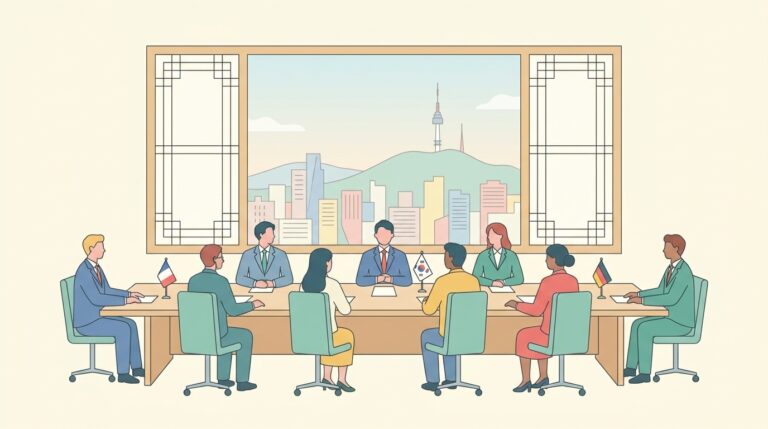
Phase 1: 공감 (Story-Driven Opening)
안녕하세요! 매일한글 에디터입니다.
Have you ever found yourself glued to a high-stakes K-drama like Designated Survivor: 60 Days or Queenmaker, marveling at how Korean diplomats and high-ranking officials navigate intense room dynamics without ever raising their voices? In Korean diplomatic and trade spheres, battles are rarely won by overt aggression. Instead, they are won through linguistic finesse, deliberate pauses, and an intricate balance between asserting national interest and maintaining face.
Now, imagine being assigned to a bilateral briefing at the Seoul Government Complex in Gwanghwamun or an RCEP (Regional Comprehensive Economic Partnership) multilateral trade round. You have spent years mastering textbook grammar. You know how to politely say “제 생각에는 이 조건이 좋습니다” (In my opinion, this condition is good). But the moment senior negotiators delve into concessions, origin certifications, and tariff schedules, using standard business Korean can make you sound inexperienced—or worse, dangerously blunt.
Over the past decade mentoring trade attachés, corporate counsels, and foreign affairs fellows in Seoul, the most consistent pain point I have observed is this: learners struggle to transition from conversational politeness to high-level diplomatic rhetoric. Textbook Korean teaches you how to agree or disagree; diplomatic Korean teaches you how to disagree constructively while expanding the negotiating table. This guide is crafted directly from field feedback and boardroom observation, designed to give you the command and cultural confidence of a seasoned trade representative.
Phase 2: 핵심 표현 3선 심층 분석 (Top 3 Core Expressions In-Depth)
1. 이견을 좁히다 (Igyeoneul jophida)
- Pronunciation: ee-gyon-eul jo-pee-da (Sounds like English “eagle” without the ‘l’ + “yawn” + “chop”-he-da)
- Meaning: Literally “to narrow differences in perspective”; diplomatically used to mean “bridging the gap” or “reaching common ground during an impasse.”
- K-Culture Moment: Late-night negotiations in a ministerial conference room. Cups of cold instant Maxim coffee litter the table. The chief negotiator unbuttons his jacket, leans forward, and asks the room how they can bridge this final tariff disagreement before dawn.
- Editor’s Insight: Saying “우리는 동의하지 않습니다” (We disagree) is diplomatic suicide in Korea—it creates immediate hostility. Using “이견을 좁히다” redirects focus away from conflicting personalities toward the technical gap itself, framing both delegations as joint problem-solvers.
- Situation Spectrum: Casual 🚫 | Semi-formal ⚠️ | Formal ✅
- 🤔 Think About It: Notice how Korean diplomacy personifies the disagreement rather than blaming the speaker. How does addressing the “gap” (이견) protect individual and institutional face in your culture?
2. 상호 호혜적인 관점에서 (Sangho hohyejeogin gwanjeomeseo)
- Pronunciation: sahng-ho ho-hye-jeog-in gwan-jeom-e-seo (Like “song-ho” + “hoe”-ye + “jeog” + “gwan”-jum-eh-suh)
- Meaning: Literally “from the perspective of mutual reciprocity”; contextually equivalent to establishing a “win-win, equitable framework.”
- K-Culture Moment: The opening address of a joint ministerial press conference at the Blue House or the Ministry of Foreign Affairs, setting a cordial, equal tone before bilateral trade talks.
- Editor’s Insight: Hohye (호혜, 互惠) is a profound East Asian diplomatic tenet. It implies not just transactional tit-for-tat, but reciprocal benevolence. Opening a rebuttal with this phrase elevates your counterproposal from self-serving demand to mutual benefit.
- Situation Spectrum: Casual 🚫 | Semi-formal ⚠️ | Formal ✅
- 🤔 Think About It: In Western multilateral negotiations, talks often center around legal rights and transactional trade-offs. How does invoking “reciprocal virtue” alter the moral weight of a concession?
3. 절충안을 모색하다 (Jeolchung-aneul mosaekhada)
- Pronunciation: jeol-choong-an-eul mo-saek-ha-da (Rhymes with “dull-choong-ahn” + “mo-sack-ha-da”)
- Meaning: Literally “to search out a compromise proposal”; diplomatically, “to actively engineer a middle-ground resolution.”
- K-Culture Moment: The pivotal turning point in a high-stakes trade dispute drama where disaster looms, and the brilliant junior negotiator presents an alternative regulatory text that satisfies both sides.
- Editor’s Insight: Unlike simply “compromising” (타협하다), which can sometimes carry a connotation of abandoning one’s core principles, jeolchung-an conveys intellectual rigor and tactical flexibility. The verb mosaekhada shows deliberate, ongoing effort.
- Situation Spectrum: Casual 🚫 | Semi-formal ⚠️ | Formal ✅
- 🤔 Think About It: Why does “exploring a compromise” sound far more proactive and authoritative in Korean than simply saying “we can concede”?
Phase 3: 교과서 한국어 vs 진짜 한국어 (Textbook vs. Real Diplomatic Korean)
Situation 1: Expressing hesitation on a proposed tariff cut
- 📖 교과서 한국어 (Textbook): “우리는 이 품목의 관세 인하에 반대합니다.” (Uri-neun i pummog-ui gwanse inhaye bandaehamnida. / “We oppose lowering tariffs on this item.”)
- 🗣️ 진짜 한국어 (Real Diplomatic): “해당 품목의 양허에 대해서는 현재로서는 난색을 표할 수밖에 없습니다.” (Haedang pummog-ui yangheo-e daehaeseoneun hyeonjae-roseoneun nansaegeul pyohal subakke eopseumnida. / “Regarding concessions for this tariff line, our delegation cannot help but express severe reservations at this juncture.”)
- 💡 왜 다를까? (Why the difference?): Saying bandaehamnida (we oppose) closes the door to talks. Advanced trade diplomats use nansaek (난색, literally ‘a troubled countenance’) coupled with yangheo (양허, tariff concessions), which firmly rejects the clause without terminating future bargaining leverage.
Situation 2: Suggesting the room move to another agenda item
- 📖 교과서 한국어 (Textbook): “이건 어려우니까 다음 주제로 넘어갑시다.” (Igeon eoryeounikka da-eum juje-ro neomeogapsida. / “Since this is difficult, let’s move to the next topic.”)
- 🗣️ 진짜 한국어 (Real Diplomatic): “본 쟁점은 잠정 보류하고, 후속 의제로 전환하는 편이 생산적일 것으로 사료됩니다.” (Bon jaengjeom-eun jamjeong boryuhago, husok uije-ro jeonhwanhaneun pyeoni saengsanjeogil geoseuro saryodoemnida. / “It is deemed productive to hold this point in abeyance tentatively and proceed to the subsequent agenda.”)
- 💡 왜 다를까? (Why the difference?): Using saryodoemnida (사료됩니다 – formal assessment) rather than personal statements (saenggakhamnida) depersonalizes the request, providing procedural dignity to everyone present.
Phase 4: K-Culture 딥다이브 & 비언어적 매너 (Non-Verbal Manners & Culture)
4-1. 눈치 (Nunchi) & Gestures in Trade Negotiations
- The Two-Handed Document Presentation: When exchanging bilateral draft texts or concession schedules, hold the document with both hands along the upper third of the paper, giving a measured 15-degree bow of the head. Never slide a document casually across the negotiating table.
- Strategic Stillness & The Reflective Pause: In multilateral forums like RCEP, responding within split seconds can signal impulsiveness or a lack of internal consensus. Experienced Korean negotiators maintain still eye contact, nod gently (kkudeogim), and pause for two to three seconds before activating their microphone. This non-verbal cue signals strategic depth.
4-2. Cultural Code Analysis: Myeongbun (명분) vs. Silli (실리)
In modern Korean corporate and trade dramas like Misaeng or Reborn Rich, negotiations are consistently underpinned by two philosophical poles: Myeongbun (moral, legal justification) and Silli (practical, substantive profit). When dealing with Korean government counterparts from ministries like MOTIE (산업통상자원부), you cannot merely pitch profit (silli). You must equip them with myeongbun—a clear public rationale that allows their delegation to report back home that national pride, local industry safeguards, and regional treaties were completely respected.
Phase 5: 실전 롤플레이 시나리오 (Real-World Roleplay Scenario)
Setting: Ministry of Trade, Industry and Energy (MOTIE) negotiation chamber, Sejong Government Complex. Bilateral chapter discussions on regional supply chain rules under RCEP.
Characters:
* Director Han (한 국장): A seasoned, sharp chief negotiator representing the Korean delegation.
* You (수석대표): The lead foreign trade representative.
- Director Han: “원산지 기준 완화 건에 대해 본 대표단은 상당한 우려를 금할 수 없습니다.”
(Wonsanji gijun wan-hwa geon-e daehae bon daepyodaneun sangdanghan u-ryeoreul geumhal su eopseumnida.)
“Regarding the relaxation of the Rules of Origin, our delegation cannot help but express substantial concern.”
🎭 Looks over his glasses, placing the draft schedule deliberately on the table. -
You: “국장님의 우려는 십분 이해합니다만, 역내 공급망의 효율성을 제고하기 위한 불가피한 조치였습니다.”
(Gukjangnim-ui u-ryeoneun sipbun ihaehamnidaman, yeongnae gonggeupmang-ui hyoyulseong-eul jegohagi wihan bulgapihan jochiyeosseumnida.)
“I fully understand your concern, Director, but this was an inevitable measure to enhance the efficiency of the regional supply chain.”
🎭 Maintaining steady eye contact while resting palms lightly on the table. -
Director Han: “그러나 국내 중소기업들의 피해를 최소화하는 장치가 전무한 상태입니다.”
(Geureona gungnae jungsogieopdeur-ui pihaereul choesohwahaneun jangchiga jeonmuhan sangtae-imnida.)
“However, there is currently no mechanism to mitigate damages to our domestic small and medium enterprises.”
🎭 Shakes his head faintly, crossing his hands. -
You: “그렇다면 상호 호혜적인 관점에서 절충안을 모색해 보는 것은 어떻겠습니까?”
(Geureotamyeon sangho hohyejeogin gwanjeomeseo jeolchung-aneul mosaekhae boneun geoseun eotteokkesseumnikka?)
“If so, what if we seek a compromise proposal from a perspective of mutual reciprocity?”
🎭 Leaning slightly forward, voice measured and open. -
Director Han: “구체적으로 어떤 방안을 염두에 두고 계십니까?”
(Guchejeogeuro eotteon bang-aneul yeomdue dugo gyesimnikka?)
“What concrete proposal do you have in mind?”
🎭 Picks up his pen, signaling openness to take notes. -
You: “유예 기간을 3년으로 연장하되, 세부 양허 일정을 단계적으로 조정하는 방안입니다.”
(Yuye giganeul samnyeon-euro yeonjanghadewi, sebu yangheo iljeong-eul dangyejeogeuro jojeonghaneun bang-animnida.)
“We propose extending the transitional grace period to three years while phasing the detailed concession schedule progressively.”
🎭 Turning the proposal sheet toward Director Han smoothly with both hands. -
Director Han: “흠, 그 정도의 조건이라면 내부적으로 검토할 만한 여지가 있을 것으로 사료됩니다.”
(Heum, geu jeongdo-ui jogeon-iramyeon naebujeogeuro geomtohal manhan yeojiga isseul geoseuro saryodoemnida.)
“Hmm. Under those terms, it is considered that there is room for our team to examine the proposal internally.”
🎭 Delivers a measured nod, annotating the clause margin. -
You: “감사합니다. 이를 토대로 양측의 이견을 좁혀 나갈 수 있기를 기대합니다.”
(Gamsahamnida. Ireul todaero yangcheug-ui igyeoneul jophyeo nagal su itgireul gidaehamnida.)
“Thank you. We look forward to narrowing our differences on this foundation.”
🎭 Inclines head respectfully with hands clasped.
🔀 Interactive Decision Point
How do you handle Director Han’s initial concern regarding SME damages?
* Choice A: “이 조건이 싫으시면 협정을 체결하기 어렵습니다.” (If you don’t like this condition, it is difficult to sign the agreement.)
* Choice B: “상호 호혜적인 관점에서 단계별 유예 기간을 두는 절충안을 모색합시다.” (Let’s seek a compromise by introducing a phased grace period from a mutually reciprocal standpoint.)
* Choice C: “국내 사정은 아쉽지만, RCEP 규범상 무조건 수용하셔야 합니다.” (Domestic circumstances are regrettable, but under RCEP norms, you must accept unconditionally.)
- Feedback:
- Choice A (Bad): Extreme breach of diplomatic decorum. It issues an ultimatum, cornering the Korean delegation and guaranteeing a breakdown in goodwill.
- Choice B (Best): Flawless C1 diplomacy. It acknowledges their concern, supplies myeongbun (domestic safeguards), and invokes mutual reciprocity (hohye).
- Choice C (Risk): While legally grounded in treaty terms, dictating “unconditional acceptance” humiliates your counterpart, triggering defensive resistance from the Korean side.
Phase 6: 10초 감정 섀도잉 드릴 (10-Second Emotional Shadowing Drill)
Practice matching the cadenced tone of a lead trade envoy. Pay attention to pause markers (/).
[🤝 단호하지만 정중하게 / Firm yet courteous]
“상호 호혜적인 / 관점에서 / 절충안을 모색하는 것이 / 바람직하다고 사료됩니다.”
(Sangho hohyejeogin / gwanjeomeseo / jeolchung-aneul mosaekhaneun geosi / baramjikhadago saryodoemnida.)
“From a mutually reciprocal perspective, it is deemed desirable to explore a compromise.”-
[🏛️ 침착하고 확신에 찬 어조로 / Calm and assured]
“양측의 실질적인 이익을 위해 / 이번 협상 라운드에서 / 이견을 좁혀 나가기를 희망합니다.”
(Yangcheug-ui siljiljeogin i-igeul wihae / ibeon hyeopsang raundueseo / igyeoneul jophyeo nagagireul huimanghamnida.)
“For the substantive benefit of both parties, we hope to narrow our differences in this negotiation round.”
Phase 7: K-Culture 미니 사전 (Diplomatic Keyword Mini-Dictionary)
- 원산지 결정기준 (Wonsanji gyeoljeonggijun) | Rules of Origin (ROO)
The technical criteria determining where goods are produced. In everyday trade talks, negotiators argue fiercely over whether manufacturing processes in free economic zones qualify under regional value content rules. - 양허안 (Yangheo-an) | Tariff Concession Schedule / Offer List
The official national schedule outlining which tariffs will be eliminated or lowered over a set period. Often heard in trade briefings: “양허안 수정본을 제출해 주시기 바랍니다” (Please submit the revised concession schedule). - 비관세 장벽 (Bigwanse jangbyeok) | Non-Tariff Barriers (NTBs)
Quotas, regulatory compliance, or technical sanitary hurdles. Used frequently when trade delegations seek regulatory harmonization outside traditional tariffs. - 국회 비준 (Gukhoe bijun) | National Assembly Ratification
The constitutional hurdle every Korean trade treaty must clear. When Korean delegates say “국회 비준이 쉽지 않습니다” (National Assembly ratification won’t be easy), they are signaling that the agreement needs a stronger political rationale to persuade Korean lawmakers.
Phase 8: 여행자 & 비즈니스 파견자를 위한 생존 키트 (Business Travel Survival Kit)
TOP 3 Survival Phrases
- “외교통상 업무차 세종청사를 방문했습니다.”
(Oegyotongsang eommucha sejongcheongsareul bangmunhaesseumnida.)
Pro Tip: Use this at security gates in the Sejong or Gwanghwamun complexes to clarify your high-level delegation purpose quickly. - “의전 차량 대기 구역이 어디입니까?”
(Uijeon charyang daegi guyeogi eodi-imnikka?)
Pro Tip: Essential when looking for official protocol/delegation transit zones at Incheon International Airport or conference venues. - “동시통역 수신기 채널 설정 확인 부탁드립니다.”
(Dongsitongyeok susingi chaeneol seoljeong hwag-in butakdeurimnida.)
Pro Tip: A polite, natural phrasing to verify simultaneous interpretation frequencies prior to the opening bell.
Editor’s Travel Note: High-Level Protocol Logistics
When visiting the Ministry of Foreign Affairs (MOFA) in Gwanghwamun or MOTIE in Sejong City, security credentials require pre-clearance. For ground navigation between ministerial buildings, remember to download the Naver Map application to navigate sprawling multi-wing government complexes with pinpoint doorway accuracy. If catching the KTX high-speed rail down to Osong Station (the gateway to the Sejong Government Complex), book tickets a week ahead using the official Korail railway booking system, as inter-city trade slots sell out swiftly during parliamentary audit seasons.
Phase 9: “한 발 더 깊이” (Deep Thinking Essay)
In international trade, legal texts are binding, but cultural grammar determines whether agreements operate smoothly or stall in red tape. In Korean administrative culture, a successful negotiation is never viewed as an arena where one party vanquishes another. Rather, it is viewed as a shared path (Doh-ri, 도리) where both entities build enduring credibility (Sin-roe, 신뢰). If a foreign delegation walks away with all the gains while leaving their Korean counterpart without face or defensible justification, future enforcement and regulatory reviews will face constant resistance. True mastery of high-level Korean diplomacy lies in making your counterpart feel that their dignity and their nation’s welfare were preserved alongside yours.
💬 Your Turn: Have you ever participated in a negotiation where personal dignity played a bigger role than raw monetary concessions? Share your experience in the comments below!
Phase 10: FAQ & 오해 방지 (FAQ Schema)
Q: Is it rude to use “아니오” (No) in a formal trade meeting?
A: While “아니오” (Anio) is technically grammatically polite, saying it flatly during bilateral trade talks sounds excessively blunt and confrontational. Instead, use nuanced diplomatic evasions such as “그 부분에 대해서는 현시점에서 확답을 드리기 곤란합니다” (Regarding that aspect, it is difficult to offer a definitive answer at this juncture) or “신중한 검토가 필요합니다” (That requires prudent review).
Q: What is the difference between “협약” (Hyeob-yak) and “협정” (Hyeob-jeong)?
A: “협약” (Agreement/Pact) often refers to broad commitments, memorandums of understanding (MOUs), or sector-specific compacts. “협정” (Agreement/Treaty) carries full binding international legal status—such as an FTA (자유무역협정, Free Trade Agreement)—which requires cabinet approval and legislative ratification.
Q: Can I address a Director General or Minister simply by their name with “-ssi” (씨)?
A: Never use “-ssi” (씨) in diplomatic or ministerial environments. It can sound dismissive or patronizing. Always address counterparts by their professional title combined with the honorific suffix “-nim” (님), such as “국장님” (Gukjang-nim – Director General) or “장관님” (Janggwan-nim – Minister).
🚨 흔한 실수 (Common Mistakes) Notice Board
- ❌ Mistake 1: Saying “우리의 요구는 이것입니다” (Our demand is this).
✅ Correct Action: Say “본 대표단의 제안 사항은 다음과 같습니다” (Our delegation’s proposal is as follows). - ❌ Mistake 2: Using informal endings like “-거든요” (-geodeunyo) to explain your country’s position.
✅ Correct Action: Stick firmly to the high-formality deferential speech level: “-ㅂ니다/습니다” (-mnida/-seumnida). - ❌ Mistake 3: Sliding treaty drafts single-handedly across the table like in Western cinema.
✅ Correct Action: Present documents with both hands while holding the paper flat and slightly bowing your upper torso.
Phase 11: 액션 미션 & 참여 유도 (Action Missions)
- 🥉 Bronze Mission (Solo Mastery): Record yourself reading the 10-Second Emotional Shadowing Drill twice. Focus on natural pacing and taking deep pauses at the slash (
/) marks. - 🥈 Silver Mission (Community Interaction): Write one sentence in the comments below using “이견을 좁히다” (to narrow differences) in a hypothetical scenario.
- 🥇 Gold Mission (Real-World Application): Watch a Korean news press release from the Ministry of Foreign Affairs (외교부) or MOTIE (산업부) on YouTube, note three technical terms used by the spokesperson, and share them on your social channels tagging #DailyHangul.
- 🎮 K-Culture Mission: Watch an episode of Designated Survivor: 60 Days (60일, 지정생존자) and spot the exact moment an envoy uses the term “호혜” (mutual reciprocity) or “유감” (regret).
Phase 12: 인터랙티브 퀴즈 챌린지 (Interactive Quiz Challenge)
Test your diplomatic instincts with this 3-question challenge!
- Situational Judgment: The opposing trade delegation refuses to lower agricultural tariffs. Which response best preserves diplomatic decorum while maintaining negotiation momentum?
- A) “그렇다면 이번 협상은 파기하겠습니다.” (Then we will terminate this negotiation.)
- B) “해당 사안은 잠정 보류하고, 상호 호혜적인 관점에서 후속 의제를 먼저 논의합시다.” (Let’s hold this matter in abeyance and discuss subsequent agendas first from a mutually reciprocal standpoint.)
- C) “어쩔 수 없네요. 그냥 넘어가겠습니다.” (It cannot be helped. We’ll just pass.)
- Fill-in-the-Blank: Fill in the missing diplomatic verb:
“양측 대표단은 치열한 논의 끝에 드디어 주요 쟁점에 대한 ________을/를 좁혔습니다.”
(The delegations finally narrowed the ________ regarding key issues after fierce discussion.) -
True / False Cultural Check: In a Korean trade summit, showing slight physical hesitation and pausing before answering is considered a sign of incompetence and unpreparedness. (True / False)
👉 Click to reveal answers & explanations
-
Answer: B
Explanation: Option B deploys the diplomatic phrase sangho hohyejeogin gwanjeom (mutual reciprocity) and tactically shelves the deadlock (jamjeong boryu) without abandoning the objective or breaking protocol. -
Answer: 이견 (I-gyeon / differences of opinion)
Full Sentence: “양측 대표단은 치열한 논의 끝에 드디어 주요 쟁점에 대한 이견을 좁혔습니다.” -
Answer: False
Explanation: In Korean diplomatic circles, a measured pause demonstrates sinjung (신중, prudence and strategic thoughtfulness), whereas impulsive, rapid counterarguments are often viewed as reckless.







