

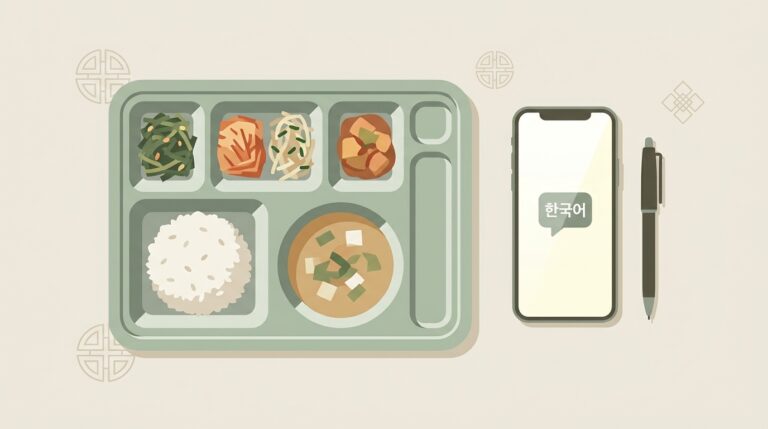
Phase 1: 공감 (Story-driven Immersion Opening)
안녕하세요! 매일한글 에디터입니다.
Imagine sitting in a trendy café in Yeonnam-dong with your Korean peers in their late twenties. The conversation seamlessly transitions from career transitions to the latest critically acclaimed drama, D.P., before someone sighs, clicking on a viral post from an online military community showing a dismal lunch tray: a scoop of cold white rice, a watery soup, and a single square of fried tofu. The table erupts into a spirited, nuanced debate: “이게 2020년대 병영 급식 수준이라니, 여전히 갈 길이 멀다” (I can’t believe this is the standard of barracks catering in the 2020s; we still have a long way to go). You understand every single isolated word, yet the deep institutional critique, socio-cultural weight, and generational grievance sail completely over your head.
For advanced learners aiming for native-level fluency (C2), military discourse in South Korea is not an isolated subculture; it is the crucible where gender dynamics, civil liberties, generational friction, and modern citizenship intersect. Nearly every native male acquaintance you meet has experienced mandatory conscription, and the national consciousness is hypersensitive to how young soldiers are treated. In recent years, public exposés detailing 부실 급식 (substandard military rations) sparked unprecedented public fury, transforming into an urgent national mandate for 병영 문화 개선 (barracks culture reform).
If you have ever felt hesitant to join these high-level discussions because you lacked the sociolinguistic nuance, this guide is crafted specifically for you. Drawing on years of real classroom feedback from diplomats, sociologists, and advanced expatriates, we will equip you with the sophisticated, C2-level register required to analyze, debate, and understand South Korea’s evolving barracks culture with sensitivity and authority.
Phase 2: 핵심 표현 3선 심층 분석 (Core Expressions Deep Dive)
1. 부실 급식 (Busil geupsik)
- Pronunciation: [Bu-sil geup-sik] (Think of boo as in boot, sil like sill in window sill, geup rhyming with a short cup, and sik like seek with an abrupt stop).
- Meaning: Literally “substandard provided meal,” but pragmatically refers to “unacceptable, neglectful institutional catering that violates basic dignity.”
- K-Culture Moment: Seen prominently in investigative news broadcasts like SBS’s Curious Stories Y or YouTube military exposé channels like Yuk-dae-jeon (육대전), where photos of raw chicken or half-portioned kimchi provoked nationwide boycotts and parliamentary audits.
- Editor’s Insight: Busil (부실) carries a biting connotation of administrative negligence and systemic corner-cutting. When applied to soldiers who are performing mandatory civic duty, it ceases to be a mere culinary critique; it becomes a moral indictment of the state failing its protectors.
- Situation Spectrum: Casual ⚠️ | Semi-formal ✅ | Formal ✅
- 🤔 Think About It: Does your native culture frame institutional food complaints as humorous domestic grievances, or as a fundamental civil rights violation? How does the mandatory nature of Korean conscription elevate a simple meal tray into a matter of national honor?
2. 병영 문화 개선 (Byeong-yeong munhwa gaeseon)
- Pronunciation: [Byeong-yeong mun-hwa gae-seon] (Byeong sounds like byung in dungaree, mun-hwa rhymes with moon-wha, and gae-seon resembles get-sun spoken with a crisp final nasal).
- Meaning: Literally “barracks culture improvement,” culturally signifying the systemic transition from Japanese imperial-era authoritarianism toward modern, human-rights-centric military life.
- K-Culture Moment: Central thematic thread in the Netflix adaptation of D.P., where characters confront the historical inertia of hazing, physical abuse, and structural indifference.
- Editor’s Insight: This phrase is the ultimate technocratic and civic buzzword. It encapsulates everything from the legalization of personal smartphone use after training hours to eliminating off-duty verbal harassment and establishing anonymous whistleblower channels.
- Situation Spectrum: Casual ⚠️ | Semi-formal ✅ | Formal ✅
- 🤔 Think About It: How does language reflect institutional transition? Notice the suffix 개선 (改善, reform/betterment), which acknowledges existing systemic flaws while projecting civic aspiration.
3. 처우 개선 (Cheo-u gaeseon)
- Pronunciation: [Cheo-u gae-seon] (Cheo sounds like chuh in churros, u like oo in zoo, followed by gae-seon).
- Meaning: Literally “treatment improvement”; sociologically refers to “raising the baseline standards of compensation, living conditions, and fundamental welfare of conscripted personnel.”
- K-Culture Moment: Frequently quoted during presidential debates and Ministry of National Defense press releases announcing the phased increase of conscript stipends toward 2 million KRW per month.
- Editor’s Insight: Cheo-u (처우) relates directly to dignity and reciprocity. Using this word demonstrates that you understand the modern Korean consensus: national defense service is no longer a unilateral sacrifice to be demanded without equitable state compensation.
- Situation Spectrum: Casual ⚠️ | Semi-formal ✅ | Formal ✅
- 🤔 Think About It: In your home country, is military service framed strictly as voluntary wage labor, patriotic philanthropy, or civic taxation? How does this alter the semantics of “treatment”?
Phase 3: 교과서 한국어 vs 진짜 한국어 (Textbook vs. Real Korean)
Situation 1: Expressing Outrage Over Poor Barracks Rations
- 📖 교과서 한국어: 군대의 식사가 매우 부족하고 영양가가 낮아 보여요. (Gundae-ui siksa-ga maeu bujokhago yeongyangga-ga naja boyeoyo. / “The meals of the military seem very insufficient and low in nutritional value.”)
- 🗣️ 진짜 한국어: 나라 지키러 간 청년들한테 이런 부실 급식을 주는 건 국가적 직무유기 아닌가요? (Nara jikirgeo gan cheongnyeondeul-hante ireon busil geupsik-eul juneun geon gukgajeok jingmuyugi aningayo? / “Isn’t serving substandard rations like this to young men who went to defend the nation a case of national dereliction of duty?”)
- 💡 왜 다를까? C2-level real Korean incorporates ethical culpability. Advanced speakers do not merely evaluate the food quality; they anchor the issue within civic contracts using terms like 직무유기 (dereliction of duty) and 청년들 (the youth bearing the defense burden).
Situation 2: Discussing Soldiers Using Smartphones After Duty
- 📖 교과서 한국어: 이제 군인들도 일과 후에 휴대전화를 쓸 수 있어서 편리해졌습니다. (Ije gunindeul-do ilgwa hue hyudaejeonhwa-reul sseul su isseoseo pyeonrihaejyeotseumnida. / “Now soldiers can also use mobile phones after the daily routine, so it has become convenient.”)
- 🗣️ 진짜 한국어: 일과 후 스마트폰 사용이 허용되면서 악습이 음지에서 양지로 드러나고 병영 부조리가 획기적으로 줄었죠. (Ilgwa hu seumateupon sayong-i heoyongdoemyeonseo akseub-i eumji-eseo yangji-ro deureonago byeong-yeong bujori-ga hoekgijeok-euro jureotjyo. / “With after-hours smartphone use permitted, toxic practices were dragged into the daylight and barracks absurdities decreased exponentially.”)
- 💡 왜 다를까? Native discourse views smartphones not as mere convenience or entertainment gadgets, but as civilian transparency tools that dismantled closed authoritarian hierarchies (음지에서 양지로).
Phase 4: K-Culture 딥다이브 & 비언어적 매너 (Deep Dive & Non-Verbal Nuance)
4-1. 눈치 (Nunchi) & Gestures in Military Discourse
When discussing military topics with native Koreans, non-verbal cues indicate your cultural empathy:
* The Somber Nod (묵직한 끄덕임): When an interlocutor recalls their service or describes past meal crises, avoid flippant humor or smiling. Maintain steady, respectful eye contact and nod slowly with pressed lips. Conscription is universally acknowledged as a period of personal sacrifice, physical strain, and forfeited youth.
* The Restrained Hands: Avoid sweeping, animated hand gestures when debating institutional misconduct. Keep hands resting calmly on the table or your lap to convey that you are treating systemic reforms (선진화) with civic gravity rather than viewing it as sensationalized melodrama.
* Reading generational trauma: Older Korean men (50s-60s) may still romanticize endure-at-all-costs mentalities (하면 된다 / “Can-do spirit”), while younger generations prioritize fundamental human rights. Tailor your nunchi: do not antagonize an elder directly; instead, frame the progress as “국격에 걸맞은 변화” (a change befitting our national standing).
4-2. Cultural Code Analysis: The Smartphone Revolution & Yuk-dae-jeon
For decades, the Korean military was an informational black box governed by strict vertical hierarchy. If a mess hall sergeant pocketed food budgets or served rotten produce, soldiers were forced to swallow the injustice under the threat of punishment for “undermining unit cohesion.”
The paradigm shifted irrevocably with two innovations: the official legalization of smartphone use after 6 PM in 2019–2020, and the rise of civilian-facing Facebook communities like “육군훈련소 대신 전해드립니다” (Delivering on Behalf of the Army Training Center, colloquially Yuk-dae-jeon).
Today’s conscripts, born as digital natives of the MZ generation, do not passively endure systemic failure. When quarantined soldiers during the pandemic received cold, deficient plastic lunchboxes, they photographed the evidence and dispatched it straight to public social media networks while off-duty. Within hours, parliamentary committees convened, commanders faced public censure, and the Defense Ministry introduced specialized civilian catering contracts. South Korea’s military mess tray is thus no longer just a dish; it is a mirror reflecting the broader democratization of Korean society.
Phase 5: 실전 롤플레이 시나리오 (Real-Life Roleplay Scenario)
Setting: A quiet craft beer pub near Yongsan, Seoul. You are discussing current domestic affairs with Min-jun (민준), a thoughtful 28-year-old postgraduate student who completed his sergeant service in an infantry division three years ago.
- Turn 1 (Min-jun): 군대 급식 문제로 뉴스에 시끌벅적하던데, 솔직히 예견된 참사 아니었나 싶어요. (Gundae geupsik munje-ro nyuseu-e sikkeulbeokjeokhadeon-de, soljikhi yegyeondoen chamsa anieotna sipeoyo. /
🎭 맥주잔을 만지작거리며 씁쓸한 표정으로 한숨을 쉰다.“The news is buzzing again over military meal issues, but honestly, I think it was a catastrophe waiting to happen.”) - Turn 2 (You): 맞아요. 특히 격리 장병 도시락 사진을 보고 많은 국민들이 경악을 금치 못했잖아요. (Majayo. Teukhi gyeongni jangbyeong dosirak sajin-eul bogo maneun gungmin-deul-i gyeong-ag-eul geumchi mothaetjanayo. /
🎭 진지하게 고개를 끄덕이며 공감을 표한다.“Exactly. Citizens were especially appalled when they saw the photos of the bento boxes given to quarantined soldiers.”) - Turn 3 (Min-jun): 저희 복무할 때만 해도 내부 고발은 꿈도 못 꿨는데, 요즘은 병사들이 목소리를 내니까 다행이에요. (Jeohui bokmuhal ttaeman haedo naebu gobal-eun kkumdo mot kkwonneunde, yojeum-eun byeongsa-deul-i moksori-reul naenikka dahaeng-ieyo. /
🎭 잔을 들어 한 모금 마신 뒤 회상하듯 말한다.“When we served, whistleblowing internally wasn’t even a dream, so it’s a relief that soldiers can voice their concerns nowadays.”) - Turn 4 (You): 스마트폰 도입이 폐쇄적이던 병영 문화를 투명하게 바꾸는 촉매제가 된 셈이네요. (Seumateupon doib-i pyeswoejeok-ideon byeong-yeong munhwa-reul tumyeonghage bakkuneun chongmaeje-ga doen sem-ineyone. /
🎭 민준의 눈을 응시하며 차분하게 분석한다.“It seems introducing smartphones served as the catalyst that made the closed barracks culture transparent.”) - Turn 5 (Min-jun): 그렇죠. 하지만 지휘관들이나 일부 간부들은 여전히 군 기강이 해이해졌다고 불평하더라고요. (Geureochyo. Hajiman jihwigwan-deul-ina ilbu ganbu-deul-eun yeojeonhi gun gigang-i haeihaejyeotdago bulpyeonghadeoragoyo. /
🎭 쓴웃음을 지으며 어깨를 으쓱인다.“Right. Yet commanders and some officers still complain that military discipline has become lax.”) - Turn 6 (You): 기본적인 처우 개선과 인권 보장이 수반되지 않는 기강은 진정한 전투력이 될 수 없죠. (Gibonjeogin cheo-u gaeseon-gwa ingwon bojang-i subandoeji anneun gigang-eun jinjeonghan jeonturyeok-i doel su eopjyo. /
🎭 단호하고 확신에 찬 어조로 맥주잔을 내려놓는다.“Discipline that does not accompany basic improvement of conditions and human rights guarantees cannot translate into genuine combat readiness.”) - Turn 7 (Min-jun): 정확한 지적이십니다! 군대를 소모품 취급하던 낡은 관행부터 뿌리 뽑아야 진정한 선진 강군이죠. (Jeonghwakhan jijeog-isipnida! Gundae-reul somopum chwigwubhadeon nalgeun gwanhaeng-buteo ppuri ppob-aya jinjeonghan seonjin gang-gun-ijyo. /
🎭 깊이 감탄하며 테이블을 가볍게 톡 친다.“Spot-on critique! Only when we uproot the archaic custom of treating conscripts as expendable commodities can we become a genuinely advanced, elite military.”) - Turn 8 (You): 맞습니다. 장병들의 식탁이야말로 한 나라의 민주주의 성숙도를 보여주는 척도니까요. (Matseumnida. Jangbyeong-deul-ui siktak-iyamallo han nara-ui minjuju-ui seongsukdo-reul boyeojuneun cheokdo-nikkayo. /
🎭 잔을 들어 가볍게 건배 제의를 한다.“Agreed. The dining table of our soldiers is indeed the ultimate benchmark reflecting a nation’s democratic maturity.”)
🔀 인터랙티브 분기점 (Interactive Branching Decision)
At Turn 6, Min-jun noted that older officers complain about loose discipline. How do you respond?
- Option A: “군대에서 밥투정하는 건 애송이들이나 하는 짓 아닌가요? 규율이 먼저죠.” (Complaining about military food is what soft kids do, isn’t it? Discipline comes first.)
- Feedback [Bad 🚫]: Disastrous misjudgment. This mirrors the dismissive, outdated rhetoric that younger Koreans vehemently reject. It ignores systemic corruption and invalidates conscript suffering.
- Option B: “차라리 군대를 모병제로 싹 바꾸면 다 해결될 텐데 왜 징병제를 고집할까요?” (If we just switch to a volunteer military system completely, it would solve everything; why stick to conscription?)
- Feedback [Risk ⚠️]: Overly reductive. While volunteer service is discussed, South Korea faces severe geopolitical tensions and demographic shortages. Framing conscription as an arbitrary choice sounds politically detached from geopolitical realities.
- Option C: “기본적인 처우 개선과 인권 보장이 수반되지 않는 기강은 진정한 전투력이 될 수 없죠.” (Discipline that does not accompany basic improvement of conditions and human rights guarantees cannot translate into genuine combat readiness.)
- Feedback [Best ✅]: Flawless C2 insight. It harmonizes defense strategy with humanitarian imperatives, establishing an articulate, balanced critique of national defense policy.
Phase 6: 10초 감정 섀도잉 드릴 (10-Second Emotional Shadowing Drill)
Practice these high-register sentences aloud. Follow the slash (/) marks for pauses and breathe matching the emotional guidepost:
- [😤 답답하고 개탄스럽게 – Expressing frustrated social grief]
나라를 지키는 청년들에게 / 이런 부실 급식을 제공하는 것은 / 국가의 명백한 직무유기입니다.
(Nara-reul jikineun cheongnyeon-deul-ege / ireon busil geupsik-eul jegonghaneun geos-eun / gukga-ui myeongbaekhan jingmuyugi-imnida.)
“Providing substandard meals / to young citizens protecting the nation / is an undeniable dereliction of duty by the state.” -
[🤔 신중하고 비판적으로 – Analytical and deliberative tone]
병영 문화 개선 없는 군기 확립은 / 구시대적 억압에 불과하며 / 진정한 사기 진작으로 이어질 수 없습니다.
(Byeong-yeong munhwa gaeseon eomneun gungi hwangnip-eun / gusidaejeok eog-ab-e bulgwahamyeo / jinjeonghan sagi jinjak-euro ieojil su eopseumnida.)
“Enforcing military discipline without barracks culture reform / amounts to nothing more than archaic repression / and cannot lead to genuine morale boosting.” -
[🫡 긍정적이고 희망차게 – Confident, progressive conviction]
투명한 소통 창구와 자율성이 보장될 때 / 비로소 건강하고 선진화된 병영이 / 완성될 것입니다.
(Tumyeonghan sotong changgu-wa jayulseong-i bojangdoel ttae / biroso geonganghago seonjinhwadoen byeong-yeong-i / wanseongdoel geos-imnida.)
“Only when transparent communication channels and autonomy are guaranteed / will a healthy and advanced barracks / truly be realized.”
Phase 7: K-Culture 미니 사전 (Mini Dictionary: 4 Key Terms)
-
짬밥 (Jjambap)
- Literal Translation: Residual military food / Slang for barracks meals.
- Everyday & Business Usage: In corporate Korea, jjambap metaphorically represents organizational seniority or time served within an industry. Ex: “내가 이 바닥에서 먹은 짬밥이 몇 년인데!” (Do you know how many years of industry experience I have under my belt?!). In food contexts, it refers to standard mess hall fare.
- 육대전 (Yuk-dae-jeon)
- Literal Translation: Acronym for “육군훈련소 대신 전해드립니다” (Delivering on Behalf of the Army Training Center).
- Everyday & Business Usage: The de facto national ombudsman social media channel for military personnel. Used as an informal verb phrase: 육대전에 제보하다 (to whistleblow or leak an institutional grievance to Yuk-dae-jeon), illustrating the digital democratizing of state oversight.
- 병영 선진화 (Byeong-yeong seonjinhwa)
- Literal Translation: Barracks modernization / advancement.
- Everyday & Business Usage: Used in policy papers, editorial columns, and governance seminars to describe structural modernizations—from professional contract catering to the reduction of corporal bullying and human rights compliance.
- 군기 확립 (Gungi hwangnip)
- Literal Translation: Establishment of military discipline.
- Everyday & Business Usage: Often invoked by conservative institutions, senior brass, or older corporate managers to emphasize cohesion, protocol, and obedience. In modern media debates, it is frequently contrasted against 인권 보장 (human rights protection).
Phase 8: 여행자를 위한 생존 키트 (Traveler’s Survival Kit)
Survival TOP 3 Expressions
- 식사가 입에 맞으셨나요? (Siksa-ga ib-e majeusyeotnayo?)
- Pronunciation: [Sik-sa-ga ib-e ma-jeu-syeot-na-yo?]
- Pro Tip: Use this polite formula when treating Korean friends who recently returned from active or reservist military training (예비군 훈련). It shows acute attentiveness to their culinary restoration!
- 고생이 많으십니다. (Gosaeng-i maneusimnida.)
- Pronunciation: [Go-saeng-i ma-neu-sim-ni-da]
- Pro Tip: If you travel through train stations like Seoul Station or Dongdaegu and pass young soldiers traveling on leave in uniform, this respectful greeting acknowledges their public service with profound Korean grace.
- 한 끼를 먹어도 제대로 먹어야죠. (Han kki-reul meogeodo jedaero meogeoyajyo.)
- Pronunciation: [Han kki-reul meo-geo-do je-dae-ro meo-geo-ya-jyo]
- Pro Tip: A cultural golden phrase across Korea. It captures the essential national belief that regardless of hardship, every human being deserves a dignified, warm, complete meal.
Editor’s Travel Note: Immersive History & Digital Navigation
If you want to experience the philosophical evolution of Korea’s defense culture firsthand, take Subway Line 4 to Samgakji Station and explore the expansive War Memorial of Korea (전쟁기념관). The permanent exhibitions contrast traditional battlefield realities with contemporary defense technology and soldier welfare developments.
- Pro Navigation Tip: Foreign mapping services often suffer from domestic security obfuscations in South Korea due to national defense regulations on satellite spatial data. Always navigate by utilizing 네이버 지도 앱 다운로드 or 카카오맵 앱 다운로드 for real-time metro exits, museum routing, and curated culinary spots nearby Yongsan.
Phase 9: “한 발 더 깊이” (Philosophical Reflection)
In traditional Korean agrarian philosophy, sharing rice (밥정, the bond forged through eating together) was the foundational bedrock of kinship and community. For generations following the Korean War, military service was characterized by the stoic adage: “참으면 윤 일병, 못 참으면 임 병장”—a grim colloquial warning that enduring abuse turns you into a silent victim, while speaking out labels you an instigator. However, modern South Korea has systematically dismantled this toxic endurance ethic. The widespread fury directed at 부실 급식 signifies that contemporary Korean society views nutritious food and bodily safety not as privileges granted by an authoritarian state, but as inviolable human rights guaranteed to sovereign citizens.
💬 Your Turn: In your home country, how does public opinion react when institutional care (for soldiers, students, or essential workers) breaks down? Does society demand structural accountability, or treat it as an inevitable bureaucratic glitch? Share your perspective in the comments below in Korean or English!
Phase 10: FAQ & 오해 방지 (FAQ Schema)
Q: Is it considered taboo or offensive for a foreign national to discuss military issues in Korea?
A: Not at all, provided you approach the topic from a place of respect and structural interest rather than mockery. Korean men often feel deeply validated when an international friend recognizes the severity of conscription, appreciates their service, and takes an informed interest in contemporary reforms rather than reciting Hollywood clichés.
Q: Why did military meal problems cause a larger public outrage than weapon procurement scandals?
A: Because food represents universal human empathy. Many Korean families have sons, brothers, partners, or grandsons currently serving. While advanced fighter jets feel abstract, an empty metal tray with rotten ingredients strikes directly at maternal and societal conscience. It is perceived as a direct betrayal of domestic trust.
Q: What does the term “MZ 군대” (MZ military) refer to in news headlines?
A: It designates the generational shift in the barracks. Today’s young conscripts are highly educated, technologically connected digital natives who reject unconditional obedience, expect clear rationale for orders, and hold institutional leadership accountable using democratic legal channels.
🚨 흔한 실수 (Common Mistakes) 경고판
- Mistake: Conflating 군기 (military discipline) with 가혹 행위 (hazing/cruelty).
- Correct Action: Distinguish between legitimate organizational training discipline (합당한 훈련과 지휘) and criminal abuse (병영 내 부조리 및 폭력).
- Mistake: Assuming all soldiers eat low-quality food today.
- Correct Action: Acknowledge that the controversy spurred rapid reform: many modern bases now feature professional civilian chefs, self-serve salad bars, and substantial menu improvements.
- Mistake: Using playful military slang like 말년 병장 (a senior sergeant waiting for discharge) or 탈영 (desertion) in professional civic discussions.
- Correct Action: Retain high-register sociolinguistic vocabulary such as 처우 개선, 사기 진작, and 병영 선진화.
Phase 11: 액션 미션 & 참여 유도 (Action Missions)
- 🥉 Bronze Mission (Solo Practice): Read the Phase 6 Shadowing Drills aloud three times in front of a mirror, ensuring your facial expression matches the specified emotional tags.
- 🥈 Silver Mission (Community Interaction): Head to YouTube, search for an investigative clip using the keywords
군 부실급식 개선(Military meal improvements), and transcribe one commentary sentence left by a veteran in the comments. - 🥇 Gold Mission (Real-world Application): In your next Korean conversational exchange or tutoring session, introduce the topic using this prompt: “최근 한국 군대의 처우 개선과 병영 문화 선진화에 대해 어떻게 생각하세요?” (What are your thoughts on recent improvements in conditions and barracks modernization in the Korean military?).
- 🎮 K-Culture Mission: Watch Episode 1 of the drama D.P. on Netflix. Note down how the older barracks dynamics operated, and notice how contemporary reforms attempt to address those exact institutional traumas.
Phase 12: 인터랙티브 퀴즈 챌린지 (Interactive Quiz Challenge)
Test your C2 grasp of Korean military cultural discourse!
- [Situational Judgement] Which phrase best demonstrates high-level civic analysis when commenting on military catering reform?
- (A) 군대 밥이 맛없으면 라면이나 끓여 먹으라고 하세요.
- (B) 장병들의 건강권과 직결된 급식 문제는 국방의 가장 기초적인 안보 과제입니다.
- (C) 옛날 군대에 비하면 요즘 군대는 호강하는 거죠.
- [Fill-in-the-Blank] Complete the sentence with the appropriate sociological vocabulary:
일과 후 스마트폰 사용 허용은 폐쇄적인 환경에서 발생하던 (________)를 근절하는 데 결정적인 역할을 했다.
(Hint: The systemic abuses, hazing, and irrational practices in barracks.) -
[True/False Cultural Quiz]
Statement: The social media channel “육대전” (Yuk-dae-jeon) is an official government bulletin run directly by the Ministry of National Defense.- (True / False)
👉 Click to reveal answers & detailed analysis
- Answer: (B)
- Analysis: Option (B) connects nutrition directly to constitutional rights (건강권) and national security (기초적인 안보 과제), capturing authentic C2 sociological analysis. Option (A) is dismissive, and Option (C) displays archaic generational gatekeeping (꼰대 마인드).
- Answer: 병영 부조리 (Byeong-yeong bujori – barracks absurdities/malpractices)
- Analysis: 병영 부조리 specifically denotes the illicit, entrenched customs of hazing, unauthorized punishment, and administrative neglect inside military units.
- Answer: False
- Analysis: 육대전 (Yuk-dae-jeon) is a purely independent, civilian-run social media community page. It functions as an outside grassroots watchdog that accepts anonymous whistleblowing messages from soldiers and their families to bring public attention to institutional malpractice.
- Analysis: 육대전 (Yuk-dae-jeon) is a purely independent, civilian-run social media community page. It functions as an outside grassroots watchdog that accepts anonymous whistleblowing messages from soldiers and their families to bring public attention to institutional malpractice.






