

Phase 1: Empathy (Story-driven Immersion Opening)
안녕하세요! 매일한글 에디터입니다. (Hello! This is your Daily Hangul editor.)
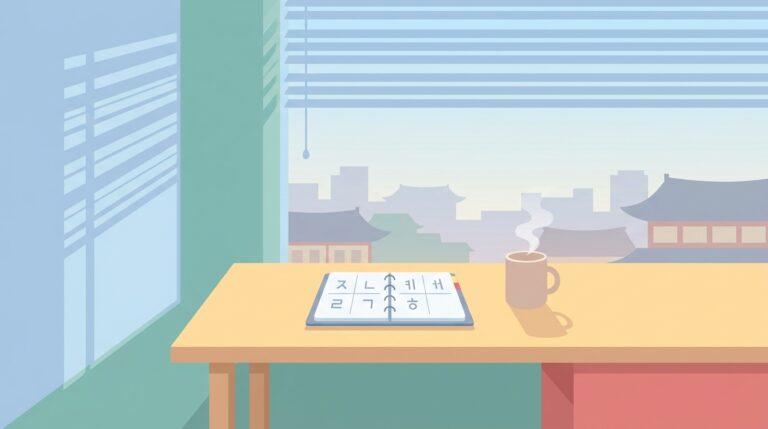
Picture this: It’s 5:15 AM in a dimly lit studio apartment in Mapo-gu, Seoul. Outside, the city is enveloped in that misty blue pre-dawn chill. Your alarm blares with an unforgiving brass tune. In any other country, hitting snooze would be an uncontested human right. But here, you log onto Instagram, and your feed is already flooded with timestamps: pristine desk setups, warm steaming tumblers of barley tea, open planners, and gym mirrors stamped with #미라클모닝 (#MiracleMorning) and #갓생 (#Godsaeng). You want to participate, to declare your bold transition into an “early bird” (아침형 인간), but when you try to articulate this in Korean, textbook phrases like “저는 매일 일찍 일어납니다” (I wake up early every day) feel laughably flat. They lack the grit, the cultural weight, and the ironic camaraderie shared by millions of Koreans hustling before sunrise.
Mastering the language of self-reinvention at a C2 level isn’t about memorizing dictionary definitions of discipline; it’s about wielding the sociolinguistic currency of modern Korea’s hyper-focused, ritualistic lifestyle. Through years of guiding advanced learners navigating executive boardrooms and Seoul’s ultra-competitive creative industries, I’ve seen how articulating your personal boundaries and routines with native-level nuance changes how people perceive your dedication. Today, we’re unpacking the real linguistic anatomy of the Korean Miracle Morning.
Phase 2: Core Expressions Deep Analysis (C2 Mastery)
1. 갓생 살다 (Gatsaeng salda)
- Pronunciation: [갓-쌩-살-다 / Gat-ssaeng sal-da] (Think of the English word god clipped abruptly, followed by saeng as in “sangria” with a sharper s).
- Meaning: Literally “living a god-tier life,” but idiomatically used to denote an impeccably productive, structured, and ethical daily grind focused on radical self-betterment.
- K-Culture Moment: Ubiquitous in Gen MZ “vloggers’ daily routine” videos on YouTube and reality shows like I Live Alone (나 혼자 산다), where celebrities meticulously clean their baseboards and read philosophy at 5:30 AM.
- Editor’s Insight: At a C2 level, note the sociolinguistic irony. While it sounds celebratory, native speakers often use it with subtle self-deprecation—acknowledging the absurd pressure of modern Korean capitalism while stubbornly striving to conquer it.
- Situation Spectrum: Casual ✅ | Semi-formal ⚠️ | Formal 🚫 (In professional writing, substitute with 생산적이고 모범적인 삶을 영위하다).
- 🤔 Think About It: Western hustle culture often glorifies monetary gain, whereas 갓생 often prioritizes minute micro-habits (drinking water, making the bed). Why does Korean society emphasize micro-routines over macro-outcomes when defining “success”?
2. 작심삼일로 끝나지 않게 쇄신하다 (Jaksimsamillo kkeunnaji anke swaesinhada)
- Pronunciation: [작-심-삼-일-로 끈-나-지 안-케 쇄-신-하-다 / Jak-sim-sam-il-lo kkeun-na-ji an-ke swae-sin-ha-da] (Swae-sin sounds like “sway-scene” spoken briskly).
- Meaning: Literally, “to revamp/innovate so it doesn’t end as a three-day resolution.” It means overhauling your entire lifestyle so your new habits don’t fizzle out prematurely.
- K-Culture Moment: Heard frequently in interviews with elite Korean athletes or startup founders reflecting on new year strategy shifts on channels like EO (Entrepreneurship & Opportunities).
- Editor’s Insight: 작심삼일 (four-character idiom, Hanja: 作心三日) is universal, but pairing it with the high-register verb 쇄신(刷新)하다 elevates your speech from colloquial complaining to high-level intellectual reflection.
- Situation Spectrum: Casual ⚠️ | Semi-formal ✅ | Formal ✅
- 🤔 Think About It: How does referencing classical Hanja idioms (사자성어) instantly change the gravity of your personal commitments in interpersonal conversations?
3. 아침형 인간으로 체질을 개선하다 (Achim-hyeong inganeuro chejireul gaeseonhada)
- Pronunciation: [아-침-형 인-간-으-로 체-지-를 개-선-하-다 / A-chim-hyeong in-gan-eu-ro che-ji-reul gae-seon-ha-da].
- Meaning: Literally “to improve one’s physical constitution into a morning-type human.” It denotes fundamentally rewiring one’s circadian rhythm and psychological disposition.
- K-Culture Moment: Used by career mentors in K-Dramas like Misaeng or self-help bestsellers discussing metabolic and operational shifts for the corporate grind.
- Editor’s Insight: 체질 (體質) refers to inherent bodily constitution (rooted in Eastern medicine). Framing habit formation as changing your 체질 implies a deep, somatic transformation rather than a superficial schedule tweak.
- Situation Spectrum: Casual ✅ | Semi-formal ✅ | Formal ✅
- 🤔 Think About It: Does your native language treat habit change as purely mental discipline, or does it also conflate biological constitution with moral willpower as Korean does?
Phase 3: Textbook Korean vs. Real Korean
Situation 1: Declaring your intention to wake up at 5 AM for personal projects
- 📖 교과서 한국어 (Textbook Korean): 저는 매일 아침 일찍 일어나서 자기계발을 열심히 실천하고 있습니다. (Jeo-neun mae-il a-chim il-jjik il-eo-na-seo ja-gi-gye-bal-eul yeol-sim-hi sil-cheon-ha-go it-seumnida.) — “I wake up early every morning and am diligently practicing self-improvement.”
- 🗣️ 진짜 한국어 (Real Korean): 저 완전 갓생러 모드 장착해서 미라클 모닝 챌린지 인증 박는 중이에요. (Jeo wan-jeon gat-saeng-leo mo-deu jang-chak-hae-seo mi-ra-keul mo-ning chael-lin-ji in-jeung bang-neun jung-i-e-yo.) — “I’ve fully equipped my ‘god-life’ mode and am logging daily proof shots for the Miracle Morning challenge.”
- 💡 왜 다를까? (Why is it different?): Modern Koreans combine English loanwords with gaming terminology (모드 장착, 인증을 박다) to treat self-discipline like an engaging, gamified social quest rather than a solitary, ascetic chore.
Situation 2: Admitting that you crashed and slept in past noon
- 📖 교과서 한국어 (Textbook Korean): 피곤해서 늦잠을 잤기 때문에 오늘의 일과 계획을 달성하지 못했습니다. (Pi-gon-hae-seo neut-jam-eul jat-gi ttae-mun-e o-neul-ui il-gwa gye-hoek-eul dal-seong-ha-ji mot-haess-eumnida.) — “Because I was fatigued, I overslept and failed to accomplish today’s routine schedule.”
- 🗣️ 진짜 한국어 (Real Korean): 어제 무리했더니 완전 기절각이라 알람 끄고 침대랑 물아일체 됐잖아요. (Eo-je mu-ri-haet-deo-ni wan-jeon gi-jeol-gak-i-ra al-lam kkeu-go chim-dae-rang mul-a-il-che dwaet-jan-a-yo.) — “I overdid it yesterday, so I was bound to pass out; I killed the alarm and achieved complete spiritual oneness with my bed.”
- 💡 왜 다를까? (Why is it different?): Highly proficient speakers deploy classical philosophical idioms like 물아일체 (物我一體 – unity of subject and object) with wicked irony to describe mundane human failings, creating instant social rapport.
Phase 4: K-Culture Deep Dive & Non-Verbal Manners
4-1. 눈치 (Nunchi) & Early Morning Non-Verbal Etiquette
In Korea, sharing your Miracle Morning journey requires surgical social calibration (눈치). If you show up to an office at 8:30 AM boasting about having run 10 kilometers and completed two chapters of economic theory, you risk being branded an insufferable try-hard who subtly shames colleagues struggling with soul-crushing commutes.
- The Subdued Acknowledgment: When sharing early morning accomplishments with peers, maintain modest eye contact, slightly lower your voice, and use self-deprecating physical gestures—such as rubbing the back of your neck with a wry smile: “피곤해 죽겠는데, 그냥 버티는 거죠” (I’m exhausted to death, but I’m just hanging in there).
- Digital Proof Etiquette (인증샷): If participating in KakaoTalk routine study groups, always crop out personal vanity elements (designer clothes, expensive watches) and focus strictly on the timestamp, your notebook margins, or the sunrise. Extravagance violates the collective ethos of raw, unpretentious effort (노력).
4-2. Cultural Code Analysis: The Godsaeng (갓생) Syndrome
Why is Seoul obsessed with 5:00 AM? The Godsaeng phenomenon isn’t merely wellness marketing; it is a structural coping mechanism. In a hyper-dense society shaped by relentless educational tracking and competitive corporate ladders, individual Koreans often feel systemic autonomy slipping through their fingers. The dawn hours represent the only uncontaminated temporal space where neither bosses, family obligations, nor societal scrutiny can intrude. Waking up early is less about productivity metrics and more about carving out sovereign existential territory.
Phase 5: Real-World Roleplay Scenario
Setting: A sleek 24-hour study lounge in Yeouido at 5:45 AM.
NPC: Min-woo (민우), a 30-something investment strategist who hasn’t missed a 5:00 AM study session in 300 days.
- 민우: 🎭 (텀블러를 내려놓으며 놀란 눈으로 쳐다본다) 어? 이 시간에 웬일이세요? 오늘 출근 전까지 여기서 공부하시게요?
(Eo? I si-gan-e wen-il-i-se-yo? O-neul chul-geun jeon-kkaji yeo-gi-seo gong-bu-ha-si-ge-yo?)
“Huh? What brings you here at this hour? Are you studying here until you head into the office today?” -
Learner: 🎭 (어색하지만 결연한 미소를 지으며) 네, 저도 매번 말로만 하던 아침형 인간으로 체질 개선 좀 해보려고 칼을 갈았거든요.
(Ne, jeo-do mae-beon mal-ro-man ha-deon a-chim-hyeong in-gan-eu-ro che-jil gae-seon jom hae-bo-ryeo-go kal-eul gar-at-geo-deun-yo.)
“Yes, I finally sharpened my blade to radically reshape my constitution into an early bird, instead of just talking about it.” -
민우: 🎭 (고개를 끄덕이며 나지막하게 웃는다) 대단하신데요! 근데 초반에 의욕만 앞서면 사흘 만에 페이스 오버되는 거 아시죠?
(Dae-dan-ha-sin-de-yo! Geun-de cho-ban-e ui-yong-man ap-seo-myeon sa-heul man-e pe-i-seu o-beo-doe-neun geo a-si-jyo?)
“Impressive! But you know that if you let pure passion lead early on, you risk redlining and burning out within three days, right?” -
Learner: 🎭 (가방에서 형광펜과 플래너를 꺼내며) 안 그래도 작심삼일 트랩을 피하려고, 오늘은 거창한 목표 대신 30분 독서 루틴부터 정착시키려고요.
(An geu-rae-do jak-sim-sam-il teu-raep-eul pi-ha-ryeo-go, o-neul-eun geo-chang-han mok-pyo dae-sin sam-sip-bun dok-seo ru-tin-bu-teo jeong-chak-si-ki-ryeo-go-yo.)
“Exactly. To dodge that three-day fizzle trap, I’m aiming to cement a humble 30-minute reading routine today rather than grandiose goals.” -
민우: 🎭 (눈을 반짝이며 엄지를 살짝 세운다) 아주 훌륭한 전략입니다. 사실 저도 루틴 무너질 때마다 멘탈 잡느라 애먹거든요.
(A-ju hul-lyung-han jeon-ryak-im-ni-da. Sa-sil jeo-do ru-tin mu-neo-jil ttae-ma-da men-tal jam-neu-ra ae-meok-geodun-yo.)
“That is a stellar strategy. Honestly, even I struggle to hold my sanity together whenever my routine crumbles.” -
Learner: 🎭 (공감한다는 듯 고개를 끄덕이며) 민우 님 같은 베테랑 갓생러도 그런 슬럼프를 겪는다니 위안이 되네요.
(Min-u nim gat-eun be-te-rang gat-saeng-leo-do geu-reon seul-reom-peu-reul gyeok-neun-da-ni wi-an-i doe-ne-yo.)
“Hearing that a veteran ‘Godsaeng-er’ like you experiences slumps brings me immense comfort.” -
민우: 🎭 (손목시계를 확인하고 책을 펼치며) 그럼 우리 오늘부터 서로 딴짓 안 하는지 감시하는 페이스메이커 할까요?
(Geu-reom u-ri o-neul-bu-teo seo-ro ttan-jit an ha-neun-ji gam-si-ha-neun pe-i-seu-me-i-keo hal-kka-yo?)
“Then shall we be pacemakers starting today, monitoring each other so we don’t procrastinate?” -
Learner: 🎭 (미소 지으며 결의를 다진다) 좋습니다! 딴짓하다 걸리면 제가 내일 모닝커피 쏘겠습니다.
(Jot-seumnida! Ttan-jit-ha-da geol-ri-myeon je-ga nae-il mo-ning-keo-pi sso-get-seumnida.)
“Deal! If you catch me slacking off, tomorrow’s morning coffee is entirely on me.”
🔀 Interactive Decision Fork
Min-woo looks at you with a challenge: “What’s the single most vital metric for keeping this morning routine going long-term?”
- Option A: “절대적인 수면 시간 상관없이 무조건 4시에 기상하는 악바리 정신이죠!” (It’s the die-hard grit to wake up at 4 AM no matter how little sleep you had!)
Feedback: 🚫 BAD. Pushing toxic 악바리 정신 (reckless stubborn grit) without recovery signals poor lifestyle design to modern Koreans, who value sustainable systems over blind masochism. - Option B: “기상 시간 자체에 집착하기보다, 전날 취침 리추얼을 통제해 생체 리듬의 복원력을 확보하는 겁니다.” (Rather than obsessing over wake-up time, it’s about controlling the pre-bed ritual to secure circadian resilience.)
Feedback: ✅ BEST. Highly sophisticated C2 register. Synthesizes sociological terminology (리추얼) with physiological concepts (복원력), positioning you as a master of holistic habit design. - Option C: “매일 인스타그램에 타임스탬프 찍어서 남들에게 욕먹지 않게 인증하는 게 최고예요.” (The best way is posting timestamps on Instagram every day so you don’t get flamed by others.)
Feedback: ⚠️ RISK. Shows cultural familiarity with 인증 culture, but sounds overly dependent on external validation rather than intrinsic discipline.
Phase 6: 10-Second Emotion Shadowing Drill
Master the cadence of real conversational delivery by mimicking the pauses (/) and emotional states below:
[🔥 비장하고 결의에 차서 / Resolute & solemnly determined]
“이번에는 / 단순한 작심삼일이 아니라, / 내 삶의 주도권을 되찾기 위해 / 기상 시간을 한 시간 앞당기기로 했어요.”
(I-beon-e-neun / dan-sun-han jak-sim-sam-il-i a-ni-ra, / nae sam-ui ju-do-gwon-eul doe-chat-gi wi-hae / gi-sang si-gan-eul han si-gan ap-dang-gi-gi-ro haess-eo-yo.)
“This time / it’s not just a fleeting three-day whim; / to reclaim sovereign control over my life, / I’ve decided to pull my wake-up time forward by an hour.”-
[🥱 나른하지만 뿌듯하게 / Languid yet brimming with self-satisfaction]
“눈꺼풀은 천근만근인데… / 고요한 새벽 공기 마시면서 책장을 넘기니까 / 묘한 희열감이 차오르네요.”
(Nun-kkeo-pul-eun cheon-geun-man-geun-in-de… / go-yo-han sae-byeok gong-gi ma-si-myeon-seo chaek-jang-eul neom-gi-ni-kka / myo-han hui-yeol-gam-i cha-o-reu-ne-yo.)
“My eyelids weigh ten thousand tons… / but flipping pages while breathing the still dawn air / fills me with this intoxicating rush of satisfaction.” -
[😂 자조적이지만 유쾌하게 / Self-deprecating yet cheerfully humorous]
“갓생 살겠다고 호기롭게 알람을 다섯 개나 맞춰놨는데, / 무의식중에 올킬하고 / 정오에 일어난 거 실화입니까?”
(Gat-saeng sal-get-da-go ho-gi-rop-ge al-lam-eul da-seot gae-na mat-chwo-nwat-neun-de, / mu-ui-sik-jung-e ol-kil-ha-go / jeong-o-e il-eo-nan geo sil-hwa-im-ni-kka?)
“I boldly set five alarms swearing I’d lead a god-tier life, / but did I seriously score an unconscious ‘all-kill’ on every single one / and wake up at noon? Is this real life?”
Phase 7: K-Culture Mini Dictionary
-
갓생 (Gatsaeng) | Noun
A portmanteau of the English “God” and the Korean 생 (生, life). It denotes an exceptionally well-regulated, productive daily life driven by small, disciplined personal routines rather than vanity. -
오운완 (O-un-wan) | Acronym
Short for “오늘 운동 완료” (Today’s Workout Complete). The premier hashtag and verbal calling-card of modern Korean gym culture, functioning as an unwritten badge of daily honor. -
현타 (Hyeonta) | Noun (Slang)
Short for “현자타임” (sage time), referring to a sudden, biting moment of reality check or existential disillusionment—often experienced when waking up at 1:00 PM after swearing you’d wake up at 5:00 AM. -
리추얼 라이프 (Ritual Life) | Noun / Konglish
Refers to the intentional practice of building inviolable, sacred personal habits (journaling, tea brewing, mobility training) to anchor oneself amidst turbulent work environments.
Phase 8: Traveler’s Survival Kit
Survival Expressions TOP 3
-
혹시 여기 콘센트 있는 좌석으로 옮겨도 될까요?
(Hok-si yeo-gi kon-sen-teu it-neun jwa-seok-eu-ro olm-gyeo-do doel-kka-yo?)
“By any chance, would it be alright if I moved to a seat equipped with a power outlet?”
💡 Pro Tip: Essential for morning café warriors hunting charging ports for their tablets in early-opening spots like Twosome Place or Starbucks. -
아침 일찍 이용할 수 있는 24시간 스터디카페 추천해 주실 수 있나요?
(A-chim il-jjik i-yong-hal su it-neun i-sip-sa-si-gan seu-teo-di-ka-pe chu-cheon-hae ju-sil su it-na-yo?)
“Could you recommend a 24-hour study café that I can access early in the morning?”
💡 Pro Tip: Korean 스터디카페 (Study Cafes) operate with automated kiosk ticketing systems and are quiet havens far superior to standard coffee shops for early morning deep work. -
디카페인 원두로 변경 가능한가요? 빈속이라서요.
(Di-ka-pe-in won-du-ro byeon-gyeong ga-neung-han-ga-yo? Bin-sok-i-ra-seo-yo.)
“Can I switch to decaf beans? It’s because I have an empty stomach.”
💡 Pro Tip: Perfect for dawn routines when excessive caffeine on an empty stomach might disrupt your energy before lunchtime.
Editor’s Travel Note
If you want to practice your Miracle Morning while traveling in Seoul, bypass noisy coffee chains and head straight to local neighborhood study hubs. Download the 네이버 지도 앱 다운로드 to search for “무인 스터디카페” (unmanned study cafes) near your hotel—most accept foreign credit cards at the kiosk. To challenge yourself socially alongside locals, install the 챌린저스 앱 확인하기 (Challengers app), an app where users stake small deposits of money on completing 6:00 AM photo check-ins.
Phase 9: “한 발 더 깊이” (A Step Deeper)
Korean culture’s historic embrace of the 빨리빨리 (hurry-hurry) ethos was long criticized by sociologists as an engine of chronic industrial burnout. However, the contemporary emergence of the Miracle Morning and 갓생 represents a fascinating philosophical transmutation: rather than speeding up to satisfy an employer or an academic examiner, the new generation is repurposing that collective velocity to nourish the interior self. In this light, the early morning is no longer an overtime shift; it is a quiet, subversive act of personal reclaiming. It demonstrates that Korean collectivism can be inverted to protect individual sovereignty.
💬 Your Turn: What does waking up early symbolize in your home country—mere pragmatic time management, or an existential statement of character? Let us know your thoughts in the comments below!
Phase 10: FAQ & Avoiding Misunderstandings
Q: Can I use the term “갓생” in a formal corporate meeting or with my university professor?
A: Absolutely not. While 갓생 is beloved across media and casual culture, using it in an academic defense or executive strategy deck sounds childish and inappropriately colloquial. Instead, opt for dignified terminology such as 자기 주도적 규율 (self-directed discipline), 생산성 제고 (productivity enhancement), or 철저한 자기관리 (thorough self-management).
Q: What is the semantic difference between “일찍 일어나는 새” and “아침형 인간”?
A: 일찍 일어나는 새 is a direct translation of the Western idiom “the early bird (that catches the worm),” focusing mainly on opportunism and speed. In contrast, 아침형 인간 (originating from a wildly popular 2003 Japanese/Korean self-help wave) carries deep biomedical and lifestyle connotations, framing early rising as a holistic bio-hack rather than mere punctuality.
Q: How do I respond if a Korean coworker notices I look exhausted and asks if I’ve been overworking?
A: Balance honesty with grit! Say: “피곤하긴 한데, 요즘 아침 시간을 활용해서 리추얼을 만드는 중이라 마음은 개운해요” (I am tired, but because I’ve been utilizing my morning hours to build rituals lately, my mind feels completely refreshed). This shows resilience without complaining.
🚨 Common Mistakes Warning Board
- Mistake: Using 기상하다 (to wake up) for yourself in casual speech.
Why it’s wrong: 기상 (起床) sounds overly military or rigid when talking to peers.
Correct Action: Say 일어나다 in conversation; reserve 기상 시간 for analytical discussions about schedules. - Mistake: Saying “미라클 모닝을 했어요” without context.
Why it’s wrong: 미라클 모닝 functions better as a lifestyle label or routine identifier rather than an isolated transitive verb.
Correct Action: Pair it with 실천하다 (to practice/execute) or 도전하다 (to challenge): “미라클 모닝 루틴을 실천하고 있어요.” - Mistake: Confusing 작심삼일 with ordinary laziness.
Why it’s wrong: 작심삼일 specifically denotes a sincere resolution that collapses quickly, not perpetual unmotivated slacking.
Correct Action: Use it only when referring to a broken promise of self-improvement.
Phase 11: Action Missions
- 🥉 Bronze Mission (Solo Mastery): Stand in front of your mirror tomorrow morning at dawn and recite the Phase 6 Shadowing Drill sentence #1 three times, focusing on shifting pitch right at the caesura
/. - 🥈 Silver Mission (Social Immersion): Take an aesthetic photo of your morning coffee, book, or planner, and post it on your Instagram Story with the caption: “작심삼일로 끝나지 않게 오늘도 갓생 모드 가동! ☕📖” Tag us at
@DailyHangul. - 🥇 Gold Mission (Real-World Deployment): Walk into an independent Korean cafe or text a Korean language exchange partner before 9:00 AM, using the phrase: “오늘 아침형 인간으로 체질 개선해보려고 일찍 나왔어요!”
- 🎮 K-Culture Mission: Watch an episode of 나 혼자 산다 (I Live Alone) or search “직장인 브이로그 갓생” on YouTube. Identify three micro-routines the creator captures before 7:00 AM and analyze how they subtitle their fatigue.
Phase 12: Interactive Quiz Challenge
Test your grasp of high-level register, contextual nuances, and cultural idioms!
- [Situation Judgment] You are writing an application letter for an executive fellowship and want to describe your unwavering morning discipline. Which phrasing is most appropriate?
- (A) 저는 매일 아침 인증 박으며 갓생 사는 중입니다.
- (B) 저는 철저한 기상 루틴을 통해 자기 주도적 삶의 태도를 체화해 왔습니다.
- (C) 저는 오운완을 실천하는 아침형 인간 그 자체입니다.
- [Fill-in-the-Blank] Complete the sentence with the appropriate Sino-Korean idiom:
“새해 다짐이 결코 (________)에 그치지 않도록, 구체적이고 지속 가능한 시스템을 구축해야 한다.” -
[True / False Cultural Check] In contemporary Korea, declaring that you are living a 갓생 primarily indicates that you have acquired vast speculative wealth through real estate or cryptocurrency.
🔍 Click here to reveal the answers and explanations!
-
Answer: (B)
Explanation: Option (A) and (C) rely on colloquial internet slang (인증 박다, 갓생, 오운완) that instantly torpedoes professional decorum. Option (B) uses sophisticated, high-register vocabulary (체화하다, 자기 주도적) suitable for professional evaluation. -
Answer: 작심삼일 (作心三日)
Explanation: The classic idiom for a resolution fizzling out after three days. -
Answer: FALSE
Explanation: 갓생 is almost exclusively associated with process-driven micro-routines—such as consistent waking times, hydration, study blocks, and exercise—rather than sudden financial windfalls.







