

Phase 1: 공감 (Story-Immersive Opening)
안녕하세요! 매일한글 에디터입니다.
Picture this: You are sitting inside a glass-walled conference room on the 14th floor of a tech enterprise in Teheran-ro, Gangnam. It feels just like a tense episode of the hit corporate drama Misaeng (Incomplete Life). The fluorescent lights reflect off pristine whiteboards covered in Gantt charts. The official product launch is in exactly ten business days. You’ve just discovered a catastrophic bottleneck in the backend database architecture that could crash the entire payment gateway.
Your Team Leader (팀장님 – Timjangnim), known across the company for an unreadable poker face and razor-sharp attention to detail, slides their glasses down and looks right at you: “프로젝트 일정, 변수 없이 계획대로 갑니까? (Is the project schedule running according to plan without unexpected variables?)”
A cold sweat breaks out on your neck. You know that simply saying “아니요, 문제가 있습니다 (No, there is a problem)” sounds dreadfully junior and creates panic. Conversely, staying quiet out of politeness could trigger corporate disaster. How do you identify critical risks, manage expectations, and propose an ironclad contingency plan in sophisticated, professional Korean without sounding like you’re evading responsibility?
Navigating corporate risk management in Korea requires more than memorizing high-level vocabulary from standard TOPIK textbooks. It demands diplomatic nuance, tactical politeness, and an understanding of organizational hierarchy. Today, drawing on ten years of mentoring global executives and project leads inside Korea’s top conglomerates, we’ll master the exact high-context linguistic maneuvers you need to flag risks gracefully and earn executive trust.
Phase 2: 핵심 표현 3선 심층 분석 (Core Expressions In-Depth)
1. 차질이 생기지 않도록 플랜 B를 마련해야 합니다.
- Pronunciation: [Cha-jil-i saeng-gi-ji an-to-rok peul-laen bi-reul ma-ryeon-hae-ya ham-ni-da] (Sound analogy: Say ‘Cha-jil-ee’ like a crisp ‘Chubby-eel’ minus the ‘b’, followed by a decisive ‘ham-ni-da’ like a military salute)
- Meaning: Direct: “We must prepare a Plan B so that setbacks do not occur.” | Real Nuance: “We need a safety net right now to protect our deliverables, our team, and our reputation before senior leadership notices.”
- K-Culture Moment: Seen in boardroom dramas like Agency (대행사) when a marketing campaign hits a sudden regulatory wall and the lead strategist commands their team to deploy a pre-approved crisis protocol.
- Editor’s Insight: The word 차질 (chajil) means a hitch, delay, or disruption. Pairing it with ‘생기지 않도록’ shows proactive accountability. Instead of sounding reactive, you frame the contingency as a sign of foresight.
- Situation Spectrum: Casual: 🚫 | Semi-formal: ⚠️ (차질 안 생기게 플랜 B 준비해요) | Formal: ✅ (차질이 생기지 않도록 플랜 B를 마련해야 합니다)
- 🤔 Think About It: In many Western teams, flagging a contingency plan is an everyday operational remark. In Korean work culture, introducing ‘플랜 B’ can signal that ‘플랜 A’ is under severe threat. Notice how the phrasing cushions the blow by focusing on the collective goal (차질 방지).
2. 리스크 요인을 선제적으로 식별하고 공유해 주십시오.
- Pronunciation: [Ri-seu-keu yo-in-eul seon-je-jeok-eu-ro sik-byeol-ha-go gong-yu-hae ju-sip-si-o] (Sound analogy: ‘Seon-je’ sounds like ‘Sun-jay’; roll smoothly through ‘sik-byeol’ like ‘seek-byull’)
- Meaning: Direct: “Please preemptively identify and share risk factors.” | Real Nuance: “Do not sit on bad news or sweep anomalies under the rug; escalate potential blockers before they detonate.”
- K-Culture Moment: In corporate thrillers, this is the hallmark line of an agile, competent director warning their project team against ‘폭탄 돌리기’ (hot-potato passing of project landmines).
- Editor’s Insight: ‘선제적’ (preemptive/proactive) is an elite executive keyword in Korea. It transforms a standard request into a strategic directive. Using ‘-해 주십시오’ demonstrates authoritative yet impeccably respectful managerial tone.
- Situation Spectrum: Casual: 🚫 | Semi-formal: ⚠️ | Formal: ✅
- 🤔 Think About It: Korean organizations place a huge premium on transparency when structured properly. Why do you think Korean project leaders emphasize ‘선제적 공유’ (preemptive sharing) over individual problem-solving?
3. 최악의 시나리오를 감안하여 완충 기간을 확보합시다.
- Pronunciation: [Choe-ak-ui si-na-ri-o-reul gam-an-ha-yeo wan-chung gi-gan-eul hwak-bo-hap-si-da] (Sound analogy: ‘Choe-ak’ sounds like ‘Chway-ahk’; ‘wan-chung’ rhymes with ‘one chew-ng’)
- Meaning: Direct: “Let us secure a buffer period considering the worst-case scenario.” | Real Nuance: “Let’s be realistic about timelines and pad the schedule so an unexpected glitch doesn’t sink our deliverables.”
- K-Culture Moment: Often heard in tech sprints or entertainment production meetings when the launch date cannot afford a slip.
- Editor’s Insight: ‘완충 기간’ (buffer period / shock-absorbing time) sounds far more objective and strategic than simply asking for “더 많은 시간” (more time). It frames the request as risk mitigation rather than poor planning.
- Situation Spectrum: Casual: ⚠️ (완충 기간 좀 잡자) | Semi-formal: ⚠️ | Formal: ✅
- 🤔 Think About It: In your culture, does asking for a ‘buffer period’ signify prudence or lack of speed? How does the concept of 완충 (absorbing a physical impact) change the emotional weight of requesting extra time?
Phase 3: 교과서 한국어 vs 진짜 한국어 (Textbook vs. Real-World)
Situation 1: Flagging an emerging roadblock during a milestone review
- 📖 교과서 한국어: “이 프로젝트에 문제가 발생할 가능성이 높습니다. (There is a high possibility that a problem will occur in this project.)”
- 🗣️ 진짜 한국어: “현재 개발 단계에서 몇 가지 변수가 돌출되어, 일정 지연 리스크가 있습니다. (A few unexpected variables have emerged in the current development phase, creating a schedule delay risk.)”
- 💡 왜 다를까? Textbook Korean directly screams “problem” (문제), which immediately sounds alarmist and suggests incompetence. C1-level business Korean replaces ‘문제’ with ‘변수’ (variables) and ‘돌출되다’ (to protrude/surface unexpectedly), which depersonalizes the issue and frames it as an external factor to be managed.
Situation 2: Proposing a mitigation workaround without blaming vendors
- 📖 교과서 한국어: “외주 업체가 늦어지면 다른 방법을 쓰겠습니다. (If the outsourced vendor is late, I will use another method.)”
- 🗣️ 진짜 한국어: “외부 협력사 이슈에 대비해, 자체 리소스 투입 등 리스크 헷징 방안을 강구 중입니다. (To hedge against potential external partner issues, we are devising risk-hedging measures such as deploying internal resources.)”
- 💡 왜 다를까? Pointing fingers directly at partners (‘외주 업체가 늦어지면’) sounds unprofessional in executive settings. Using loan words like ‘리스크 헷징’ (risk hedging) alongside formal native collocations like ‘방안을 강구하다’ (to devise measures) signals high strategic acumen.
Phase 4: K-Culture 딥다이브 & 비언어적 매너 (Culture & Mannerisms)
4-1. 눈치 (Nunchi) & Gestures: Delivering Risk Assessments to Stakeholders
When identifying a project risk in a Korean meeting, how you present your body matters as much as your grammar.
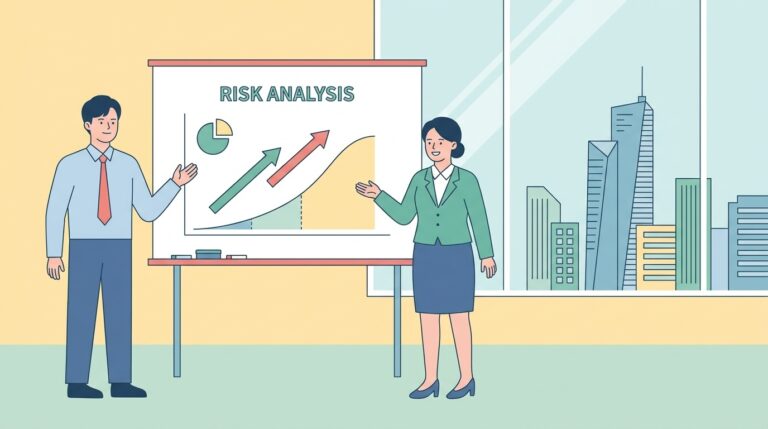
* The Document Tilt: When pointing to a risk matrix or burn-down chart, use an open palm facing upward rather than an index finger. Pointing with a finger can come across as accusatory, especially if the risk points toward another department’s delay.
* The Softened Gaze (시선 처리): Do not lock unblinking eye contact with the executive while delivering bad news. Glance down at the data points, look up to meet their eyes respectfully, and nod slightly to acknowledge the gravity of the situation. This posture communicates seriousness rather than defiance.
* Tone Pitch: Lower your vocal register by half an octave. Fast, high-pitched speech when reporting risk conveys panic. A calm, measured baritone signals that while the risk is serious, you remain in complete control.
4-2. Cultural Code: The Art of ‘보고’ (Executive Escalation) & ‘폭탄 돌리기’
In Korean organizational psychology, silence is never golden when risks emerge. The worst corporate sin is not making a mistake; it is hiding a delay until it becomes impossible to fix. This is colloquially referred to as 폭탄 돌리기 (passing around a live bomb) until it explodes in the C-suite’s hands.
However, you cannot just drop bad news without bringing the cure. Korean workplace culture strictly adheres to the principle of “보고 시 대안 제시” (Always present an alternative when reporting a problem). If you point out that the API integration might fail, you must present Options A, B, and C in the same breath. Showing that you have already calculated the operational blast radius is what separates an average employee from a trusted senior lead.
Phase 5: 실전 롤플레이 시나리오 (Real-World Roleplay Scenario)
Setting: A minimalist boardroom at a fintech startup in Pangyo Techno Valley. Rain taps against the glass. Team Leader Min (민 팀장), an intensely analytical former strategy consultant, is reviewing the sprint burndown chart.
Characters:
* 민 팀장 (Team Leader Min): Demanding, metric-driven, appreciates straight talk accompanied by clear solutions.
* 나 (Alex / Project Lead): Pragmatic, bilingual technical project manager managing an upcoming release.
민 팀장: 알렉스 님, 결제 모듈 QA 테스트 결과는 어떻게 나왔습니까? 이번 주 금요일 배포에 지장 없겠죠?
(Alex-nim, gyeol-je mo-dyul QA te-seu-teu gyeol-gwa-neun eo-tteo-ke na-wat-seum-ni-kka? I-beon ju geum-yo-il bae-po-e ji-jang eop-get-jyo?)
“Alex, how did the QA test results for the payment module turn out? No disruption to this Friday’s deployment, right?”
🎭 안경을 벗으며 서류를 책상 위에 내려놓는다.
나 (Alex): 팀장님, 전반적인 기능 검증은 완료되었으나, 트래픽 급증 시 응답 지연 문제가 일부 확인되었습니다.
(Tim-jang-nim, jeon-ban-jeok-in gi-neung geom-jeung-eun wan-ryo-doe-eot-eu-na, teu-rae-pik geup-jeung si eung-dap ji-yeon mun-je-ga il-bu hwak-in-doe-eot-seum-ni-da.)
“Team Leader Min, overall functional validation is complete, but we have identified some response delay issues during sudden traffic spikes.”
🎭 차분하게 태블릿의 성능 모니터링 그래프를 민 팀장 쪽으로 돌려 보여준다.
민 팀장: 응답 지연이라… 금요일 배포 강행하면 트래픽 몰릴 때 시스템 다운될 리스크가 있다는 뜻입니까?
(Eung-dap ji-yeon-i-ra… Geum-yo-il bae-po gang-haeng-ha-myeon teu-rae-pik mol-ril ttae si-seu-tem da-un-doel ri-seu-keu-ga it-da-neun tteut-im-ni-kka?)
“Response delays… Does that mean if we push forward with Friday’s release, we risk a system crash under high traffic?”
🎭 눈썹을 살짝 찌푸리며 화면을 응시한다.
나 (Alex): 네, 맞습니다. 최악의 경우 결제 이탈률이 급증할 수 있어, 선제적인 리스크 대응이 필요하다고 판단했습니다.
(Ne, mat-seum-ni-da. Choe-ak-ui gyeong-u gyeol-je i-tal-ryul-i geup-jeung-hal su it-seo, seon-je-jeok-in ri-seu-keu dae-eung-i pil-yo-ha-da-go pan-dan-haet-seum-ni-da.)
“Yes, that is correct. In the worst-case scenario, checkout abandonment could spike, so we judged that proactive risk response is required.”
🎭 인정하면서도 당황하지 않고 단호한 어조를 유지한다.
민 팀장: 그렇다면 배포 일정을 미루자는 건가요? 마케팅 팀에서 이미 사전 등록 프로모션을 오픈했는데…
(Geu-reo-ta-myeon bae-po il-jeong-eul mi-ru-ja-neun geon-ga-yo? Ma-ke-ting tim-e-seo i-mi sa-jeon deung-rok peu-ro-mo-syeon-eul o-peun-haen-neun-de…)
“Then are you suggesting we postpone deployment? Marketing has already launched the pre-registration promotion…”
🎭 미간을 짚으며 난감하다는 제스처를 취한다.
나 (Alex): [Your Turn! See Interactive Branch below]
🔀 인터랙티브 분기점 (Interactive Branching Point)
What should you say next to handle this high-stakes risk response?
- Option A (Best): “배포 전면 연기보다는, 코어 결제 엔진만 우선 핫픽스하여 48시간 완충 기간을 확보한 후 단계적 오픈을 제안드립니다. 마케팅 유입량은 대기열 시스템으로 완충 가능합니다.”
(Rather than a full postponement, I propose hot-fixing the core payment engine to secure a 48-hour buffer period followed by a staged rollout. Marketing inflow can be buffered using a queue system.) - Option B (Bad): “네, 마케팅 팀에 연락해서 당장 프로모션 취소해 달라고 하세요. 서버 터지면 제 탓 아닙니다.”
(Yes, contact marketing and tell them to cancel the promo immediately. If the server blows up, it’s not my fault.) - Option C (Risk): “그냥 금요일에 배포하고 밤새 모니터링하면서 문제 생기면 그때 코드 고치시죠. 어떻게든 되겠죠.”
(Let’s just deploy on Friday and monitor overnight, fixing bugs as they happen. It’ll work out somehow.)
Detailed Feedback:
* Option A (Best): 🏆 Executive Level. You avoided binary thinking (all-or-nothing cancelation), offered an elegant technical compromise (단계적 오픈 – phased release), leveraged a buffer period (완충 기간), and protected cross-functional harmony with marketing.
* Option B (Bad): 💥 Career Limiting. Passing blame to marketing and deflecting personal accountability breaks the collective team culture instantly. It displays low emotional intelligence.
* Option C (Risk): ⚠️ Reckless Gambler. While sometimes seen in chaotic crunch environments, gambling on production stability without safety margins destroys senior leadership’s confidence in your professional risk management capability.
Phase 6: 10초 감정 섀도잉 드릴 (Shadowing Drill)
Practice pacing, breathing, and pitch markers. Slashes (/) indicate brief breath pauses.
[😰 조심스럽지만 차분하게 - Careful yet collected]
“현재 일정상 / 예상치 못한 변수가 돌출되어, / 사전 점검이 반드시 선행되어야 합니다.”
(Hyeon-jae il-jeong-sang / ye-sang-chi mot-han byeon-su-ga dol-chul-doe-eo, / sa-jeon jeom-geom-i ban-deu-si seon-haeng-doe-eo-ya ham-ni-da.)
“Given our current timeline / unexpected variables have emerged, / so preliminary verification must take precedence.”-
[🤝 확신에 차고 든든하게 - Confident and reassuring]
“리스크는 명확히 식별되었으니, / 플랜 B를 즉각 가동하여 / 차질 없이 론칭을 완수하겠습니다.”
(Ri-seu-keu-neun myeong-hwak-hi sik-byeol-doe-eot-eu-ni, / peul-laen bi-reul jeuk-gak ga-dong-ha-yeo / cha-jil eop-si ron-ching-eul wan-su-ha-get-seum-ni-da.)
“Since the risks have been clearly identified, / we will activate Plan B immediately / and complete the launch without setbacks.”
Phase 7: K-Culture 미니 사전 (Mini Dictionary)
-
변수 (Byeonsu)
Literally: Variable (mathematics).
Real Usage: In corporate Korea, nobody likes saying the harsh word ‘문제’ (problem). ‘변수’ is the universally accepted polite corporate euphemism for unforeseen risks, sudden roadblocks, or erratic client requests. -
리스크 헷징 (Riseukeu het-jing)
Literally: Risk hedging.
Real Usage: Adopted from financial parlance, product managers use this to describe deploying backup servers, preparing alternative copy, or splitting traffic so single points of failure do not compromise a release. -
일정 펑크 (Il-jeong peong-keu)
Literally: Schedule puncture (flat tire).
Real Usage: Informal industry slang used among peers when a milestone completely collapses or a contractor disappears without delivering. -
안전장치 (Anjeon-jangchi)
Literally: Safety catch / safeguard mechanism.
Real Usage: A metaphor for technical circuit breakers, contractual penalties, or rollback plans designed to cushion business operations.
Phase 8: 여행자/주재원을 위한 생존 키트 (Survival Kit for Expats & Business Nomads)
Practical Survival Phrases TOP 3
- “일정에 변수가 생겨서, 우선순위 조율이 필요합니다.”
(Il-jeong-e byeon-su-ga saeng-gyeo-seo, u-seon-sun-wi jo-yul-i pil-yo-ham-ni-da.)
Pro Tip: Use this when your plate is overloaded and you must negotiate deadlines with senior managers without saying “I can’t do this.” - “만약의 사태에 대비해 대체 방안을 검토해 주십시오.”
(Man-yak-ui sa-tae-e dae-bi-hae dae-che bang-an-eul geom-to-hae ju-sip-si-o.)
Pro Tip: Perfect polite sentence to send vendors or cross-functional partners when you anticipate their delivery will be late. - “우려되는 리스크 포인트를 정리해서 메일로 공유해 드리겠습니다.”
(U-ryeo-doe-neun ri-seu-keu po-in-teu-reul jeong-ri-hae-seo me-il-ro gong-yu-hae deu-ri-get-seum-ni-da.)
Pro Tip: De-escalates heated verbal debates in meetings by shifting the conversation into a documented, factual digital audit trail.
Editor’s Expat Note
Working in Korean startup hubs like Pangyo or Seoul’s Yeouido financial district requires seamless digital workflows. When collaborating across local teams, bookmark the official 노션 한국어 비즈니스 템플릿 가이드 to structure contingency matrices standard across Korean tech environments. If running between client syncs across town, make sure to download the 카카오 T 비즈니스 앱 다운로드 for real-time receipt archiving and corporate taxi booking during critical deployment crunch nights.
Phase 9: “한 발 더 깊이” (Reflective Question)
In Western individualist corporate settings, acknowledging a risk is often viewed purely as technical transparency and proactive initiative. In Korean collectivist business culture, raising a project risk is an intensely delicate social act. Because project success is viewed as a collective communal accomplishment (우리 회사의 성과), highlighting an operational weakness requires protecting the face (체면) of all involved units while safeguarding the collective outcome. It is never about finding who is at fault; it is about demonstrating that you care enough about the group’s shared destination to build a bridge before anyone falls into the chasm.
💬 Your Turn: In your home country’s corporate culture, is flagging a project delay seen as a sign of prudence or a sign of weakness? How would your direct manager react if you asked for a ‘완충 기간’ (buffer period) today? Share your thoughts in the comments below!
Phase 10: FAQ & 오해 방지 (FAQ Schema)
Q: Can I use the English word ‘Risk’ directly in Korean meetings?
A: Absolutely! In modern Korean business environments (especially tech, marketing, and finance), ‘리스크’ (riseukeu) is universally used. However, remember to pair it with natural Korean verbs such as ‘식별하다’ (to identify), ‘헤지하다/헷징하다’ (to hedge), or ‘관리하다’ (to manage), rather than awkward literal translations.
Q: What is the subtle difference between ‘대책’ (daechaek) and ‘대응 방안’ (daeeung bangan)?
A: ‘대책’ often carries an emergency tone, suggesting something has already gone wrong and requires immediate damage control (e.g., 비상대책위원회 – Emergency Response Committee). In contrast, ‘대응 방안’ (response measure) is forward-looking, methodical, and calm, making it the preferred C1-level term for risk planning.
Q: How do I tell a Korean senior executive their deadline is mathematically impossible?
A: Never say “불가능합니다 (That is impossible).” Instead, frame it through technical scope and resources: “요청하신 일정에 맞추기 위해 리소스를 집중하고 있으나, QA 검증 시간 부족으로 출시 후 안정성 리스크가 우려됩니다. 핵심 기능 우선 출시 후 순차 업데이트를 제안드려도 되겠습니까?”
🚨 흔한 실수 (Common Mistakes) 경고판
- Mistake: Using “문제가 터졌습니다” (A problem exploded) with executives.
Correct Action: Use “예상치 못한 변수가 확인되었습니다” (An unexpected variable has been identified). - Mistake: Saying “제 잘못이 아닙니다” (It’s not my fault) during risk post-mortems.
Correct Action: Focus on process: “협업 과정에서 커뮤니케이션 갭이 발생하여, 프로세스 개선안을 마련했습니다.” - Mistake: Requesting “시간 더 주세요” (Give me more time).
Correct Action: Say “완충 기간을 3일 정도 확보하고자 합니다” (We would like to secure a buffer period of about three days).
Phase 11: 액션 미션 & 참여 유도 (Action Missions)
- 🥉 Bronze Mission (Self-Practice): Stand in front of your mirror and practice Shadowing Drill #1. Pay strict attention to lowering your vocal pitch and maintaining respectful, calm posture while pausing at the slashes.
- 🥈 Silver Mission (Social Share): Pick one of the C1 corporate vocabulary terms from Phase 7 (like ‘변수’ or ‘완충 기간’) and write a sample sentence in Korean. Post it in the comments below or tweet it tagging @DailyHangul for personal editor feedback!
- 🥇 Gold Mission (Real-World Deployment): In your next standup, meeting, or email exchange with Korean colleagues or language partners, replace the simple word ‘문제’ with ‘돌출된 변수’ and suggest a ‘플랜 B’. Notice how their facial expression shifts toward immediate professional respect.
- 🎮 K-Culture Mission: Watch Episode 1 or 2 of Misaeng (미생) or Start-Up (스타트업). Keep a tally of how many times characters use ‘보고’ (reporting), ‘변수’ (variables), and manage project constraints under intense pressure!
Phase 12: 인터랙티브 퀴즈 챌린지 (Interactive Quiz Challenge)
Test your executive-level risk management reflexes!
1. 상황 판단 퀴즈 (Situational Judgment)
Your cross-border supply chain partner informs you that crucial components will be delayed by two weeks, threatening the quarterly release target. How do you summarize this to your executive team in an email subject line?
- A) 공급망 파산으로 인한 프로젝트 파기 안내
- B) [공유] 공급망 지연 변수 발생에 따른 1차 대응 방안 및 일정 조율안 보고
- C) 부품 납품 지연 문제: 외주사 과실 보고서
🔍 정답과 해설 확인하기 (Click to expand)
정답: B
해설: Option B represents the gold standard of C1 business Korean. It categorizes the email as an executive share [공유], uses the objective term ‘변수’ rather than emotional blaming, and immediately signals that response measures (‘1차 대응 방안’) and schedule alignment proposals (‘일정 조율안’) are attached inside. Option A is catastrophic hyperbole, while Option C breaches professional etiquette by openly attacking external partners in the headline.
2. 빈칸 채우기 퀴즈 (Fill-in-the-Blank)
다음 문장의 빈칸에 들어갈 가장 격식 있고 자연스러운 C1 표현은 무엇일까요?
“배포 직전 트래픽 부하가 우려되므로, 비상시 가동할 수 있는 ( )를 선제적으로 마련해야 합니다.”
* A) 펑크 (Peong-keu)
* B) 플랜 B (Plan B)
* C) 핑계 (Ping-gye)
🔍 정답과 해설 확인하기 (Click to expand)
정답: B (플랜 B)
해설: In this high-stakes contingency context, preparing ‘플랜 B’ (Plan B / alternative safeguard) perfectly fits the collocation ‘선제적으로 마련해야 합니다’ (must preemptively prepare). ‘펑크’ is informal slang meaning a schedule cancellation/blowout, and ‘핑계’ means an excuse!
3. 문화 상식 True/False
문제: In Korean business hierarchy, it is considered polite to quietly fix a severe project risk by yourself without notifying management, as long as it gets solved before release day.
- A) True
- B) False
🔍 정답과 해설 확인하기 (Click to expand)
정답: B (False)
해설: In Korean organizations, hiding a potential blocker—even with pure intentions of fixing it alone—is seen as an organizational risk. If your solo fix fails, the company suffers without warning. Proactive reporting (‘선제적 보고’) with a suggested workaround (‘대응 방안’) is always the expected professional conduct.







