

Phase 1: 공감 (Story-Driven Opening)
안녕하세요! 매일한글 에디터입니다.
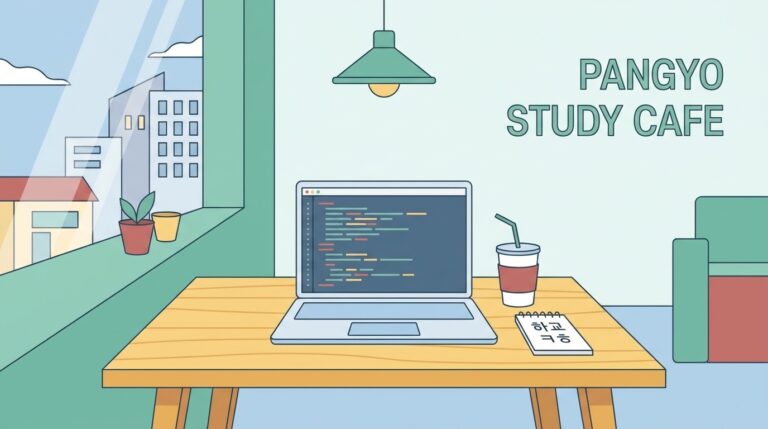
Picture this: It’s 10:30 PM in a sleek co-working cafe tucked away in Pangyo Techno Valley—South Korea’s answer to Silicon Valley. Across wooden communal tables, illuminated by the glow of mechanical keyboards and terminal screens, young professionals and career switchers are sipping their third iced Americanos. They are not merely browsing; they are fiercely dissecting algorithmic logic on Baekjoon (백준) and streaming Python backend tutorials on Inflearn (인프런). This is South Korea’s roaring self-improvement zeitgeist: the pursuit of 갓생 (God-saeng, living an ultra-productive, disciplined life).
Perhaps you are an advanced Korean speaker (C2 level) aiming to join a Korean tech startup, network with local software engineers, or simply navigate domestic coding communities independently. Yet, when you dive into local forums like Velog, OKKY, or Discord developer channels, you hit an invisible barrier. Traditional academic Korean teaches you dry phrases like “컴퓨터 프로그램을 독학하고 있습니다” (I am self-studying computer programs), whereas real Korean developers talk about “삽질” (debugging through trial and error), “벽을 느끼다” (hitting a steep learning curve), and completing “토이 프로젝트” (toy projects).
Linguistic mastery at the C2 tier means mastering the socio-professional register—commanding both the high-context humility and technical slang native to Korea’s vibrant tech ecosystem. Based on years of mentoring bilingual professionals and tech expatriates in Seoul, this guide delivers an insider’s roadmap to mastering Python basics, exploring top local self-study platforms, and speaking like a seasoned Korean software developer.
Phase 2: 핵심 표현 3선 심층 분석 (Core Expressions)
1. 코딩 독학하다가 벽을 느꼈어요 (Koding dok-hak-ha-da-ga byeog-eul neu-kkyeo-sseo-yo)
- Pronunciation: [Koding dok-hak-ha-da-ga byeog-eul neu-kkyeo-sseo-yo] (Imagine saying coding, then doke-hahk, followed by byug-eul like the English word “bug” with a soft ‘y’, and neu-kkyo-ssuh-yo).
- Meaning: Literal: “While self-studying coding, I felt a wall.” / Nuance: “I hit a massive plateau or stumbling block while trying to teach myself to code.”
- K-Culture Moment: Seen frequently in career-transition vlogs and dramas like Start-Up (스타트업), where a self-taught programmer confesses their burnout or imposter syndrome when dealing with complex data structures.
- Editor’s Insight: 벽을 느끼다 (to feel a wall) is an idiomatic powerhouse in Korean self-improvement culture. It expresses genuine cognitive struggle without sounding overly pessimistic. It signals resilience—admitting you’ve reached your current limit and are actively seeking breakthrough mentorship.
- Situation Spectrum: Casual (✅), Semi-formal (✅), Formal (⚠️ – In formal board meetings, opt for “학습 곡선에서 한계에 직면했습니다”).
- 🤔 Think About It: In English, we say “hit a wall” (an external impact). In Korean, you feel the wall (벽을 느끼다), emphasizing internalized perception and psychological awareness. How does this subtle shift reflect Korean introspection?
2. 인프런이나 백준에서 기초부터 파고 있어요 (In-peureon-i-na Baekjun-eseo gicho-buteo pago isseoyo)
- Pronunciation: [In-peu-reon-i-na Baek-jun-e-seo gi-cho-bu-teo pa-go i-sseo-yo] (In-fruh-on, then Back-june, followed by gee-choh-boo-tuh pah-goh ee-ssuh-yoh).
- Meaning: Literal: “I am digging from the basics on Inflearn or Baekjoon.” / Nuance: “I’m grinding the fundamentals from scratch using Korea’s top coding platforms.”
- K-Culture Moment: A staple line among college students and junior engineers sharing their study routines on Instagram study-grams (#공스타그램) or tech boot camp retrospectives.
- Editor’s Insight: The verb 파다 literally means “to dig,” but in colloquial Korean, it means to deep-dive intensely into a subject. Mentioning Inflearn (Korea’s premier tech video course platform) and Baekjoon (the go-to platform for algorithmic problem sets) instantly signals that you understand the domestic IT training landscape.
- Situation Spectrum: Casual (✅), Semi-formal (✅), Formal (✅).
- 🤔 Think About It: Why do Koreans prefer platform-specific study references over generic phrases like “studying online”? It builds instant peer rapport by anchoring your efforts in shared cultural touchstones.
3. 파이썬 문법 떼고 바로 토이 프로젝트 들어가려고요 (Pai-sseon munbeop ttego baro toi peurojekteu deureogaryeogoyo)
- Pronunciation: [Pai-sseon mun-beop tte-go ba-ro to-i peu-ro-jek-teu deu-reo-ga-ryeo-go-yo] (Pie-sun, moon-bup, crisp double-t sound tteh-goh, bah-roh toy pro-jec-teu).
- Meaning: Literal: “After detaching Python grammar, I intend to enter a toy project directly.” / Nuance: “Once I finish mastering Python basics, I plan to jump straight into building a side project.”
- K-Culture Moment: Common in tech meetups and developer Discord communities when junior developers pitch their roadmaps to prospective study groups.
- Editor’s Insight: The idiom 문법을 떼다 derives from 책을 떼다 (to complete a book thoroughly from start to finish). Pairing this with 토이 프로젝트 (toy project/side project) reflects modern agile learning: ditching prolonged theory to learn by doing.
- Situation Spectrum: Casual (✅), Semi-formal (✅), Formal (⚠️ – In an executive interview, use “기초 문법을 수료한 후 실무 기반 파일럿 프로젝트를 수행하고자 합니다”).
- 🤔 Think About It: Contrast 떼다 (to detach/peel off completion) with the English “to wrap up” or “finish.” In Korean, it implies peeling off a finished layer so you can move forward cleanly.
Phase 3: 교과서 한국어 vs 진짜 한국어 (Textbook vs. Real Korean)
Situation 1: Introducing your coding journey to peers
- 📖 교과서 한국어: 저는 독학으로 프로그래밍 언어를 학습하고 있는 초심자입니다. (Jeo-neun dok-hak-eu-ro peu-ro-geu-rae-ming eon-eo-reul hak-seup-ha-go it-neun cho-sim-ja-im-ni-da. / “I am a novice learner who is studying a programming language through self-education.”)
- 🗣️ 진짜 한국어: 저 지금 파이썬 독학 중인데, 아직 완전 코린이에요! (Jeo ji-geum pai-sseon dok-hak jung-in-de, a-jik wan-jeon ko-rin-i-e-yo! / “I’m currently teaching myself Python, but I’m still a total coding baby!”)
- 💡 왜 다를까? Textbook Korean sounds like an academic dissertation. Native speakers use playful portmanteaus like 코린이 (코딩 [coding] + 어린이 [child]) to humble themselves and build quick, warm camaraderie.
Situation 2: Explaining a bug debugging dilemma
- 📖 교과서 한국어: 작성한 코드에 오류가 발생하여 원인을 규명하기 위해 많은 시간을 소모했습니다. (Jak-seong-han ko-deu-e o-ryu-ga bal-saeng-ha-yeo won-in-eul gyu-myeong-ha-gi wi-hae man-eun si-gan-eul so-mo-haet-seum-ni-da. / “An error occurred in the written code, so I consumed a lot of time to investigate the cause.”)
- 🗣️ 진짜 한국어: 코드에 자꾸 에러 떠서 어젯밤에 몇 시간 동안 삽질했잖아요. (Ko-deu-e ja-kku e-reo tteo-seo eo-jet-bam-e myeot si-gan dong-an sap-jil-haet-jan-a-yo. / “Errors kept popping up in my code, so I spent hours shoveling in vain last night.”)
- 💡 왜 다를까? 삽질하다 (to shovel fruitlessly) is the ultimate developer colloquialism for spinning your wheels debugging before realizing a simple missing colon was the problem. It brings immediate humor to shared developer misery.
Phase 4: K-Culture 딥다이브 & 비언어적 매너 (Deep Dive & Non-Verbal Nuance)
4-1. 눈치 (Nunchi) & Code-Sharing Manners
In Korean collaborative spaces—whether a bustling Pangyo incubator or a developer study group (스터디)—communication follows distinct high-context rules:
1. The Code-Review Head Tilt & Laptop Angle: When asking a senior engineer or peer to glance at your code, do not thrust your screen into their line of sight. Gently swivel your laptop at a 45-degree angle, lower your posture slightly, and state: “혹시 시간 되실 때 이 부분 한 번만 봐주실 수 있나요?” (Could you take a quick look at this section whenever you have a moment?).
2. The Deferential Slack/Discord Etiquette: Never drop an isolated line of error code with “Help.” First post: context, what you tried (삽질 내역), and official documentation checked. This displays 배려 (consideration) and respects the mentor’s time.
4-2. Culture Code: The “갓생 (God-saeng)” and “모각코 (Mo-gak-ko)” Phenomena
Self-improvement in Korea is communal. Rather than studying isolated at home, young Koreans congregate for 모각코 (모여서 각자 코딩 – “Gathering together to code individually”). Participants sit in silent solidarity at cafes, streaming lofi hip-hop, sharing screen time, and posting their GitHub commit streaks (잔디 심기, literally “planting grass”). This culture merges hyper-competition with mutual encouragement: you aren’t competing against each other; you are collectively conquering the algorithmic frontier.
Phase 5: 실전 롤플레이 시나리오 (Interactive Roleplay)
Setting: A sunlit lounge at a tech hub in Pangyo. You are sitting with Minho, a senior backend developer, looking over your Python scripts on your laptop.
Characters:
* You: Advanced Korean learner building automated data crawlers in Python.
* 민호 (Minho): Seasoned software engineer who mentors junior developers in his spare time.
민호: 요즘 파이썬 공부하신다고 들었는데, 진도는 좀 잘 나가고 있어요?
(Yo-jeum pai-sseon gong-bu-ha-sin-da-go deu-reot-neun-de, jin-do-neun jom jal na-ga-go i-sseo-yo?)
“I heard you’ve been studying Python lately. How is your progress coming along?”
You: 🎭 [머리를 긁적이며 겸손하게 웃는다 – Scratching your head with a modest smile]
인프런 강의 들으면서 기초 문법은 뗐는데, 혼자 코드 짜려니까 벽이 느껴지네요.
(In-peureon gang-ui deu-reu-myeon-seo gi-cho mun-beop-eun ttet-neun-de, hon-ja ko-deu jja-ryeo-ni-kka byeog-i neu-kkyeo-ji-ne-yo.)
“I finished the basic syntax through Inflearn lectures, but trying to write code on my own makes me hit a wall.”
민호: 아, 누구나 처음에 다 그래요. 혹시 백준이나 프로그래머스 같은 알고리즘 사이트도 풀어보셨어요?
(A, nu-gu-na cheo-eum-e da geu-rae-yo. Hok-si Baekjun-i-na Peurogeuraemeoseu gat-eun al-go-ri-jeum sa-i-teu-do pul-eo-bo-syeo-sseo-yo?)
“Ah, everyone goes through that at first. Have you tried solving problems on algorithm platforms like Baekjoon or Programmers?”
You: 🎭 [진지한 눈빛으로 태블릿 필기를 보여주며 – Showing your tablet notes with a focused gaze]
네, 프로그래머스 입문 문제부터 풀고 있는데 가끔 어이없는 문법 오류로 몇 시간씩 삽질해요.
(Ne, Peurogeuraemeoseu ip-mun mun-je-bu-teo pul-go it-neun-de ga-kkeum eo-i-eop-neun mun-beop o-ryu-ro myeot si-gan-ssik sap-jil-hae-yo.)
“Yes, I’m working through Programmers beginner problems, but I occasionally waste hours on ridiculous syntax errors.”
민호: 🎭 [크게 공감하며 웃는다 – Chuckling in deep empathy]
그 삽질이 다 실력이 되는 거죠! 저도 주니어 때는 들여쓰기 에러 하나 때문에 밤새웠어요.
(Geu sap-jil-i da sil-ryeok-i doe-neun geo-jyo! Jeo-do ju-ni-eo ttae-neun deul-yeo-sseu-gi e-reo ha-na ttae-mun-e bam-sae-wo-sseo-yo.)
“That trial and error is what builds true expertise! When I was a junior, a single indentation error kept me up all night.”
You: 파이썬은 들여쓰기가 진짜 엄격하더라고요. 이제 기초 문법 넘어 토이 프로젝트로 넘어가도 될까요?
(Pai-sseon-eun deul-yeo-sseu-gi-ga jin-jja eom-gyeok-ha-deo-ra-go-yo. I-je gi-cho mun-beop neo-meo to-i peu-ro-jek-teu-ro neo-meo-ga-do doel-kka-yo?)
“Python’s indentation is truly strict. Do you think I can move beyond basic grammar to a toy project now?”
민호: 완전 추천이죠! 이론만 백날 보는 것보다 작더라도 크롤러나 웹 봇 하나 만들어보는 게 훨씬 빨라요.
(Wan-jeon chu-cheon-i-jyo! I-ron-man baek-nal bo-neun geot-bo-da jak-deo-ra-do keu-rol-reo-na wep bot ha-na man-deul-eo-bo-neun ge hwol-ssin bpal-ra-yo.)
“Wholeheartedly recommended! Building a small web crawler or bot is ten times faster than studying theory for a hundred days.”
You: 🎭 [두 손으로 아이스 아메리카노를 쥐며 각오를 다진다 – Clasping your iced Americano with both hands in determination]
좋아요! 이번 주말 모각코 스터디에서 작은 웹 스크래핑 프로젝트부터 바로 들어가야겠어요.
(Joh-a-yo! I-beon ju-mal mo-gak-ko seu-teo-di-e-seo jak-eun wep seu-keu-rae-ping peu-ro-jek-teu-bu-teo ba-ro deu-reo-ga-ya-get-eo-yo.)
“Awesome! In this weekend’s Mo-gak-ko study, I’ll dive straight into a mini web-scraping project.”
🔀 인터랙티브 분기점: How should you respond if Minho offers to review your GitHub repository?
- Choice A: “바쁘신데 폐를 끼치고 싶지 않습니다. 제 코드는 아직 공개하기에 너무 부끄럽습니다.”
- Choice B: “진짜요? 바쁘실 텐데 시간 내주시면 정말 감사하죠! 잔디 열심히 심고 있으니 피드백 부탁드립니다!”
- Choice C: “네, 링크 드릴 테니까 문제점 전부 고쳐서 다시 보내주세요.”
Feedback:
* Choice A (Risk – Overly Rigid): While polite, this sounds like formal corporate rejection. It closes down Minho’s friendly offer and stalls mentor rapport.
* Choice B (Best – Culturally Native & Engaging): Expresses vibrant gratitude, acknowledges his busy schedule (바쁘실 텐데), and uses insider lingo (잔디 심기 for daily commits). Perfect blend of humility and enthusiasm!
* Choice C (Bad – Social Blunder): Treats a senior engineer like an unpaid proofreader. Violates peer boundaries completely.
Phase 6: 10초 감정 섀도잉 드릴 (Shadowing Drill)
Practice these lines aloud, adjusting your rhythm and pauses (/) to mirror authentic emotional cadences.
[😅 약간 쑥스럽지만 솔직하게 - Slightly embarrassed yet candid]
인프런 강의 완강했는데요, / 막상 코드를 직접 치려니까 / 완전 머릿속이 하얘지더라고요.
(In-peureon gang-ui wan-gang-haet-neun-de-yo, / mak-sang ko-deu-reul jik-jeop chi-ryeo-ni-kka / wan-jeon meo-rit-sok-i ha-yae-ji-deo-ra-go-yo.)
“I finished the entire Inflearn course, / but the moment I went to type the code myself, / my mind went completely blank.”-
[🔥 열정적이고 패기 넘치게 - Passionate and ambitious]
이번 달 안으로 / 파이썬 기초 문법 끝내고, / 주말마다 모각코 나가서 / 토이 프로젝트 완성할 겁니다!
(I-beon dal an-eu-ro / pai-sseon gi-cho mun-beop kkeut-nae-go, / ju-mal-ma-da mo-gak-ko na-ga-seo / to-i peu-ro-jek-teu wan-seong-hal geom-ni-da!)
“Within this month, / I will finish Python basic syntax, / join Mo-gak-ko every weekend, / and build a toy project!” -
[💡 깨달음을 얻고 안도하며 - Relieved and enlightened]
아, 이 에러가 / 들여쓰기 때문이었네요! / 세 시간 동안 삽질했는데 / 속이 다 시원해요.
(A, i e-reo-ga / deul-yeo-sseu-gi ttae-mun-i-eot-ne-yo! / Se si-gan dong-an sap-jil-haet-neun-de / sok-i da si-won-hae-yo.)
“Ah, this error was / because of indentation! / I’ve been shoveling for three hours, / what a huge relief.”
Phase 7: K-Culture 미니 사전 (Key Slang Dictionary)
-
코린이 (Ko-rin-i) | Noun
- Translation: Coding Novice / Coding Kid
- Usage: Blends 코딩 + 어린이. A self-effacing title used even by experienced professionals when venturing into a completely new programming language (e.g., “저 자바만 하다가 파이썬은 코린이라 많이 여쭤볼게요!”).
- 삽질 (Sap-jil) | Noun / Verb (-하다)
- Translation: Shoveling / Fruitless trial-and-error debugging
- Usage: Derived from tedious military digging duty. Describes searching Stack Overflow for hours only to discover a typo or environment configuration fault.
- 모각코 (Mo-gak-ko) | Noun
- Translation: Gathering to code individually (모여서 각자 코딩)
- Usage: The ultimate productivity format in Korea. A group meets at a cafe, agrees on a sprint time (e.g., 2 hours), codes in silence, and does a quick demo over craft beer or coffee afterward.
- 잔디 심기 (Jan-di Sim-gi) | Noun / Idiom
- Translation: Planting grass (Committing code daily on GitHub)
- Usage: GitHub’s green contribution squares resemble a lawn. In Korean tech circles, consistent learners boast about “1일 1커밋으로 잔디 꽉 채우기” (Filling the lawn with daily commits).
Phase 8: 여행자 & 체류자를 위한 생존 키트 (Expat & Tech Survival Kit)
Top 3 Real-Life Survival Phrases for Study Cafes & Tech Meetups:
- 혹시 여기 콘센트 자리 비어 있나요?
(Hok-si yeo-gi kon-sen-teu ja-ri bi-eo in-na-yo?)
“Excuse me, is this outlet seat available?”
Pro Tip: In Korean laptop-friendly cafes, seats with power outlets (콘센트 자리) are prime real estate. Always confirm politely before taking the adjacent stool. -
와이파이 비밀번호랑 화장실 비밀번호 좀 알 수 있을까요?
(Wa-i-pa-i bi-mil-beon-ho-rang hwa-jang-sil bi-mil-beon-ho jom al su iss-eul-kka-yo?)
“Could I get the Wi-Fi password and restroom code?”
Pro Tip: The receipt almost always contains these credentials. Look for WIFI PW and 화장실 PW near the bottom. -
혹시 파이썬 스터디 모각코 참여하려면 어디서 신청하나요?
(Hok-si pai-sseon seu-teo-di mo-gak-ko cham-yeo-ha-ryeo-myeon eo-di-seo sin-cheong-ha-na-yo?)
“Excuse me, where do I apply if I want to join the Python Mo-gak-ko study?”
Editor’s Tech Navigation Note:
- Finding Coding Hotspots: Use the 네이버 지도 앱 다운로드 to locate specialized study cafes (스터디카페) and 24-hour developer lounges near Gangnam Station Exit 11 or Pangyo Techno Valley.
- Where to Learn: Browse courses on the 인프런 공식 플랫폼 둘러보기 for interactive Korean-taught web development courses, and use 프로그래머스 코딩테스트 연습 to benchmark your Python logic directly against Korean technical interview standards.
Phase 9: “한 발 더 깊이” (Cultural Essay)
Korea’s obsession with coding self-improvement cannot be divorced from its historical respect for autodidactic perseverance. From the intense Joseon dynasty scholars burning midnight tallow candles to modern software engineers cramming Python in 24-hour study lounges, self-cultivation (자기수양) has continually been viewed as a moral and communal duty. In this hyper-connected society, knowledge is rarely hoarded; it is documented on open blogs like Velog and exchanged in spontaneous 모각코 gatherings. When you learn Korean technical slang, you are not simply acquiring jargon—you are stepping into a vibrant collective consciousness that celebrates resilience over instant perfection.
💬 Your Turn: Have you ever experienced 벽을 느끼다 (hitting a wall) while learning a new skill, whether coding or Korean? How do you overcome the dreaded 삽질 in your daily routine? Leave your thoughts below!
Phase 10: FAQ & 오해 방지 (FAQ Schema)
Q: Is it rude to use terms like ‘코린이’ (coding child) when talking to senior colleagues in Korea?
A: Self-identifying as a 코린이 shows charming humility. However, never call someone else a 코린이 unless they have labeled themselves as such first and you are close friends; calling a peer or junior a 코린이 can sound patronizing or condescending.
Q: Which site should I tackle first: Inflearn or Baekjoon?
A: Start with Inflearn (인프런). It offers video-based instruction covering syntax and setup in friendly Korean. Once you finish basic syntax (문법을 떼다), transition to Baekjoon (백준) or Programmers (프로그래머스) to test your logic on beginner algorithm challenges (알고리즘 문제 풀이).
Q: In Korean tech companies, do engineers address each other by job title or English names?
A: At modern startups and IT unicorns (like Kakao, Line, Toss, and Coupang), it is extremely common to use English names or the suffix 님 (-nim, e.g., 민호 님) instead of rigid bureaucratic ranks (대리님, 과장님). This fosters a flatter, more open feedback culture.
🚨 흔한 실수 (Common Mistakes) Checklist
- Literal Translation of “Bug”: Do not say 벌레가 있어요 (Beol-le-ga iss-eo-yo) when your code fails! Native developers use 버그 났어요 (Beo-geu nas-seo-yo) or 에러 떴어요 (E-reo tteot-seo-yo).
- Confusing ‘스터디’ with School Homework: In Korea, a 스터디 is not a passive class—it is an autonomous, peer-run accountability group. If you join one, you are expected to present your code or share weekly blog posts.
- Over-apologizing for Mistakes: Instead of endless 죄송합니다 when hitting syntax roadblocks during pair programming, use the growth-oriented: “이 부분 제가 아직 미숙한데, 많이 배우겠습니다!” (I’m still inexperienced in this area, but I’ll learn quickly!).
Phase 11: 액션 미션 & 참여 유도 (Action Missions)
- 🥉 Bronze Mission (Solo Practice): Say this sentence out loud 5 times using natural intonation: “파이썬 기초 문법 떼고 토이 프로젝트 시작했어요!”
- 🥈 Silver Mission (Digital Footprint): Open a GitHub account or Korean tech forum (like Velog), and title your very first study log: “[파이썬 독학] 코린이의 첫 번째 삽질 기록” (Python Self-Study: A Coding Kid’s First Debugging Log).
- 🥇 Gold Mission (Real-World Engagement): Visit a local cafe or study group, and use the term 모각코 or ask a developer friend: “혹시 파이썬 공부할 때 인프런 강의 들어보셨어요?”
🎮 K-Culture Mission: Search the hashtag #모각코 or #개발자공스타그램 on Instagram. Observe the workstation setups, the iced Americanos, and leave an encouraging Korean comment on someone’s study post: “열정 대단하세요! 저도 파이썬 독학 중인데 자극받고 갑니다!” (Incredible passion! I’m also self-studying Python and feel so inspired!).
Phase 12: 인터랙티브 퀴즈 챌린지 (Interactive Quiz)
Test your C2 grasp of Korean developer culture! Choose your answers before opening the toggles.
1. 상황 판단 (Situational Judgment)
You spent three hours chasing a bug caused by Python’s white-space indentation. How do you describe this experience naturally to a Korean developer friend over coffee?
* (A) 오늘 컴퓨터와 3시간 동안 심각한 결투를 벌였습니다.
* (B) 들여쓰기 하나 때문에 세 시간 동안 삽질했잖아요.
* (C) 파이썬의 백과사전적인 문법 규율을 깊이 탐색했습니다.
2. 빈칸 채우기 (Fill in the Blank)
- “저 이번에 인프런 강의 보면서 파이썬 기초 문법 완전히 [ _____ ], 이제 웹 크롤링 토이 프로젝트 시작해요!”
- (힌트: To peel off/detach a book or subject, meaning to finish it completely)
3. True / False Cultural Check
- Statement: In Korea, committing code daily to turn your GitHub calendar squares green is referred to as ‘감자 캐기’ (harvesting potatoes).
- ( True / False )
👉 정답 및 해설 확인하기 (Click to reveal answers & explanations)
- 정답: (B)
- 해설: 삽질하다 is the authentic, culturally rich expression for spending painstaking effort on troubleshooting a minor code error. Options (A) and (C) sound like translated historical fiction!
- 정답: 뗐는데 (or 떼고)
- 해설: 문법을 떼다 (to master/finish basic grammar) is the native idiom used when completing an introductory technical textbook or course.
- 정답: False
- 해설: It is called 잔디 심기 (planting grass) because the green contribution squares on GitHub resemble a freshly manicured lawn, not potatoes!
- 해설: It is called 잔디 심기 (planting grass) because the green contribution squares on GitHub resemble a freshly manicured lawn, not potatoes!







