

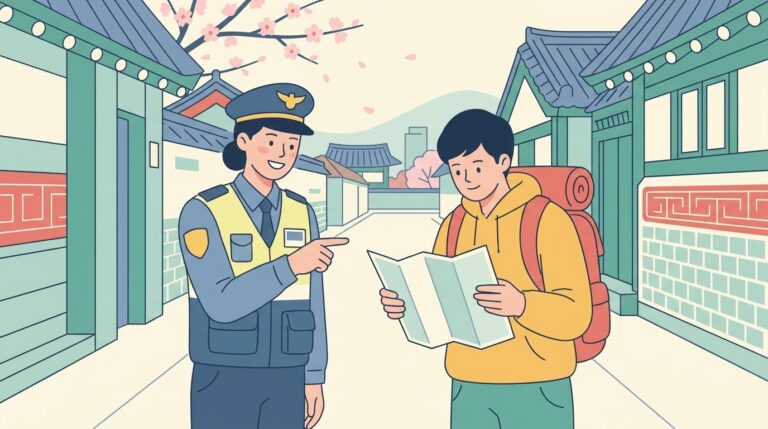
안녕하세요! 매일한글 에디터입니다.
Imagine this: You are wandering through the neon-lit alleyways of Hongdae after enjoying a warm bowl of tteokbokki. Suddenly, you realize your backpack is missing, or worse, you witness an altercation that makes your heart race. In K-dramas like Voice or Signal, dialing the police looks intense and dramatic, but in real life, being an absolute beginner in Korean can make calling the police feel terrifying.
“What if they don’t speak English? What if I freeze up?”
Take a deep breath! Over the past ten years coaching foreign residents and travelers across Seoul, I have seen so many students panic unnecessarily. You do not need complex grammar to stay safe. With just a few simple, high-impact words at the A1 level, you can communicate an emergency clearly and get immediate help. This step-by-step emergency guide is crafted directly from real dispatcher protocols and student experiences to ensure you feel protected and confident during your stay in Korea.
Phase 2: Core 3 Expressions In-Depth
1. 도와주세요! (Dowajuseyo!)
- Pronunciation: [Do-wa-ju-se-yo] (Sounds like: “Dough-wah-joo-say-yo” – think of soft pizza dough followed by joo and say-yo)
- Meaning: Literal: “Please give help” | Actual: “Help me!” / “Please help!”
- K-Culture Moment: Heard in almost every K-drama thriller when a character is cornered or spots a passerby while running away from trouble.
- Editor’s Insight: This is the single most universal emergency phrase in the Korean language. It is polite (ending in -yo), urgent, and universally understood by both dispatchers and pedestrians on the street.
- Situation Spectrum: Casual ⚠️ | Semi-formal ✅ | Formal ✅
- 🤔 Think About It: Why do Koreans add the polite ending -yo even in life-or-death emergencies? In Korean society, respect is deeply embedded even in moments of urgency to summon cooperative aid quickly.
2. 경찰 불러주세요! (Gyeongchal bulleojuseyo!)
- Pronunciation: [Gyeong-chal bul-leo-ju-se-yo] (Sounds like: “Gyung-chahl bool-luh-joo-say-yo” – gyung rhymes with young)
- Meaning: Literal: “Please call the police” | Actual: “Call the police!”
- K-Culture Moment: When bystanders gather around a sudden disturbance in an Itaewon club street or an accidental collision in Gangnam, someone immediately shouts this to the crowd.
- Editor’s Insight: Use this when you are speaking to a Korean bystander near you so they can dial 112 on their local phone if your battery is dead or you are overwhelmed.
- Situation Spectrum: Casual 🚫 | Semi-formal ✅ | Formal ✅
- 🤔 Think About It: Notice the verb bulleojuda (to call/summon on someone’s behalf). It asks the community to step in and take action with you.
3. 여기예요! (Yeogiyeyo!)
- Pronunciation: [Yeo-gi-ye-yo] (Sounds like: “Yuh-ghee-yay-yo”)
- Meaning: Literal: “It is here” | Actual: “I am right here!” / “Over here!”
- K-Culture Moment: When a patrol car arrives on the scene with flashing lights, the victim waves both hands overhead shouting this phrase.
- Editor’s Insight: When dispatchers ask where you are, or when the police arrive at a crowded subway exit, this simple phrase immediately anchors their attention to you.
- Situation Spectrum: Casual ⚠️ | Semi-formal ✅ | Formal ✅
- 🤔 Think About It: Korean prioritizes spatial context. Pinpointing your immediate location (yeogi) comes before lengthy descriptions of what happened.
Phase 3: Textbook Korean vs. Real Korean
Scenario 1: Asking someone to dial the police
- 📖 교과서 한국어 (Textbook Korean): 경찰관을 즉시 호출해 주시겠습니까? (Gyeongchalgwaneul jeuksi hochulhae jusigesseumnikka? / Would you be willing to summon a police officer immediately?)
- 🗣️ 진짜 한국어 (Real Korean): 경찰 불러주세요! (Gyeongchal bulleojuseyo! / Please call the police!)
- 💡 왜 다를까? (Why is it different?): Textbooks often teach excessively formal, indirect honorifics. In an emergency, indirect speech slows down reaction time. Clear, direct imperatives ending in -juseyo are natural, respectful, and fast.
Scenario 2: Stating that you lost something valuable or were robbed
- 📖 교과서 한국어 (Textbook Korean): 저의 귀중품을 도난당하였습니다. (Jeoui gwijungpumeul donandanghayeosseumnida. / My valuables have been stolen.)
- 🗣️ 진짜 한국어 (Real Korean): 지갑 잃어버렸어요! (Jigap ireobeoryeosseoyo! / I lost my wallet!)
- 💡 왜 다를까? (Why is it different?): Native speakers state the specific item followed by ireobeoryeosseoyo (lost/missing) first. The police dispatcher will deduce theft or loss from context.
Phase 4: K-Culture Deep Dive & Non-Verbal Manners
4-1. 눈치 (Nunchi) & Gestures
When calling 112 or approaching a Korean police officer, non-verbal clarity is half the conversation:
* Two-Handed Phone Presentation: If you have an address written on your smartphone (such as your hotel reservation or a screen capture of a map), present your phone using both hands or with your left hand supporting your right elbow. This conveys respect and seriousness.
* Point and Match: Look around for convenience store signs (CU, GS25, 7-Eleven) or utility poles. Utility poles in Korea have unique 8-digit location codes. If you cannot pronounce the street name, take a photo or point to the pole number.
* Eye Contact and Body Orientation: Turn your entire torso toward the officer or bystander. Avoid waving a single finger; open your palm when gesturing direction.
4-2. Cultural Code Analysis: The 112 Speed Culture (빨리빨리)
Korea is famous for its palli-palli (hurry-hurry) culture, and this shines brightest in emergency response. The Korean National Police Agency operates an ultra-modern 112 Emergency Call Center. Even if you speak broken Korean, the 112 operator can instantly confer with the 1330 Korea Travel Hotline translation service or the BBB Korea interpretation network. Furthermore, local neighborhood police boxes known as 파출소 (Pachulso) or 지구대 (Jigudae) are dotted across almost every major district, meaning physical response times are often under 3 to 5 minutes.
Phase 5: Real Role-play Scenario
Setting: 112 Emergency Dispatch Center, 11:30 PM. You are outside Exit 2 of Hongik University Station. Your travel tote bag was snatched from a bench.
- Turn 1 (Dispatcher): 🎭 Calm, professional voice through receiver
네, 112 경찰입니다. (Ne, il-il-i gyeongchal-imnida. / Yes, this is 112 Police.) - Turn 2 (You): 🎭 Taking a breath, speaking clearly
도와주세요! (Dowajuseyo! / Help me!) - Turn 3 (Dispatcher): 🎭 Attentive tone
무슨 일 있으세요? (Museun il isseuseyo? / What is the problem?) - Turn 4 (You): 🎭 Urgent but steady
가방 잃어버렸어요! (Gabang ireobeoryeosseoyo! / I lost my bag! / My bag was taken!) - Turn 5 (Dispatcher): 🎭 Typing sounds in background
위치가 어디예요? (Wichiga eodiyeyo? / Where is your location?) - Turn 6 (You): 🎭 Looking at the subway entrance sign
홍대입구역 2번 출구예요! (Hongdaeipgu-yeok i-beon chul-gu-yeyo! / It is Hongik University Station Exit 2!) - Turn 7 (Dispatcher): 🎭 Reassuring tone
알겠습니다. 경찰 바로 갑니다. (Algetseumnida. Gyeongchal baro gamnida. / Understood. Police are heading there immediately.) - Turn 8 (You): 🎭 Bowing head slightly toward phone
감사합니다. 여기 있어요! (Gamsahamnida. Yeogi isseoyo! / Thank you. I am right here!)
🔀 Interactive Branching Point
When the dispatcher asks for your location (위치가 어디예요?), how do you respond?
- Choice A: “모르겠어요, 서울이에요!” (Moreugesseoyo, Seourieyo! / I don’t know, it’s Seoul!)
- Feedback [Risk]: Seoul is a massive metropolis with 10 million residents! The dispatcher will struggle to track you down unless they initiate GPS tracking, which takes precious minutes.
- Choice B: “홍대입구역 2번 출구 앞 편의점이에요.” (Hongdaeipgu-yeok i-beon chul-gu ap pyeon-ui-jeom-ieyo! / In front of the convenience store at Hongik Univ. Station Exit 2.)
- Feedback [Best]: Spot on! Combining a landmark (station + exit) with a nearby business gives the patrol unit your exact GPS coordinates.
- Choice C: Just speak English rapidly without pause: “Hey, someone took my purse near a club!”
- Feedback [Bad]: While dispatchers can connect translators, sudden rapid English can cause initial delays. Starting with keywords like subway station names works much better.
Phase 6: 10-Second Emotional Shadowing Drill
Practice these lines out loud. Pay attention to the pauses marked with /.
[🚨 긴급하고 다급하게 - Urgent and desperate]
도와주세요! / 경찰 / 불러주세요!
(Dowajuseyo! / Gyeongchal / bulleojuseyo!)-
[📍 차분하고 또박또박하게 - Calm and clear location briefing]
여기 / 홍대입구역 / 근처예요.
(Yeogi / Hongdaeipgu-yeok / geuncheoyeyo.) -
[👋 안도하며 손짓하듯 - Relieved as patrol car arrives]
경찰관님! / 저 / 여기 있어요!
(Gyeongchalgwannim! / Jeo / yeogi isseoyo!)
Phase 7: K-Culture Mini Dictionary
- 112 (일일이 – Il-il-i): The national emergency telephone number for police in South Korea. Always pronounced as three individual digits: il – il – i.
- 경찰 (Gyeongchal): Police / Police Officer. Frequently paired with -gwan (경찰관) when addressing an individual officer respectfully.
- 파출소 (Pachulso): A local branch police station found in shopping streets and residential neighborhoods. Perfect walk-in spot if you lose your phone or passport.
- 위치 (Wichi): Location / Position. When a dispatcher asks “위치?”, they are asking for your current address or nearby landmark.
Phase 8: Survival Kit for Travelers
Top 3 Survival Phrases
- 도와주세요! (Dowajuseyo!) – Help me!
- Pro Tip: Shout this clearly if someone is threatening you; Koreans nearby will turn their attention instantly.
- 영어 할 수 있는 사람 있어요? (Yeongeo hal su inneun saram isseoyo?) – Is there someone who can speak English?
- Pro Tip: Great for finding a bilingual bystander who can talk to 112 on your behalf.
- 여기가 어디예요? (Yeogiga eodiyeyo?) – Where is this place?
- Pro Tip: Use this with store clerks to learn your exact location to tell the dispatcher.
Editor’s Travel Note
- Navigation Essential: Google Maps does not offer full walking navigation in South Korea due to local data protection laws. Always keep the 네이버 지도 앱 다운로드 (Naver Map app) installed on your phone. You can tap any building to display the Korean address to show the police.
- Direct English Emergency Support: You can call the 24/7 Korea Travel Hotline at 1330 directly from any phone for instant three-way interpretation with police or medical responders.
Phase 9: 한 발 더 깊이 (One Step Deeper)
South Korea consistently ranks among the safest countries in the world, largely due to a cultural mindset rooted in mutual community watch and high-tech infrastructure like public CCTV networks. Because citizens take pride in public safety, stepping up to assist someone who shouts “도와주세요!” is considered a basic civic duty. Even when language barriers exist, the impulse to help is remarkably strong among locals.
💬 Your Turn: If you were caught in an emergency in a foreign country, what is the very first piece of information you would look for on the street? Share your thoughts in the comments below!
Phase 10: FAQ & Common Mistakes
Q: Can I dial 112 from a foreign SIM card or a phone with no cellular service?
A: Yes! All mobile phones in South Korea can dial 112 even without an active SIM card or roaming plan, as long as the phone catches any local cellular antenna signal.
Q: What if I don’t speak any Korean when the 112 operator answers?
A: Stay on the line! Speak clearly: “English please.” The 112 command center has a dedicated foreign language interpretation bridge system that connects a third-party translator within seconds.
Q: What is the difference between 112 and 119 in Korea?
A: 112 is exclusively for the Police (theft, disputes, crime). 119 is for Fire, Ambulance, and Rescue services. If you need medical attention, call 119.
🚨 흔한 실수 (Common Mistakes) Warning Board
- Mistake: Shouting “Help!” in English only in quiet residential areas.
- Correct Action: Use 도와주세요! (Dowajuseyo!). Even elderly locals who don’t know English will instantly recognize this distress call.
- Mistake: Dialing 911.
- Correct Action: While some Korean telecom networks auto-redirect 911 to 112 or 119, it is not 100% guaranteed. Memorize 112 for Police and 119 for Ambulance.
- Mistake: Hanging up immediately when hearing rapid Korean from the dispatcher.
- Correct Action: Never hang up! Korean dispatch centers can triangulate your phone’s GPS tower location as long as the call remains connected.
Phase 11: Action Mission & Engagement
- 🥉 Bronze Mission: Stand in front of your mirror and practice saying “도와주세요! 경찰 불러주세요!” three times with an assertive, clear voice.
- 🥈 Silver Mission: Save 112 and the Korea Travel Hotline (1330) into your phone favorites right now, and take a screenshot of your hotel’s Korean address.
- 🥇 Gold Mission: Next time you walk through a Korean neighborhood or watch a K-drama, spot a local 파출소 (Pachulso) or police car and quietly whisper 경찰 (Gyeongchal)!
🎮 K-Culture Mission: Watch an episode of a Korean police procedural or urban thriller (such as Taxi Driver or Live). Listen carefully for how civilians call out when they need emergency assistance!
Phase 12: Interactive Quiz Challenge
Test what you learned today before you go!
Question 1: Situational Judgment
You are at a street stall in Myeongdong and notice someone pickpocketing a tourist’s coat. You want to ask the stall owner to summon law enforcement. What should you say?
* A) 도와주세요, 물 주세요! (Help, give me water!)
* B) 경찰 불러주세요! (Please call the police!)
* C) 여기가 어디예요? (Where is this place?)
Question 2: Fill in the Blank
When giving your location to the 112 operator, complete this phrase:
“홍대입구역 2번 출구__________!” (It’s Hongik Univ. Station Exit 2!)
* A) 예요 (yeyo)
* B) 아니에요 (anieyo)
* C) 가세요 (gaseyo)
Question 3: True or False
In Korea, 112 handles medical ambulances and firefighting, while 119 handles police reports. (True / False)
👉 Click to reveal answers & explanations!
- Question 1 Answer: B) 경찰 불러주세요! (Gyeongchal bulleojuseyo!)
Explanation: This directly and politely requests the bystander to call the police on your behalf. - Question 2 Answer: A) 예요 (yeyo)
Explanation: ~예요 / ~이에요 means “it is / I am at.” Combined with the location, it cleanly communicates your spot to the dispatcher. - Question 3 Answer: False!
Explanation: It is the reverse! 112 is for Police, and 119 is for Fire & Medical Emergencies.







