

Phase 1: Empathy (Immersive Storytelling Opening)
안녕하세요! 매일한글 에디터입니다. (Hello! This is your Daily Hangul editor!)
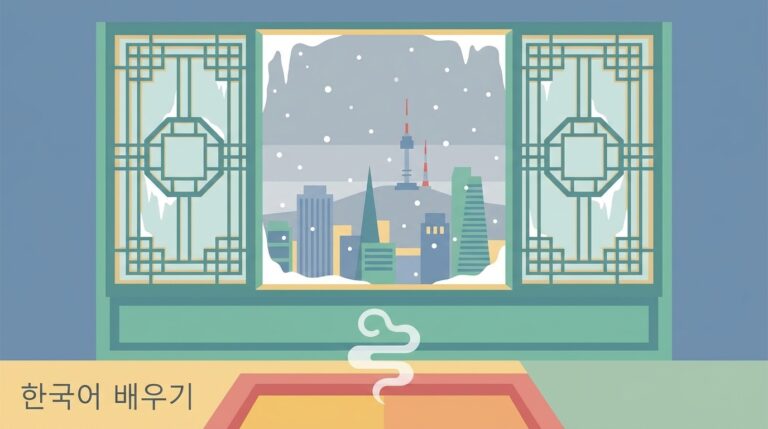
Picture this: It is 6:45 AM in central Seoul. You wake up to a piercing, rhythmic alarm—not your phone’s morning wake-up chime, but the jarring shriek of an emergency alert notification (긴급재난문자). The thermometer on your screen reads a bone-chilling -16°C (3°F), courtesy of the notorious Siberian Express blasting down across the peninsula. Shivering under your duvet, you crawl toward the bathroom for a warm shower before work, pull the lever, and… absolute silence. Not a single drop of water emerges. Panic sets in. Down in your villa’s basement or outside your apartment door, the metal water meter has succumbed to the freeze—a notorious Korean winter phenomenon known as 수도 계량기 동파 (water meter bursting from freezing).
If you have ever watched slice-of-life K-dramas like Reply 1988 or My Liberation Notes, you know that Korean winters are not just a poetic backdrop of soft snowfall and steaming street-side fish cakes (eomuk). They are an annual test of residential resilience. Navigating building superintendents, understanding civic maintenance announcements, and communicating technical household crises require far more than basic conversational phrases. This guide was built in direct response to real advanced learners and expats who found themselves linguistically paralyzed when the pipes froze. By mastering the high-register vocabulary, idiomatic repairs, and communal etiquette in this lesson, you will handle civic cold alerts like a seasoned Seoul resident.
Phase 2: In-Depth Analysis of 3 Core Expressions
1. 한파특보가 발효되었으니 계량기 동파에 유의하시기 바랍니다.
- Pronunciation: [Han-pa-teuk-bo-ga bal-hyo-doe-eot-ssu-ni gye-ryang-gi dong-pa-e yu-ui-ha-si-gi ba-ram-ni-da]
- Sound Analogy: Pronounce “bal-hyo” like “bal” in balance + “hyo” in hygiene; note the slight tension on “tt” in teukbo.
- Meaning: Literal: “Because a cold wave advisory has taken effect, please take caution regarding water meter freezing/bursting.” | Nuance: The quintessential formal civil broadcast sentence heard in residential building elevators and municipal text alerts warning residents to act immediately.
- K-Culture Moment: The iconic apartment intercom announcement (관리사무소 안내방송) that interrupts quiet weekend mornings across Seoul complexes as temperatures plunge below -10°C.
- Editor’s Insight: The word 동파 (凍破, dongpa) combines “freeze” (동) and “rupture/break” (파). In high-level Korean, note the use of 발효되다 (to take legal/administrative effect) rather than simple start verbs like 시작되다.
- Situation Spectrum: Casual: 🚫 | Semi-formal: ⚠️ | Formal: ✅
- 🤔 Think About It: In many Western individualistic households, pipe insulation is an individual homeowner responsibility. Why does Korean collective housing treat freeze prevention as a communal announcement involving public notifications?
2. 물을 똑똑 떨어지게 약하게 틀어 두세요.
- Pronunciation: [Mu-reul ttok-ttok tteo-reo-ji-ge ya-kha-ge teu-reo du-se-yo]
- Sound Analogy: The onomatopoeia “ttok-ttok” snaps crisply at the front of your mouth like a wooden clock ticking.
- Meaning: Literal: “Leave the water running weakly so it drips drop by drop.” | Nuance: The golden native household rule for sub-zero nights to prevent standing pipe water from turning into an ice wedge.
- K-Culture Moment: An experienced Korean landlady or mother-in-law visiting your studio flat (one-room), immediately checking the bathroom sink before leaving and giving this exact stern directive.
- Editor’s Insight: 똑똑 (dripping) is often upgraded by hyper-vigilant Koreans during severe cold snaps to 졸졸 (trickling steadily), because a pure drip can still freeze at -15°C! Demonstrating mastery over both onomatopoeic words signals native-level domestic fluency.
- Situation Spectrum: Casual: ✅ | Semi-formal: ✅ | Formal: ⚠️
- 🤔 Think About It: How does Korean reliance on mimetic and onomatopoeic words (의성어/의태어) clarify precise physical actions better than abstract adjectives?
3. 보온재를 채워 넣어서 동파를 예방해야 돼요.
- Pronunciation: [Bo-on-jae-reul chae-wo neo-eo-seo dong-pa-reul ye-bang-hae-ya dwae-yo]
- Sound Analogy: “Bo-on” sounds like “bo-own”; ensure the smooth liaison between “chae-wo” and “neo-eo-seo”.
- Meaning: Literal: “You need to fill in thermal insulation material to prevent freezing ruptures.” | Nuance: Practical home-care speak for stuffing thermal foam, Styrofoam blocks, or old padded blankets into exterior meter boxes.
- K-Culture Moment: A weekend scene in a typical multi-family red-brick villa (빌라) where neighbors exchange spare insulation bubble wrap (bbokbbogi) in the stairwell.
- Editor’s Insight: 보온재 (boonjae) is the official terminology, but in conversational shorthand, Koreans often say 헌 옷 (old clothes) or 뽁뽁이 (bubble wrap) interchangeably when discussing meter prep.
- Situation Spectrum: Casual: ✅ | Semi-formal: ✅ | Formal: ✅
- 🤔 Think About It: What does the practice of stuffing old down parkas into external utility boxes reveal about the pragmatic, resourceful problem-solving culture in Korea’s urban residential history?
Phase 3: Textbook Korean vs. Real Native Korean
Situation 1: Calling the Superintendent When the Pipes Freeze
- 📖 교과서 한국어 (Textbook):
“수도관이 얼어서 물이 나오지 않습니다. 와서 확인해 주십시오.”
(Sudo-gwani eoreoseo muri naoji antheumnida. Waseo hwaginhae jusipsio.)
“The water pipe is frozen and water is not coming out. Please come and check.” - 🗣️ 진짜 한국어 (Real Native C2):
“소장님, 날이 너무 추워서 계량기 쪽이 꽁꽁 얼어붙었나 봐요. 온수고 냉수고 아예 안 나와서 그러는데 한번 봐주실 수 있을까요?”
(Sojangnim, nari neomu chuwoseo gyeryanggi jjogi kkongkkong eoreobuteonna bwayo. Onsugo naengsugo aye an nawaseo geureoneunde hanbeon bwajusil su isseulkkayo?)
“Manager, with this extreme cold, it looks like the meter side froze rock solid. Neither hot nor cold water comes out at all—could you possibly take a quick look?” - 💡 왜 다를까? (Why the Difference?):
Textbook Korean sounds like an impersonal police report. Native Korean utilizes softening honorific prefixes (Sojangnim), expressive adverbs (kkongkkong), paired polarity expressions (onsugo naengsugo – neither hot nor cold), and indirect modal endings (-na bwayo) that invite assistance rather than demanding it.
Situation 2: Discussing Boiler Settings Before Going on Holiday
- 📖 교과서 한국어 (Textbook):
“집을 비울 때는 보일러 난방을 끄지 마십시오.”
(Jibeul biul ttaeneun boilleo nanbangeul kkeuji masipsio.)
“Do not turn off the boiler heating when leaving the house vacant.” - 🗣️ 진짜 한국어 (Real Native C2):
“며칠 집 비울 때 보일러 아예 꺼버리면 배관 터져서 물바다 돼요. 꼭 ‘외출’로 돌려놓고 가세요.”
(Myeochil jip biul ttae boilleo aye kkeobeorimyeon baegwan teojyeoseo mulbada dwaeyo. Kkok ‘oechul’ro dollyeonohko gaseyo.)
“If you turn the boiler completely off while away for a few days, the pipes will burst and flood everything. Make sure you set it to ‘Away’ mode before you go.” - 💡 왜 다를까? (Why the Difference?):
Natives emphasize the vivid catastrophic consequence—물바다 (mulbada, a sea of water / severe flood) and 배관 터지다 (burst pipes)—and refer specifically to the standard thermostat interface function: the infamous 외출 (oechul, outing/away) dial.
Phase 4: K-Culture Deep Dive & Non-Verbal Manners
4-1. 눈치 (Nunchi) & Gestures: Apartment & Villa Maintenance Etiquette
When dealing with building cold wave crises in Korea, high linguistic proficiency must be paired with acute nunchi (social radar):
* The Shared Burden Posture: If pipes burst in a multi-unit building, it frequently cuts off hot water for adjacent units down the vertical drainage stack. When speaking to your building manager (관리소장님) or landlord, avoid an accusatory stance. Bow slightly with hands clasped politely in front of your lower torso, maintaining an empathetic expression: “추우신데 고생 많으십니다” (Chuwosinde gosaeng maneusimnida – “You are suffering a lot in this cold”). Establishing relational warmth softens the administrative burden before presenting your emergency.
* The Stairwell Observation: In Korean villa buildings, utility meters line the communal stairwells. Walking past a neighbor’s open meter cabinet and noticing exposed pipes without insulation, it is customary communal etiquette to politely inform them or message the resident group chat rather than ignoring it, as one burst meter can flood the shared entry staircase with instant black ice.
4-2. Cultural Code Analysis: The Ondol Legacy and the ‘Disaster Alert’ Psychology
Korea’s entire residential winter culture stems from 온돌 (ondol, underfloor radiant heating). Unlike Western forced-air HVAC systems that heat ambient air, an ondol floor houses a network of water pipes beneath your floorboards. If these freeze or burst, repairs involve tearing up flooring—a logistical nightmare costing millions of won.
This engineering reality explains the societal intensity surrounding winter municipal management. Every winter, the Ministry of the Interior and Safety (행정안전부) blasts cell broadcast alerts categorizing cold: 한파주의보 (Cold Wave Advisory, when lows drop below -12°C for 2+ consecutive days) and the extreme 한파경보 (Cold Wave Warning, below -15°C). The collective Korean psyche reacts promptly: convenience stores stock heat packs (hot-pack) at checkouts, public transport stations activate heated benches (온열의자), and landlords send urgent text alerts reminding tenants to run their taps overnight.
Phase 5: Real-Life Roleplay Scenario
Setting: It is 7:30 AM on a Monday in January. You live in a modern villa in Mapo-gu, Seoul. After an overnight low of -17°C, you turn on the kitchen tap and get nothing. You walk down to the ground-floor management office (관리실) to consult the building manager, Mr. Park.
- Mr. Park: 어서 오세요, 302호 분이시죠? 얼굴이 사색이 되셨네. 무슨 일 있으세요?
(Eoseo oseyo, sambae-i-ho bunisijyo? Eolguri sasaegi doesyeonne. Museun il isseuseyo?)
“Welcome. You’re from unit 302, right? Your face is pale as a sheet. What’s happened?”
🎭 Hands holding a warm thermos, looking up with genuine concern -
You: 네, 소장님. 아침에 일어나 보니까 온수는커녕 찬물도 한 방울도 안 나와서요.
(Ne, sojangnim. Achime ireona bonikka onsuneunkeonyeong chanmuldo han banguldo an nawaseoyo.)
“Yes, Manager Park. I woke up this morning and not a single drop of cold water comes out, let alone hot water.”
🎭 Rubbing cold hands together, polite and distressed -
Mr. Park: 아이고, 어젯밤 한파경보 내렸을 때 물 좀 틀어놓고 주무셨어요?
(Aigo, eojetbam hanpa-gyeongbo naeryeosseul ttae mul jom teureonohko jumusyeosseoyo?)
“Oh dear… did you leave the water running a tiny bit overnight when the Cold Wave Warning dropped?”
🎭 Clicking his tongue lightly with sympathetic dismay -
You: 지난주에 보온재 채워 넣었다고 안심하고 깜빡 잠갔지 뭐예요. 계량기 함 열어봤더니 유리창까지 성에가 하얗게 꼈더라고요.
(Jinanju-e boonjae chaewo neoeottago ansimhago kkamppak jamgatji mwoyeyo. Gyeryanggi ham yeoreobwatdeoni yurichangkkaji seong-ega hayake kkkyeotdeoragoyo.)
“I felt safe because we packed in thermal insulation last week, so I slipped up and turned it off completely. When I checked the meter box, even the glass window was frosted white.”
🎭 Sighing softly, showing self-awareness of the oversight -
Mr. Park: 혹시 계량기 덮개 열었을 때 계량기 유리가 깨져 있었습니까? 금 간 건 아니죠?
(Hoksi gyeryanggi deopgae yeoreosseul ttae gyeryanggi yuriga kkaejyeo isseosseumnikka? Geum gan geon anijyo?)
“When you opened the cover, was the meter glass broken? It hasn’t cracked, has it?”
🎭 Leaning forward intently to check for physical structural damage -
You: 다행히 유리가 파손되진 않았는데, 배관 연결 부위가 돌처럼 굳어 있어요.
(Dahaenghi yuriga pasondoejin ananneunde, baegwan yeonggyeol buwiga dolcheoreom gudeo isseoyo.)
“Thankfully the glass isn’t shattered, but the pipe joint sections are frozen stiff like stone.”
🎭 Making a rigid fist gesture to indicate the frozen state -
Mr. Park: 그나마 파손 안 됐으면 천만다행입니다. 절대 뜨거운 끓는 물 확 붓지 마세요! 배관 터집니다. 헤어드라이어로 미지근한 바람부터 살살 녹이셔야 해요.
(Geunama pason an dwaesseumyeon cheonmandahaeng-imnida. Jeoldae tteugeoun kkeulneun mul hwak butji maseyo! Baegwan teojimnida. Heeodeurai-eoro mijigeunhan barambuteo salsal nogisyeoya haeyo.)
“If it’s not shattered, that’s an enormous relief. Whatever you do, never pour boiling water directly on it! The pipes will crack. Use a hair dryer on lukewarm air and thaw it gradually.”
🎭 Gesturing firmly with palms downward to stress safety -
You: 네, 말씀해 주신 대로 미열로 천천히 녹여보고, 한 시간 뒤에도 안 나오면 다시 연락드리겠습니다. 추운데 신경 써주셔서 감사합니다!
(Ne, malsseumhae jusin daero miyeollo cheoncheonhi nogyeobogo, han sigan dwie-do an naomyeon dasi yeollakdeurigesseumnida. Chuwonde singyeong sseojusyeoseo gamsahamnida!)
“Understood. I will thaw it gradually with low heat as you advised, and reach back out in an hour if it still doesn’t flow. Thank you for looking out for me in this freezing cold!”
🎭 Bowing at a clean 30-degree angle with a grateful smile
🔀 Interactive Choice Point: How Would You Respond to Mr. Park?
If Mr. Park says the whole line is jammed and asks if you want to call an emergency thaw technician (haebing eopche), what is your response?
- Option A: “아저씨가 관리인이니까 알아서 다 고쳐서 물 나오게 해주셔야죠.”
(Ajjeossiga gwalliin-inikka araseo da gochyeoseo mul naoge haejusyeoyajyo. – “You’re the superintendent, so figure it out and fix it all so the water comes back.”)- Feedback [Bad]: Fatal cultural error. Superintendents manage shared facilities, not private negligence within single-unit meter valves. Demanding this will destroy communal rapport and earn you a reputation as a difficult tenant (jin-sang).
- Option B: “제가 드라이어로 30분 정도 시도해 보고, 안 풀리면 사설 해빙 업체 견적을 같이 알아봐 주실 수 있을까요?”
(Jega deurai-eoro samsipbun jeongdo sidohae bogo, an pullimyeon saseol haebing eopche gyeonjeogeul gachi arabwa jusil su isseulkkayo? – “I will try with the hair dryer for about 30 minutes, and if it doesn’t loosen, could you perhaps help me look into quotes for a private thawing service?”)- Feedback [Best]: Displays self-reliance, respect for his expertise, and asks for advisory support rather than shifting blame. He will happily help you find a non-scamming local plumber.
- Option C: “그냥 놔두면 낮에 영상으로 올라가니까 알아서 녹지 않을까요?”
(Geunyang nwadumyeon naje yeongsang-euro ollaganikka araseo nokji aneulkkayo? – “If we just leave it, won’t it thaw on its own as it rises above zero this afternoon?”)- Feedback [Risk]: High risk! Sustained sub-zero pipe ice expands further as pressure builds, turning a frozen pipe into an exploded burst (pason/dongpa) by noon. Immediate mitigation is mandatory.
Phase 6: 10-Second Emotion Shadowing Drill
Practice these high-frequency winter emergency sentences with emotional immersion. Pay close attention to pauses marked by /.
[🚨 다급하고 걱정스럽게 - Urgent and alarmed]
“소장님, / 계량기가 꽁꽁 얼어붙어서 / 물이 한 방울도 안 나와요!”
(Sojangnim, / gyeryanggiga kkongkkong eoreobuteoseo / muri han banguldo an nawayo!)-
[💡 안도하며 능숙하게 - Relieved and seasoned]
“다행히 유리는 안 깨졌으니까 / 헤어드라이어로 / 미지근하게 녹여볼게요.”
(Dahaenghi yurineun an kkaejeosseunikka / heeodeurai-eoro / mijigeunhage nogyeobolgeyo.) -
[🥶 뼛속까지 시린 듯 오들오들 떨며 - Shivering to the bone]
“오늘 밤 영하 15도까지 떨어진다니까 / 수도꼭지 조금 틀어놓고 / 외출 모드로 해놔야겠어요.”
(Oneul bam yeongha sibodo-kkaji tteoreojindanikka / sudokkokji jogeum teureonohko / oechul modeuro haenwayagesseoyo.)
Phase 7: K-Culture Mini Dictionary
- 동파 (Dongpa / 凍破)
Literal translation: Freezing and bursting.
Usage: Refers technically and colloquially to water meters, pipes, or boiler valves rupturing due to internal water expansion below zero. Used constantly in news and administrative notices. - 한파특보 (Hanpa Teukbo / 寒波特報)
Literal translation: Cold Wave Special Report.
Usage: The umbrella civil weather notification issued by the Korea Meteorological Administration. Divided into 한파주의보 (Advisory: overnight low below -12°C) and the harsher 한파경보 (Warning: overnight low below -15°C). - 뽁뽁이 (Bbokbbogi)
Literal translation: Bubble wrap (mimetic word from the popping sound).
Usage: Sold by the meter at Daiso and hardware stores each November; taped to single-pane windows with soapy water or bundled around outdoor water pipes as Korea’s favorite affordable insulation shield. - 외출 모드 (Oechul Modeu)
Literal translation: ‘Outing’ or ‘Away’ Mode.
Usage: The vital setting on Korean wall-mounted boiler thermostats (ondol jojolgi). It prevents internal circulation water in the floor coils from freezing by firing short bursts of heat at minimal gas consumption while the resident is away.
Phase 8: Survival Kit for Travelers & Expats
Top 3 Survival Phrases
- Phrase 1: 온수가 전혀 안 나오는데 배관이 얼었나 봐요.
(Onsuga jeonhyeo an naoneunde baegwani eoreonna bwayo.)
Translation: “No hot water is coming out at all; it seems the pipes are frozen.”
Pro Tip: Use this when cold water runs fine but hot water fails—it signifies that the exterior cold water line is intact, but the thin boiler inflow pipe is frozen. - Phrase 2: 동파 예방 차원에서 물을 조금 틀어두었습니다.
(Dongpa yebang cha-woneseo mureul jogeum teureodueosseumnida.)
Translation: “I left the water running slightly to prevent freeze damage.”
Pro Tip: Leave this note for your Airbnb host or housemates if you step out, reassuring them that you are handling cold precautions responsibly. - Phrase 3: 계량기 동파 신고는 어디로 해야 하나요?
(Gyeryanggi dongpa singgoneun eodiro haeya hanayo?)
Translation: “Where should I report a frozen/burst water meter?”
Pro Tip: If the glass breaks, municipal water authorities replace it. Calling local city hotlines resolves it.
Editor’s Travel Note: Domestic Winter Hotlines & Navigation
- Emergency Municipal Hotline: In Seoul, dial 120 (without area code) to reach the 다산콜센터 (Dasan Call Center) for civil assistance with language translation options. For direct waterworks reporting, dial 121 (상수도사업본부).
- Local Hardware Stores: If you need insulation tape or replacement Styrofoam boxes, search for 철물점 (cheolmuljeom) on Naver Map app download for iOS and Android. These mom-and-pop stores stock specialized pipe sleeves that chain stores often run out of during deep January freezes.
Phase 9: “A Step Deeper” (Reflective Humanities Essay)
In the West, domestic heating is often experienced as an ambient, invisible shield controlled by a central thermostat. In Korea, winter management is viscerally tangible and profoundly communal. Because traditional heating relies on ondol—water circulating directly beneath your living floorboards—a frozen pipe is not merely an inconvenience; it threatens the foundational sanctuary of the home. Furthermore, in high-density urban settings where tens of families share a single vertical plumbing backbone, one tenant’s negligence in failing to let a faucet drip can burst the communal riser pipe, cutting off water for five stories of neighbors. Thus, when building managers broadcast stern instructions over intercoms or neighbors leave bubble wrap on stairwells, it reflects a unique Korean civic dynamic: survival in the harsh peninsula winter has always been an interdependent, cooperative endeavor.
💬 Your Turn: Have you ever experienced an extreme cold alert or frozen pipes in your home country or while living abroad? How does your culture handle communal winter maintenance compared to Korea’s public alert system? Share your stories in the comments below!
Phase 10: FAQ & Avoiding Misunderstandings
Q: Why do Koreans say to pour lukewarm water instead of boiling water on frozen pipes?
A: Rapid thermal shock. Pouring 100°C boiling water directly onto frozen cast iron, copper, or PVC pipes causes immediate thermal expansion stress, which shatters the pipe or snaps the brass joints. Always use warm water (around 30-40°C), wrap the pipe in warm towels first, or use a hair dryer on a medium heat setting from a safe 10cm distance.
Q: Does turning the boiler to ‘외출’ (Away) mode consume massive amounts of gas?
A: On the contrary, ‘외출’ mode is engineered for maximal efficiency. It maintains boiler water temperature just above freezing (typically firing only if internal temperatures drop under 8-10°C). If you switch the boiler completely OFF during a cold snap, reheating cold floor slabs from 0°C back to 22°C when you return will burn significantly more gas and risk a catastrophic multi-million won pipe fracture.
Q: Who pays for a broken water meter in a rented Korean apartment or villa?
A: Under Korean civil tenancy standards, if the tenant took standard preventive measures (such as packing the meter box with insulation material) and the freeze occurred during an unprecedented historic cold snap, the landlord or local municipality replaces it. However, if the tenant left windows wide open or failed to insulate the meter box despite formal warnings, the repair costs may fall on the tenant.
🚨 Common Mistakes (흔한 실수) Warning Board
- Mistake: Cranking the hair dryer to maximum heat right against the plastic meter glass.
Correct Action: Keep the dryer at least 10–15 cm away and sweep the warm air along the metal piping leading into the meter, rather than focusing heat on the sensitive dial face. - Mistake: Dripping only cold water while leaving the hot water line completely sealed.
Correct Action: Turn the single-lever faucet halfway between hot and cold so that a trickle moves through both lines, ensuring neither the main supply nor the boiler coil freeze. - Mistake: Packing damp, wet towels into the outdoor meter box.
Correct Action: Wet fabric freezes into an ice block overnight, accelerating the freeze! Only use completely dry clothes (헌 옷), bubble wrap (뽁뽁이), or polystyrene foam.
Phase 11: Action Mission & Engagement
- 🥉 Bronze Mission (Solo Mastery): Check your own home faucet right now and practice toggling your water lever to the exact ‘trickle’ position (졸졸 흐르는 정도) while repeating aloud: “물을 조금 틀어놔서 동파를 막아야겠어” (Mureul jogeum teureonwaseo dongpareul magayagesseo).
- 🥈 Silver Mission (Social Connection): Take a photo of a unique Korean winter scene (a covered water meter, a thermal tent at a bus stop, or your insulated window) and post it to Instagram or X with the caption: #한파경보 #계량기동파예방 #DailyHangul.
- 🥇 Gold Mission (Real-Life Application): Next time you step into your building lobby or speak with your landlord during cold weather, use the polite greeting: “추운 날씨에 동파 피해는 없으신가요?” (Chuun nalssie dongpa pihaeneun eopseusingayo? – “Are you free from any freeze damage in this cold weather?”).
- 🎮 K-Culture Media Mission: Watch an episode of a Korean winter variety show (like 2 Days & 1 Night or Three Meals a Day) and spot the cast members obsessing over keeping the boiler on or checking the outdoor tap with blankets. Transcribe their natural winter exclamations!
Phase 12: Interactive Quiz Challenge
Test your real-world command of Korean winter survival terminology with these three questions:
1. Situational Judgment:
The Korea Meteorological Administration issues a 한파경보 (overnight low -16°C). You plan to take an overnight weekend trip to Busan. What is the most appropriate native-level action regarding your home utilities?
* (A) 보일러 전원을 완전히 끄고 모든 수도꼭지를 꽉 잠근다.
* (B) 보일러를 ‘외출’ 모드로 맞춰두고, 수돗물이 가늘게 졸졸 흐르도록 온수 쪽으로 살짝 틀어둔다.
* (C) 보일러 실내 온도를 30도로 맞추고 화장실 문을 활짝 열어둔다.
2. Fill-in-the-Blank:
“겨울철에는 영하 10도 이하로 떨어질 때 수도 계량기 ______ 현상이 자주 발생하므로 보온재를 미리 채워 넣어야 합니다.”
* Word bank: [난방 / 동파 / 환기 / 침수]
3. True or False Culture Check:
True or False: If a water pipe freezes, the most effective native repair method is pouring boiling water (100°C) directly over the frozen pipe joints as quickly as possible.
👉 Click to reveal answers & in-depth explanations
-
Answer: (B)
Explanation: Turning the boiler completely off (A) risks freezing the internal floor pipes. Setting it to 30°C (C) wastes immense energy. Setting the thermostat to ‘외출’ (Away) mode and leaving a gentle trickle through the hot water channel (B) prevents both the boiler line and the meter from freezing. -
Answer: 동파 (Dongpa – Freezing and bursting)
Explanation: The standard compound noun for winter plumbing freeze damage is 동파. -
Answer: False
Explanation: Pouring boiling water directly on frozen pipes causes sudden expansion and pipe rupture (열충격으로 인한 파열). You must thaw gradually using lukewarm water (30–40°C) or low-heat hair drying.







