

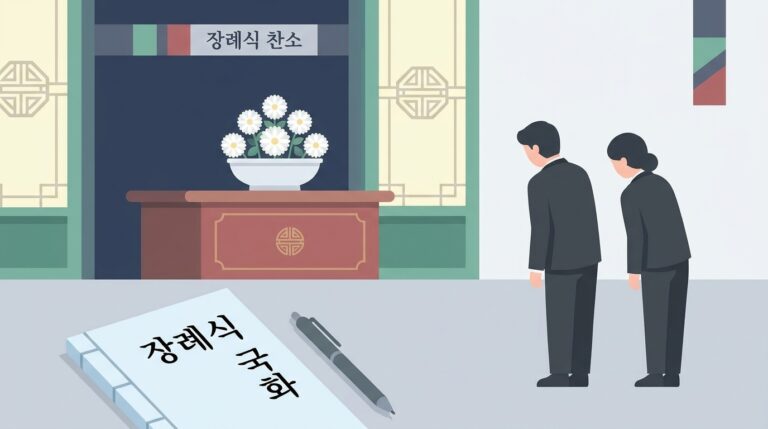
Attending a Korean Funeral: What to Wear and How to Pay Your Respects
Phase 1: 공감 (Story-driven Opening)
안녕하세요! 매일한글 에디터입니다.
Imagine this scenario: You have just settled into your life or job in Seoul, and your phone chimes with a KakaoTalk notification. A colleague’s parent has passed away, accompanied by a formal digital notice (부고, bugo). Your heart races. First comes sympathy, but immediately after, panic sets in: What do I wear? You open your wardrobe and see bright hoodies, jeans, and colorful sneakers. Do you need an expensive tailored black suit right this second? Will people judge you if you wear dark navy? And how do you greet the grieving family without committing an unintentional cultural faux pas?
If you have watched K-dramas like My Mister or Crash Landing on You, you know Korean funeral halls (jangnyesikjang, 장례식장) are central hubs of community mourning, marked by rows of black suits, white chrysanthemums, and quiet dignity. Navigating these rituals as a non-native can feel intimidating, but you do not need to stress. In this guide, built from years of on-the-ground intercultural mentoring, we break down everything you need to know about Korean funeral attire, bowing rules, and essential expressions so you can show heartfelt respect with calm confidence.
Phase 2: 핵심 표현 3선 심층 분석 (Top 3 Essential Expressions)
1. 삼가 고인의 명복을 빕니다 (Samga goin-ui myeongbogeul bimnida)
- Pronunciation: Sam-ga go-in-ui myeong-bo-geul bim-ni-da (Sounds like: “Sum-gah go-een-wee myung-boh-gool beem-nee-dah“)
- Meaning: Literal: “Reverently, I pray for the deceased’s blessing in the afterlife.” | Nuance: “May the deceased rest in peace / Please accept my deepest condolences.”
- K-Culture Moment: Seen on funeral ribbons and condolence guestbooks in K-dramas whenever a character formally pays their respects.
- Editor’s Insight: This is the most prestigious and formal phrase of condolence in the Korean language. It uses high Sino-Korean vocabulary (Hanja). While you can say it directly, it is even more common in written condolence messages.
- Situation Spectrum: Casual 🚫 | Semi-formal ⚠️ | Formal ✅
- 🤔 Think About It: Notice how Korean creates specialized ceremonial vocabulary (samga, goin) rather than relying on everyday adjectives like “sad” or “sorry.” How does your native language mark solemn life transitions?
2. 어떤 옷을 입고 가야 해요? (Eotteon oseul ipgo gaya haeyo?)
- Pronunciation: Eo-tteon o-seul ip-go ga-ya hae-yo? (Sounds like: “Uh-tton oh-seul eep-go gah-yah heh-yo?“)
- Meaning: Literal: “What clothes should I wear and go?” | Nuance: “What kind of outfit should I wear to attend?”
- K-Culture Moment: Coworkers whispering by the water cooler after receiving a bereavement announcement, confirming their outfit choices before heading out together after work.
- Editor’s Insight: Use this when asking a trusted Korean friend or coworker for advice before attending an event. It sounds natural, proactive, and respectful.
- Situation Spectrum: Casual ✅ | Semi-formal ✅ | Formal ⚠️
- 🤔 Think About It: In many cultures, funeral clothes are purely personal. In Korea, matching the group’s muted aesthetic is an act of shared harmony (jeong and nunchi).
3. 조문 드리러 왔습니다 (Jomun deurireo watseumnida)
- Pronunciation: Jo-mun deu-ri-reo wat-seum-ni-da (Sounds like: “Joh-moon doo-ree-raw wat-soom-nee-dah“)
- Meaning: Literal: “I have arrived to offer condolence visitations.” | Nuance: “I am here to pay my respects.”
- K-Culture Moment: Stated clearly to the reception desk staff or the chief mourner (sangju) upon entering the altar room.
- Editor’s Insight: Jomun refers strictly to the formal act of visiting a funeral to console the mourners. Using the honorific verb deuridad shows great politeness.
- Situation Spectrum: Casual 🚫 | Semi-formal ⚠️ | Formal ✅
- 🤔 Think About It: Using polite verbs like deurida elevates the recipient and lowers oneself—a foundational concept in Korean social etiquette.
Phase 3: 교과서 한국어 vs 진짜 한국어 (Textbook vs. Real Korean)
Situation 1: Offering Comfort to a Grieving Friend or Colleague
- 📖 교과서 한국어: 슬퍼하지 마십시오. (Seulpeohaji masipsio.) — “Do not be sad.”
- 🗣️ 진짜 한국어: 얼마나 상심이 크세요… 마음 잘 추스르세요. (Eolmana sangsim-i keuseyo… maeum jal chuseureuseyo.) — “You must be heartbroken… Please take gentle care of yourself.”
- 💡 왜 다를까?: Telling someone “do not be sad” feels mechanical and dismissive. Native speakers validate the grief first (sangsim-i keuseyo) and gently advise them to steady their heart (chuseureuseyo).
Situation 2: Asking if Dark Clothes are Acceptable When You Lack a Full Suit
- 📖 교과서 한국어: 검은 정장이 없으면 가면 안 됩니까? (Geomeun jeongjang-i eopseumyeon gamyeon an doemnikka?) — *”If I lack a black suit, can I not go?”
- 🗣️ 진짜 한국어: 어두운 셔츠에 슬랙스 입고 가도 괜찮죠? (Eoduun syeocheu-e seullaekseu ipgo gado gwaenchantjyo?) — “It’s completely fine if I wear a dark shirt and slacks, right?”
- 💡 왜 다를까?: Textbook sentences sound confrontational. The real Korean alternative is collaborative and checks whether sensible dark neutrals will suffice—which they almost always do.
Phase 4: K-Culture 딥다이브 & 비언어적 매너 (Deep Dive & Non-Verbal Etiquette)
4-1. 눈치 (Nunchi) & Physical Etiquette: The Outfit and the Bow
- The Footwear Rule: You must take off your shoes before stepping onto the mats in front of the altar. Always wear solid dark or black socks. Bare feet, open sandals, white athletic socks, or socks with playful cartoon prints are considered disrespectful.
- The Suit Standards: A black suit, white dress shirt, and plain black necktie are the standard for men. For women, a black suit, dark blouse, or conservative dark dress with dark stockings is ideal. If you don’t own a black suit, dark charcoal or deep navy without patterns is widely accepted.
- Hand Placement (Gongsubeop, 공수법): This is critical! At celebratory events, men put their left hand over their right. But at funerals, the reverse is true: Men place their right hand on top of the left, while women place their left hand on top of the right.
- The Bows: When facing the altar portrait of the deceased, perform two deep formal bows touching knees to the floor, followed by one slight standing bow. Then, turn toward the chief mourner (sangju) and bow once.
4-2. Cultural Code: The Spicy Beef Soup (Yukgaejang, 육개장)
After paying respects at the altar, you will be escorted to the dining hall. The hosts will serve you a meal, almost always centered around Yukgaejang (spicy shredded beef soup), boiled pork (suyuk), and side dishes.
Why red soup? Historically, red chili broth was believed to ward off negative spirits (aek-un), while hot, nourishing beef broth sustained guests traveling from afar. Eating this meal with other visitors and quietly sharing stories is not rude; it fulfills an ancient social duty to keep the family company so the venue does not feel deserted.
Phase 5: 실전 롤플레이 시나리오 (Practical Role-Play Scenario)
Setting: The funeral hall at Sinchon Severance Hospital. You meet your Korean colleague, Ji-hoon, in the lobby. You are both dressed in dark clothes holding condolence envelopes (buuigeum).
- Ji-hoon: 옷 깔끔하게 잘 입고 오셨네요. 어두운 톤이라 아주 단정해요. (Ot kkalkkeumhage jal ipgo osyeonneyo. Eoduun ton-ira aju danjeonghaeyo.)
🎭 Examining your dark grey blazer approvingly.
“You dressed very neatly. The dark tone looks very respectful.” -
Learner: 다행이에요. 검은 정장이 없어서 걱정했거든요. (Dahaeng-ieyo. Geomeun jeongjang-i eopseoseo geokjeonghaetgeodeunyo.)
🎭 Sighing in relief while smoothing out your lapels.
“What a relief. I was worried because I don’t own a solid black suit.” -
Ji-hoon: 양말도 어두운 색 신으셨죠? 신발 벗고 들어가야 하거든요. (Yangmaldo eoduun saek sineusyeotjyo? Sinbal beotgo deureogaya hageodeunyo.)
🎭 Glancing down toward your shoes.
“You’re wearing dark socks too, right? We have to take off our shoes inside.” -
Learner: 네, 검은 양말로 신었어요. 조의금 봉투는 어디에 내요? (Ne, geomeun yangmal-ro sineosseoyo. Jo-ui-geum bongtuneun eodie naeyo?)
🎭 Showing the white envelope in your hands.
“Yes, I wore black socks. Where do we submit the condolence money envelope?” -
Ji-hoon: 입구 방명록 옆에 함이 있어요. 이름 적고 넣으면 돼요. (Ipgu bangmyeongnok yeope ham-i isseoyo. Ireum jeokgo neoeumyeon dwaeyo.)
🎭 Pointing toward the wooden podium desk.
“There is a box next to the guestbook at the entrance. Write your name and drop it in.” -
Learner: 알겠습니다. 절할 때 손 위치는 어떻게 해요? (Algetseumnida. Jeolhal ttae son wichineun eotteoke haeyo?)
🎭 Keeping hands respectfully together in front.
“Understood. What is the hand position when we bow?” -
Ji-hoon: 장례식에서는 오른손이 위로 가도록 포개세요. 두 번 절하면 됩니다. (Jangnyesigeseoneun oreunson-i wiro gadorok pogaeseyo. Du beon jeolhamyeon doemnida.)
🎭 Demonstrating the right-over-left hand posture quietly.
“At a funeral, place your right hand over your left. We bow twice.” -
Learner: 조문 끝나고 육개장도 먹고 가야 하죠? (Jomun kkeutnago yukgaejangdo meokgo gaya hajyo?)
🎭 Nodding with understanding.
“After paying respects, we stay to eat some soup too, right?”
🔀 Interactive Choice Point
You step up to greet the chief mourner (sangju) after bowing to the memorial photo. What do you do?
- Option A: Smile brightly, offer a warm two-handed handshake, and say “힘내세요! 화이팅!” (Himnaeseyo! Hwaiting!)
- Option B: Make solemn eye contact, bow once deeply, and say quietly, “얼마나 상심이 크십니까…” (Eolmana sangsim-i keusimnikka…)
- Option C: Say nothing at all, turn around quickly, and walk immediately into the dining hall.
Feedback:
* Option A (Bad): Never say “Hwaiting!” or smile at a funeral. Handshakes are also generally avoided unless initiated by the elder mourner.
* Option B (Best): Perfect! A quiet, reverent bow with this empathetic phrase is the gold standard of etiquette.
* Option C (Risk): While silence is better than cheerful shouting, turning your back without acknowledging the mourner appears cold and careless.
Phase 6: 10초 감정 섀도잉 드릴 (10-Second Emotion Shadowing Drill)
Practice reading these sentences aloud, respecting the rhythm marks (/) and feeling the emotional tone:
[🕊️ 깊은 애도와 정중함을 담아]
삼가 / 고인의 명복을 / 빕니다.
(Samga / goin-ui myeongbogeul / bimnida.)-
[🥺 진심 어린 위로의 톤으로]
얼마나 / 상심이 크세요… / 마음 잘 / 추스르세요.
(Eolmana / sangsim-i keuseyo… / maeum jal / chuseureuseyo.) -
[🤝 차분하고 단정한 어조로]
어두운 옷으로 / 갈아입고 / 바로 가겠습니다.
(Eoduun oseuro / gara-ipgo / baro gagetseumnida.)
Phase 7: K-Culture 미니 사전 (Mini Dictionary)
- 조의금 / 부의금 (Jo-ui-geum / Bu-ui-geum) | Condolence money
- Cash presented in a plain white vertical envelope at the entrance. Customary amounts are odd numbers: 50,000 KRW (standard coworker), 100,000 KRW (close friend/colleague), or more.
- 상주 (Sang-ju) | Chief Mourner
- Typically the eldest son or immediate family member, wearing an armband with one or two black stripes.
- 빈소 (Bin-so) | Memorial Altar Room
- The private ceremonial room in the funeral complex where the deceased’s portrait, flower arrangements, and incense burner are situated.
- 육개장 (Yuk-gae-jang) | Spicy Beef Soup
- The symbolic meal served to funeral visitors in the reception area, accompanied by rice, kimchi, and drinks.
Phase 8: 여행자를 위한 생존 키트 (Traveler’s Survival Kit)
Survival Expressions TOP 3
- 봉투에 이름 어디에 써요? (Bongtue ireum eodie sseoyo?)
- Romanization: Bong-tu-e i-reum eo-di-e sseo-yo?
- Pro Tip: Write your name vertically on the back-left bottom edge of the condolence envelope.
- 종교적인 이유로 절 대신 묵념해도 될까요? (Jonggyojeogin iyuro jeol daesin mungnyeomhaedo doelkkayo?)
- Romanization: Jong-gyo-jeog-in i-yu-ro jeol dae-sin mung-nyeom-hae-do doel-kka-yo?
- Pro Tip: If your religion forbids bowing to photos or altars, it is 100% acceptable to stand in silence (mungnyeom) for 10 seconds with bowed head.
- 삼가 조의를 표합니다 (Samga jouireul pyohamnida)
- Romanization: Sam-ga jo-ui-reul pyo-ham-ni-da.
- Pro Tip: A safe, highly polite phrase meaning “I express my heartfelt condolences.”
Editor’s Travel Note
- Finding Locations: Download the Naver Map app for funeral hall navigation. Major hospitals like Asan Medical Center, Samsung Medical Center, or Severance have separate buildings labeled Jangnyesikjang (장례식장).
- ATM Cash Withdrawal: Funeral envelopes require physical banknotes. Use the lobby ATM before entering the floor, as card payments for condolence money are rare.
Phase 9: “한 발 더 깊이” (Cultural Insights)
In many Western cultures, a funeral is an intensely private family matter. In Korea, funerals are distinctly communal. Rooted in the ancestral spirit of pum-asi (품앗이)—the ancient tradition of exchanging labor and mutual support—attending a funeral is less about your personal closeness to the deceased and more about standing beside the living. When you show up dressed in quiet dark tones, you send an unmistakable signal: “You are not carrying this heavy grief alone.”
💬 Your Turn: Have you ever attended a memorial or funeral service in another country? What dress code rule surprised you the most? Share your thoughts in the comments below!
Phase 10: FAQ & 오해 방지 (FAQ Schema)
Q: What if I do not own a black suit or black tie?
A: Do not panic. While a black suit is standard, neat dark navy, dark charcoal, or deep brown trousers paired with a dark button-down shirt or sweater is completely acceptable. Avoid bright primary colors, denim, shorts, sandals, and flashy logos.
Q: Can I wear jewelry or makeup?
A: Keep accessories minimal. Remove flashy, jangly necklaces, large earrings, or sparkling wristwatches. Neutral, subtle makeup is expected; avoid bright red lipstick or heavy perfume.
Q: How long should I stay at the funeral hall?
A: After bowing at the altar, spend at least 30 to 45 minutes sitting in the dining area eating soup and conversing quietly with fellow guests. Leaving immediately after dropping off your envelope can appear transactional.
🚨 Common Mistakes (흔한 실수 TOP 3)
- Mistake 1: Clinking glasses during drinks. While beer or soju may be served at the tables, never clink glasses or say “Geonbae!” (Cheers). Simply drink quietly.
- Mistake 2: Wearing bare ankles or white socks. Always wear dark socks that cover your ankles when bowing.
- Mistake 3: Bowing three times instead of two. Two full bows and one standing nod are for the deceased. Three full bows are reserved for deities or Buddhist temple ceremonies.
Phase 11: 액션 미션 & 참여 유도 (Action Missions)
- 🥉 Bronze Mission: Practice placing your right hand over your left hand and saying “삼가 고인의 명복을 빕니다” smoothly three times.
- 🥈 Silver Mission: Check your travel wardrobe today. Identify one dark, solid shirt and black pair of socks suitable for an emergency formal event in Korea.
- 🥇 Gold Mission: Watch a funeral scene in a K-drama (like Hospital Playlist or My Mister) and identify the chief mourner’s armband, the table arrangement, and the food served.
- 🎮 K-Culture Quest: Look up what ribbon inscriptions say on large flower stands (Geunjo Hwahwan, 근조화환) sent to funeral doors!
Phase 12: 인터랙티브 퀴즈 챌린지 (Quiz Challenge)
Q1. Situational Judgment: You arrive straight from work in dark charcoal slacks and a dark navy sweater. You realize you are wearing bright yellow cartoon socks. What is the best action?
1. Step onto the mats anyway; nobody looks at your feet.
2. Stop by the hospital lobby convenience store (CU/GS25) and buy a pair of plain black socks for 2,000 KRW before going up.
3. Keep your outdoor shoes on during the bow.
Q2. Fill in the Blank:
At a Korean funeral, when performing a ceremonial bow, men place their ________ hand over their ________ hand.
Q3. True or False:
Eating Yukgaejang (spicy beef soup) in the funeral dining hall is considered disrespectful because it looks like a party.
👉 Click to reveal answers & explanations!
- Q1 Answer: 2. Convenience stores in hospital basements always stock plain black socks and black neckties specifically for this emergency. Never keep shoes on or wear bright socks.
- Q2 Answer: Right hand over their Left hand (오른손이 위로).
- Q3 Answer: False. Eating the meal provided by the family is an essential gesture of accepting their hospitality and keeping them company during their grief.







