

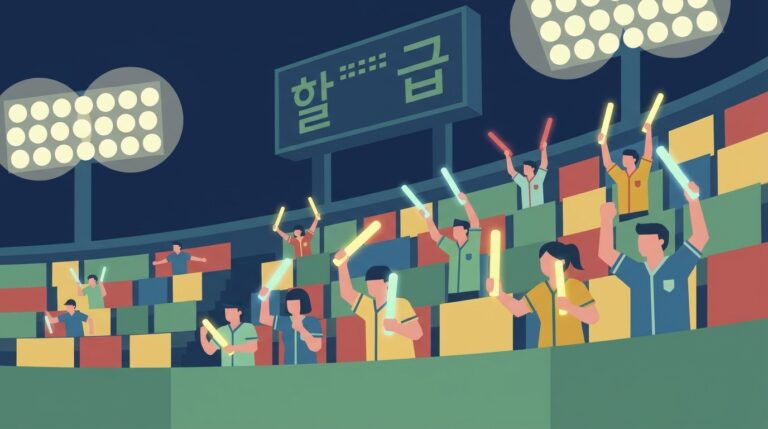
Master the Stadium Beat: Your Ultimate Guide to KBO Cheering Songs and Baseball Culture
Phase 1: Empathy & Story Opening
안녕하세요! 매일한글 에디터입니다. (Hello! This is your Daily Hangul editor.)
Imagine this: It’s a balmy Friday evening at Jamsil Baseball Stadium in Seoul. The electric smell of crispy fried chicken (chimaek) and buttery roasted dried squid drifts through the stands. Around you, thousands of fans clad in matching jerseys begin drumming their thundersticks in a mesmerizing, uniform beat. Suddenly, without warning, 25,000 strangers rise to their feet, swaying shoulder to shoulder and singing a chorus so loud and melodic you feel it vibrate through your ribs. Is this a top-tier K-pop stadium concert? No—it’s just the bottom of the third inning of a regular KBO league game.
If you have ever visited a Korean baseball stadium or watched clips of KBO games on social media, you might have felt that sudden wave of cultural vertigo. You desperately want to scream your heart out alongside the crowd, but you freeze: What are the lyrics everyone is chanting? Why are they pointing at the batter in sync? How do they all know this dance? As an intermediate Korean learner, textbook phrases like “야구를 좋아합니다” (I like baseball) leave you completely stranded on the dugout bench.
Cheering at a Korean baseball game is not a passive spectator sport; it is an energetic, communal theater powered by collective energy (heung, 흥) and razor-sharp social synchronization. Based on years of taking international learners right into the loudest cheering sections (응원석, eungwon-seok), I’ve distilled this guide to take your Korean out of the classroom and straight into the bleachers. Today, you will learn the exact phrases, cultural cues, and linguistic nuances needed to sing, cheer, and celebrate like a lifelong local fan.
Phase 2: Core 3 Expressions In-Depth Analysis
1. 안타를 쳐주세요 (Antareul chyeojuseyo)
- Pronunciation: [An-ta-reul chyeo-ju-se-yo] (Sound analogy: Think of saying Ahn-tah-reul, followed by a snappy chyeo-joo-seh-yo with a rhythmic, bouncing cadence).
- Meaning: Literally: “Please hit a base hit.” | Nuanced: “We believe in you—send that ball flying right now!”
- K-Culture Moment: This is the universal heartbeat of KBO offense. During suspenseful counts (like full counts with runners in scoring position), the stadium brass band kicks off this classic melody while cheerleaders lead high-energy arm chops toward home plate.
- Editor’s Insight: While
치다(chida) means “to hit,” adding-어 주세요(-eo juseyo) softens the command into an earnest collective petition. Even though it uses polite honorifics, when roared by 20,000 fans at the top of their lungs, it transforms into an exhilarating battle cry. - Situation Spectrum:
- Casual (with friends): ✅
- Semi-formal (talking to adjacent fans): ✅
- Formal (workplace presentation): 🚫 (Too specific to sports/playful situations)
- 🤔 Think About It: In Western baseball, cheering often centers on individual heckling or simple organic chants like “Let’s go [Team]!” Why do you think Korean cheers use polite request grammar (
-주세요) even when shouting aggressively at elite professional athletes?
2. 외쳐라 [팀명], 승리를 위하여 (Oechyeora [Team name], seungrireul wihayeo)
- Pronunciation: [Oe-chyeo-ra [Team], seung-ni-reul wi-ha-yeo] (Sound analogy: Way-chyeo-rah, rolling into seung-nee-reul wee-ha-yeo).
- Meaning: Literally: “Cry out, [Team], for victory!” | Nuanced: “Unite your voices—we fight together until we win!”
- K-Culture Moment: Heard during pivotal, late-inning rally moments (like the bottom of the 8th inning). Smoke machines flare, team flags wave from the railings, and fans hook arms across rows to belt out their official team anthem.
- Editor’s Insight:
외치다(oechida) means to shout or proclaim boldly. The ending-라(-ra) is the imperative form often found in heroic poetry or anthems. Pairing it with~를 위하여(for the sake of ~) gives the sentence a dramatic, epic gravity typical of Korean group anthems. - Situation Spectrum:
- Casual (at the stadium/noraebang): ✅
- Semi-formal: ⚠️ (Only appropriate when building team morale or toasts)
- Formal: 🚫
- 🤔 Think About It: Notice how this chant addresses the entire community rather than a single player. What does this reveal about the bond between sports teams and regional identity in South Korea?
3. 오늘 경기 완전 찢었다! (Oneul gyeonggi wanjeon jjijeotda!)
- Pronunciation: [O-neul gyeong-gi wan-jeon jji-jeot-da] (Sound analogy: Wan-jeon sounds like “one-john”, and jji has a sharp, tense double-J pop like “jeep” with extra punch).
- Meaning: Literally: “Today’s match completely tore it up!” | Nuanced: “That game was legendary / They absolutely slayed today!”
- K-Culture Moment: The post-game subway commute on Seoul Subway Line 2 leaving Sports Complex Station. Exhausted, hoarse fans re-watching walk-off home run highlights on their phones and texting their group chats.
- Editor’s Insight: At the B2 level, moving past vanilla words like
재미있었어요(It was fun) or대단했어요(It was great) is essential. The verb찢다(jjitda, to tear) is contemporary Korean slang used when someone dominates a performance—identical to “ripped the stage” or “slayed.” - Situation Spectrum:
- Casual (friends, social media captions): ✅
- Semi-formal: ⚠️ (Acceptable with close coworkers over drinks)
- Formal: 🚫
- 🤔 Think About It: English uses physical metaphors like “crushed it” or “killed it” for success. How does the imagery of “ripping up” a stadium match your native culture’s celebration slang?
Phase 3: Textbook Korean vs. Real Korean
Situation 1: Consoling a batter who struck out or grounded into a double play
- 📖 교과서 한국어 (Textbook Korean):
괜찮습니다. 다음 기회에 잘하면 됩니다.
(Gwaenchansseumnida. Daeum gihoee jalhamyeon doemnida.)
“It is alright. It is fine if you do well on the next opportunity.” - 🗣️ 진짜 한국어 (Real Stadium Korean):
아, 까비! 괜찮아, 다음 타석에 한 방 가자!
(A, kkabi! Gwaenchana, daeum taseoge han bang gaja!)
“Ah, what a close one! Shake it off, let’s smash a big one next at-bat!” - 💡 왜 다를까? (Why the difference?): Stadium communication demands high emotional velocity.
까비(kkabi) is the universally loved youth slang contraction of아깝다(akkapda, what a shame/so close). Instead of stiff multi-clause sentences, real fans use punchy idioms like한 방(han bang, a big hit/shot) to reignite instant optimism.
Situation 2: Celebrating an explosive home run that clears the fence
- 📖 교과서 한국어 (Textbook Korean):
홈런을 쳐서 정말 기쁘고 흥분됩니다.
(Homreoneul chyeoseo jeongmal gippeugo heungbundoemnida.)
“Because they hit a home run, I am truly happy and excited.” - 🗣️ 진짜 한국어 (Real Stadium Korean):
와, 미쳤다! 담장 훌쩍 넘어갔네. 오늘 타격감 제대로 각성했다!
(Wa, michyeotda! Damjang huljjeok neomeogatne. Oneul tagyeokgam jedaero gakseonghaetda!)
“Whoa, insane! It completely cleared the wall. His batting instinct fully awakened today!” - 💡 왜 다를까? (Why the difference?): B2 fluency requires natural descriptive adverbs like
훌쩍(effortlessly flying over) and dynamic metaphors. The term각성하다(gakseonghada), originally meaning spiritual or mental awakening (often seen in gaming and fantasy webtoons), is staple slang among Korean sports fans to describe an athlete entering god-mode.
Phase 4: K-Culture Deep Dive & Non-Verbal Manners
4-1. 눈치 (Nunchi) & Stadium Etiquette
Going to a KBO game is an exercise in collective coordination. Here is how to keep your nunchi meter full:
1. The Inning Divide: Offense is for singing; defense is for breathing. In KBO culture, teams only conduct organized, loudspeaker-led cheering when their team is at bat (공격, gong-gyeok). When your team takes the field to defend (수비, subi), the cheerleaders step down. That is your cue to sit, eat your snacks, or visit the restroom without blocking other fans’ view.
2. The Thunderstick Code: Keep your plastic bat or clapper (ttakttagi) at chest height. Swinging it wildly over your head blocks the sightlines of the passionate fans sitting behind you who are tracking every pitch.
3. Rivalry Courtesy: Never wear an opposing team’s jersey into the dedicated home cheering block (usually the 1st base side for Seoul home teams, or 3rd base for select regional stadiums). Cheering for the away team in the heart of the home section will earn you fierce glares.
4-2. Cultural Codes: The K-Pop & K-Food Symphony
KBO games are essentially a 3-hour outdoor party where baseball merely provides the background soundtrack. Every individual player on the roster has their own custom walk-up song (eungwon-ga), frequently adapted from iconic K-pop hits with lyrics cleverly replaced by the player’s name. You’ll hear retro pop, trot, and current Billboard-topping melodies repurposed into synchronized stadium bops.
Food culture is equally integral. Gone are the days of sad lukewarm hot dogs. Korean stadiums boast on-site craft beer stations, spicy rice cakes (tteokbokki), pork belly cups (samgyeopsal dosirak), and cold noodles delivered straight to your seating tier. The shared ritual of dividing boxes of seasoned fried chicken with stadium neighbors during an inning change is one of the quickest ways to experience Korean jeong (affectionate bonding).
Phase 5: Real-Life Roleplay Scenario
Setting: The scorching bottom of the 8th inning at Jamsil Baseball Stadium. The home team is down by one run, with runners on first and second.
Characters:
* You: An intermediate Korean learner attending your first live KBO game.
* Min-woo (민우): A friendly, die-hard season ticket holder sitting next to you, sporting a jersey plastered with player patches.
- 민우: 혹시 야구장 직관 처음 오신 거예요? 아까부터 응원 동작 엄청 열심히 따라 하시던데요!
(Hoksi yagujang jikgwan cheoeum osin geoyeyo? Kkabuteo eungwon dongjak eomcheong yeolsimhi ttara hasideondeyo!)
🎭 Hands you an extra plastic clapper with a warm grin.
“By any chance, is this your first time watching live at the stadium? I noticed you’ve been working so hard trying to copy the cheer moves since earlier!” -
You: 네, 현장 분위기가 생각했던 것보다 훨씬 뜨거워서 완전 감동받았어요!
(Ne, hyeonjang bunwigiga saenggakhaetdeon geotboda hwolssin tteugeowoseo wanjeon gamdongbadasseoyo!)
🎭 Bows head slightly and smiles while adjusting your baseball cap.
“Yes, the atmosphere here is so much more electric than I expected—I’m totally blown away!” -
민우: 이제 8회 말 약속의 시간입니다. 지금 타석에 우리 팀 간판타자 나왔어요!
(Ije pal-hoe mal yaksogui sigan-imnida. Jigeum taseoge uri tim ganpantaja nawasseoyo!)
🎭 Stands up abruptly on the bleacher step, clapping his hands twice.
“Now it’s the bottom of the 8th: the ‘Promised Inning.’ Our team’s franchise star hitter is stepping up to the plate right now!” -
You: 아, 저 선수 등장곡 아까 들었는데… 응원가 가사가 뭐였죠?
(A, jeo seonsu deungjanggok akka deureonneunde… eungwonga gasaga mwoyeotjyo?)
🎭 Leans in slightly over the roaring stadium noise to listen carefully.
“Ah, I heard his walk-up music earlier… what were the lyrics to his chant again?” -
민우: 간단해요! ‘날려라 안타!’ 세 번 외치고 마지막에 선수 이름 크게 부르면 돼요.
(Gandanhaeyo! ‘Nallyeora anta!’ se beon oechigo majimage seonsu ireum keuge bureumyeon dwaeyo.)
🎭 Points his finger forward rhythmically in time with the stadium organ.
“It’s super simple! Just chant ‘Send that hit flying!’ three times, then roar his name at the end.” -
You: 날려라 안타! 날려라 안타! 날려라 안타, 최! 강! 한! 화!
(Nallyeora anta! Nallyeora anta! Nallyeora anta, Choe! Gang! Han! Hwa!)
🎭 Pumps the clapper into the air in perfect sync with the drumbeat.
“Send that hit flying! Send that hit flying! Send that hit flying—Migh-ty Han-wha!” -
민우: 와, 박자감 장난 아닌데요? 방금 투수 볼 빠졌어요. 이번에 진짜 안타 각이에요!
(Wa, bakjagam jangnan anindeoyo? Banggeum tusu bol ppajyeosseoyo. Ibeone jinjja anta gagieyo!)
🎭 High-fives you mid-air as the batter takes ball three.
“Whoa, your rhythm is no joke! The pitcher just missed outside. A base hit is definitely written in the stars now!” -
You: 제발 담장 넘겨서 오늘 경기 시원하게 역전했으면 좋겠어요!
(Jebal damjang neomgyeoseo oneul gyeonggi siwonhage yeokjeonhaesseumyeon jokesseoyo!)
🎭 Clenches fist tightly, eyes glued to the batter's stance.
“I pray he clears the fence and we pull off a thrilling comeback win today!”
🔀 Interactive Choice Point
The batter cracks a screaming fly ball deep toward the right-field fence! The crowd goes wild. Min-woo leaps up and shouts, “넘어갔다!” (It went over!). How do you respond?
- Option A:
대박, 역전 홈런 맞죠? 오늘 직관 오길 진짜 잘했네요!(Daebak, yeokjeon homreon matjyo? Oneul jikgwan ogil jinjja jalhaenneyo!)
Feedback: BEST. Energetic, naturally uses intermediate sports vocabulary (역전 홈런– comeback home run,직관– watching live), and validates the shared joy. - Option B:
야구 선수가 공을 멀리 쳐서 팀의 점수가 올라갔습니다.(Yagu seonsuga gongeul meolli chyeoseo timui jeomsuga ollagasseumnida.)
Feedback: BAD. Grammatically correct but sounds like an automated encyclopedia entry. It completely kills the stadium hype. - Option C:
야! 심판 똑바로 봐라!(Ya! Simpan ttokbaro bwara!)
Feedback: RISK. Highly aggressive slang meaning “Hey umpire, open your eyes!” It’s confrontational, completely inappropriate when your own team just hit a game-winning home run, and drops honorifics with zero social cushion.
Phase 6: 10-Second Emotion Shadowing Drill
Train your intonation by following the rhythm markers (/) and channeling the emotional cues inside brackets:
[🔥 타오르는 열정으로 / With raging stadium fire]
외쳐라 / 승리의 함성! / 오늘 무조건 / 이긴다!
(Oechyeora / seungniui hamseong! / Oneul mujogeon / iginda!)
“Shout / the roar of victory! / Today, without fail / we take the win!”-
[🙌 다 같이 떼창하듯 / In melodic unison like a stadium choir]
워어어~ / 날려버려라! / 저 하늘 끝까지 / 날려라 안타!
(Wo-eo-eo~ / nallyeobeoryeora! / Jeo haneul kkeutkkaji / nallyeora anta!)
“Wo-o-o~ / Blast it away! / All the way to the edge of the sky / Send that hit flying!” -
[🤩 감격에 벅차올라 / Overwhelmed with euphoric disbelief]
미쳤다 진짜! / 이걸 역전하네! / 오늘 경기 / 완전 찢었다!
(Michyeotda jinjja! / Igeol yeokjeonhane! / Oneul gyeonggi / wanjeon jjijeotda!)
“Truly insane! / They actually turned this around! / Today’s game / totally slayed!”
Phase 7: K-Culture Mini Dictionary
- 떼창 (Ttechang)
Literal: Group singing.
Usage: Used for massive crowd sing-alongs at concerts and baseball games. When foreign rock bands or K-pop groups visit Korea, ttechang is what leaves performers in tears of awe. - 육성응원 (Yukseong-eungwon)
Literal: Vocal cord cheering (unamplified cheering).
Usage: At dramatic moments, stadiums intentionally cut the sound system and drums completely. Fans scream the team chant using solely their raw, unamplified voices. It creates an unforgettable, chilling rumble. - 유니폼 마킹 (Yunipom making)
Literal: Uniform marking / Heat-pressing.
Usage: The ritual of purchasing a team jersey at the stadium shop and getting your favorite player’s name and back number heat-pressed on the spot. If a player gets traded, fans jokingly lament their “busted marking” (마킹 망했다). - 직관 (Jikgwan)
Literal: Direct viewing.
Usage: Watching a sports match live at the venue in person. The opposite is집관(jipgwan – watching the broadcast live at home on TV).
Phase 8: Traveler’s Survival Kit
Survival TOP 3 Phrases
응원석 쪽으로 가려면 몇 번 게이트로 가야 해요?
(Eungwonseok jjogeuro garyeomyeon myeot beon geiteuro gaya haeyo?)
Pro Tip: Stadium concourses are mazes. Cheering sections are specifically numbered; showing this to stadium staff gets you pointed straight to the right entrance stairwell.치맥 세트 포장해 주시고, 컵홀더도 챙겨주세요.
(Chimaek seteu pojanghae jusigo, keopholdeodo chaenggyeojuseyo.)
Pro Tip: Stadium seats have limited beverage space. Asking for a cardboard cup holder (keopholde) avoids tragic beer spills when everyone jumps up for a home run.혹시 이 자리 예매하신 분 계신가요?
(Hoksi i jari yemaehasin bun gyesingayo?)
Pro Tip: KBO seats fill up fast during sellouts. Use this polite query to check whether an empty adjacent seat is reserved or just temporarily vacated.
Editor’s Travel Note
- Ticketing Prep: Booking online can be tough for non-residents. Download the Interpark Ticket Mobile App for KBO Bookings well ahead of time, or arrive at the box office (매표소) 2 hours before first pitch on weekdays for walk-up outfield or upper-tier tickets.
- Transit Strategy: After the final out at Jamsil, the subway entrance at Sports Complex Station (Lines 2 & 9) becomes an absolute bottleneck. Walk one station over to Sincheon / Jamsilsaene Station, or reserve a ride using the Kakao T Taxi Service App from a designated pickup zone.
- Payments: Korean stadiums are almost 100% cashless. Bring your international Visa/Mastercard or reload a local transportation card with debit capabilities.
Phase 9: “One Step Deeper” (Reflective Mini-Essay)
In many global sporting cultures, fan loyalty manifests as rivalry, tribal tension, and aggressive defense of territory. But Korean baseball cheering reveals something fundamentally different: it is an institutionalized outlet for collective catharsis. In a society structured by rigid workplace hierarchies, high stress, and rigorous etiquette, the stadium stands as a rare zone of total emotional release.
Here, a corporate CEO in his fifties and a university freshman in her twenties hold ends of the same banner, jumping in unison while howling an off-key pop melody. The language of KBO cheering reflects this distinct blend of jeong (deep relational affection) and heung (explosive, shared joy). You aren’t just an observer evaluating an athletic performance—you are an active participant carrying the batter across home plate through vocal resonance.
💬 Your Turn: What does cheering look and sound like in your country’s favorite sport? Do you sing melodic fight songs, or focus on rhythmic clapping and individual banter? Tell us your home team’s best chant in the comments below!
Phase 10: FAQ & Common Mistakes
Q: Can I bring outside food and drinks into a Korean baseball stadium?
A: Yes, with sensible safety restrictions! You can bring in store-bought food, snacks, and non-alcoholic drinks. Canned or plastic bottled beer (under 1 liter per person) is allowed, but hard liquor and glass bottles are strictly prohibited at entry checkpoints.
Q: What if I don’t know any of the team’s cheer songs before going?
A: Don’t worry at all! Every section has cheer captains (eungwondanjang) standing on elevated platforms who demonstrate the arm choreography before the music starts. The song choruses repeat 3 to 4 times, so you will pick up the melody within a single half-inning.
Q: Are KBO games child- and family-friendly?
A: Exceptionally so. Korean baseball stadiums have dedicated family zones, picnic grass areas, stroller parking, and strict policies against drunken brawls or abusive profanity in standard seating areas.
🚨 Common Mistakes Alert Board
- Mistake: Shouting “홈런!” (Home run!) on every single fly ball.
Correct Action: Wait for the ball trajectory. In experienced fan talk, shouting “홈런!” prematurely before the ball clears the warning track jinxes the hit into an easy outfield catch. Stick with날려라!(Send it flying!) until the ball actually clears the fence. - Mistake: Using informal language (banmal) when chatting with neighboring fans just because everyone is excited.
Correct Action: Even during shared celebration high-fives, always maintain polite endings (-요or-습니다) unless the other person explicitly invites you to speak comfortably (mal noheuseyo). - Mistake: Forgetting which inning your team is batting.
Correct Action: Never blast horns or stand to lead chants when your team is on the field pitching. Showing quiet respect during your pitcher’s windup is vital stadium etiquette.
Phase 11: Action Missions
- 🥉 Bronze Mission (Solo Practice): Look up the official YouTube channel of any KBO team (e.g., LG Twins, Doosan Bears, Lotte Giants, Kia Tigers) and shadow-sing one player’s cheer song three times out loud until your pronunciation flows smoothly.
- 🥈 Silver Mission (Social Share): Post an Instagram Story or tweet featuring your favorite Korean baseball snack combo with the caption:
야구장 직관 갈 땐 역시 치맥이 진리! 오늘 경기 완전 찢었다!(When watching baseball live, chimaek is the ultimate truth! Today’s game totally slayed!). - 🥇 Gold Mission (Real-Life Application): Attend a KBO game (or visit a local Korean sports pub during the Korean Series), sit in the active cheering zone, and execute at least two high-fives with neighboring fans using the phrase
오늘 경기 진짜 대박이네요!(Today’s game is truly incredible!).
🎮 K-Culture Mission: Watch an episode of the award-winning Korean baseball drama Hot Stove League (스토브리그) or look up a viral fancam of Lotte Giants fans singing “Busan Seagulls” (부산갈매기). Notice how the crowd’s facial expressions change when singing in unison.
Phase 12: Interactive Quiz Challenge
Test your stadium Korean! Click on the toggle to see if your baseball instincts are ready for the big leagues.
1. Situational Judgment
You are standing in the cheering section in the 9th inning. Your team’s hitter just struck out to end the inning, but the team played an incredible game. What is the most natural, supportive phrase to shout?
* A) 아저씨, 야구 그만두세요. (Mister, quit baseball.)
* B) 수고하셨습니다! 다음 경기에서 이기면 됩니다! (Great effort! It’s fine if we win the next game!)
* C) 아, 까비! 그래도 오늘 끝까지 잘 싸웠다! (Ah, what a close one! Still, you fought well until the end today!)
2. Fill-in-the-Blank
Complete the iconic stadium chant:
“안타를 ________! [선수 이름] 안타!”
(Hint: Polite request grammar for ‘to hit’ in real-time cheering)
3. True / False Cultural Fact
T/F: In Korean baseball stadiums, fans are expected to remain seated throughout the entire match to maintain visual order, exactly like a movie theater.
👉 Click here to reveal answers & explanations!
-
Answer: C (
아, 까비! 그래도 오늘 끝까지 잘 싸웠다!)
Explanation: Option A is rude and offensive. Option B is overly formal and stiff. Option C perfectly blends natural intermediate slang (까비) with genuine sportsmanship and collective pride. -
Answer: 쳐주세요 (chyeojuseyo)
Explanation: Derived from치다(to hit) +-어 주세요(please do ~). The full chant rings out as: “안타를 쳐주세요! [선수 이름] 안타!” -
Answer: FALSE
Explanation: In the designated cheering sections (응원석), fans stand on their feet during almost the entire half-inning when their team is on offense, dancing and jumping in choreographed routines led by the cheer squad!







