

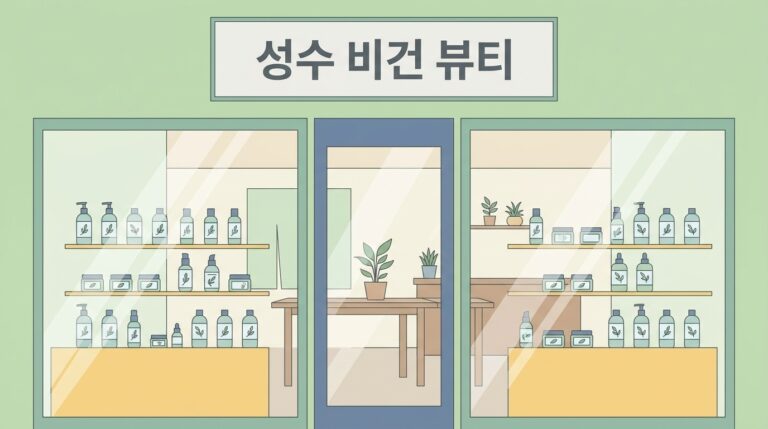
안녕하세요! 매일한글 에디터입니다. Hello, your trusted K-culture navigator and Daily Hangul editor here! Picture this: You are standing in the middle of a trendy, sun-drenched cosmetics flagship in Seongsu-dong. Minimalist glass vials gleam on recycled wood display cases, botanical aromas fill the air, and sleek placards boast phrases like ‘EVE VEGAN’ and ‘PETA Certified.’ You want more than just a surface-level product; you want to know if the formulation truly excludes synthetic fragrances, whether the squalane is 100% plant-derived, or if the brand sponsors empty-bottle upcycling initiatives.
Yet, when the friendly store consultant approaches, your advanced linguistic confidence suddenly feels trapped inside beginner textbooks. In my 10 years guiding learners through Korean culture, even advanced (C1) students often stumble when transitioning from standard classroom Korean to the intricate, trend-sensitive vocabulary of Korea’s ethical beauty revolution. Today, we will bridge that exact gap. By the end of this guide, you will master the sophisticated linguistic nuances needed to navigate the vanguard of K-Beauty with elegance and cultural authority.
Phase 2: Core Expressions Deep Dive
1. 동물성 원료를 배제하고 비건 인증을 받은 라인인가요?
- Pronunciation: Dongmulseong wollyoreul baejehago bigeon injeung-eul badeun rain-ingayo? (Pronunciation hint: Think Dong-mool-sung won-ryo-reul beh-jeh-ha-go bee-gun in-jeung-eul bah-deun line-in-ga-yo?)
- Meaning: Literal: “Is this a line that excluded animal-derived ingredients and received vegan certification?” | Real Nuance: “Could you confirm if this specific product line is certified cruelty-free and 100% vegan?”
- K-Culture Moment: You will hear this exact query on beauty podcasts and YouTube reviews by conscious beauty creators like Liah Yoo or in beauty editorials in Vogue Korea.
- Editor’s Insight: Advanced speakers use the formal verb 배제하다 (baejehada, to exclude/rule out) rather than the basic 빼다 (ppaeda, to remove/take out). It demonstrates discernment and professional knowledge of cosmetic formulation standards.
- Situation Spectrum: Casual: ⚠️ | Semi-formal: ✅ | Formal: ✅
- 🤔 Think About It: Notice how Korean skincare uses clear regulatory vocabulary like ‘인증 (injeung)’ to express ethical verification, mirroring Korean consumers’ high demand for institutional credibility.
2. 착한 성분 위주라 민감성 피부에도 자극이 덜하겠죠?
- Pronunciation: Chakhan seongbun wiju-ra mingamseong pibuedo jageug-i deolhagetjyo? (Pronunciation hint: Chak-hahn sung-boon wee-joo-rah meen-gahm-sung pee-boo-eh-doh jah-geuk-ee dul-ha-get-jyo?)
- Meaning: Literal: “Since it centers on ‘good ingredients’, it would be less irritating to sensitive skin, right?” | Real Nuance: “Since this has a clean formulation, it shouldn’t trigger sensitive skin reactions, correct?”
- K-Culture Moment: A staple phrase on beauty analysis shows like Get It Beauty and widely popularized by clean-ingredient analysis apps like Hwahae (화해).
- Editor’s Insight: ‘착한 성분’ (chakhan seongbun, literally ‘good/kind ingredients’) is an essential K-Beauty buzzword representing non-toxic, hypoallergenic, and ethically sourced raw ingredients. Adding the soft confirmation ending ‘~겠지요? / ~겠죠?’ creates a collaborative, polite conversation.
- Situation Spectrum: Casual: ✅ | Semi-formal: ✅ | Formal: ⚠️
- 🤔 Think About It: In English, we say “clean” or “non-toxic,” but Korean personifies ingredients as ‘착하다’ (kind/virtuous). What does it say about Korean worldview when ethics are attributed to botanical extracts?
3. 지속 가능한 친환경 패키징이나 리필 스테이션이 마련되어 있나요?
- Pronunciation: Jisok ganeunghan chihwangyeong paekijang-ina ripil seuteisyeon-i maryeondoe-eo innayo? (Pronunciation hint: Jee-sok gah-neung-hahn chee-hwahn-gyung pack-ee-jing-ee-nah ree-peel stay-shun-ee mah-ryun-dweh-uh een-nah-yo?)
- Meaning: Literal: “Is sustainable eco-friendly packaging or a refill station prepared?” | Real Nuance: “Does this brand offer eco-conscious packaging or in-store refill options?”
- K-Culture Moment: Frequently asked in eco-flagship hubs in Seongsu-dong, such as Aromatica or Amorepacific Seongsu, where customers bring clean empty containers for refills.
- Editor’s Insight: ‘마련되어 있다’ (maryeondoe-eo itda) sounds infinitely more sophisticated than the simple ‘있어요?’ (isseoyo?). It inquires about the establishment’s intentional systems rather than just mere physical presence.
- Situation Spectrum: Casual: 🚫 | Semi-formal: ✅ | Formal: ✅
- 🤔 Think About It: The Korean consumer base values zero-waste movements; asking this shows you are not just a skincare consumer, but an engaged, socially conscious participant.
Phase 3: Textbook Korean vs. Real-World Korean
Situation 1: Inquiring about harmful chemical preservatives
- 📖 교과서 한국어 (Textbook): 이 화장품에 유해한 화학 성분이 포함되어 있습니까? (I hwajangpum-e yuhaehan hwahak seongbun-i pohamdoe-eo isseumnikka? – “Are harmful chemical components included in this cosmetic?”)
- 🗣️ 진짜 한국어 (Real-World): 혹시 주의 성분이나 인공 향료 배제된 EWG 그린 등급 제품 맞나요? (Hoksi ju-ui seongbun-ina ingong hyangryo baejedon EWG geurin deunggeup jepum mannayo? – “By any chance, is this an EWG Green Grade formula free of caution ingredients and synthetic fragrances?”)
- 💡 왜 다를까? (Why the difference?): Korean clean beauty consumers use metric-based industry benchmarks like ‘EWG Green’ and ‘주의 성분’ (caution ingredients from the Hwahae analysis database). Speaking in specifics signals real cultural literacy.
Situation 2: Asking if the brand practices animal testing
- 📖 교과서 한국어 (Textbook): 회사가 동물 실험을 하지 않습니까? (Hoesaga dongmul silheom-eul haji anseumnikka? – “Does the company not conduct animal experiments?”)
- 🗣️ 진짜 한국어 (Real-World): 브랜드 전 제품 크루얼티 프리 인증받은 거 맞죠? (Beuraendeu jeon jepum keurueolti peuri injeungbadeun geo matjyo? – “All products across this brand are certified cruelty-free, right?”)
- 💡 왜 다를까? (Why the difference?): Direct negative interrogatives (하지 않습니까?) sound confrontational and prosecutorial in Korean retail culture. Using the accepted loanword ‘크루얼티 프리’ (cruelty-free) paired with a confirmation tag (맞죠?) is modern, polite, and precise.
Phase 4: K-Culture Deep Dive & Non-Verbal Manners
4-1. 눈치 (Nunchi) & Retail Etiquette
When shopping in high-end Korean clean beauty boutiques, body language speaks volumes:
* The Two-Finger Tester Swatch: When testing serums or balms, gently use the side of your ring finger or a disposable wooden spatula. Never dip fingers straight into open sample jars.
* The Polite Deflection Gesture: When beauty store clerks approach you with “도와드릴까요?” (May I help you?), if you wish to inspect ingredient tables independently without lingering pressure, gently tilt your head 15 degrees, place one hand near your chest, and say with a warm smile: “편하게 전성분 좀 둘러보고 말씀드릴게요.” (Pyeonhage jeonseongbun jom dulleobogo malsseumdeurilgeyo – I’ll just check the full ingredient lists for a moment and let you know).
4-2. Cultural Code: The Rise of ‘가치소비’ (Value-Based Consumption)
South Korea’s cosmetic market underwent an ethical renaissance. Today’s urban Gen Z and Millennials embrace 가치소비 (Gachi-sobi)—meaning purchasing items that reflect personal values, ethics, and environmental justice. Clean beauty in Seoul is no longer a niche subculture; mainstream players like CJ Olive Young dedicate whole boutique zones to clean, vegan, and dermocosmetic curation. Displaying awareness of certifications like EVE VEGAN (France) or 한국비건인증원 (Korea Agency of Vegan Certification) immediately earns mutual respect from industry curators.
Phase 5: Real-World Roleplay Scenario
Setting: Green Archive, an eco-luxury vegan skincare store in Seongsu-dong. Sunlight streams through recycled glass panels onto moss displays.
NPC: Min-seo (민서) – An articulate, eco-aesthetic aesthetician and skincare specialist.
- Turn 1 (Min-seo): 어서 오세요! 저희 브랜드는 전 제품 비건 소사이어티 인증을 받은 클린 포뮬러만 선보이고 있어요. 특별히 찾으시는 라인이 있으신가요? (Eoseo oseyo! Jeohui beuraendeuneun jeon jepum Bigeon Sosai-eoti injeung-eul badeun keullin pomyulleoman seonbo-igo isseoyo. Teukbyeolhi chajeusineun rain-i issu-singayo?)
- 🎭 Min-seo hands you an upcycled cotton testing wipe with a gentle two-handed bow.
- Translation: “Welcome! Our brand exclusively offers clean formulas certified by the Vegan Society. Are you looking for any specific line today?”
- Turn 2 (You): 네, 반갑습니다. 요즘 환절기라 피부 장벽이 무너져서, 동물성 원료를 철저히 배제한 보습 진정 라인을 찾고 있어요. (Ne, bangapseumnida. Yojeum hwanjeolgi-ra pibu jangbyeog-i muneojyeoseo, dongmulseong wollyoreul cheoljeohi baejehan boseup jinjeong rain-eul chatgo isseoyo.)
- 🎭 You gesture lightly toward the hydration serum counter, maintaining friendly eye contact.
- Translation: “Hello! My skin barrier has been quite sensitized due to the seasonal transition, so I am looking for an intensive moisturizing and calming line that strictly excludes animal-derived ingredients.”
- Turn 3 (Min-seo): 잘 찾아오셨네요. 이 에센스는 피토-스쿠알란과 병풀 추출물 베이스라 자극 없이 속건조를 잡아주거든요. 인공 유화제도 전혀 사용하지 않았습니다. (Jal chaja-osyeotneyo. I esenseuneun pito-seukualran-gwa byeongpul chuchulmul beiseu-ra jageuk eopsi sokgeonjoreul jabajugeodeunyo. Ingong yuhwaje-do jeonhyeo sayonghaji anatseumnida.)
- 🎭 She presses a test pump onto her own wrist first to demonstrate the velvety texture.
- Translation: “You’ve come to the right place. This essence uses a phyto-squalane and Centella Asiatica base to relieve inner dryness without irritation. It’s formulated without artificial emulsifiers.”
- Turn 4 (You): EWG 그린 등급 성분 위주라 안심이 되네요. 혹시 제형에 사용된 점증제나 유효 성분도 유전자 변형(Non-GMO) 원료인가요? (EWG geurin deunggeup seongbun wiju-ra ansim-i doeneyo. Hoksi jehyeong-e sayongdoen jeomjeungjena yuhyo seongbundo Non-GMO wollyo-ingayo?)
- 🎭 You lean in slightly to read the micro-print packaging with keen interest.
- Translation: “It’s reassuring that it relies on EWG Green Grade ingredients. May I ask if the thickeners and active ingredients used in the formulation are also Non-GMO?”
- Turn 5 (Min-seo): 네, 100% Non-GMO 인증 식물성 포뮬러예요. 프랑스 EVE 비건 인증 라벨도 케이스 후면에서 확인하실 수 있습니다. (Ne, baek-peosenteu Non-GMO injeung sikmulseong pomyulleo-yeyo. Peurangseu EVE bigeon injeung rabel-do ke-iseu humyeon-eseo hwaginhasi-su itsseumnida.)
- 🎭 She turns the bottle gracefully, tapping the certification seal with her index finger.
- Translation: “Yes, it is a 100% Non-GMO certified botanical formula. You can verify the French EVE VEGAN seal right on the back of the carton.”
- Turn 6 (You): 확실하네요. 혹시 다 쓰고 난 후에 공병 수거 캠페인이나 본품 리필 스테이션도 운영하시나요? (Hwaksilhani-eyo. Hoksi da sseugo nan hue gongbyeong sugeo kaempein-ina bonpum ripil seuteisyeon-do un-yeonghasinayo?)
- 🎭 You examine the glass pump container approvingly.
- Translation: “That’s reassuring. By the way, once I finish this, do you operate an empty bottle return initiative or in-store refill stations for the product?”
- Turn 7 (Min-seo): 물론이죠! 공병을 세척해 가져오시면 10% 할인 혜택을 드리고, 펌프 부품까지 완전 분리배출 가능한 에코 패키징을 채택하고 있어요. (Mullon-ijyo! Gongbyeong-eul secheokhae gajyeo-osimyeon sip-peosenteu hal-in hyetaeg-eul deurigo, peompeu bupum-kkaji wanjeon bullibaechool ganeunghan eko paekijang-eul chaetaekhago isseoyo.)
- 🎭 She shows you a biodegradable container dismantle chart with genuine pride.
- Translation: “Of course! If you bring back your rinsed empty bottle, we offer a 10% discount, and our eco-packaging allows every part, down to the pump spring, to be completely recycled.”
- Turn 8 (You): 환경과 성분 모두 신뢰가 가네요. 이 에센스랑 크림 리필 세트로 구매할게요. (Hwangyeong-gwa seongbun modu sinrhoega ganeyo. I esenseurang keurim ripil seteu-ro gumaehalgeyo.)
- 🎭 You hand over your payment card with both hands and an appreciative nod.
- Translation: “Both your ingredient philosophy and eco-responsibility inspire confidence. I’ll take this essence and the cream refill set, please.”
🔀 Interactive Decision Point
Min-seo asks if you want to sample an unreleased clean sunscreen sample that has natural tea-tree scent. How do you respond?
- Choice A: “저 화학 성분 민감해서 그런 샘플 필요 없는데요.” (Jeo hwahak seongbun mingamhaeseo geureon saempeul piryo eomneundeyo.)
- Choice B: “천연 에센셜 오일에도 민감하게 반응할 수 있어서, 전성분표 먼저 확인해 봐도 될까요?” (Cheon-yeon esensyeol oil-edo mingamhage baneunghal su isseoseo, jeonseongbunpyo meonjeo hwaginhae bwado doelkkayo?)
- Choice C: “공짜면 그냥 아무거나 가방에 넣어주세요.” (Gongjjamyeon geunyang amugeona gabang-e neo-eojuseyo.)
🎯 Choice Feedback:
- Choice A (Bad): Aggressive and blunt. Using ‘그런’ dismissively implies the gift is unworthy, triggering loss of face (체면) in retail etiquette.
- Choice B (Best): Perfect C1 nuance! Acknowledges that even natural botanical oils (천연 에센셜 오일) can cause contact dermatitis, while politely asking to examine the full ingredient table first (전성분표).
- Choice C (Risk): Overly transactional and borderline impolite in upscale boutiques. It ignores the curator’s personalized recommendation.
Phase 6: 10-Second Emotion Shadowing Drill
Practice reading these out loud, observing rhythm breaks (/) and emotional tone cues:
[🌿 차분하고 전문적인 호기심]
“동물 실험을 배제한 제품인가요, / 아니면 전 공정 공식 비건 인증까지 / 마친 라인인가요?”
(Dongmul silheom-eul baejehan jepum-ingayo, / animyeon jeon gongjeong gongsik bigeon injeung-kkaji / machin rain-ingayo?)-
[💡 확신에 찬 꼼꼼함]
“합성 계면활성제 대신 / 식물 유래 성분을 사용해서 / 피부 자극을 최소화한 점이 / 마음에 드네요.”
(Hapseong gyemyeonhwalseongje daesin / sikmul yurae seongbun-eul sayonghaeseo / pibu jageug-eul choesohwahan jeom-i / ma-eum-e deuneyo.) -
[🌱 다정하고 윤리적인 동참]
“리필 스테이션 이용 시 / 용기를 직접 소독해 오면 / 바로 충전 가능한가요?”
(Ripil seuteisyeon iyong si / yong-gireul jikjeop sodokhae omyeon / baro chungjeon ganeunghangayo?)
Phase 7: K-Culture Mini Dictionary
- 착한 성분 (Chakhan Seongbun) | Clean / Non-toxic Ingredients
- Everyday/Business Usage: Refers to formulations that consciously avoid the ’20 caution ingredients’ designated by dermatological consumer indices. Essential when reading product tags in Olive Young.
- 가치소비 (Gachi-sobi) | Value-Driven / Conscious Consumption
- Everyday/Business Usage: Sociological keyword applied when consumers deliberately support cruelty-free, zero-waste, and socially conscious enterprises over cheaper generic brands.
- 공병 수거 (Gongbyeong Sugeo) | Empty Cosmetic Bottle Recycling Campaign
- Everyday/Business Usage: Major K-Beauty stores offer store points or membership discounts when customers return cleaned, empty cosmetic containers for proper plastic/glass recycling.
- 전성분 (Jeonseongbun) | Full Ingredient List (All Ingredients Disclosure)
- Everyday/Business Usage: Under South Korea’s Mandatory Cosmetic Ingredient Disclosure Act, brands must display all components. Advanced shoppers simply ask: “전성분표 어디서 볼 수 있나요?” (Where can I see the full ingredient list?).
Phase 8: Traveler’s Survival Kit
Top 3 Survival Expressions
- 1. 혹시 피부 자극 유발 성분 있나요?
- Hoksi pibu jageuk yubal seongbun innayo?
- Pro Tip: Use this concise phrase if your skin reacts easily to chemical sunscreen agents or synthetic colorants.
- 2. 비건 인증 마크 어디에 표기되어 있나요?
- Bigeon injeung makeu eodi-e pyogidoe-eo innayo?
- Pro Tip: Helps you locate French EVE, British Vegan Society, or Korean Vegan labels printed on the back fold.
- 3. 리필 가능한 본품 용기인가요?
- Ripil ganeunghan bonpum yonggi-ingayo?
- Pro Tip: Essential when purchasing heavier glass jars so you know if you can buy lightweight refill pods for travel.
Editor’s Travel Note: Navigating Conscious Beauty in Seoul
- Essential Skincare App: Download the Hwahae Cosmetic Ingredient App. Even without full Korean fluency, you can enter barcode scans to see instant safety breakdowns and vegan indicators.
- Seongsu Ethical Shopping Trail: Head out through Seongsu Station (Line 2) Exit 3 to find high-concept clean beauty showrooms. Many stores participate in direct paper packaging options without plastic shrink-wraps.
- Tax Refund Tip: Most clean beauty boutiques offer Instant Duty-Free (현장 즉시 환급). Keep your passport ready at the counter.
Phase 9: A Step Deeper (Reflective Essay)
In many international beauty markets, ‘clean beauty’ began primarily as an individual wellness choice—a self-centered search for allergy-free formulas that do not irritate personal skin. However, in South Korea, the explosive growth of clean and vegan beauty is deeply tied to collective social accountability (공동체 의식). The transition from aggressive ’10-step glass skin regimens’ toward mindful skincare mirrors a generational pivot: young Koreans now view their vanity table as a reflection of ethical civic behavior. Skincare is no longer just about personal aesthetics; it is an active dialogue with the environment.
💬 Your Turn: Does your home culture view beauty consumption as an individual health choice or a collective environmental responsibility? Share your thoughts below in Korean using the term 가치소비!
Phase 10: FAQ & Avoiding Misunderstandings
Q: Does the Korean label ‘자연주의’ (Nature-oriented) guarantee that a product is 100% vegan?
A: No. ‘자연주의’ (Jayeon-juui, Naturalism) simply implies botanical concepts and plant extracts. These products may still contain honey, beeswax, propolis, or animal-derived squalane. To ensure ethical purity, specifically demand ‘비건 인증’ (Vegan certification) or ask: “동물 유래 성분이 일절 들어가지 않았나요?” (Are there absolutely no animal-derived components?).
Q: Can I bring foreign brand bottles to Korean cosmetic refill stations?
A: Most Korean refill hubs (like Aromatica or Amorepacific Refill Stations) require either proprietary sanitized brand bottles or empty vessels certified for cosmetic reuse to comply with strict Ministry of Food and Drug Safety hygiene laws. Check with staff beforehand: “타사 공병도 리필 가능한가요?” (Can empty containers from other brands be refilled?).
Q: How do I express that I have a specific botanical extract allergy without sounding dramatic?
A: State it calmly using the particle ‘~에 반응하다’: “제가 [병풀 / 티트리 / 쑥] 성분에 알레르기 반응이 있어서요. 그 성분이 함유되어 있나요?” (I have an allergic reaction to [Centella / Tea Tree / Mugwort]. Is that component included?).
🚨 Common Mistakes Alert:
- Mistake: Saying “이거 야채 화장품이에요?” (Is this vegetable cosmetic?)
- Correct Action: Use 식물성 (Sikmulseong – Plant-derived/Botanical) or 비건 (Bigeon – Vegan). ‘야채’ sounds like culinary salad greens!
- Mistake: Demanding “독극물 없어요?” (Does it have no poison?) when checking non-toxic makeup.
- Correct Action: Ask for 무자극 (Mujageuk – Hypoallergenic/Zero irritation) or 유해 성분 배제 (Yuhae seongbun baeje – Excluded harmful substances).
- Mistake: Confusing ‘리필’ (Refill) with ‘샘플’ (Sample packets).
- Correct Action: Use ‘본품 리필용’ when purchasing secondary replacement pouches for pump jars.
Phase 11: Action Missions
- 🥉 Bronze Mission (Solo Practice): Stand in front of your bathroom mirror with your favorite skincare item. Speak out loud in Korean for 60 seconds explaining whether it has 착한 성분 and why your skin likes it.
- 🥈 Silver Mission (Community Interaction): Visit a K-Beauty brand’s official Instagram account (e.g., Isntree, Manyo, or Aromatica). Find their latest post and leave a respectful question in Korean asking about their packaging or vegan certifications: “친환경 리필 라인도 출시 계획이 있나요?”
- 🥇 Gold Mission (Real-world Execution): During your next visit to an Olive Young or Korean boutique, initiate a live C1 inquiry with the staff using Expression #1 or Expression #2!
- 🎮 K-Culture Mission: Watch an episode of a Korean beauty vlogger reviewing clean products. Transcribe every time they utter the terms 착한 성분, 비건 인증, or 속건조.
Phase 12: Interactive Quiz Challenge
1. Situational Judgment: You want to know if a moisturizing cream contains animal-derived collagen or plant-derived phyto-collagen. What is the most sophisticated C1 phrase?
* A) 콜라겐이 동물에서 왔어요 식물에서 왔어요?
* B) 함유된 콜라겐이 동물성인가요, 아니면 식물 유래 피토 콜라겐인가요?
* C) 진짜 비건 맞아요? 의심스러워서요.
2. Fill-in-the-Blank: Fill in the essential buzzword meaning conscious, value-based consumption:
* “요즘 MZ세대는 성분뿐만 아니라 기업의 윤리적 가치를 보고 구매하는 ( ____ )를 지향합니다.”
3. True or False: In Korea, any product stamped with ‘자연주의’ (Nature-concept) is legally certified as cruelty-free and vegan.
* True / False
👉 Click to view Answers & Explanations
- Answer: B
- Explanation: Option B uses precise formulation vocabulary (함유된, 동물성, 식물 유래). Option A sounds childlike, and Option C is accusatory and impolite.
- Answer: 가치소비 (Gachi-sobi)
- Explanation: ‘가치소비’ encapsulates ethical, conscious consumerism in contemporary Korean society.
- Answer: False
- Explanation: ‘자연주의’ is a generic marketing aesthetic. Only official certification badges like 한국비건인증원, The Vegan Society, or EVE VEGAN legally ensure absence of animal testing and animal derivatives.
- Explanation: ‘자연주의’ is a generic marketing aesthetic. Only official certification badges like 한국비건인증원, The Vegan Society, or EVE VEGAN legally ensure absence of animal testing and animal derivatives.







