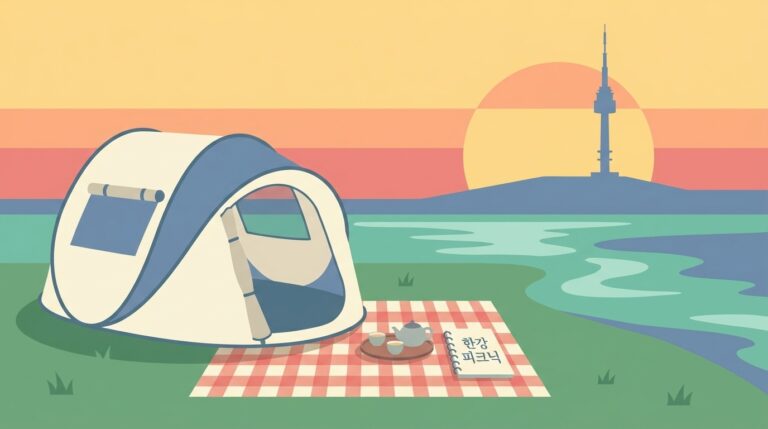
Phase 1: Empathy (Welcome to the Han River!)
안녕하세요! 매일한글 에디터입니다. Have you ever dreamed of enjoying that picture-perfect Han River picnic seen in your favorite K-Dramas? You grab crispy fried chicken, rent a cozy pop-up tent, and head toward the cool breeze. But suddenly, a park patrol whistles at you, or that springy wire tent refuses to fold into its bag, turning your relaxing picnic into a sweaty comedy! Don’t panic. As a 10-year Seoul culture guide, I have seen hundreds of beginners freeze in this exact spot. Based on real student feedback and field experience, this survival guide teaches you the exact beginner phrases to rent, pitch, and fold your tent effortlessly like a true Seoulite!
Phase 2: 3 Core Expressions in-depth
1. 여기 텐트 쳐도 돼요? (Yeogi tenteu chyeodo dwaeyo?)
- Pronunciation: [Yeo-gi ten-teu chyeo-do dwae-yo?] (Think of Yo-gi Bear + Tent + Chaw like chew + Dway-yo)
- Meaning: Literal: “Here tent hit also is it okay?” vs Real Nuance: “Can I pitch a tent right here?”
- K-Culture Moment: Seen frequently in slice-of-life K-Dramas whenever characters unpack picnic gear on the riverbanks.
- Editor’s Insight: Han River parks have strict designated Shade Tent Zones (그늘막 허용구역). Setting up outside these zones results in spot fines, so asking nearby picnickers or staff with this phrase keeps you 100% safe!
- Situation Spectrum: Casual: ⚠️ (여기 텐트 쳐도 돼?) / Semi-formal: ✅ (여기 텐트 쳐도 돼요?) / Formal: ✅ (여기 텐트 쳐도 됩니까?)
- 🤔 Think About It: In Korea, public parks prioritize shared harmony over personal territory. Why do you think asking permission before occupying public lawn space is considered vital manners here?
2. 텐트 세트 주세요 (Tenteu seteujuseyo)
- Pronunciation: [Ten-teu se-teu ju-se-yo] (Sounds like Tent + Set + Jew-say-yo)
- Meaning: Literal: “Tent set give please” vs Real Nuance: “I’d like the tent rental package, please.”
- K-Culture Moment: Stepping out of Yeouinaru Station Exit 2, you will encounter rental shops displaying vibrant wagons packed with mats, tents, and fairy lights.
- Editor’s Insight: ~주세요 (juseyo) is your magic beginner wand. Rental shops bundle tents with picnic mats and carts under numbered packages (e.g., Set 1, Set 2). Just say the set name + 주세요!
- Situation Spectrum: Casual: 🚫 / Semi-formal: ✅ (텐트 세트 주세요) / Formal: ✅ (텐트 세트로 부탁드립니다)
- 🤔 Think About It: Rather than lugging heavy camping gear across the subway, Seoulites prefer renting pop-up bundles for 4 hours. How does this compare to outdoor recreation culture in your hometown?
3. 이거 어떻게 접어요? (Igeo eotteoke jeobeoyo?)
- Pronunciation: [I-geo eo-tteo-ke jeo-beo-yo?] (Sounds like Ee-gaw + Uh-ttoh-keh + Jaw-baw-yo)
- Meaning: Literal: “This how fold?” vs Real Nuance: “How do I fold this back up?”
- K-Culture Moment: A legendary viral meme in Korea features exhausted picnickers battling a circular pop-up tent that snaps back into shape like an angry spring.
- Editor’s Insight: Pop-up tents fold using a tricky figure-8 motion. If you get stuck, never hesitate to look around and use this phrase. Friendly locals will almost always jump in to help fold it for you!
- Situation Spectrum: Casual: ⚠️ (이거 어떻게 접어?) / Semi-formal: ✅ (이거 어떻게 접어요?) / Formal: ✅ (이것을 어떻게 접습니까?)
- 🤔 Think About It: Asking strangers for physical assistance often triggers Jeong (정, warm communal empathy) in Korea. Would you feel comfortable asking a stranger for help in your city?
Phase 3: Textbook Korean vs Real Korean
Situation 1: Asking if tent pitching is permitted
- 📖 교과서 한국어 (Textbook): 이곳에 텐트를 설치해도 괜찮습니까? (Igose tenteureul seolchihaedo gwaenchansseumnikka?)
- 🗣️ 진짜 한국어 (Real-life): 여기 텐트 돼요? (Yeogi tenteu dwaeyo?)
- 💡 왜 다를까? (Why the difference?): Real Koreans rarely use formal words like “설치하다” (to install). Instead, they drop grammatical particles and use the flexible verb “되다” (to work / to be permitted).
Situation 2: Asking someone nearby to help fold your tent
- 📖 교과서 한국어 (Textbook): 저를 도와서 텐트를 접어 주시겠습니까? (Jeoreul dowaseo tenteureul jeobeo jusigesseumnikka?)
- 🗣️ 진짜 한국어 (Real-life): 이거 좀 도와주세요! (Igeo jom dowajuseyo!)
- 💡 왜 다를까? (Why the difference?): Adding “좀” (a little / please) naturally softens the urgency of your request without needing complex, stiff grammatical endings.
Phase 4: K-Culture Deep Dive & Non-verbal Manners
4-1. 눈치 (Nunchi) & Gestures
- The Strict Two-Sides Open Rule: According to Seoul Metropolitan Park regulations, shade tents (그늘막) MUST have at least two mesh doors unzipped and wide open at all times. Zipping all four flaps shut can lead to a whistle warning or a fine from patrolling bicycle guards!
- The Begging Tilt: When asking a neighboring tent owner for folding help with “이거 좀 도와주세요!”, tilt your head slightly and clasp your hands lightly at chest height. It conveys polite, endearing vulnerability.
4-2. Culture Code: Han River Urban Healing
- Setting up a tent at Han River is not hardcore survival camping—it is a cozy, micro-living room experience known as “도심 힐링” (urban healing).
- Picnickers pair their tent with “치맥” (chimaek: fried chicken + beer) or convenience store “한강 라면” (foil-tray automated ramen), creating the quintessential Seoul spring and autumn ritual.
Phase 5: Real-Life Roleplay Scenario
Background & NPC Profile
- Location: Yeouido Han River Park rental shop alley outside Yeouinaru Station Exit 2.
- NPC: Minho (민호) — A 22-year-old friendly college student working part-time at the tent rental shop.
Dialogue
- 민호: 어서 오세요! 텐트 빌리러 오셨어요? (Eoseo oseyo! Tenteu billireo osyeosseoyo? / Welcome! Are you here to rent a tent?)
🎭 Waves cheerfully beside stacks of colorful wagons. - 알렉스: 네! 텐트 세트 주세요. (Ne! Tenteu seteujuseyo. / Yes! A tent set, please.)
🎭 Points at Set #1 on the rental menu board with an excited smile. - 민호: 네, 1번 세트 드릴게요. 신분증 있으세요? (Ne, ilbeon seteudeurilgeyo. Sinbunjeung isseuseyo? / Sure, I’ll prepare Set #1. Do you have an ID card?)
🎭 Holds out two open palms respectfully. - 알렉스: 여기 있어요. 그런데 어디에 텐트 쳐요? (Yeogi isseoyo. Geureonde eodie tenteu chyeoyo? / Here it is. But where do I pitch the tent?)
🎭 Hands over passport using both hands. - 민호: 공원 안쪽 잔디밭으로 가시면 돼요! (Gongwon anjjok jandibateuro gasimyeon dwaeyo! / Just head to the lawn area inside the park!)
🎭 Points toward the river breeze path. - 알렉스: 알겠습니다. 혹시 문 다 닫아도 돼요? (Algesseumnida. Hoksi mun da dadado dwaeyo? / Got it. By the way, can I close all the doors?)
🎭 Makes a zipper gesture with two fingers. - 민호: 안 돼요! 두 면은 꼭 열어 두셔야 해요. (An dwaeyo! Du myeoneun kkok yeoreo dusyeoya haeyo. / No, you can’t! You must keep two sides open.)
🎭 Crosses fingers into a gentle ‘X’ shape while smiling. - 알렉스: 아, 네! 감사합니다! (A, ne! Gamsahamnida! / Ah, understood! Thank you!)
🎭 Bows slightly and pulls the wagon handle.
🔀 Interactive Decision Point
It is 6:55 PM. Park broadcast chimes announce that all tents must be folded by 7:00 PM. Your pop-up tent refuses to collapse and twists into an awkward pretzel. What do you say to the friendly Korean couple next to your mat?
* Choice A: “저기요, 이거 접는 것 좀 도와주세요!” (Jeogiyo, igeo jeomneun geot jom dowajuseyo!)
* 👉 Feedback [Best]: Polite, clear, and perfectly uses “저기요” (excuse me) + “좀 도와주세요”. They will laugh warmly and twist your tent into a circle in 5 seconds flat!
* Choice B: “야! 이거 접어!” (Ya! Igeo jeobeo!)
* 👉 Feedback [Bad]: Danger! “야” is informal banmal used only with very close childhood friends. Strangers will freeze in shock!
* Choice C: “텐트가 고장 났습니다.” (Tenteuga gojang nasseumnida.)
* 👉 Feedback [Risk]: Stiff and passive. The couple will assume the rental tent is broken, rather than realizing you need folding help.
Phase 6: 10-Second Emotion Shadowing Drill
Read these aloud while mimicking the emotional tone and natural pauses indicated by the slash (/):
[😊 기쁘고 신나게 / Cheerful & Excited]
여기 / 텐트 세트 / 하나 주세요! (Yeogi / tenteu seteuhana / juseyo!)
“One tent rental package over here, please!”-
[🙋♂️ 조심스럽고 공손하게 / Cautious & Inquiring]
실례지만, / 여기 / 텐트 쳐도 돼요? (Sillyejiman, / yeogi / tenteu chyeodo dwaeyo?)
“Excuse me, but is it okay to pitch a tent here?” -
[🥺 진땀 빼며 다급하게 / Pleading & Playfully Frantic]
저기요… / 이거 접는 것 / 좀 도와주세요! (Jeogiyo… / igeo jeomneun geot / jom dowajuseyo!)
“Excuse me… could you please help me fold this?”
Phase 7: K-Culture Mini Dictionary
- 그늘막 (Geuneulmak) | Shade canopy / Pop-up tent | The official administrative term used on park notice boards (e.g., 그늘막 텐트 허용구역 – Shade Canopy Allowed Zone).
- 돗자리 (Dotjari) | Picnic mat | The padded or silver reflective mat placed inside the tent or directly on the grass.
- 한강 라면 (Hangang ramyeon) | Han River instant ramen | Ramen boiled in paper-foil bowls using specialized automatic cookers at riverside convenience stores.
- 왜건 (Waegon) | Collapsible pull wagon | The four-wheeled cart rental shops provide to pull your tent, blanket, Bluetooth speaker, and table across the park.
Phase 8: Survival Kit for Travelers
TOP 3 Survival Expressions
- 돗자리도 있어요? (Dotjarido isseoyo?)
- Meaning: Do you have a picnic mat too?
- Pro Tip: Tents on bare grass can feel damp; always ask for an extra cushioned mat (엠보싱 돗자리)!
- 몇 시까지 반납해요? (Myeot sikkaji bannaphaeyo?)
- Meaning: What time should I return this?
- Pro Tip: Rental shops usually offer 4-hour slots. Note down the exact return time to avoid late fees.
- 쓰레기봉투 주세요. (Sseuregibongtu juseyo.)
- Meaning: Please give me a trash bag.
- Pro Tip: Keep your picnic area clean. Han River parks enforce strict waste separation rules.
Editor’s Travel Note
- Subway Access: Yeouinaru Station (Line 5), Exit 2 or 3 is the picnic epicenter of Seoul.
- Essential Apps: Search for certified rental shops using the Naver Map app download or KakaoMap app download using the keyword “한강 텐트 대여” (Han River tent rental).
- Deposit Requirement: Most rental counters require a physical photo ID (passport or Alien Registration Card) as a rental collateral deposit.
Phase 9: “한 발 더 깊이” (One Step Deeper)
Seoul’s Han River tent regulations offer a fascinating window into Korean civic balance. In a dense metropolis dominated by high-rise apartment complexes, the river represents an accessible sanctuary for relaxation. The strict “two sides open” rule may seem peculiar to visitors, but it ensures safety, visibility, and mutual respect in a communal public space.
💬 Your Turn: Have you ever wrestled with an instant folding tent before, or do you prefer relaxing on a simple picnic mat under the trees? Share your outdoor stories in the comments below!
Phase 10: FAQ & Common Mistakes
Q: Can I pitch my tent at Han River during the winter?
A: No. Shade tent zones only operate during the warm seasons (typically April to October). During the winter months, all tents are prohibited to preserve park grounds, though you can still picnic on regular mats.
Q: Can I close all four sides of my tent if I want to take a short nap?
A: Absolutely not! Park patrol guards regularly cycle through and will blow their whistle or tap your tent if all sides are zipped shut. Keep at least two opposing mesh flaps open at all times.
Q: What happens if I keep my tent up past 7:00 PM?
A: Tents must be folded away by 7:00 PM (or 8:00 PM during peak midsummer). If you refuse to pack your tent, you can face fines up to 1,000,000 KRW. You can, however, remain on your picnic mat as long as you like into the night!
🚨 Common Mistakes Alert!
- Mistake: Forgetting a physical ID card when renting equipment.
- Correct Action: Always carry a physical passport or ARC; phone photos of IDs are often rejected by rental vendors.
- Mistake: Forcing the tent frame when folding it until the internal wire snaps.
- Correct Action: Never force it! Fold the tent into a taco shape, tuck the top rim inward, and twist. If it resists, ask someone with “이거 좀 도와주세요!”
- Mistake: Pitching a tent right along the paved bicycle path.
- Correct Action: Set up strictly on the grass within designated zones. Cyclists ride fast along the river trails!
Phase 11: Action Mission & Engagement
- 🥉 Bronze Mission (Solo Practice): Stand in front of your mirror and practice saying: “텐트 세트 주세요!” (Tenteu seteujuseyo!) 3 times smoothly with an upbeat voice.
- 🥈 Silver Mission (Social Share): Post a photo of your favorite outdoor spot on Instagram or X tagging @DailyHangul with the caption: “여기 텐트 쳐도 돼요?”
- 🥇 Gold Mission (Real Life Action): Visit Yeouido, Banpo, or Ttukseom Han River Park, rent a picnic wagon using only Korean, and fold your tent cleanly!
- 🎮 K-Culture Mission: Watch an episode of a Korean variety show like I Live Alone (나 혼자 산다) and spot picnickers preparing foil-tray ramyeon by the Han River!
Phase 12: Interactive Quiz Challenge
1. Situational Judgment
You are standing at the tent rental counter and want to rent Package #1 politely. What do you say?
* A) 1번 세트 주세요 (Ibeon seteujuseyo)
* B) 1번 세트 줘 (Ibeon seteu jwo)
* C) 1번 세트 비싸요 (Ibeon seteu bissayo)
Click to view Answer & Explanation
Correct Answer: A
Adding ~주세요 (juseyo) creates a polite, natural request suitable for shops and restaurants. Choice B is impolite banmal to a stranger, and Choice C means “Set #1 is expensive!”
2. Fill-in-the-Blank
Fill in the missing word when asking someone for help folding your pop-up tent:
“이거 어떻게 ________?” (How do I fold this?)
* A) 먹어요 (meogeoyo – eat)
* B) 접어요 (jeobeoyo – fold)
* C) 사요 (sayo – buy)
Click to view Answer & Explanation
Correct Answer: B (접어요)
“접다” (jeopda) means “to fold”. Together, “어떻게 접어요?” means “How do I fold this?”
3. Culture True or False
True or False: You are legally allowed to zip up all four flaps of your tent at Han River Park if the sun is too bright.
Click to view Answer & Explanation
Correct Answer: False
Seoul regulations strictly require at least two sides of shade canopy tents to remain open at all times for ventilation, safety, and park visibility!