

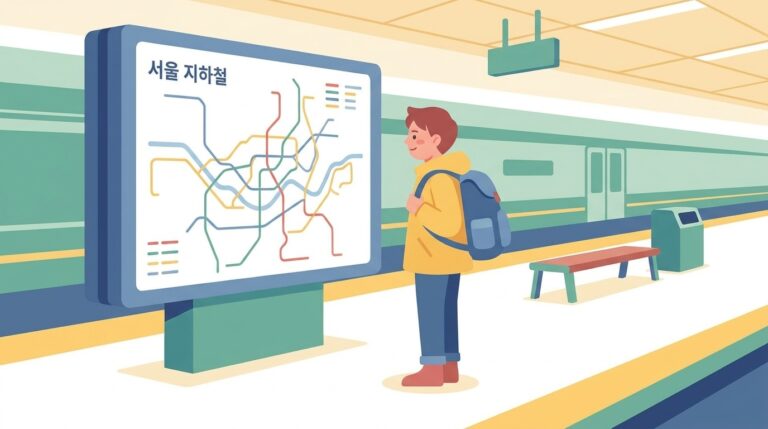
Phase 1: 공감 (Story-Driven Opening)
안녕하세요! 매일한글 에디터입니다.
Picture this: You just spent an exhilarating afternoon shopping and cafe-hopping in Hongdae. With bags in hand and a bubble tea on your mind, you rush down into the bustling underground station. The cheerful bird-chirping melody echoes over the speakers, signaling that the train is pulling in. You swipe your card, bolt onto the platform, and squeeze through the closing doors just in the nick of time. You let out a sigh of relief, look up at the electronic route display, and suddenly freeze: Wait… why is the next stop Hapjeong when you’re supposed to be going toward Sinchon?
Panic sets in. You are on Seoul Subway Line 2—the infamous circular loop—and you are heading in the complete opposite direction. Don’t worry! Even native Seoulites who have lived here for decades hop on the wrong platform during rush hour. Based on coaching hundreds of A1 beginners at Daily Hangul, getting turned around on public transit is the #1 shared fear for Korea travelers. Today, you’ll master the exact survival phrases to ask for help, turn around effortlessly, and ride the Seoul subway like a confident local.
Phase 2: 핵심 표현 3선 심층 분석 (Top 3 Core Expressions)
1. 반대 방향이에요 (Bandae banghyang-ieyo)
- Pronunciation: [Bandae bang-hyang-ee-yo] (Sounds like Bahn-day bahng-hyahng-ee-yo)
- Meaning: “It’s the opposite direction.”
- K-Culture Moment: You hear this when an attentive local spots you staring blankly at a route map inside the station and gently points across the tracks.
- Editor’s Insight: Bandae means “opposite/reverse” and banghyang means “direction.” When combined with the polite ending -ieyo, it forms an indispensable phrase whether someone is warning you or you are confirming your mistake.
- Situation Spectrum: Casual ⚠️ | Semi-formal ✅ | Formal ✅
- 🤔 Think About It: In English, we usually say “You’re going the wrong way!” but Korean focuses on the spatial relationship (“opposite direction”). How does naming the direction feel gentler than calling your action “wrong”?
2. 이쪽이 맞아요? (Ijjogi majayo?)
- Pronunciation: [I-jjo-gi ma-ja-yo?] (Sounds like Ee-jjo-gee mah-jah-yo?)
- Meaning: “Is this side / this way correct?”
- K-Culture Moment: Seen in almost every rom-com drama where the protagonist, completely lost on a busy street, turns to a handsome passerby showing their phone screen.
- Editor’s Insight: Ijjok literally means “this side.” When standing on a dual platform with trains running on both sides, simply pointing your finger toward the track and asking “Ijjogi majayo?” communicates your entire question in four short syllables.
- Situation Spectrum: Casual ⚠️ | Semi-formal ✅ | Formal ✅
- 🤔 Think About It: Korean often points to locations relative to the speaker (ijjok = this side, geujjok = your side, jeojjok = that side over there). Notice how physical proximity is baked into everyday grammar.
3. 어디서 갈아타요? (Eodiseo garatayo?)
- Pronunciation: [Eo-di-seo ga-ra-ta-yo?] (Sounds like Uh-dee-suh gah-rah-tah-yo?)
- Meaning: “Where do I transfer?”
- K-Culture Moment: The classic Seoul station transfer scene where travelers have to navigate the labyrinth of Line 1, Line 4, and the AREX airport railroad.
- Editor’s Insight: Eodi means “where,” and garatada is the compound verb meaning “to change vehicles/transfer.” If you took the wrong train, you will inevitably need to ask where to get off and switch tracks.
- Situation Spectrum: Casual ⚠️ | Semi-formal ✅ | Formal ✅
- 🤔 Think About It: In Korean, the particle -seo marks the specific location where an active physical action (transferring) occurs.
Phase 3: 교과서 한국어 vs 진짜 한국어 (Textbook vs. Real Korean)
Situation 1: Asking if this train goes toward City Hall
- 📖 교과서 한국어 (Textbook): 이 지하철은 시청역으로 갑니까? (I jihacheoreun sicheong-yeogeuro gamnikka?)
- 🗣️ 진짜 한국어 (Real-life): 이거 시청 가요? (Igeo Sicheong gayo?)
- 💡 왜 다를까?: In fast-paced subway stations, native speakers drop formal grammatical markers like destination particles (-euro) and the noun yeok (station). Shortening “Does this train proceed toward City Hall Station?” to “This goes to City Hall?” saves precious seconds before the doors shut.
Situation 2: Realizing you boarded the wrong train
- 📖 교과서 한국어 (Textbook): 저는 반대 방향 열차를 탔습니다. (Jeoneun bandae banghyang yeolchareul tatseumnida.)
- 🗣️ 진짜 한국어 (Real-life): 반대로 탔어요! (Bandaero tasseoyo!)
- 💡 왜 다를까?: Korean conversation naturally omits “I/me” when it is obvious from context. Bandaero tasseoyo (“I rode in reverse!”) is snappy, emotionally authentic, and conveys immediate realization.
Phase 4: K-Culture 딥다이브 & 비언어적 매너 (K-Culture Deep Dive)
4-1. 눈치 (Nunchi) & Subway Etiquette
If you realize you might be on the wrong side of the platform, look around before speaking. Koreans value peace and quiet in transit cars—loud shouting across the train is a major faux pas. When approaching someone on the platform:
1. Give a subtle 15-degree head bow.
2. Hold your phone map at chest level so they can glance without invading personal space.
3. Keep your hand gesture low: point with an open hand rather than a single sharp index finger directly at someone’s face.
4-2. The 15-Minute Magic Rule (K-Transit Hack)
Have you ever tapped through the turnstile, only to realize the platform you need is completely separated by stairs and you have to cross over? In the past, tapping out meant paying a double fare. But thanks to Seoul Metro’s commuter-friendly policy, if you tap out and re-enter the same station on the opposite side within 15 minutes, you get a free transfer! You will see local students and commuters do this briskly without hesitation.
Phase 5: 실전 롤플레이 시나리오 (Real-World Roleplay Scenario)
Setting: Platform of Dongdaemun History & Culture Park Station. You are trying to reach Myeongdong, but the signs show confusing names.
Character: Min-ji (민지), a friendly Korean college student holding an iced Americano and wearing headphones around her neck.
- Turn 1 (You): 저기요, 실례합니다. (Jeogiyo, sillyehamnida.)
- 🎭 Action: Giving a slight bow and making polite eye contact.
- Translation: “Excuse me, pardon me.”
- Turn 2 (Min-ji): 네? 무슨 일이세요? (Ne? Museun iriseyo?)
- 🎭 Action: Pulling her headphones down to listen attentively.
- Translation: “Yes? What’s going on?”
- Turn 3 (You): 명동 가고 싶어요. 이쪽이 맞아요? (Myeongdong gago sipeoyo. Ijjogi majayo?)
- 🎭 Action: Pointing toward the oncoming blue Line 4 train track.
- Translation: “I want to go to Myeongdong. Is this side right?”
- Turn 4 (Min-ji): 아, 명동이요? 여긴 반대 방향이에요! (A, Myeongdong-iyo? Yeogin bandae banghyang-ieyo!)
- 🎭 Action: Shaking her hands lightly with a worried smile.
- Translation: “Ah, Myeongdong? This side is the opposite direction!”
- Turn 5 (You): 헐, 반대 방향이에요? (Heol, bandae banghyang-ieyo?)
- 🎭 Action: Eyes widening in mild shock.
- Translation: “Oh no, the opposite direction?”
- Turn 6 (Min-ji): 네, 계단으로 건너가셔야 해요. 저쪽으로 가세요. (Ne, gyedaneuro geonneogasyeoya haeyo. Jeojjogeuro gaseyo.)
- 🎭 Action: Pointing toward the overhead stairs across the hall.
- Translation: “Yes, you have to cross over via the stairs. Please go that way.”
- Turn 7 (You): 아, 계단이요! 정말 감사합니다. (A, gyedaniyo! Jeongmal gamsahamnida.)
- 🎭 Action: Nodding gratefully with two hands together.
- Translation: “Ah, the stairs! Thank you so much.”
- Turn 8 (Min-ji): 조심해서 가세요! (Josimhaeseo gaseyo!)
- 🎭 Action: Giving a warm parting wave.
- Translation: “Have a safe trip!”
🔀 Interactive Decision Branch
What would you say if the subway doors opened right in front of you while you were still unsure?
* Choice A: “이거 명동 가요?” (Igeo Myeongdong gayo?)
* Outcome (Best!): Quick, polite, and directly checks the destination with passengers boarding next to you. You get a fast “yes” or “no” before doors close.
* Choice B: “도와주세요!” (Dowajuseyo!)
* Outcome (Risk): Literally translates to “Save me / Help me!” This sounds like a life-threatening emergency and will cause unnecessary alarm on the platform.
* Choice C: Just boarding anyway and hoping for the best.
* Outcome (Bad): You’ll end up riding all the way to Nowon or Danggogae on the outskirts of northeastern Seoul!
Phase 6: 10초 감정 섀도잉 드릴 (10-Second Emotion Shadowing Drill)
Practice reading these out loud, mimicking the rhythm pauses (/) and the emotional context tags:
[😰 당황하고 다급하게 / Panicked & Urgent]
저기요! / 이거 / 반대 방향이에요?
(Jeogiyo! / Igeo / bandae banghyang-ieyo?)-
[🤔 갸우뚱하며 확인하듯 / Curious & Checking]
홍대 가려면… / 이쪽이 / 맞아요?
(Hongdae garyeomyeon… / ijjogi / majayo?) -
[🙏 안도하며 고마운 마음으로 / Relieved & Grateful]
알려주셔서 / 정말 / 감사해요!
(Allyeojusyeoseo / jeongmal / gamsahaeyo!)
Phase 7: K-Culture 미니 사전 (Mini Dictionary)
- 갈아타는 곳 (Garataneun got) | Transfer Point / Interchange
- Found on brightly colored ceiling signs overhead. Look for colored circles with line numbers (e.g., green 2, orange 3) pointing toward transfer corridors.
- 출구 (Chulgu) | Exit
- Marked with distinctive black boxes and yellow numbers (e.g., 출구 3). Finding the right exit number in Korean subway stations saves up to 15 minutes of walking above ground.
- 개찰구 (Gaechalgu) | Turnstile / Ticket Barrier
- The sensor gates where you tap your T-money card or smartphone transit pass.
- ~행 (~haeng) | Bound for / Heading toward
- Appears right after station names on electronic signs (e.g., ‘성수행’ = Bound for Seongsu). Crucial for checking whether your train is going clockwise or counterclockwise!
Phase 8: 여행자를 위한 생존 키트 (Traveler’s Survival Kit)
Top 3 Survival Phrases
- 1. 반대로 탔어요. (Bandaero tasseoyo.)
- Pronunciation: [Bahn-dae-ro tah-ssuh-yo]
- Pro Tip: Tell this to the station agent at the information bell if you accidentally entered the wrong gate.
- 2. 어느 쪽이에요? (Eoneu jjogieyo?)
- Pronunciation: [Uh-neu jjoh-gee-eh-yo]
- Pro Tip: Use this when standing under a sign with two opposing directional arrows.
- 3. 다음 역이 어디예요? (Daeum yeogi eodiyeyo?)
- Pronunciation: [Dah-eum yuh-gee uh-dee-yay-yo]
- Pro Tip: Ask this to your seat neighbor if you missed the audio broadcast.
Editor’s Travel Note
Always set up navigation tools before boarding. You can review our detailed 네이버 지도 앱 완벽 활용 가이드 to search bilingual train departures in real time. Also, keep the 카카오지하철 노선도 및 환승 가이드 handy on your home screen—it shows which train car door is closest to the stairs for ultra-fast transfers!
Phase 9: “한 발 더 깊이” (Cultural Reflection)
In many Western transport systems, speaking to an unacquainted person on a subway can feel awkward or invasive. But in South Korea, asking an elder or a fellow commuter for transit directions is seen as completely natural. Korean culture carries a deep undercurrent of Jeong (정)—a warm, collective empathy toward travelers. Even if someone speaks minimal English, they will often physically walk you over to the opposite staircase just to ensure you make it safely onto the correct train.
💬 Your Turn: Have you ever ridden a train in the wrong direction while traveling? How did you solve it? Share your funniest transit story in the comments below!
Phase 10: FAQ & 흔한 실수 (FAQ Schema)
Q: What should I do if I tapped into the wrong turnstile and can’t cross over?
A: Look right beside the turnstiles for the Help Bell (도움 호출 벨 / Doum hochul bel). Press it, and when the station attendant answers through the speaker, say: “반대로 들어왔어요” (Bandaero deureowasseoyo – I entered in the opposite direction). They will instantly buzz the gate open for you free of charge!
Q: How do I know which direction a circular line (like Line 2) is heading?
A: Look for two indicators: 내선순환 (Naeseon-sunhwan / Inner Loop – Clockwise) and 외선순환 (Oeseon-sunhwan / Outer Loop – Counter-clockwise). Electronic signs always display the next three major stations in Korean and English (e.g., “Bound for City Hall & Dongdaemun”).
Q: What is the fastest way to ask someone if this platform goes to Gangnam?
A: Walk up, show your destination on your phone, and say: “강남 가요?” (Gangnam gayo?) with a rising questioning tone. It is instantly understood, friendly, and polite.
🚨 Common Mistakes Warning Board
- ❌ Mistake 1: Saying “틀린 방향이에요” (Teullin banghyang-ieyo).
- Correct Action: Teullida means morally or mathematically “wrong/incorrect.” Instead, always use 반대 방향이에요 (opposite direction).
- ❌ Mistake 2: Dropping the polite ending -yo under stress and just shouting “반대!” (Bandae!).
- Correct Action: Even when rushing, maintain basic politeness by appending -ieyo: 반대 방향이에요!.
- ❌ Mistake 3: Forgetting to tap your transit card when buzzing through the emergency handicap gate.
- Correct Action: If an attendant buzzes you through, listen for their instruction; usually you don’t need to double-tap, which prevents fare calculation errors.
Phase 11: 액션 미션 & 참여 유도 (Action Missions)
- 🥉 Bronze Mission (Self-Practice): Stand in front of your mirror. Point left and say “이쪽이 맞아요?”, then point right and say “반대 방향이에요!” 5 times smoothly.
- 🥈 Silver Mission (Social Share): Open your subway or map app, find your dream destination in Korea (e.g., Busan, Hongdae, Seongsu), and comment below:
[Your Destination] 가고 싶어요! 이쪽이 맞아요?. - 🥇 Gold Mission (Real-world Challenge): On your next trip to Korea (or when helping a tourist in your hometown), confidently use “이쪽이 맞아요?” or “어디서 갈아타요?” without glancing at a dictionary.
🎮 K-Culture Mission: Watch any episode of a subway-heavy K-Drama (like My Liberation Notes or Extraordinary Attorney Woo). Listen closely during station platform scenes to catch the automated voice announcing the incoming destination (~행 열차가 들어오고 있습니다)!
Phase 12: 인터랙티브 퀴즈 챌린지 (Interactive Quiz Challenge)
Test your subway survival skills! Try answering the three questions below before clicking to see the solutions.
- Situational Judgment: You want to head toward Hongdae, but a friendly Korean commuter tells you: “반대 방향이에요!” What should you do?
- A) Board the incoming train immediately.
- B) Stay on the exact same train and wait 30 minutes.
- C) Step away from the platform, find the stairs, and cross over to the opposing track.
- Fill-in-the-Blank: Complete the question meaning “Is this side correct?”:
- “________이 맞아요?” (Hint: “This side” in Korean).
- True or False Culture Quiz: If you accidentally enter the wrong turnstile in the Seoul Metro, you must always pay a new fare to cross to the opposite side. (True / False?)
👉 Click to reveal answers & explanations
- Answer: C. 반대 방향이에요 means you are on the opposite side! Take the stairs to reach the platform running the other way.
- Answer: 이쪽 (Ijjok). Together it forms 이쪽이 맞아요? (Ijjogi majayo?).
- Answer: False. Seoul Metro has a 15-minute free re-entry rule at the same station, and you can also press the Help Bell at the turnstile to cross over for free!







