

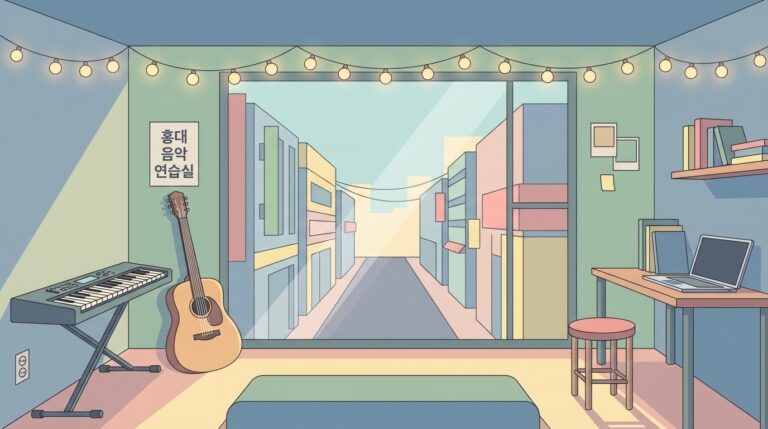
Talk About Playing Music in Korean Like a Hongdae Indie Band Pro
Phase 1: Empathy & Connection
안녕하세요! 매일한글 에디터입니다. (Hello! I’m your Daily Hangul editor.)
Imagine strolling down the electric, art-lined streets of Hongdae on a Friday evening. The air is cool, laughter spills from open cafes, and around a bustling street corner, a young indie musician strums an acoustic guitar, singing a soulful melody that stops a crowd in its tracks. You feel that sudden surge of inspiration—you play the guitar too, or maybe the piano or drums back home! You want to strike up a friendly chat, ask about their setup, or tell a new Korean friend about your musical hobby. But suddenly, your brain freezes. You search your mental dictionary for the word “to play,” find nolda (놀다), and quickly realize using it for instruments sounds bizarre to native speakers! Talking about creative hobbies is one of the quickest, warmest ways to make real connections in Korea. Based on real feedback from dozens of our A2 learners who felt stuck between dry textbook grammar and real-world conversations, this guide will give you the exact conversational tools, cultural cues, and confidence to jam with Korean musicians smoothly.
Phase 2: Core Expressions Deep Dive
1. 기타 칠 줄 알아요? (Gita chil jul arayo?)
- Pronunciation: Gita chil jul arayo? (Pronounce it like: Gee-tah chill jool ah-rah-yo)
- Meaning: Literal: “Do you know the way to strike guitar?” | Real Nuance: “Can you play the guitar? / Do you know how to play the guitar?”
- K-Culture Moment: Seen frequently in K-Dramas like Hospital Playlist (슬기로운 의사생활) when friends gather to start an amateur band and check each other’s hidden talents.
- Editor’s Insight: In Korean, instruments don’t take a generic verb like “play.” Instead, Koreans use action-based verbs! For keyboard and string instruments struck with fingers or picks (guitar, piano, drums), we use 치다 (chida – to hit/strike). The pattern
-(으)ㄹ 줄 알아요is the standard A2 way to ask about someone’s learned skill. - Situation Spectrum: Casual: ✅ (기타 칠 줄 알아?) | Semi-formal: ✅ (기타 칠 줄 알아요?) | Formal: ✅ (기타 치실 줄 아십니까?)
- 🤔 Think About It: Why do you think Korean uses specific tactile verbs (striking, blowing) rather than one catch-all word like “play”? How does this reflect the physical relationship to the craft?
2. 요즘 피아노 배우고 있어요. (Yojeum piano bae-u-go isseoyo.)
- Pronunciation: Yojeum piano bae-u-go isseoyo. (Pronounce it like: Yo-jeum pee-ah-no bay-oo-go ee-ssuh-yo)
- Meaning: Literal: “These days, piano learning am.” | Real Nuance: “I’m currently taking piano lessons / learning the piano these days.”
- K-Culture Moment: Breaking the ice over an iced Americano at a cozy hobby academy (취미 학원) in Seoul.
- Editor’s Insight: Koreans value self-development (자기계발, Jagigyebal). Saying you are actively learning an instrument (
-고 있어요= present progressive) signals dedication and instantly sparks positive follow-up questions from locals! - Situation Spectrum: Casual: ✅ (요즘 피아노 배우고 있어) | Semi-formal: ✅ (요즘 피아노 배우고 있어요) | Formal: ⚠️ (요즘 피아노를 배우고 있습니다)
- 🤔 Think About It: In many Western countries, hobbies are often seen purely as leisure. In Korea, actively taking lessons as an adult shows self-care and passion. How are adult hobbies viewed in your hometown?
3. 아직 서툴러요, 취미로만 해요. (Ajik seotulleoyo, chwimiro-man haeyo.)
- Pronunciation: Ajik seotulleoyo, chwimiro-man haeyo. (Pronounce it like: Ah-jeek suh-tool-luh-yo, chwee-mee-ro-mahn hey-yo)
- Meaning: Literal: “Still clumsy, hobby-only do.” | Real Nuance: “I’m still a beginner, I just do it for fun!”
- K-Culture Moment: After playing a short riff at a rehearsal studio, responding politely when someone compliments your playing.
- Editor’s Insight: Humility (겸손, Gyeomson) is the golden key in Korean social interactions. Even if you can shred an electric guitar like a rockstar, lowering yourself slightly with “서툴러요” (I am clumsy/unskilled) makes you look gracious and likeable.
- Situation Spectrum: Casual: ✅ (아직 서툴러, 취미로만 해) | Semi-formal: ✅ (아직 서툴러요, 취미로만 해요) | Formal: ✅ (아직 서툽니다, 취미로만 하고 있습니다)
- 🤔 Think About It: When complimented in your home language, is it standard to accept it directly with “Thank you,” or do you downplay it as Koreans do?
Phase 3: Textbook vs Real Korean
Situation 1: Asking What Instruments Someone Can Play
- 📖 교과서 한국어: 어떤 악기를 연주하십니까? (Eotteon aggireul yeonjuhasimnikka?)
- 🗣️ 진짜 한국어: 다룰 줄 아는 악기 있어요? (Darul jul aneun akgi isseoyo?)
- 💡 왜 다를까?: The verb yeonjuhada (연주하다) sounds like a formal stage recital in an orchestral concert hall. In everyday friendly chats, Koreans use the verb daruda (다루다 – to handle/manage) to ask if you can play any instruments.
Situation 2: Praising Someone’s Playing in Real Time
- 📖 교과서 한국어: 당신의 연주는 참으로 훌륭합니다. (Dangsin-ui yeonjuneun chameuro hullyunghamnida.)
- 🗣️ 진짜 한국어: 와, 진짜 잘 치시네요! (Wa, jinjja jal chisineyo!)
- 💡 왜 다를까?: Textbook sentences often awkwardly insert “당신” (you), which can sound cold or confrontational in spoken Korean. Real natives simply use an emotional exclamation (와!) paired with the direct honorific verb (잘 치시네요).
Phase 4: K-Culture Deep Dive & Non-Verbal Manners
4-1. 눈치 (Nunchi) & Practice Room Etiquette
If you find yourself invited to a Korean rehearsal studio (합주실, Habjushil):
* Respect the Gear: Never touch another musician’s guitar or keyboard without asking first: “한번 쳐봐도 돼요?” (Hanbeon chyeobwado dwaeyo? – May I try playing it?).
* The Two-Hand Hand-off: When passing a guitar pick, a cable, or sheet music, always use both hands or support your right forearm with your left hand.
* Active Listening: When a bandmate tests out a riff, give an approving nod and say “오, 좋은데요!” (Oh, that sounds great!). Silence can be interpreted as disapproval.
4-2. The Boom of K-Bands and Adult Music Academies
Korean indie music is having a global renaissance thanks to bands like DAY6, Silica Gel, and The Rose. In Seoul, adult hobby music academies like Piano Libre provide chic, cafe-like environments where university students and office workers practice until late at night. Music is no longer just for competitive exams in Korea; it has transformed into a therapeutic sanctuary away from the fast-paced work week.
Phase 5: Real Roleplay Scenario
Setting: A vibrant, soundproof band rehearsal room in Mapo-gu, Seoul. You (Alex) have joined a weekend hobby jam session organized by your friendly Korean acquaintance, Min-woo (민우).
- 민우: 알렉스 씨, 연습실 와줘서 고마워요! (Alex-ssi, yeonseupsil wajwoseo gomawoyo! – “Thanks for coming to the practice room, Alex!”)
🎭 [Unzips his guitar case with a welcoming smile] - Alex: 초대해 줘서 감사해요. 다들 멋있어요! (Chodaehae jwoseo gamsahaeyo. Dadeul meosisseoyo! – “Thanks for inviting me. Everyone looks so cool!”)
🎭 [Glances admiringly around at the amplifiers and drum set] - 민우: 혹시 다룰 줄 아는 악기 있어요? (Hoksi darul jul aneun akgi isseoyo? – “By the way, do you know how to play any instruments?”)
🎭 [Tunes his guitar strings gently] - Alex: 네, 저 베이스 조금 칠 줄 알아요. (Ne, jeo be-i-seu jogeum chil jul arayo. – “Yes, I can play the bass a little bit.”)
🎭 [Gestures modestly with his hands] - 민우: 진짜요? 우리 밴드 지금 베이스가 필요한데! (Jinjja-yo? Uri baendeu jigeum be-i-seu-ga piryohande! – “Really? Our band actually needs a bass player right now!”)
🎭 [Eyes widen in pleasant surprise] - Alex: 아직 서툴러요, 취미로만 해요. (Ajik seotulleoyo, chwimiro-man haeyo. – “I’m still clumsy, I only play for fun.”)
🎭 [Waves his hands slightly with a shy chuckle] - 민우: 괜찮아요! 우리 이 곡 쉬우니까 같이 맞춰볼래요? (Gwaenchanayo! Uri i gok swiunikka gachi matchwobollaeyo? – “No problem! This song is easy, want to jam together?”)
🎭 [Points invitingly toward the Fender bass in the corner] - Alex: 좋아요, 천천히 해볼게요! (Joh-ayo, cheoncheonhi haebolgeyo! – “Sounds awesome, I’ll give it a try slowly!”)
🎭 [Picks up the instrument strap and nods ready to learn]
🔀 Interactive Choice Point
How should Alex reply to Min-woo’s invitation to jam?
* Option A: “저 진짜 프로처럼 잘 쳐요, 다 비켜보세요!” (I play like a pro, step aside!)
Feedback (Bad): While confident, this comes off as boastful and self-centered in a collaborative Korean rehearsal space.
* Option B: “부족하지만 열심히 맞춰볼게요!” (I have a lot to learn, but I’ll do my best to match with you!)
Feedback (Best): Perfect! It balances modest charm with enthusiasm and teamwork.
* Option C: “틀리면 부끄러우니까 그냥 구경만 할게요.” (I’ll be embarrassed if I make mistakes, so I’ll just watch.)
Feedback (Risk): Polite, but too passive. It closes the door to bonding through music.
Phase 6: 10-Second Emotion Shadowing Drill
Read these aloud while mirroring the emotion in the brackets. The slash (/) marks a natural breath pause.
[😊 Exciting & Inquiring]기타 / 칠 줄 알아요? (Gita / chil jul arayo?)[🌿 Calm & Friendly]요즘 / 피아노 / 배우고 있어요. (Yojeum / piano / bae-u-go isseoyo.)[🥺 Shy & Humble]아직 / 서툴러요, / 취미로만 / 해요. (Ajik / seotulleoyo, / chwimiro-man / haeyo.)[🔥 Passionate & Ready]같이 / 한번 / 맞춰볼까요? (Gachi / hanbeon / matchwobolkkayo? – “Shall we jam together once?”)
Phase 7: K-Culture Mini Dictionary
- 합주실 (Habjushil) | Band Practice Room / Rehearsal Studio | Soundproof rental spaces equipped with drum kits, guitar/bass amps, and PA systems rented by the hour across university districts.
- 악보 (Akbo) | Sheet Music / Chord Chart | Musicians frequently ask: “악보 볼 줄 알아요?” (Do you know how to read sheet music?).
- 버스킹 (Beoseuking) | Busking / Street Performance | A borrowed English term deeply rooted in the youth culture of Hongdae and Han River parks.
- 세션 (Sesyeon) | Session Musician / Band Member | Often used in hobby forums when recruiting: “베이스 세션 구합니다” (Looking for a bass player session).
Phase 8: Survival Kit for Travelers
Survival Expressions TOP 3
- 기타 피크 하나만 빌릴 수 있을까요? (Gita pikeu hanaman billil su isseulkkayo?)
- Meaning: “Could I borrow one guitar pick?”
- Pro Tip: Studio desks in Korea almost always have an assortment of spare picks for players.
- 드럼 스틱 어디서 사요? (Deureom seutik eodiseo sayo?)
- Meaning: “Where can I buy drumsticks?”
- Pro Tip: Helpful when visiting traditional music hubs like Nakwon Arcade.
- 합주실 1시간 예약하고 싶어요. (Habjushil han-sigan yeyakhago sipeoyo.)
- Meaning: “I’d like to reserve the rehearsal room for 1 hour.”
- Pro Tip: In Korea, band spaces are almost always billed per hour, not per person.
Editor’s Travel Note
- Visit Nakwon Arcade (낙원악기상가): Located near Jongno 3-ga Station, this historic multi-story building is Korea’s instrument paradise, with hundreds of independent shops selling everything from vintage pedals to traditional gayageums.
- Booking Practice Rooms: Finding indie practice spaces is easy when you search with the [Naver Map app download] using the Korean search term “합주실”.
- Slippers Culture: Many private rehearsal spaces require you to swap your outdoor shoes for indoor slippers (실내화) right at the doorway to protect the carpets and gear.
Phase 9: One Step Deeper (Cultural Reflection)
In traditional Korean society, music was rarely an isolated, solo pursuit; it was centered around community festivals like Pungmulnori, where drumming, dancing, and singing unified the village. Today’s modern practice rooms mirror that exact same communal spirit of 조화 (Johwa – harmony). When speaking about musical hobbies in Korea, claiming you are “modest and still learning” isn’t a sign of low self-esteem—it is a warm social gesture that leaves room for others to guide, join, and collaborate with you without intimidation.
💬 Your Turn: What instrument do you play, or what have you always dreamed of playing? Practice introducing your hobby in the comments below using: “저 [Instrument] 칠 줄 알아요!”
Phase 10: FAQ & Common Mistakes
Q: Can I use the verb “놀다” (nolda) to say I “play” an instrument?
A: No, never! “놀다” means to hang out with friends or fool around. If you say “기타 놀아요,” it sounds like you are playing with a toy guitar. Always use specific verbs like “치다” (piano/guitar/drums) or “불다” (flute/sax).
Q: What verb do I use for bowed string instruments like the violin or cello?
A: For bowed instruments, use the verb 켜다 (kyeoda – to saw/draw a bow). For example: “바이올린 켤 줄 알아요” (I know how to play the violin).
Q: How do I ask someone to play a song for me politely?
A: Say “한 곡 연주해 주세요!” (Han gok yeonjuhae juseyo! – “Please play a song for us!”) or to a close friend, “한 곡만 쳐 줘!” (Han gongman chyeo jwo!).
🚨 Common Mistakes Alert!
- Saying “기타를 놀다” ❌
Correction: Always use 기타를 치다 ✅. - Addressing an acquaintance as “당신” (Dangsin) ❌
Correction: Use their name + 씨 (e.g., “민우 씨, 드럼 칠 줄 알아요?”) or omit the pronoun entirely ✅. - Bragging directly about your skill level right away ❌
Correction: Use the cultural buffer “취미로 조금 해요” (I play a bit as a hobby) first ✅.
Phase 11: Action Mission & Engagement
- 🥉 Bronze Mission (Solo): Say aloud in front of a mirror 3 times: “저는 [your instrument] 칠 줄 알아요!”
- 🥈 Silver Mission (Social): Share your favorite Korean song or practice video on social media with the caption: “취미로 악기 연습 중! 🎸” (Practicing my instrument as a hobby!).
- 🥇 Gold Mission (Real-world): Next time you meet a Korean speaker, ask them: “혹시 다룰 줄 아는 악기 있어요?”
- 🎮 K-Culture Mission: Watch a music variety show clip (like Begin Again or Hospital Playlist) and listen for the moments they use the word 합주 (ensemble jam)!
Phase 12: Interactive Quiz Challenge
1. Situational Judgment:
You are at an amateur studio jam. Someone asks you: “기타 잘 치세요?” (Do you play guitar well?). What is the most culturally natural, modest response?
a) 네, 저 프로예요.
b) 아직 서툴러요, 취미로만 해요.
c) 당신은 왜 물어보세요?
2. Fill-in-the-Blank:
“요즘 새로운 취미로 드럼을 [ _____ ] 있어요.” (I am learning drums these days as a new hobby.)
Hint: The verb meaning ‘to learn’ in present continuous tense.
3. True or False:
In Korean, you use the verb 치다 for piano, guitar, and drums. (True / False)
👉 Click here to check the answers & explanations!
- Answer: b) 아직 서툴러요, 취미로만 해요.
Explanation: Responding with modesty while mentioning you do it for fun shows great Korean conversational manners. - Answer: 배우고 (bae-u-go)
Explanation: “배우다” (to learn) + “-고 있어요” (am doing) creates “배우고 있어요” (am learning). - Answer: True!
Explanation: All instruments that are struck with hands, picks, or sticks take the verb 치다.







