

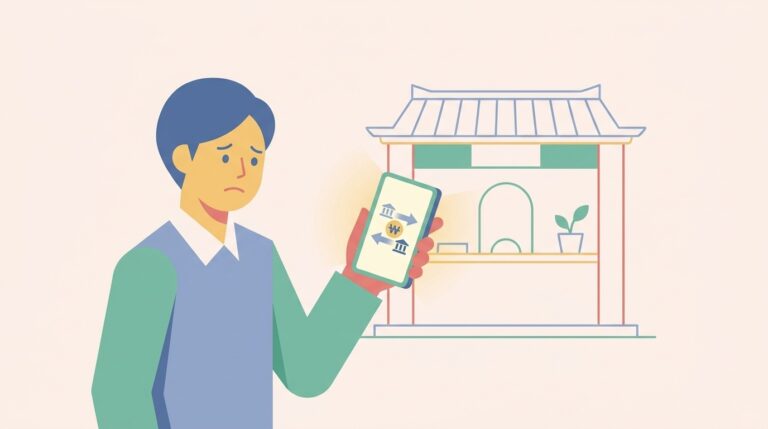
Phase 1: Empathy (스토리 몰입형 오프닝)
안녕하세요! 매일한글 에디터입니다.
Picture this: You are sitting at an aesthetic café in Seongsu-dong, sipping an iced Americano and savoring a freshly baked salt bread. You need to split the bill with your Korean friend or wire money for a concert ticket. You open your banking app, tap your phone screen with lightning speed, and hit “Transfer.” Suddenly, your stomach drops. You misread one single digit in the account number. The screen flashes: Transfer Complete (이체 완료) to a total stranger named “Kim Chul-soo.”
A cold sweat runs down your neck. You panic: Can I get my money back? Is it gone forever? How do I even explain this in Korean when my level is barely beginner?
Take a deep breath! You are definitely not alone. Over 300 international students and travelers have reached out to me with this exact banking nightmare. In South Korea, where mobile banking is faster than a Seoul express train, accidental transfers happen more often than you think. In this friendly guide, tailored specifically for A1 beginners, I will equip you with 3 magic phrases and cultural know-how to walk into any Korean bank, state your problem clearly, and get immediate help without feeling intimidated.
Phase 2: Core Expressions (핵심 표현 3선 심층 분석)
1. 잘못 보냈어요. (Jalmot bonaesseoyo.)
- Pronunciation: [Jal-mot bo-nae-sseo-yo] (Sound analogy: Think of saying “Jahl-mote” like a moat around a castle, followed by “bo-neh-ssuh-yo”)
- Meaning: Literal: “I sent wrongly.” | Real Nuance: “I sent it by mistake / I transferred money to the wrong person.”
- K-Culture Moment: You will see this all the time in K-dramas when a clumsy protagonist mistakenly wires monthly rent money to an ex-partner or a suspicious account and gasps at their screen!
- Editor’s Insight: In Korean, the adverb 잘못 (jalmot) means “wrongly” or “by error,” and 보냈어요 (bonaesseoyo) is the polite past tense of 보내다 (to send). Even if you forget everything else, saying this one sentence while showing your mobile screen will instantly explain your emergency.
- Situation Spectrum: Casual: ⚠️ 잘못 보냈어 (Jalmot bonaesseo) | Semi-formal: ✅ 잘못 보냈어요 (Jalmot bonaesseoyo) | Formal: ✅ 잘못 보냈습니다 (Jalmot bonaesseumnida)
- 🤔 Think About It: In English, we often say “I made a mistake.” In Korean, speakers link the error directly to the action (wrongly sent), shifting the focus from personal fault to the action itself. How does phrasing an error this way feel compared to your native language?
2. 취소할 수 있어요? (Chwisohal su isseoyo?)
- Pronunciation: [Chwi-so-hal su i-sseo-yo] (Sound analogy: “Chwee-soh-hahl soo ee-ssuh-yo”)
- Meaning: Literal: “Can cancel?” | Real Nuance: “Can I cancel this? / Is cancellation possible?”
- K-Culture Moment: A character at a train counter, department store, or bank asking anxiously if a transaction can still be undone.
- Editor’s Insight: The grammar pattern -(으)ㄹ 수 있어요? is the gold standard for asking “Can I…?” or “Is it possible to…?” in Korean. Pair it with 취소 (chwiso), which means cancellation, to ask for immediate reversal.
- Situation Spectrum: Casual: ⚠️ 취소할 수 있어? (Chwisohal su isseo?) | Semi-formal: ✅ 취소할 수 있어요? (Chwisohal su isseoyo?) | Formal: ✅ 취소 가능합니까? (Chwiso ganeunghamnikka?)
- 🤔 Think About It: Notice that Koreans rarely include the pronoun “I” (제가). Leaving out “I” sounds softer, less self-centered, and much more natural in everyday Korean service counters!
3. 도와주세요. (Dowajuseyo.)
- Pronunciation: [Do-wa-ju-se-yo] (Sound analogy: “Doh-wah-joo-seh-yo”)
- Meaning: Literal: “Give help.” | Real Nuance: “Please help me out.”
- K-Culture Moment: The quintessential cry for help heard in emotional K-drama scenes whenever someone is lost or facing a crisis.
- Editor’s Insight: While it sounds dramatic in movies, in a bank setting with a calm, polite tone, 도와주세요 (Dowajuseyo) shows humility and signals to the teller that you are a foreigner in urgent need of their guidance.
- Situation Spectrum: Casual: 🚫 도와줘 (Dowajwo) | Semi-formal: ✅ 도와주세요 (Dowajuseyo) | Formal: ✅ 도와주시겠습니까? (Dowajusigetseumnikka?)
- 🤔 Think About It: Korean culture places high value on mutual assistance (Jeong and community care). Expressing your vulnerability politely almost always triggers a protective, helpful response from bank staff.
Phase 3: Textbook Korean vs Real Korean (교과서 한국어 vs 진짜 한국어)
Situation 1: Explaining you entered the wrong account number
- 📖 교과서 한국어: 제가 계좌번호를 오기입하여 타인에게 송금하였습니다. (Je-ga gye-jwa-beon-ho-reul o-gi-ip-ha-yeo ta-in-e-ge song-geum-ha-yeoss-seum-ni-da.)
- 🗣️ 진짜 한국어: 계좌번호를 잘못 입력했어요. (Gyejwabeonhoreul jalmot imnyeokhaesseoyo.)
- 💡 왜 다를까? Textbook Korean teaches Sino-Korean legal terms like 오기입 (mis-entry) and 송금 (remittance). Real locals use everyday conversational verbs like 잘못 입력했어요 (entered wrongly), which is vastly easier for beginners to pronounce!
Situation 2: Asking if you can get the money back
- 📖 교과서 한국어: 오송금된 금원의 반환 처리를 요청합니다. (O-song-geum-doen geum-won-ui ban-hwan cheo-ri-reul yo-cheong-ham-ni-da.)
- 🗣️ 진짜 한국어: 돈을 돌려받을 수 있을까요? (Doneul dollyeobadeul su isseulkkayo?)
- 💡 왜 다를까? Bureaucratic phrases like 반환 처리 (return processing) belong in legal documents. Everyday Koreans talk about money directly as 돈 (don) and use the warm compound verb 돌려받다 (to receive back).
Phase 4: K-Culture Deep Dive & Non-Verbal Manners (K-Culture 딥다이브)
4-1. 눈치 (Nunchi) & Gestures
When you enter a bank in distress, your body language speaks before your words do:
* Two-Hand Phone Rule: When showing your mobile banking transfer history to a bank teller, always hold your phone with both hands or support your right forearm with your left hand. In Korea, presenting items with one hand can appear careless or dismissive.
* The Humble Micro-Bow (목례 – Mongnye): Lower your head slightly while saying “저기요… 잘못 보냈어요” (Jeogiyo… jalmot bonaesseoyo). This non-verbal gesture shows you are not angry at the bank, but rather asking for their compassionate assistance.
4-2. Cultural Code: The Double-Edged Sword of “Ppalli-Ppalli”
South Korea is proud of its ultra-fast 빨리빨리 (Ppalli-ppalli – hurry, hurry) lifestyle. Because of this, Korean financial networks allow instant peer-to-peer transfers 24/7/365 via apps like Toss or KakaoPay. But speed creates slips! Accidental transfers are so common that the South Korean government and the Korea Deposit Insurance Corporation (KDIC) created an official program called 착오송금 반환지원제도 (Mistaken Remittance Return Support System). You are dealing with an everyday phenomenon, so never feel embarrassed!
Phase 5: Real-Life Roleplay Scenario (실전 롤플레이 시나리오)
Setting: Inside a KB Kookmin Bank branch near Sinchon Station. The counter is quiet, and Teller Minho sits behind the glass divider with a friendly smile.
- Minho (Teller): 안녕하세요! 어떤 일로 오셨어요? (Annyeonghaseyo! Eotteon illo osyeosseoyo? – Hello! What brings you in today? 🎭 Smiling warmly and clasping hands on the desk)
- You (Learner): 저… 돈을 잘못 보냈어요. (Jeo… doneul jalmot bonaesseoyo. – Um… I sent money by mistake. 🎭 Holding phone forward with both hands, looking flustered)
- Minho: 아이쿠, 정말 당황하셨겠어요. 언제 보내셨어요? (Aiku, jeongmal danghwanghasyeotgesseoyo. Eonje bonaesyeosseoyo? – Oh dear, you must be so shocked! When did you send it? 🎭 Adjusting his glasses and looking at the screen)
- You: 10분 전에 보냈어요. 취소할 수 있어요? (Sip-bun jeone bonaesseoyo. Chwisohal su isseoyo? – I sent it 10 minutes ago. Can I cancel it? 🎭 Pressing palms together earnestly)
- Minho: 계좌 이체는 바로 입금돼서 즉시 취소는 어려워요. (Gyejwa icheneun baro ipgeumdwaeseo jeuksi chwisoneun eoryeowoyo. – Bank transfers go through instantly, so direct cancellation isn’t possible. 🎭 Speaking gently to reassure you)
- You: 어떡해요? 도와주세요. (Eotteokaeyo? Dowajuseyo. – What should I do? Please help me. 🎭 Bowing head slightly with wide, worried eyes)
- Minho: 걱정 마세요! 상대방 은행에 반환 신청 접수해 드릴게요. (Geokjeong maseyo! Sangdaebang eunhaenge banhwan sincheong jeopsuhae deurilgeyo. – Don’t worry! I will submit a return request to the recipient’s bank. 🎭 Nodding reassuringly and handing over a digital signature pad)
- You: 정말 감사합니다! (Jeongmal gamsahamnida! – Thank you so very much! 🎭 Bowing politely at a 30-degree angle with a sigh of relief)
🔀 Interactive Choice Point
What will you say when the teller tells you instant cancellation is impossible?
- Option A: “돈 내놔요! 빨리요!” (Don naenwayo! Ppalliyo! – Give me my money! Hurry up!)
- Option B: “어떡해요? 도와주세요.” (Eotteokaeyo? Dowajuseyo. – What should I do? Please help me.)
- Option C: “몰라요. 그냥 해주세요.” (Mollayo. Geunyang haejuseyo. – I don’t care. Just do it.)
Feedback:
* Option A is [Bad]: Demanding money aggressively from the teller will create conflict. The bank teller did not take your funds and has to follow legal recovery procedures!
* Option B is [Best!]: Expresses your genuine difficulty and politely asks the teller to intervene. This builds instant rapport and makes the staff member want to go above and beyond for you.
* Option C is [Risk]: Saying “I don’t care, just do it” sounds rude and dismissive, violating standard Korean social etiquette at service counters.
Phase 6: 10-Second Emotion Shadowing Drill (10초 감정 섀도잉 드릴)
Practice reading these aloud! Follow the pause markers (/) and embody the emotion tag in brackets:
[😰 당황스럽고 다급하게 - Flustered & Urgent]
저… / 돈을 / 잘못 보냈어요!
(Jeo… / doneul / jalmot bonaesseoyo!)-
[🥺 간절하고 조심스럽게 - Pleading & Gentle]
취소할 / 수 있어요?
(Chwisohal / su isseoyo?) -
[🙏 진심 어린 공손함 - Heartfelt & Respectful]
제발 / 도와주세요.
(Jebal / dowajuseyo.)
Phase 7: K-Culture Mini Dictionary (핵심 키워드 4개)
- 계좌번호 (Gyejwabeonho) | Noun: Account Number
- The unique series of 11 to 14 numbers assigned to a Korean bank account. You will always be asked: “계좌번호가 어떻게 되세요?” (What is your account number?).
- 이체 (Iche) | Noun: Bank Transfer / Wire
- The most common button on mobile apps. If you transfer between two accounts in the same bank, it is called 당행이체 (danghaeng-iche); to another bank, it is 타행이체 (tahaeng-iche).
- 착오송금 (Chago-songgeum) | Noun: Accidental Transfer / Mistaken Remittance
- The official financial term for wiring funds to the wrong recipient. You will see this written on official bank claim forms.
- 고객센터 (Gogaek-senteo) | Noun: Customer Support Center
- The customer service hotline. If an error happens late at night when physical bank branches are closed, calling the 고객센터 immediately is your best first move.
Phase 8: Survival Kit for Travelers (여행자를 위한 생존 키트)
Survival Expressions TOP 3
- 계좌번호 확인해 주세요. (Gyejwabeonho hwaginhae juseyo. – Please check the account number.)
- Pro Tip: Use this when paying at a flea market or pop-up store to double-check before pressing send.
- 이체 확인증 주세요. (Iche hwaginjeung juseyo. – Please give me the transfer confirmation receipt.)
- Pro Tip: Keep this screenshot or paper slip as legal evidence of where your money was sent.
- 한국어가 서툴러요. (Hangugeoga seotulleoyo. – My Korean is clumsy / not fluent.)
- Pro Tip: Saying this first lowers expectations and encourages the teller to use simple words or translation apps.
Editor’s Travel Note
- App Tip: For international travelers and residents, using the KakaoBank official mobile app or checking the Toss mobile banking guide provides clear English transaction receipts.
- Night Emergencies: If you transfer money mistakenly after 4:00 PM (when branches close), do not wait until morning! Look up your bank’s telephone customer center immediately. Automated English hotlines are available for major banks like Shinhan, Hana, and KB Kookmin.
Phase 9: One Step Deeper (한 발 더 깊이)
Why can’t Korean banks just reverse the transfer immediately? South Korea’s banking law strongly protects property ownership: once money lands in someone’s account, it legally belongs to that account holder until they agree to return it. Banks are not allowed to unilaterally pull funds back out. However, under Korean criminal law, keeping money sent to you by mistake constitutes embezzlement (횡령죄 – Hoengnyeongjoe)! This legal tension highlights Korea’s deep balance between rock-solid individual rights and strong community responsibility.
💬 Your Turn: Have you ever mistakenly sent money via Venmo, PayPal, or Zelle to a stranger? How did your home country handle it? Share your story in the comments below!
Phase 10: FAQ & Common Mistakes (FAQ & 오해 방지)
Q: Can a Korean bank teller just click a button to reverse my wrong transfer immediately?
A: No. Korean regulations prohibit banks from forcibly pulling money from the recipient’s balance. The teller must contact the recipient’s bank, who will then call the person to request voluntary return authorization.
Q: What should I do if the person who received my money refuses to send it back?
A: Don’t panic. You can apply for the government-backed Mistaken Remittance Return Support System through the Korea Deposit Insurance Corporation (KDIC). They have legal authority to retrieve the funds through court orders.
Q: I cannot speak any Korean on the phone. How do I report this?
A: Visit a physical branch with your passport, Alien Registration Card (if you have one), and phone. You can also dial 1345 (the Korea Immigration Contact Center), which provides free three-way phone interpretation while you talk with your bank!
🚨 Common Mistakes Warning (흔한 실수 TOP 3)
- Mistake: Panicking and screaming in English at the bank security guard.
- Correct Action: Walk past security to the counter ticketing machine, press 일반창구 (General Counter), sit down, and show your phone while saying: “잘못 보냈어요.” (Jalmot bonaesseoyo).
- Mistake: Waiting a week hoping the stranger will send it back on their own.
- Correct Action: Report it within hours! If the stranger withdraws the cash or their account gets frozen for debt, recovery takes much longer.
- Mistake: Deleting the transfer record or closing your banking app.
- Correct Action: Take an immediate screenshot of the transaction details (transaction ID, time, recipient name, and account number).
Phase 11: Action Missions (액션 미션 & 참여 유도)
- 🥉 Bronze Mission (Solo Practice): Stand before a mirror, make a worried face, and say: “저… 잘못 보냈어요. 도와주세요!” out loud 3 times.
- 🥈 Silver Mission (Social Share): Write down 잘못 보냈어요 (I sent it by mistake) on a sticky note, stick it on your study desk, and share your study setup on Instagram tagging @DailyHangul!
- 🥇 Gold Mission (Real Life Application): Open your banking app or receipt and locate the two key words: 계좌번호 (Account number) and 이체 (Transfer).
- 🎮 K-Culture Mission: Watch any modern K-drama episode and listen closely for the phrase 도와주세요! Notice the actor’s facial expression and hand position!
Phase 12: Interactive Quiz Challenge (인터랙티브 퀴즈 챌린지)
Test your knowledge before you go!
- Situational Judgment: You typed the wrong digit and wired 50,000 KRW to the wrong account. What is the most polite and natural A1 sentence to say to the teller?
- (A) 돈 주세요. (Don juseyo.)
- (B) 잘못 보냈어요. 취소할 수 있어요? (Jalmot bonaesseoyo. Chwisohal su isseoyo?)
- (C) 취소해라. (Chwisohaera.)
- Fill in the Blank: Complete the sentence meaning “I sent money by mistake.”
- 돈을 _______ 보냈어요. (Hint: Starts with ‘잘’)
- True or False: In Korea, if you mistakenly transfer money, the bank has the legal right to instantly take the money back from the recipient’s account without asking them.
- [ True / False ]
👉 Click here to reveal answers & explanations!
- Answer: (B)
- Explanation: (B) is polite, natural, and accurately communicates both the problem and your question. (A) sounds like a robbery (“Give me money”), and (C) is rude impolite speech.
- Answer: 잘못 (jalmot)
- Explanation: 잘못 means “wrongly / by mistake”. Together with 보냈어요, it means “sent by mistake”.
- Answer: False
- Explanation: Korean banks cannot seize funds without the recipient’s consent due to personal asset protection laws. The recipient must confirm the return or legal procedures must be filed.
- Explanation: Korean banks cannot seize funds without the recipient’s consent due to personal asset protection laws. The recipient must confirm the return or legal procedures must be filed.







