

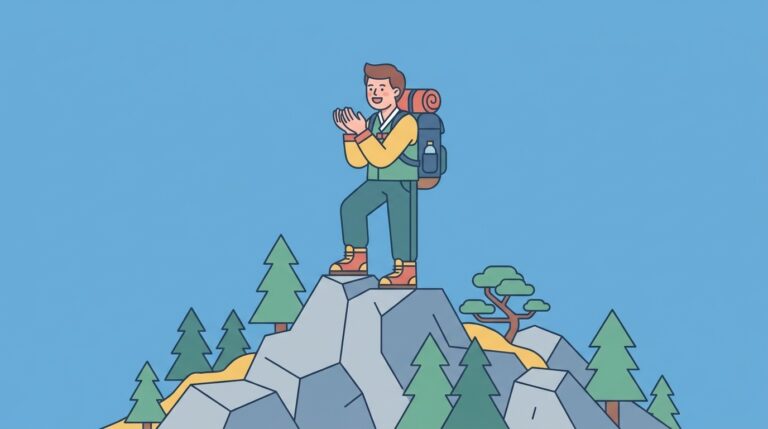
The Mountaintop Secret: How to Shout Yaho and Celebrate Like a True Korean Hiker
Phase 1: Empathy (Story-Immersive Opening)
안녕하세요! 매일한글 에디터입니다. (Hello! This is your Daily Hangul editor.)
Picture this: You have just spent two grueling hours climbing the granite staircases of Bukhansan or Namsan on a crisp Sunday morning. Your calves are burning, your heart is pounding, but suddenly, the trees clear. Beneath you, the entire skyline of Seoul opens up like an endless sea of gleaming towers and winding rivers.
You remember every iconic K-drama and variety show you have ever watched. The main characters stand proudly on the peak, cup their hands around their mouth, and scream into the clouds: “야호! (Yaho!)”
You take a deep breath, ready to unleash your own shout. But then… you freeze. You look around. A group of stylishly dressed Korean aunties (ahjummas) in vibrant neon windbreakers are quietly unpacking cherry tomatoes. A hiking club is calmly taking photos. An awkward panic sets in: Wait, do real people actually shout ‘Yaho’ in real life? Will everyone stare at me? Is it rude? What am I supposed to say instead?
Take a deep breath and relax! Hiking—or 등산 (deungsan)—is practically Korea’s national pastime. Over 70% of the Korean peninsula is mountainous, and reaching a summit is one of the most rewarding cultural experiences you can have in the country.
Knowing how to celebrate at the peak, what to shout, and how to read the mountain room (nunchi) will transform you from a confused tourist into a welcomed friend on the trail. Based on real questions from our Daily Hangul beginner community, here is your friendly, battle-tested guide to mastering Korea’s mountaintop magic!
Phase 2: Core Expressions (핵심 표현 3선)
1. 야호! (Yaho!)
- Pronunciation: [Ya-ho!] (Think of saying “Yah!” like “Yacht”, followed by a cheerful “Hoh!” like Santa’s laugh, but light and breezy.)
- Meaning: Literal: Mountain yell / holler | Actual Nuance: “I conquered the mountain! Goodbye stress, hello world!”
- K-Culture Moment: You will see this in classic Korean entertainment—from 2 Days & 1 Night (1박 2일) to coming-of-age dramas—whenever characters reach a high vantage point to shout out their new year resolutions or romantic confessions.
- Editor’s Insight: The shout “야호” historically entered Korea through early 20th-century alpine climbing traditions (derived from the European alpine call “Joo-hoo”). While older generations shouted it with all their lung power, modern hikers use it with a bit more restraint to respect nature.
- Situation Spectrum: Casual: ✅ | Semi-formal: ⚠️ | Formal: 🚫
- 🤔 Think About It: When people in your home country reach the top of a scenic overlook, do they shout, whistle, or maintain complete silence? How does the sound reflect how your culture interacts with nature?
2. 정상에 도착했어요! (Jeongsange dochakhaesseoyo!)
- Pronunciation: [Jeong-sang-e do-chak-haet-seo-yo!] (Sounds like jung-sahng-eh doh-chahk-haet-saw-yoh)
- Meaning: Literal: “Arrived at the summit!” | Actual Nuance: “We made it to the top! All that sweating was worth it!”
- K-Culture Moment: Whenever K-pop idols film their outdoor vlogs hiking Inwangsan, they point the camera at their flushed, smiling faces and cheer this exact phrase.
- Editor’s Insight: This sentence uses the polite past tense -았/었어요. It is friendly, modest, and universally safe to say to any fellow hiker catching their breath beside you.
- Situation Spectrum: Casual: ✅ | Semi-formal: ✅ | Formal: ✅
- 🤔 Think About It: Notice how Korean uses the particle -에 (e) to mark the summit as a destination of arrival. How does your language express completing a physical challenge?
3. 경치가 진짜 좋아요! (Gyeongchiga jinjja joayo!)
- Pronunciation: [Gyeong-chi-ga jin-jja jo-a-yo!] (Sounds like gyung-chee-gah jeen-jjah joh-ah-yoh)
- Meaning: Literal: “The scenery is really good!” | Actual Nuance: “The view is breathtaking! I can’t believe my eyes.”
- K-Culture Moment: Hikers sitting on flat rocks, cracking open thermoses of iced barley tea, always say this while gazing out across the granite peaks.
- Editor’s Insight: While textbooks often teach 아주 (aju) or 매우 (maeu) for “very,” native speakers in casual settings almost always use 진짜 (jinjja – truly/really). It gives your reaction genuine warmth!
- Situation Spectrum: Casual: ✅ | Semi-formal: ✅ | Formal: ✅
- 🤔 Think About It: Complimenting the shared environment (경치) is the ultimate icebreaker in Korean culture. It invites the other person to agree without putting pressure on them.
Phase 3: Textbook Korean vs. Real Korean (교과서 한국어 vs. 진짜 한국어)
Situation 1: Greeting another hiker struggling uphill
- 📖 교과서 한국어: “안녕하십니까? 힘드십니까?” (Annyeonghasimnikka? Himdeusimnikka? – “How do you do? Are you experiencing difficulty?”)
- 🗣️ 진짜 한국어: “힘내세요! 다 왔어요!” (Himnaeseyo! Da wasseoyo! – “Cheer up! You’re almost there!”)
- 💡 왜 다를까? (Why is it different?): Trail etiquette in Korea is all about warmth and solidarity. You don’t use stiff business Korean on a dirt path! Note: Be careful with “다 왔어요”—in Korean hiking culture, veteran hikers often say “you’re almost there” when you still have 20 steep minutes left!
Situation 2: Asking someone to take your photo at the summit marker
- 📖 교과서 한국어: “저의 사진을 찍어 주실 수 있습니까?” (Jeoui sajineul jjigeo jusil su itseumnikka? – “Can you take a photograph of me?”)
- 🗣️ 진짜 한국어: “사진 한 장만 찍어 주시겠어요?” (Sajin han jangman jjigeo jusigesseoyo? – “Could you please take just one photo for me?”)
- 💡 왜 다를까? (Why is it different?): Saying “저의 사진” sounds like a translated written document. Adding “한 장만 (just one photo)” adds polite consideration (배려 – baeryeo), making the listener much happier to take three or four great shots for you!
Phase 4: K-Culture Deep Dive & Non-Verbal Manners
4-1. 눈치 (Nunchi) & Mountain Gestures
- The Cup-Hands Pose: If you want to yell or pose for a photo, cup both hands beside your cheeks (palms forward). It is the universal sign of mountain joy in Korea!
- The Modern Sound Rule: Here is an insider secret: In recent years, Korea’s National Park Service has promoted a quiet mountain campaign. Loud, piercing screams can stress nesting birds and wildlife. Modern nunchi means you either shout a playful, medium-volume “야호~!” with your friends, or playfully mimic the mouth shape silently for an epic photo.
- The Summit Stone Queue (정상석 줄서기): Korean peaks have large engraved stones (정상석). There is almost always an orderly single-file line to take pictures. Never jump the queue, and offer to snap a photo for the person ahead of you—they will gladly return the favor!
4-2. Cultural Code: The Ahjussi & Ahjumma Hiking Universe
In Korea, hiking isn’t a casual stroll; it is a full subculture. You will see hikers equipped head-to-toe in premium technical gear (등산복 – deungsanbok), complete with trekking poles and UV-shielding visors.
Most importantly, every authentic Korean hike follows a golden rule: the hike never truly ends at the peak. It ends at the foothills (하산 – hasan), seated at an open-air wooden table sharing sizzling seafood scallion pancakes (해물파전 – haemul pajeon) and a bowl of chilled rice wine (막걸리 – makgeolli). That is where the real bonding happens!
Phase 5: Real-Life Roleplay Scenario (실전 롤플레이)
Setting: The rocky summit of Baegundae on Bukhansan. A gentle breeze is blowing. You meet Min-soo (민수 아저씨), an energetic local hiker in colorful gear.
- Alex (You): “드디어 정상에 도착했어요!”
(Deudieo jeongsange dochakhaesseoyo! / “We finally arrived at the summit!”)
🎭 [Wipes sweat from forehead, panting with a proud smile] -
Min-soo (NPC): “수고했어요! 첫 등산인데 정말 잘 타네요.”
(Sugohaesseoyo! Cheot deungsaninde jeongmal jal taneyo. / “Great effort! It’s your first time, but you climb really well.”)
🎭 [Pats Alex on the shoulder and offers a cold bottled water] -
Alex (You): “감사합니다! 여기서 야호 외쳐도 돼요?”
(Gamsahamnida! Yeogiseo yaho oechyeodo dwaeyo? / “Thank you! May I shout ‘Yaho’ here?”)
🎭 [Looks around excitedly, bringing hands toward mouth] -
Min-soo (NPC): “하하, 작게 외치면 괜찮아요. 새들이 놀라지 않게요.”
(Haha, jakge oechimyeon gwaenchannayo. Saedeuri nollaji ankkeyo. / “Haha, it’s fine if you shout it softly so the birds don’t get scared.”)
🎭 [Chuckles warmly and demonstrates a gentle cheer] -
Alex (You): “야호~! 경치가 진짜 좋아요!”
(Yaho~! Gyeongchiga jinjja joayo! / “Yaho~! The view is truly amazing!”)
🎭 [Cups hands lightly, shouting toward the horizon with a beaming grin] -
Min-soo (NPC): “그렇죠? 서울이 한눈에 다 보이죠?”
(Geureotjyo? Seouri hannune da boijyo? / “Right? You can see all of Seoul in a single glance, can’t you?”)
🎭 [Points toward the sparkling Han River in the distance] -
Alex (You): “네, 올라오길 정말 잘했어요!”
(Ne, ollaogil jeongmal jalhaesseoyo! / “Yes, I am so glad I came up!”)
🎭 [Nods enthusiastically, soaking in the panoramic view] -
Min-soo (NPC): “자, 정상석 앞에서 사진 한 장 찍어 줄게요!”
(Ja, jeongsangseok apeseo sajin han jang jjigeo julkkeyo! / “Now, let me take a photo of you in front of the summit stone!”)
🎭 [Pulls out his smartphone and gestures toward the stone marker]
🔀 Interactive Choice Point
Min-soo turns to you with a wink: “내려가서 파전이랑 막걸리 한잔 어때요? (How about a slice of pajeon and a cup of makgeolli once we head down?)”
How do you respond?
- Option A: “좋아요! 제가 막걸리 살게요!” (Joayo! Jega makgeolli salkeyo! – “Sounds great! I’ll buy the makgeolli!”)
- Option B: “싫어요. 저는 지금 집으로 바로 갈래요.” (Sireoyo. Jeoneun jigeum jibeuro baro gallaeyo. – “I hate that. I want to go straight home right now.”)
- Option C: “막걸리만 마시고 파전은 안 먹을래요.” (Makgeolliman masigo pajeoneun an meogeullaeyo. – “I’ll only drink makgeolli and won’t eat any pajeon.”)
Feedback:
* Option A (Best!): 🌟 100 points! You embraced the peak-to-table Korean hiking tradition. Offering to pay for the drinks shows incredible warmth and respect.
* Option B (Bad): 🚫 Ouch! Using “싫어요 (I hate it / No)” is blunt and creates instant awkwardness. If you are tired, soften it: “가고 싶지만 오늘은 조금 피곤해서 다음에 꼭 갈게요! (I’d love to, but I’m a bit tired today, so definitely next time!)”
* Option C (Risk): ⚠️ Makgeolli and pajeon are a sacred culinary duo in Korea. Refusing the food might make your hiking companion worry about you drinking on an empty stomach!
Phase 6: 10-Second Emotion Shadowing Drill (감정 섀도잉 드릴)
Practice these lines out loud. Pause at the slashes (/) and match the emotional vibe in brackets:
[😮 숨차지만 뿌듯하게 - Breathless but proud]
“드디어 / 정상에 / 도착했어요!”
(Deudieo / jeongsange / dochakhaesseoyo!)-
[😊 맑고 신나게 - Bright and joyful]
“야호~! / 경치가 / 진짜 좋아요!”
(Yaho~! / Gyeongchiga / jinjja joayo!) -
[🤝 다정하고 힘차게 - Warm and encouraging]
“힘내세요! / 거의 / 다 왔어요!”
(Himnaeseyo! / Geoui / da wasseoyo!)
Phase 7: K-Culture Mini Dictionary (핵심 어휘)
- 정상석 (Jeongsangseok) | Summit Marker Stone | The inscribed granite rock standing at mountain peaks recording its name and altitude. Taking a photo touching this rock is the essential proof-of-climb (인증샷 – injeung-syat).
- 등산복 (Deungsanbok) | Outdoor Hiking Attire | High-performance colorful jackets, pants, and hats. Wearing technical gear is both a safety measure and a symbol of Korean weekend leisure culture.
- 하산 (Hasan) | Descent from the Mountain | Going down the trail. In everyday conversation, friends often say: “하산하고 뭐 먹지? (What are we eating after descending?)”
- 막걸리 (Makgeolli) | Sparkling Rice Wine | A fermented, cloudy, mildly sweet traditional alcohol served cold in shallow metal bowls. The undisputed national drink of Korean hikers.
Phase 8: Survival Kit for Travelers (여행자를 위한 생존 키트)
Top 3 Survival Phrases for the Trail
- “정상까지 얼마나 남았어요?” (Jeongsangkkaji eolmana namasseoyo? / “How much further to the summit?”)
Pro Tip: When an elderly Korean hiker answers “Just 5 minutes!”, prepare yourself mentally for at least another 15 minutes of stairs! - “먼저 가세요.” (Meonjeo gaseyo. / “Please go ahead.”)
Pro Tip: If you are walking slowly on a narrow mountain ridge, step to the side, smile, and say this. It demonstrates elite mountain manners. - “사진 찍어 드릴까요?” (Sajin jjigeo deurilkkayo? / “Would you like me to take a photo for you?”)
Pro Tip: Offer this to couples or groups waiting at the summit stone. You will instantly win their hearts and likely receive some trail snacks in return!
Editor’s Travel Note
- Trail Maps: Standard international apps frequently lose detail on Korean nature trails. Before heading out, complete your Naver Map app download to check accurate trail difficulty and live bus schedules.
- Hydration Secret: Don’t just pack water! Stop by a neighborhood convenience store or local market and pack crisp cucumbers (오이 – oi) and mini cherry tomatoes. Cucumbers contain over 95% water and minerals, making them the classic snack favored by Korean trail masters.
Phase 9: “One Step Deeper” (한 발 더 깊이)
In the densely populated subways of Seoul, personal boundaries are strictly kept. Strangers rarely make eye contact or start idle conversations. However, the exact moment Koreans step onto a dirt mountain trail, an invisible social switch flips.
Total strangers greet you with cheerful nods, share peeled tangerines on resting boulders, and cheer “힘내세요!” with wholehearted warmth. Why? In Korean society, the mountain represents an egalitarian sanctuary. Status, corporate ranks, and formal social barriers dissolve in nature, leaving everyone as equal comrades conquering the slope together.
💬 Your Turn: Have you ever noticed people behaving much warmer in nature compared to busy cities in your own country? What is your favorite way to greet fellow hikers? Share your thoughts in the comments below!
Phase 10: FAQ & Avoiding Misunderstandings (FAQ 스키마)
Q: Is shouting “야호 (Yaho)” strictly illegal on Korean mountains?
A: No, it is not illegal, and nobody will give you a ticket for it. However, the Korea National Park Service actively advises against loud screaming to protect resting wildlife and maintain peace for everyone. A cheerful, moderate shout or a fun photo pose is the recommended modern etiquette!
Q: Can I drink makgeolli at the top of the mountain?
A: No! Since 2018, consuming alcohol on mountain trails and designated summit rocks within national and provincial parks is strictly banned to prevent falls and accidents. Always save your celebratory drinks and savory pancakes for the licensed restaurants at the foot of the mountain.
Q: Why do hikers tell me “다 왔어요 (You’re almost there)” when it’s not true?
A: This is Korea’s beloved “benevolent hiker lie” (등산객의 선의의 거짓말). It is given purely as emotional encouragement so you don’t give up on difficult inclines. Take it with a smile and keep moving forward!
🚨 Common Mistakes Alert (흔한 실수 TOP 3)
- Screaming at the top of your lungs near historical mountain temples: Temple areas are quiet spiritual retreats. Keep your voice low until you are well clear of temple grounds.
- Wearing smooth city sneakers: Korean mountains like Bukhansan and Gwanaksan consist of steep, slippery granite rocks. Always wear shoes with solid rubber traction.
- Ignoring greetings on narrow passages: When brushing shoulders on single-track paths, ignoring someone’s greeting can feel frosty. A simple head nod and a quick “안녕하세요” makes all the difference.
Phase 11: Action Mission & Engagement (액션 미션)
- 🥉 Bronze Mission (Solo Practice): Stand up straight, cup your hands lightly around your cheeks, and practice saying: “경치가 진짜 좋아요! (The view is truly great!)” three times in under 10 seconds.
- 🥈 Silver Mission (Social Media): Post a photo of your local hike or favorite scenic view on Instagram. Add the Korean caption: “정상에 도착했어요! 야호~ (Reached the summit! Yaho~)” and tag @DailyHangul!
- 🥇 Gold Mission (Real Life): On your next hike in Korea (even an easy hill like Namsan), greet three passing hikers with a bright “힘내세요!” and snap a commemorative photo at the summit marker!
- 🎮 K-Culture Mission: Watch an episode of a Korean outdoor variety show or the mountain drama Jirisan, and listen carefully for the moment someone shouts “야호!” or cheers “다 왔어요!”
Phase 12: Interactive Quiz Challenge (퀴즈 챌린지)
Test what you have learned today! Select your answers before revealing the solution below.
1. Situational Judgment:
You have finally reached the top of Cheonggyesan. You see a line of five people standing patiently in front of the summit stone marker. What should you do?
(A) Shout “야호!” at full volume and push your way into the center to get a quick selfie.
(B) Politely wait at the end of the line, and kindly offer to take a photo for the person ahead of you.
(C) Drink a can of beer right on top of the rock to celebrate your victory.
2. Fill-in-the-Blank:
To encourage a tired climber panting up the stairs, you smile and say:
“________! 다 왔어요!” (Hint: “Cheer up! / Hang in there!”)
3. True or False:
In modern Korean hiking etiquette, you should scream “야호” as loudly as possible without checking your surroundings to show your physical strength.
(True / False)
👉 Click here for answers and explanations!
1. Answer: (B)
Explanation: Waiting your turn at the summit stone (정상석) and offering to take photos is top-tier Korean mountain etiquette. Drinking at summits is prohibited by law, and cutting the line will upset the entire hiking community!
2. Answer: 힘내세요 (Himnaeseyo)
Explanation: 힘내세요 combines 힘 (strength) and the polite imperative ending. It is the warmest encouragement on Korean trails.
3. Answer: False
Explanation: Modern outdoor manners prioritize preserving nature and keeping mountain animals undisturbed. A cheerful, medium-volume yell or a smiling pose is the cool, considerate way to do it!







