

안녕하세요! 매일한글 에디터입니다.
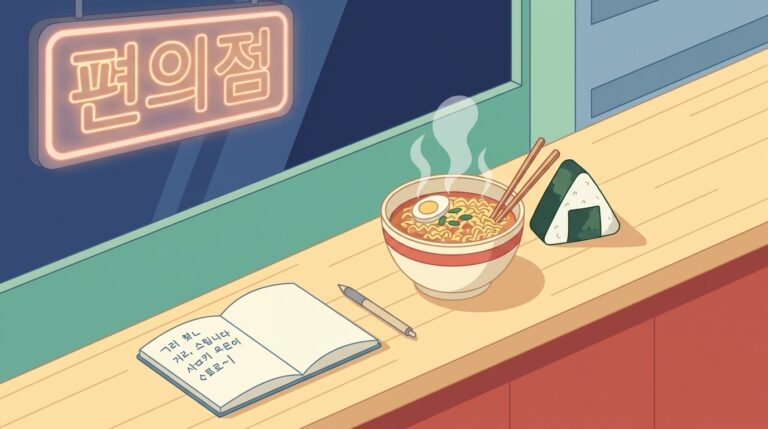
Picture this: It is 1:30 AM in the lively streets of Mapo-gu, Seoul. You have spent the evening singing your lungs out at a noraebang (karaoke) or wrapping up an intense study session. Your stomach lets out an unmistakable rumble. In many countries, your options at this hour are limited to greasy fast-food drive-thrus. But here in South Korea, glowing like an oasis in the midnight neon, sits a 24-hour convenience store—a pyeon-ui-jeom (편의점).
You step through the sliding glass doors, welcomed by a friendly electronic chime. Before you lies an overwhelming wonderland: walls of color-coded instant ramyeon, pyramids of samgak-gimbap (triangular rice balls), savory sausages, dumplings, and pouches of pouch-drinks chilling beside cups of ice. You want to recreate that viral spicy-cheesy feast you saw your favorite K-pop idol make on YouTube, but you freeze. Which ingredients go together? How do you ask your Korean companion if putting string cheese on spicy rice cakes is actually good, without sounding like a robotic language textbook?
Many intermediate Korean learners hit a wall here. You know how to politely say, “이것은 얼마입니까?” (Igeoseun eolmaimnikka? / How much is this?), but you lack the insider culinary vocabulary and colloquial swagger that Koreans actually use when engineering late-night culinary masterpieces. Fret not! Drawing from real feedback from our Daily Hangul learners, this guide is your definitive survival blueprint to navigating Korea’s legendary late-night snack (yasik, 야식) culture and mastering the art of convenience store kkul-johap (꿀조합, honey combinations).
Phase 2: Core Expressions Deep Dive
1. 꿀조합 (Kkul-johap)
- Pronunciation: [Kkul-jo-hap] (Sounds like “Cool-joe-hop” with a tense, snappy kk sound at the start)
- Meaning: Literal: “Honey combination” | Nuanced: An unbeatable, divine food or item pairing discovered through ingenious trial and error.
- K-Culture Moment: Seen constantly on variety shows like Omniscient Interfering View or food Mukbang channels when creators unveil life-changing recipes—like combining fiery Buldak ramen with sweet corn cheese.
- Editor’s Insight: In modern Korean slang, the prefix kkul- (꿀, honey) denotes anything extraordinarily delightful, effortless, or top-tier (e.g., kkultip for pro-tips). When you describe a snack as a kkul-johap, you aren’t merely saying it tastes fine; you are validating it as a tried-and-true gastronomic hack.
- Situation Spectrum: Casual: ✅ | Semi-formal: ⚠️ | Formal: 🚫
- 🤔 Think About It: In English, we often say “a match made in heaven.” Why do you think Korean urban slang associates sweet honey (kkul) with perfection and effortless value?
2. 매콤달콤하다 (Maekom-dalkomhada)
- Pronunciation: [Mae-kom-dal-kom-ha-da] (Think “Meh-comb dahl-comb ha-da”)
- Meaning: Literal: “To be slightly spicy and sweet” | Nuanced: That addictive sweet-and-spicy flavor profile that defines classic Korean comfort foods like tteokbokki and seasoned fried chicken.
- K-Culture Moment: In the drama Let’s Eat (식샤를 합시다), the characters close their eyes and sigh dramatically when taking a bite of street food, praising how the dish is perfectly maekom-dalkom without being overwhelmingly pungent.
- Editor’s Insight: Intermediate Korean rewards sensory specificity. Rather than just saying masiss-eoyo (맛있어요, It’s delicious) or maewoyo (매워요, It’s spicy), using maekom-dalkomhada instantly marks you as someone with a refined palate who understands the harmony of Korean seasoning.
- Situation Spectrum: Casual: ✅ | Semi-formal: ✅ | Formal: ✅
- 🤔 Think About It: Notice the rhythmic reduplication (-kom, -kom). How does your native language create playful, sensorial sounds for food textures and tastes?
3. 국룰 (Gung-nul)
- Pronunciation: [Gung-nul] (Due to nasal assimilation, the k sound in guk morphs into ng when meeting r/n: “Goong-nool”)
- Meaning: Literal: “National law/rule” | Nuanced: The universally accepted, unspoken gold standard or etiquette that everyone agrees upon.
- K-Culture Moment: When friends argue over whether to pour sauce over sweet-and-sour pork (tangsoo-yuk) or dip it, someone inevitably shouts, “찍먹이 국룰이지!” (Jjingmeogi gungnuriji! / Dipping is the undisputed national rule!).
- Editor’s Insight: This internet-born portmanteau (gukga [nation] + rule) has entered mainstream daily speech among Gen Z and Millennials. At convenience stores, adding a slice of processed cheddar cheese to hot ramen broth isn’t just an option—it is practically gung-nul.
- Situation Spectrum: Casual: ✅ | Semi-formal: ⚠️ | Formal: 🚫
- 🤔 Think About It: Calling an informal preference a “national rule” highlights Korea’s strong communal consensus. Does your culture have unspoken food traditions elevated to “law”?
Phase 3: Textbook Korean vs. Real Korean
Situation 1: Asking if two food items go well together
- 📖 교과서 한국어 (Textbook Korean): 이 라면과 삼각김밥을 함께 먹으면 맛이 어울립니까? (I ramyeongwa samgakgimbabeul hamkke meogeumyeon masi eoullimnikka? / If I eat this ramen and triangular gimbap together, do their flavors match?)
- 🗣️ 진짜 한국어 (Real-world B2 Korean): 이거 두 개 같이 먹으면 꿀조합이에요? 아니면 너무 투머치인가요? (Igeo du gae gachi meogeumyeon kkuljohabieyo? Animyeon neomu tumeochiingayo? / Is it an absolute honey-combo if I eat these two together, or is it a bit too much?)
- 💡 왜 다를까? (Why the difference?): Textbooks default to formal interrogative endings and classical verbs like eoulrida (어울리다). Native speakers naturally incorporate ubiquitous slang like kkul-johap and the Konglish loanword too much (tumeochi, 투머치) to sound conversational and breezy.
Situation 2: Asking someone how long to microwave your instant meal
- 📖 교과서 한국어 (Textbook Korean): 전자레인지에 몇 분 동안 음식을 데워야 합니까? (Jeonjareinjie myeot bun dongan eumsigeul dewoya hamnikka? / For how many minutes must I heat the food in the microwave oven?)
- 🗣️ 진짜 한국어 (Real-world B2 Korean): 이거 전자레인지에 얼마나 돌려야 돼요? 1분이면 충분해요? (Igeo jeonjareinjie eolmana dollyeoya dwaeyo? Ilbunimyeon chungbunhaeyo? / How long should I zap this in the microwave? Is one minute enough?)
- 💡 왜 다를까? (Why the difference?): Real Koreans almost never say “데우다” (dewo-da, to warm up) when talking about microwaves; they say “돌리다” (dallida, to spin/run), referencing the turntable rotating inside the microwave.
Phase 4: K-Culture Deep Dive & Non-Verbal Manners
4-1. 눈치 (Nunchi) & The Convenience Store Code
Korean convenience stores are marvels of trust and communal autonomy. Unlike convenience store culture in many Western countries, Korean pyeon-ui-jeom feature full DIY food preparation stations with boiling water dispensers, microwaves, and dining counters. However, using these spaces requires high nunchi (cultural situational awareness):
* The Trash Sorting Ritual: Leaving your half-eaten cup of noodles in the standard trash bin is a major social taboo. Look for the separate bucket marked eumsingmul sseuregi (음식물 쓰레기, food waste) to discard remaining soup, then rinse and toss the paper cup into recycling (jaehwaryong, 재활용).
* The Microwave Queue Dance: During peak midnight hours, a queue forms naturally around the two store microwaves. Keep one eye on the timer; hovering directly over someone’s shoulder is considered invasive, but walking away too far means someone else will slip their cheese-topped dish inside before you can say jamkkanmanyo!
4-2. The “Modisumer” Renaissance
South Korea’s late-night snack craze is spearheaded by Modisumers (a portmanteau of “modify” and “consumer”)—everyday people who invent and share custom culinary hacks. The most legendary example is the “Mark Meal” (Mark Jeongsik, 마크정식), invented by a fan of the K-pop group GOT7: instant spaghetti, spicy tteokbokki, string cheese, and a smoked sausage combined into one decadent tray. Eating late-night snacks in Korea is not simply eating; it is an act of participatory pop culture, bonding friends over savory, carb-heavy innovation after midnight.
Phase 5: Real-World Roleplay Scenario
Setting: It is 2:00 AM at a bustling GS25 overlooking the Han River in Yeouido. You are standing with your Korean university senior, Min-ji (민지), staring intently into the instant food chiller.
- Min-ji: 야, 새벽 2시엔 역시 라면이지. 너 맵찔이야, 아니면 매운 거 잘 먹어?
(Ya, saebyeok dusien yeoksi ramyeoniji. Neo maepjjiriya, animyeon maeun geo jal meogeo?)
🎭 Chuckling playfully while pointing between a mild snack and a fiery Buldak bowl.
“Hey, 2 AM calls for ramen without question. Are you a spice-wimp, or can you handle the heat?” -
You: 저 매운 거 꽤 잘 먹어요! 스트레스 풀리는 매콤달콤한 조합으로 가고 싶어요.
(Jeo maeun geo kkwae jal meogeoyo! Seuteureseu pullineun maekomdalkomhan johabeuro gago sipeoyo.)
🎭 Smiling with confidence and picking up a container of instant tteokbokki.
“I handle spicy food quite well! I want to go for a sweet-and-spicy combo that melts away stress.” -
Min-ji: 오, 자신만만한데? 그럼 불닭볶음면에 치즈랑 삼각김밥 넣는 거 국룰인 거 알지?
(O, jasinmanmanhande? Geureom buldakbokkeummyeone chijeurang samgakgimbap neonneun geo gungnurin geo alji?)
🎭 Nodding approvingly and grabbing a packet of string cheese.
“Oh, confident, are we? Then you know it’s the undisputed national rule to add cheese and triangular gimbap into Buldak stir-fry noodles, right?” -
You: 당연하죠! 삼각김밥은 참치마요로 고르면 완전 꿀조합이겠네요.
(Dang-yeonhajyo! Samgakgimbabeun chamchimayoro goreumyeon wanjeon kkuljohabigenneneyo.)
🎭 Enthusiastically inspecting the triangular gimbap display shelf.
“Naturally! If we pick tuna mayo for the triangular rice ball, it’ll be an absolute honey-combo.” -
Min-ji: 빙고! 센스 있네. 저기 뜨거운 물 먼저 붓고, 치즈는 전자레인지에 마지막에 돌리자.
(Bingo! Senseu inne. Jeogi tteugeoun mul meonjeo bungo, chijeuneun jeonjareinjie majimage dollija.)
🎭 Handing you the noodles and walking toward the hot water dispenser.
“Bingo! You’ve got great intuition. Let’s pour the hot water over there first, and zap the cheese in the microwave at the very end.” -
You: 네, 좋아요. 계산 먼저 하고 바로 조리 시작할게요.
(Ne, joayo. Gyesan meonjeo hago baro jori sijakhalkeyo.)
🎭 Pulling out your card and heading smoothly to the cashier counter.
“Sounds great. I’ll pay first and then get right to cooking.” -
Min-ji: 그래! 내가 테이블 닦아두고 젓가락 챙겨둘게.
(Geurae! Naega teibeul dakkadugo jeotgarak chaenggyeodulke.)
🎭 Grabbing napkins from the dispenser and heading to the counter seat.
“Awesome! I’ll wipe down the table and grab our wooden chopsticks.” -
You: 얼른 먹고 한강 바람 쐬러 가요!
(Eolleun meokgo hangang baram ssoereo gayo!)
🎭 Beaming while receiving the receipt from the cashier.
“Let’s dig in quickly and go catch the Han River night breeze!”
🔀 Interactive Decision Point
Min-ji asks you how you plan to finish the leftover spicy sauce in the bowl once the noodles are eaten. How do you respond?
- Choice A: “국물은 버리고 그냥 음료수로 입가심할래요.” (Gungmureun beorigo geunyang eumryosuro ipgasimhallaeyo. / Let’s dump the soup and just cleanse our palates with a beverage.)
- Choice B: “여기에 참치마요 삼각김밥 비비고 스트링 치즈 얹어서 렌지 돌려 먹어야죠!” (Yeogie chamchimayo samgakgimbap bibigo seuteuring chijeu eonjeoseo renji dollyeo meogeoyajyo! / We have to crush the tuna mayo gimbap into this, top it with string cheese, and microwave it!)
- Choice C: “직원분한테 밥 더 달라고 부탁드려 볼까요?” (Jigwonbunhante bap deo dallago butakdeuryeo bolkkayo? / Shall we ask the store clerk to give us some extra rice on the house?)
Feedback on Your Choice:
- Choice A (Risk): Culturally safe, but Min-ji might sigh in disappointment! In Korean convenience store culture, leaving the remaining spicy sauce without mixing in rice (bap) is considered a wasted opportunity for greatness.
- Choice B (Best!): Perfect score! You have executed the quintessential Modisumer finisher. Min-ji will look at you with newfound respect and declare you an honorary local.
- Choice C (Bad): Major social blunder! A convenience store is a retail mart, not a full-service sit-down restaurant (bapsang). The clerk does not cook fresh rice behind the counter, and asking for free food violates store boundaries.
Phase 6: 10-Second Emotional Shadowing Drill
Sharpen your intonation and pacing by practicing these authentic lines with their emotional markers.
[🤤 군침 돌며 기대하는 톤]
불닭에 / 치즈 추가는 / 완전 국룰 아니야? /
(Buldage / chiju chuganeun / wanjeon gungnul aniya?)
“Adding cheese to Buldak / is the total national rule, / right?”-
[🤩 번뜩이는 아이디어에 신나서]
이 과자랑 / 바닐라 아이스크림 같이 먹으면 / 대박 꿀조합이야! /
(I gwajarang / banilla aiseukeurim gachi meogeumyeon / daebak kkuljohabiya!)
“If you eat these chips / together with vanilla ice cream, / it’s an epic honey combo!” -
[🥺 맵지만 포기 못 하는 애교 섞인 톤]
나 완전 맵찔이라서 / 쿨피스 꼭 사야 돼. /
(Na wanjeon maepjjiriraseo / Kulpiseu kkok saya dwae.)
“I’m a total spice-wimp, / so I definitely have to buy sweet peach milk!”
Phase 7: K-Culture Mini Dictionary
- 삼각김밥 (Samgak-gimbap) | Triangular Rice Ball
- Everyday Usage: Korea’s most iconic affordable quick-bite. Wrapped in crisp nori seaweed with a special numbered plastic tab (1-2-3) designed to prevent the seaweed from getting soggy before opening.
- 맵찔이 (Maepjjiri) | Spice-Wimp / Low Spice Tolerance Individual
- Everyday Usage: A blend of maepda (매콤하다/맵다, spicy) and jjijiri (찌질이, wimp). Used in self-deprecating banter when you can’t tolerate traditional Korean spice levels without chugging milk.
- 모디슈머 (Modisumer) | DIY Food Hacker
- Everyday Usage: Consumer culinary innovators who combine pre-packaged grocery products into brand new recipes. Heavily targeted by food corporations during new snack launches.
- 해장 (Haejang) | Hangover Relief / Stomach Soothing
- Everyday Usage: Eating spicy broth, instant noodles, or ice cream late at night or the morning after drinking to detox and settle the stomach.
Phase 8: Traveler’s Survival Kit
Survival Expressions TOP 3
- “포장해 갈게요.” (Pojanghae galgeyo.)
- Meaning: “I’ll take it to go.”
- Pro Tip: If you don’t plan to use the in-store high-top tables and want to eat on a bench outside or back at your accommodation.
- “영수증은 버려주세요.” (Yeongsujeungeun beoryeojuseyo.)
- Meaning: “Please discard the receipt for me.”
- Pro Tip: Cashiers ask this routinely after tapping your payment card. Say it with a slight bow to sound effortlessly fluent.
- “뜨거운 물 어디 있어요?” (Tteugeoun mul eodi isseoyo?)
- Meaning: “Where is the hot water?”
- Pro Tip: Use this if you are inside a multi-level convenience store and can’t spot the instant ramen prep station.
Editor’s Travel Note
- Finding Open Stores: While GS25, CU, and 7-Eleven are plentiful, use the 네이버 지도 앱 다운로드 to quickly verify 24-hour branches with outdoor seating tables (pyeon-ui-jeom teibeu).
- Payment & T-Money: You don’t need cash! Your subway transit card (T-Money or Namane Card) doubles as a debit card at every major convenience store chain in Korea.
Phase 9: “한 발 더 깊이” (One Step Deeper)
In many Western cultures, late-night snacking is a solitary indulgence, often associated with guilt or mindless grazing in front of a refrigerator. In South Korea, however, yasik (야식) is an interactive, communal pillar of urban social survival. After enduring high-stress workdays and hyper-competitive academic hours (hagwon culture), the brightly lit 24-hour convenience store acts as a non-judgmental, democratic decompression chamber.
When Koreans gather around plastic tables at 2:00 AM to combine cheap noodles, melted cheese, and canned drinks, they aren’t just eating food—they are engaging in an equalizing, creative ritual that transforms everyday convenience store inventory into personalized comfort.
💬 Your Turn: Have you ever invented your own DIY snack combination when raiding your pantry late at night? What would be your dream Korean convenience store food combo? Let us know in the comments below!
Phase 10: FAQ & Avoiding Misunderstandings
Q: Can I drink alcoholic beverages at the outdoor tables of a convenience store?
A: It depends on local district regulations. While drinking canned beer (pyeon-maek, 편맥) outside convenience stores has long been a beloved summer pastime, many Seoul municipalities have cracked down on late-night noise in residential areas. Always check for signboards indicating eumju geumji (음주 금지, alcohol prohibited) or ask the cashier first: “여기서 맥주 마셔도 돼요?” (Yeogiseo maekju masyeodo dwaeyo? / Can I drink beer here?).
Q: How do I peel triangular gimbap (삼각김밥) without ripping the seaweed to shreds?
A: Follow the 1-2-3 rule! Pull tab #1 straight down the middle and all the way around the back. Then gently pull corner #2 to slide off the plastic sleeve, and finally slide off corner #3. Never try to tear it open sideways with brute force!
Q: Do I need to clean the table before I leave?
A: Absolutely yes. Convenience stores operate with minimal staff (often just one lone cashier). Cleanliness is self-service: wipe up spilled soup with paper towels and deposit all wrappers into the appropriate bins before stepping outside.
🚨 흔한 실수 (Common Mistakes) Top 3
- Throwing soup into the dry recycling bin: Always pour residual noodle broth into the dedicated food waste bucket (eumsikmul). Tossing liquid into the paper/plastic bin contaminates recyclables and frustrates store workers.
- Microwaving items with metallic foil lids: Korean instant ramen bowls often have aluminum peel-off lids. Leaving even a speck of foil on the rim before microwaving can spark a fire inside the store appliance!
- Expecting the clerk to cook your food: Unlike hot-food delis in other countries, Korean convenience store workers ring up your items; the culinary engineering and reheating are 100% in your hands.
Phase 11: Action Missions
- 🥉 Bronze Level (Solo Drill): Stand in front of your mirror and practice the 3-step shadowing drill from Phase 6 until the pronunciation of maekom-dalkomhada rolls off your tongue naturally.
- 🥈 Silver Level (Social Share): Snap a photo of your next meal or grocery run. Share it on Instagram or X with the caption: “오늘의 꿀조합!” (Oneurui kkuljohap! / Today’s honey combination!) and tag
@DailyHangul. - 🥇 Gold Level (Real-World Mission): Visit a local Asian supermarket or Korean convenience store. Purchase two disparate instant items (like spicy ramen + cheese stick), assemble them, and record a 15-second video explaining in Korean why it is a gung-nul combo!
🎮 K-Culture Mission: Watch any episode of the K-drama Work Later, Drink Now (술꾼도시여자들) or a YouTube mukbang by Tzuyang. Spot the exact moment someone pairs food items and listen closely to see if you catch the words kkul-johap (꿀조합) or maekom (매콤)!
Phase 12: Interactive Quiz Challenge
Test your mastery of Korean convenience store hacks and vocabulary! Can you score 3 out of 3?
- Situation Judgment: You and a Korean friend are at CU. Your friend cannot eat spicy food at all. Which of the following expressions should your friend use to warn you?
- A) “나 완전 국룰이야!”
- B) “나 완전 맵찔이야!”
- C) “나 완전 모디슈머야!”
- Fill-in-the-Blank: Complete the sentence with the correct natural verb for using a microwave:
“이 삼각김밥, 전자레인지에 30초만 ________ 돼요.”- A) 돌리면 (dollyeomyeon)
- B) 끓이면 (kkeurimyeon)
- C) 구우면 (gu-umyeon)
- True or False Cultural Etiquette: Leaving uneaten ramen broth inside the paper cup and throwing it directly into the regular waste bin is standard polite practice at Korean convenience stores.
- True / False
👉 Click here to reveal the answers and explanations!
- Answer: B (맵찔이 – Maepjjiri)
- Explanation: Maepjjiri is the contemporary colloquial slang for someone with zero spice tolerance. Option A means “I am a national rule,” which makes no sense, and Option C means “I am a DIY food hacker.”
- Answer: A (돌리면 – Dollyeomyeon)
- Explanation: In colloquial Korean, using a microwave is universally expressed with the verb dallida/dollida (돌리다, to spin/run). Kkeurida (끓이다) means to boil in a pot, and gupda (굽다) means to grill or bake.
- Answer: False
- Explanation: You must separate liquid broth into the designated food waste container (eumsikmul beorineun got) before recycling the container. Leaving soup in the trash bin creates odor and makes recycling impossible.







