

Phase 1: Empathy & Immersive Storytelling
안녕하세요! 매일한글 에디터입니다.
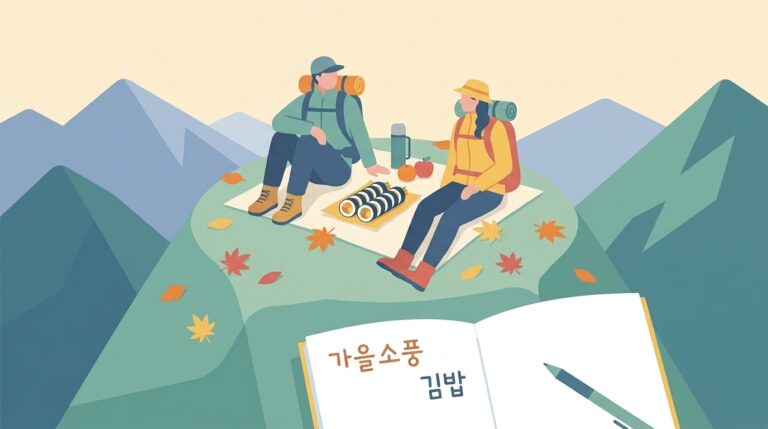
Imagine this: You have tackled the relentless granite staircases of Bukhansan (북한산). Your quadriceps are on fire, your breathable athletic shirt is soaked in sweat, and you finally collapse onto a flat boulder near Baegundae Peak. Just as you reach into your minimalist hydration vest for a processed energy gel, an elderly Korean couple wearing vibrant neon outdoor gear unzips a backpack that seems to defy the laws of physics. Out comes a segmented lunch box brimming with freshly sliced cucumber, bite-sized tuna gimbap wrapped in gleaming foil, half-frozen cherry tomatoes, and—incredibly—a steaming thermos that instantly transforms into a fragrant bowl of spicy cup ramen.
Catching your dazed, hungry stare, the smiling samchon (uncle) gestures enthusiastically toward you, thrusting a pair of wooden chopsticks into your hands with a booming sentence loaded with colloquial idioms. In standard textbooks, you learned to ask, “식사를 하셨습니까?” (Did you eat a meal?), but on the rugged ridgelines of Korea’s mountains, that textbook phrase sounds like an alien transmission. If you refuse bluntly out of western politeness, you risk bruising their warm sense of mountain jeong (communal affection). If you accept awkwardly, you might stumble over the intricate sociolinguistic dance of trail hospitality.
Over the past ten years coaching expatriate professionals and advanced learners in Seoul, I have watched brilliant C1 students freeze at this exact altitude. Hiking in Korea is not an isolated test of endurance; it is a traveling culinary salon and a communal ritual. Mastering haengdongsik (행동식 – trail snacks) and sanhaeng dosirak (산행 도시락 – packed lunches) vocabulary unlocks an authentic portal into Korean social psychology. This guide provides field-tested, C1-level linguistic strategies so you can banter, graciously share, and reciprocate on the mountain peaks like a true veteran alpinist.
Phase 2: In-Depth Analysis of 3 Key Expressions
1. 당 떨어지기 전에 하나 드세요. (Dang tteoreojigi jeone hana deuseyo.)
- Pronunciation: [Dang tteo-reo-ji-gi jeo-ne ha-na deu-se-yo] (Phonetic cue: Dahng like ‘gong’, tteo-reo-ji-gi like ‘tuh-ruh-jee-ghee’)
- Meaning: Literal: “Eat one before your sugar drops.” / Nuanced: “Take a quick energy snack before your blood sugar crashes; let me look out for you.”
- K-Culture Moment: Seen frequently in mountain trekking scenes across K-dramas (such as Work Later, Drink Now / 술꾼도시여자들), where friends or seasoned hikers pull out chocolate bars, dried persimmons, or jelly candy the moment an ascent gets steep.
- Editor’s Insight: Dang (당) refers to glucose/sugar. In everyday Korean life, Koreans use dang tteoreojida (당 떨어지다) to describe sudden physical or mental exhaustion. On the trail, offering something sweet with this phrase is the ultimate expression of proactive empathy. It frames the gift not as a handout, but as a practical preventative measure for mutual safety.
- Situation Spectrum:
- Casual: ✅ (당 떨어지기 전에 먹어!)
- Semi-formal: ✅ (당 떨어지기 전에 하나 드세요.)
- Formal: ⚠️ (당이 떨어지시기 전에 드십시오 – slightly overly dramatic for trail vibes)
- 🤔 Think About It: In many Western trekking cultures, hikers maintain strict caloric autonomy; sharing rations can feel invasive. Why does Korean culture turn metabolic need into an immediate communal bonding experience?
2. 보온병에 온수를 챙겨 왔거든요. (Boonbyeong-e onsureul chaenggyeo watgeodeunyo.)
- Pronunciation: [Bo-on-byeong-e on-su-reul chaeng-gyeo wat-geo-deun-yo] (Phonetic cue: Bo-own-byung-eh own-soo-rul cheng-gyuh waht-guh-doon-yo)
- Meaning: Literal: “Because I made sure to pack hot water in a thermos.” / Nuanced: “I have boiling water ready to go in my thermal flask, so please let me make you some ramen / coffee!”
- K-Culture Moment: In mountain vlogs and variety shows like 2 Days & 1 Night, packing a heavy stainless-steel thermos filled with rolling boiling water is considered the mark of an elite mountain gourmet, enabling the sacred pinnacle moment: summit ramen.
- Editor’s Insight: The sentence ending -거든요 (-geodeunyo) provides unspoken background context. By stating that you have hot water, you are subtly inviting the listener to produce their freeze-dried food, mix coffee, or mini cup noodles without feeling burdened (budam). It highlights forward-thinking hospitality.
- Situation Spectrum:
- Casual: ✅ (보온병에 온수 챙겨 왔거든!)
- Semi-formal: ✅ (보온병에 온수를 챙겨 왔거든요.)
- Formal: ⚠️ (보온병에 온수를 챙겨 왔습니다 – perfectly correct, but lacks conversational warmth)
- 🤔 Think About It: Carrying an extra 1.5 kilograms of hot water up a 45-degree rock incline is pure altruistic labor. What does this reveal about how Koreans view comfort and hospitality in extreme settings?
3. 정성껏 싸 왔는데 한 입 맛이라도 보세요. (Jeongseongkkeot ssa watneunde han ip mas-irado boseyo.)
- Pronunciation: [Jeong-seong-kkeot ssa wat-neun-de han ip ma-si-ra-do bo-se-yo] (Phonetic cue: Juhng-sung-kkut sah waht-noon-deh hahn eep mah-she-rah-doh boh-seh-yoh)
- Meaning: Literal: “I packed this with great devotion, so please try at least one mouthful.” / Nuanced: “I prepared this with love from home; it would make me truly happy if you tasted even a single bite.”
- K-Culture Moment: Classic encounter at mountain gazebos (jeongja) where strangers open side dishes like rolled omelets (gyeran-mari), spicy braised tofu (dubu-jorim), and home-rolled gimbap, warmly insisting everyone seated nearby takes a sample.
- Editor’s Insight: Jeongseongkkeot (정성껏) translates to ‘with heartfelt sincerity and care’. When an elder or hiking companion uses this phrase, turning them down cold can feel like a direct rejection of their goodwill. Even if you are full, the culturally fluent move is to accept a tiny bite (han ip) with exaggerated delight before expressing gratitude.
- Situation Spectrum:
- Casual: ✅ (정성껏 싸 왔는데 한 입 먹어봐!)
- Semi-formal: ✅ (정성껏 싸 왔는데 한 입 맛이라도 보세요.)
- Formal: 🚫 (Sounds overly personal for an official boardroom briefing, but acceptable among colleagues on a company hike)
- 🤔 Think About It: How does the linguistic framing of food as an artifact of “emotional effort” (jeongseong) change the dynamic between host and guest compared to commercial food offers?
Phase 3: Textbook Korean vs. Real-World Korean
Situation 1: Suggesting a snack break when energy flags on the trail
- 📖 교과서 한국어 (Textbook):
“간식을 드시겠습니까? 조금 쉬었다가 갑시다.” (Gansig-eul deusigesseumnikka? Jogeum swieottaga gapsida.)
Translation: Would you like to eat a snack? Let us rest a little and then go. - 🗣️ 진짜 한국어 (Real Native C1):
“여기 경치 좋은 데서 당 보충 좀 하고 갈까요?” (Yeogi gyeongchi joeun deseo dang bochung jom hago galkkayo?)
Translation: Shall we replenish our glucose right here with this great view before moving on? - 💡 왜 다를까? (Why the Difference?):
Textbooks default to the generic noun gansik (간식) and robotic imperatives. Real hikers refer to the specific physiological objective—dang bochung (당 보충 – sugar replenishment)—and combine it with an appreciation of the landscape (gyeongchi joeun deseo), making the pause poetic yet practical.
Situation 2: Offering your homemade trail food without seeming boastful
- 📖 교과서 한국어 (Textbook):
“제가 만든 음식을 드셔 보세요. 아주 맛있습니다.” (Jega mandeun eumsig-eul deusyeo boseyo. Aju mas-isseumnida.)
Translation: Please eat the food that I made. It is very delicious. - 🗣️ 진짜 한국어 (Real Native C1):
“별건 아니지만, 오이 하나 베어 무실래요? 목 축이기에 딱이에요.” (Byeolgeon anijiman, oi hana beeo musillaeyo? Mok chug-igie ttag-ieyo.)
Translation: It’s nothing fancy, but would you like a bite of fresh cucumber? It’s just the thing to wet your whistle. - 💡 왜 다를까? (Why the Difference?):
Praising your own cooking (Aju mas-isseumnida) violates the quintessential Korean virtue of humility (gyeomyang). Authentic native speakers downplay their offering (byeolgeon anijiman – it’s nothing special) while highlighting its immediate functional benefit to the recipient (mok chug-igi – slaking one’s thirst).
Phase 4: K-Culture Deep Dive & Non-Verbal Manners
4-1. 눈치 (Nunchi) & Gestures on the Ridge
Eating on a Korean mountain slope has its own non-verbal choreography dictated by terrain, wind, and hierarchy:
* The Two-Handed Extension Under Duress: Even when balancing precariously on a slab of granite, never hand food, napkins, or thermoses with a single, limp hand. Anchor your right elbow or forearm lightly with your left hand. This demonstrates deference and respect while adapting to the physical constraints of the mountain.
* The Sliced Cucumber Offering (Oi-nanum): In Korean trail culture, raw whole cucumbers (오이) and cherry tomatoes (방울토마토) are the supreme hydration hacks. When slicing cucumber on a portable cutting mat, the preparer always offers the sweet, crisp center slices to guests or elders first, saving the bitter ends for themselves.
* The Waste Bag Reflex (Kkalkkeumham): When accepting food, instantly reveal your personal zip-lock trash bag. Leaving even a single grape stem or piece of foil on the mountain is considered an unforgivable cultural faux pas. Showing that you manage your own waste before taking someone’s gimbap signals high cultural polish (nunchi).
4-2. Cultural Codes: 정상 컵라면 (Summit Cup Ramen) & The Communal Mat
Reaching the summit (jeongsang) of peaks like Jirisan or Seoraksan culminates in what Koreans affectionately call sansang manchan (산상 만찬 – mountaintop banquet).
While alcohol consumption on national park trails has been heavily restricted by law since 2018 (ending the legendary open-air makgeolli parties of the early 2000s), food culture stepped in to fill the emotional void. Hikers sit together on reflective silver foam sitting mats (bangseok). One person produces homemade pickled radish (danmuji), another pulls out seasonal fruit, and someone clicks on a thermos filled with boiling water to make small cup noodles (yukgaejang sagabal). Rejecting this communal feast by walking away to eat a lone protein bar behind a boulder is interpreted not as independence, but as aloofness. Sharing food at altitude is an ancient equalizer: regardless of socioeconomic status or age, everyone on the summit shares the same wind, the same blisters, and the same warm broth.
Phase 5: Real-Life Roleplay Scenario
Setting: A shaded scenic overlook below Baegundae Peak on Mount Bukhansan. Cool autumn breeze, leaves rustling.
Characters:
* Min-seok (민석): A seasoned 50-something hiker sporting an immaculate trekking outfit, unzipping an insulated multi-tier lunchbox.
* Alex (알렉스): An advanced Korean learner who climbed the trail with lightweight gear.
민석: 어이구, 젊은 친구! 여기까지 숨도 안 차고 단숨에 올라왔네? 대단해요!
(Eo-i-gu, jeolmeun chin-gu! Yeogi-kkaji sumdo an chago dansume ollawatne? Daedanhaeyo!)
“Well hello there, young friend! You made it all the way up here without even losing your breath in one go? Impressive!”
🎭 [Wiping his brow with a mountaineering towel and nodding with hearty admiration]
알렉스: 아닙니다, 선배님. 막판 깔딱고개에서 허벅지 터지는 줄 알았습니다.
(Animnida, seonbaenim. Makpan kkaltak-gogae-eseo heobeokji teojineun jul alatseumnida.)
“Not at all, veteran hiker! During that final killer ridge incline, I honestly thought my thighs were going to explode.”
🎭 [Laughing modestly while stretching out tired calves with hands on knees]
민석: 하하, 거기가 마의 구간이지! 이리 와서 돗자리에 엉덩이 좀 붙여요. 마침 점심 펼치던 참인데.
(Haha, geogiga ma-ui gugan-iji! Iri waseo dotjari-e eongdeongi jom buchyeoyo. Machim jeomsim pyeolchideon cham-inde.)
“Haha, that section is sheer purgatory! Come over here and take a seat on this mat. I was just laying out lunch anyway.”
🎭 [Patting the empty space on his reflective silver picnic mat]
알렉스: 아이고, 실례가 될까 조심스럽네요. 저도 행동식이 조금 있긴 한데요.
(Aigo, sillye-ga doelkka josimseureopneyo. Jeodo haengdongsik-i jogeum itgin handeyo.)
“Oh, I wouldn’t want to intrude. I actually have a few trail rations on me as well.”
🎭 [Hesitating politely, showing his backpack with an apologetic smile]
민석: 아이, 사양 말고! 집사람이 새벽부터 정성껏 싼 묵은지 김밥인데, 맛이라도 봐요. 온수도 넉넉해요.
(Ai, sayang malgo! Jipsaram-i saebyeokbuteo jeongseongkkeot ssan mugeunji gimbap-inde, mas-irado bwayo. Onsudo neokneokhaeyo.)
“Hey, no holding back now! My wife woke up at dawn to lovingly roll this aged kimchi gimbap; at least try a piece. I have plenty of hot water, too.”
🎭 [Holding out a foil tray of gleaming gimbap with both hands, eyes twinkling]
알렉스: 정성이 담긴 귀한 음식인데, 그럼 감사히 염치 불고하고 한 줄 얻어먹겠습니다.
(Jeongseong-i damgin gwihan eumsik-inde, geureom gamsahi yeomchi bulgohago han jul eodeomeokgetseumnida.)
“Since you packed this with such dedication, I will cast shame aside and gratefully enjoy a roll.”
🎭 [Receiving the food with both hands, bowing his head slightly in sincere appreciation]
민석: 그래, 그래! 산에서는 든든하게 먹어야 하산할 때 다리가 안 풀려요. 컵라면도 하나 부을까?
(Geurae, geurae! San-eseoneun deundeunhage meogeoya hasanhal ttae dari-ga an pullyeoyo. Keopramyeon-do hana bueulkka?)
“Yes, that’s it! On the mountain, you’ve got to eat heartily so your legs don’t buckle on the descent. Shall I pour hot water on a cup of ramen for you too?”
*🎭 [Already unscrewing the heavy cap of his stainless steel thermos with enthusiasm]
알렉스: 라면까지 뺏어 먹으면 너무 죄송하죠! 대신 제 배낭에 있는 샤인머스캣 좀 나눠 드시겠어요?
(Ramyeon-kkaji ppaeseo meogeumyeon neomu joesonghajyo! Daesin je baenange inneun syain-meoseukaet jom nanwo deusigesseoyo?)
“Taking your ramen on top of this would make me feel far too guilty! Instead, would you care to share some of the Shine Muscat grapes in my pack?”
*🎭 [Pulling out a clean container of washed grapes and offering it forward with both hands]
🔀 Interactive Decision Point
Suppose Min-seok now offers to pour you a small paper cup of his home-brewed medicinal ginseng liquor (insamju). How do you respond?
- Choice A: “국립공원 내 음주는 불법인데, 신고당하고 싶으세요?”
(Drinking in national parks is illegal; do you want to be reported?) - Choice B: “마음은 정말 감사하지만, 하산길 발 디딤이 불안해서 알코올은 정중히 사양하겠습니다.”
(I am truly grateful for your warm thought, but because footing on the descent is tricky, I must politely decline any alcohol.) - Choice C: “오, 귀한 술이네요! 법이고 뭐고 정상이니까 원샷하겠습니다!”
(Oh, precious liquor! Law or whatever, we’re at the summit, so bottoms up!)
Detailed Branching Feedback:
- Choice A (Bad): While legally correct, this hyper-confrontational phrasing destroys rapport instantly, shaming an elder in front of bystanders and displaying zero social tact (nunchi).
- Choice B (Best): Demonstrates flawless C1 pragmatic competence. You acknowledge their hospitality (ma-eum-eun jeongmal gamsahajiman), cite a safety-first reason (hasangil bal didim), and use elevated honorific softeners (jeongjunghi sayanghagetseumnida).
- Choice C (Risk): Dangerous and reckless. Drinking alcohol in designated Korean national park zones carries a fine of up to 100,000 KRW, increases rescue hazards on steep granite slopes, and sets a poor personal standard.
Phase 6: 10-Second Emotional Shadowing Drill
Master the rhythmic cadence and emotional subtext of mountain communication. Practice pacing using the slash (/) pause indicators:
- [🥺 지쳤지만 고마움을 듬뿍 담아 – Exhausted but glowing with humble gratitude]
“아이구, / 귀한 음식을 나눠 주셔서 / 몸 둘 바를 모르겠습니다.”
(A-i-gu, / gwi-han eum-si-geul na-nwo ju-syeo-seo / mom dul ba-reul mo-reu-get-seum-ni-da.)
“Oh my goodness, / you’re sharing such precious food with me / I hardly know how to express my gratitude.” -
[😊 활기차고 배려심 넘치게 – Peppy, caring, and encouraging]
“하산길 다리 풀리면 위험하니까, / 여기서 당 충전 제대로 하고 / 내려가요!”
(Ha-san-gil da-ri pul-li-myeon wi-heom-ha-ni-kka, / yeo-gi-seo dang chung-jeon je-dae-ro ha-go / nae-ryeo-ga-yo!)
“If your legs buckle on the descent it’s dangerous, / so let’s properly recharge our sugar levels right here / before heading down!” -
[🤝 겸손하고 정중하게 나눔을 제안할 때 – Modest and respectful food barter]
“보잘것없는 간식이지만, / 가시는 길에 하나씩 / 입가심으로 드셔 보세요.”
(Bo-jal-geot-eop-neun gan-si-gi-ji-man, / ga-si-neun gi-re ha-na-ssik / ip-ga-sim-eu-ro deu-syeo bo-se-yo.)
“It’s just an insignificant snack, / but as you make your way along, / please enjoy one each as a palate cleanser.”
Phase 7: K-Culture Mini Dictionary
-
행동식 (行動食, Haengdongsik)
- Literal Translation: Action food / Movement nourishment.
- Usage: High-density, portable trail snacks eaten while moving or during quick 3-minute breathers (e.g., energy bars, dried fruits, roasted nuts, or yanggaeng – red bean jelly). Unlike a seated meal (siksa), it prevents lethargy while sustaining climbing stamina.
- 산상 만찬 (山上晩餐, Sansang Manchan)
- Literal Translation: Mountain-top banquet / Feast above the clouds.
- Usage: A lighthearted, humorous cultural term for the surprisingly lavish spread Korean hikers unpack on mountain summits—featuring multiple types of gimbap, fresh fruit containers, side dishes, and thermos noodles.
- 당 충전 (糖充電, Dang Chungjeon)
- Literal Translation: Sugar recharging.
- Usage: Originally a fitness/office slang phrase, now ubiquitous on Korean trails. Refers to eating fast-acting carbohydrates to combat the sudden trembling of leg muscles caused by glycogen depletion.
- 흔적 남기지 않기 (LNT, Heunjeok Namgiji Ankki)
- Literal Translation: Leaving no trace behind.
- Usage: The core ethical principle of modern Korean hiking. Encompasses ssuregi doegajyeogagi (쓰레기 되가져가기 – packing out all your trash), including biodegradable items like fruit peels, which disrupt local mountain ecology.
Phase 8: Traveler’s Survival Kit
Survival Expressions TOP 3
- “시원한 오이 하나 드시고 가세요!” (Siwonhan oi hana deusigo gaseyo!)
- Pro Tip: When an elder hiker yells this down the path at you, don’t walk past shyly! Stop, smile, bow your head slightly, accept the cucumber with both hands, and say “감사히 잘 먹겠습니다!” (I will eat this with gratitude!).
- “보온병 온수 좀 나눠 써도 될까요?” (Boonbyeong onsu jom nanwo sseodo doelkkayo?)
- Pro Tip: If your thermos ran cold or you ran out of boiling water for your trail ramen, asking this politely at a mountain shelter (daepiso) will almost always be met with generous help.
- “쓰레기 봉투 여분 있으신가요?” (Sseuregi bongtu yeobun itsusin-gayo?)
- Pro Tip: If your snack wrapper tore or you collected trail trash along the way, this phrase proves your environmental manners to fellow mountaineers immediately.
Editor’s Travel Note: Trail Logistics
- Digital Navigation: Never rely on generic global maps on Korean ridgelines. Before heading out, install the Naver Map application for precise mountain trail navigation, which outlines detailed trail gradients, public restrooms, and real-time trail closures.
- Convenience Store Raid (편의점 털기): Hit a CU or GS25 right outside the subway station at the mountain base (such as Gupabal Station for Bukhansan). Grab two triangle kimbap (samgak gimbap), a pack of yanggaeng (sweet red bean jelly – the ultimate traditional energy bar), a bottle of Pocari Sweat, and an insulated 500ml thermos flask filled with hot water from your accommodation or convenience store dispenser.
- National Park Regulations: Remember that drinking alcohol, smoking, and using portable butane gas burners (beoseuteo) are strictly banned outside of designated cooking zones in mountain shelters. Transgressions carry steep spot fines.
Phase 9: “One Step Deeper” (Sociolinguistic Insight)
In Western individualist traditions, the mountain is often viewed as a rugged arena for personal conquest—a place where self-reliance is prized above all else, and carrying someone else’s burden is an intrusion on their autonomy. In Korea, however, the concept of the mountain exists in deep symbiosis with gongdongche (공동체 – collective community) and jeong (정 – bonding affection). Sharing food with complete strangers on a granite precipice dissolves the rigid social hierarchies of modern urban Korean life. When an executive and a university student share a tube of gimbap on the summit of Jirisan, corporate titles, age gaps, and social anxieties evaporate into the mist. Offering food is a linguistic and somatic bridge: it declares that up here, above the clouds, we survive and celebrate together.
💬 Your Turn: Have you ever experienced food sharing with strangers while traveling in Korea or on a mountain trail? What trail snack from your home country would you pack to share with a Korean hiking group? Share your story in the comments below!
Phase 10: FAQ & Avoiding Misunderstandings
Q: What should I do if a Korean hiker offers me food, but I have food allergies or dietary restrictions (e.g., vegetarian or halal)?
A: Never simply wave your hands in silence or say a blunt “안 먹어요” (I won’t eat that). Instead, acknowledge their kindness first, then specify your biological constraint politely: “정말 감사하지만, 제가 특정 알레르기가 있어서 마음만 감사히 받겠습니다.” (I am truly grateful, but because I have a specific allergy, I will gratefully accept just the warm thought.)
Q: Is it considered rude to offer store-bought snacks if everyone else has elaborate home-cooked food?
A: Absolutely not! Modern Koreans completely understand that solo travelers and young hikers rely on convenience stores. In fact, high-end imported chocolates, premium dried nuts, or seasonal fruit like Shine Muscat grapes bought from the market are enthusiastically welcomed by veteran mountain groups.
Q: Can I bring portable gas stoves to cook ramen on top of famous peaks like Bukhansan or Seoraksan?
A: No. Cooking with an open flame outside of designated national park shelter cooking zones (chwiseojang) is strictly illegal and heavily fined. This is why seasoned hikers carry high-efficiency thermal flasks (boonbyeong) that keep water near boiling temperatures for up to 8 hours.
🚨 Common Mistakes Board
- Mistake: Discarding fruit peels (like watermelon rinds or banana peels) in mountain bushes thinking they are natural compost.
- Correct Action: Keep all biological waste in your personal zip-lock bag. At high altitudes, fruit peels ferment slowly, attract wild boars, and disrupt fragile alpine flora.
- Mistake: Refusing an elder’s snack offer with flat textbook negatives like “싫습니다” (I dislike it) or “필요 없습니다” (I don’t need it).
- Correct Action: Soften your refusal by prioritizing gratitude: “배가 너무 불러서 아쉽지만 마음만 감사히 받겠습니다” (I am so full, sadly, but I will treasure your kind intention).
- Mistake: Accepting food without verbally reciprocating before eating.
- Correct Action: Always utter the foundational etiquette phrase with a respectful nod: “감사히 잘 먹겠습니다!” (I will eat this with utmost gratitude!).
Phase 11: Action Missions & Real-World Challenges
- 🥉 Bronze Mission (Solo Shadowing): Record a 15-second voice memo reciting the Phase 6 Shadowing Drill #2 (“하산길 다리 풀리면 위험하니까, 여기서 당 충전 제대로 하고 내려가요!”). Listen back to ensure you hit the intonation dip at 위험하니까 and the upbeat lift at 내려가요.
- 🥈 Silver Mission (Community Engagement): Next time you prepare your hiking pack, take a photo of your haengdongsik (trail snacks) and post it on your Instagram Story or Korean study group with the caption: “오늘의 행동식 당 충전 라인업 완료! #매일한글 #등산스타그램”.
- 🥇 Gold Mission (Real Trail Application): On your next trek up Bukhansan, Inwangsan, or Gwanaksan, carry an extra small bunch of washed cherry tomatoes. Offer a pair to an oncoming hiker with the phrase: “목 축이고 가세요!” (Wet your throat before you go!). Report their reaction in the comments!
🎮 K-Culture Mission: Watch an episode of the trekking-themed variety show Europe Outside Your Tent (텐트 밖은 유럽) or the mountain climbing episode of Work Later, Drink Now. Spot at least two scenes where someone uses the phrase 당 떨어진다 or offers a trail snack, and notice their body language.
Phase 12: Interactive Quiz Challenge
Test your situational mastery and advanced cultural awareness. Think through each question before expanding the answers below!
1. Situational Judgment (Multiple Choice)
You have joined a Korean hiking club (deung-san donghohoe). During a rest stop, the club leader opens a container of braised pork belly and homemade kimchi, offering you the first bite on a leaf of perilla. You are mildly full from your energy bar. What is the most culturally nuanced C1 response?
* (A) “방금 에너지 바를 먹어서 전혀 먹고 싶지 않습니다.”
* (B) “선배님 정성인데 염치 불고하고 한 쌈만 맛보겠습니다! 꿀맛이네요!”
* (C) “돼지고기는 칼로리가 너무 높아서 하산할 때 몸이 무거워집니다.”
* (D) “나중에 먹을 테니 제 배낭에 싸 주십시오.”
2. Fill-in-the-Blank (Advanced C1 Particle & Idiom)
Fill in the blank with the appropriate native expression that softens an offer of food:
“[ 1 ] 아니지만, 정상 올라가서 라면 국물에 같이 곁들여 드세요.”
(It’s nothing special, but please enjoy this together with your ramen broth at the summit.)
3. True or False: Cultural Nuance
[True / False] In Korean national parks, bringing raw cucumbers and cherry tomatoes is popular primarily because water bottles are heavy, and biting into cool cucumber replenishes both electrolytes and slakes thirst quickly without causing heavy stomach bloating on steep ascents.
👉 Click here to reveal the Answers & Expert Explanations!
- Correct Answer: (B)
- Explanation: Option (B) demonstrates advanced awareness of jeong and social grace. Using “염치 불고하고” (casting shame aside) acknowledges the privilege of eating their homemade food, while “꿀맛이네요” (it tastes like honey!) provides the enthusiastic positive reinforcement expected in communal dining. Options (A) and (C) are blunt and kill the group’s warm mood.
- Correct Answer: 별건 (or 별것은)
- Explanation: “별건 아니지만” (It is nothing grand/special) is the quintessential Korean humble opener used when presenting home-packed food or gifts to prevent the recipient from feeling social pressure (budam).
- Correct Answer: True
- Explanation: Cucumbers consist of over 95% water and provide crisp potassium replenishment without sloshing heavily in the stomach during rapid altitude gains. It remains the reigning king of traditional Korean trail snacks.
- Explanation: Cucumbers consist of over 95% water and provide crisp potassium replenishment without sloshing heavily in the stomach during rapid altitude gains. It remains the reigning king of traditional Korean trail snacks.







