

Phase 1: Empathy (Welcome to the Neon Glow!)
안녕하세요! 매일한글 에디터입니다. (Hello! I’m your Daily Hangul editor.)
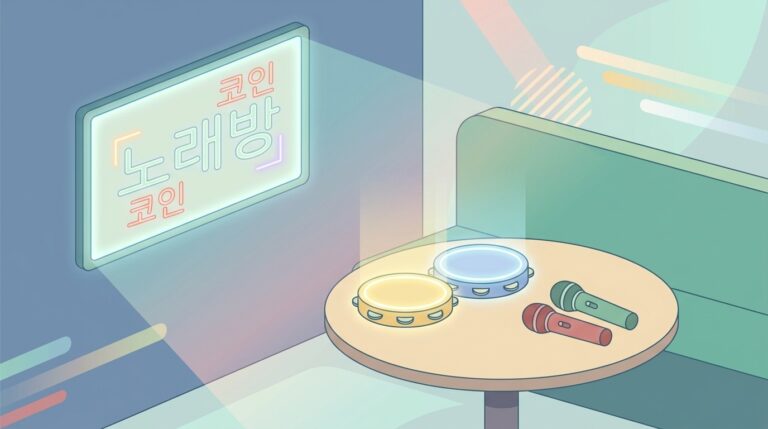
Picture this: It is 10:30 PM on a Friday in Seoul. You just had delicious Korean barbecue with your local friends in Hongdae, and someone eagerly points toward a glowing neon sign shouting, “2차는 노래방!” (Round two is Noraebang!) Before you can even process the thrill, you step into a lively room filled with mirror balls, cozy couches, and a table featuring two shiny wireless microphones.
Then, someone hands you the remote control—and your heart stops. It looks like the flight deck of a spaceship, densely packed with dozens of buttons entirely in Hangul! You want to join the fun, but thoughts race through your mind: What if I cut someone’s song by accident? How do I search for a track? How do I ask for more time?
Take a deep breath! Every foreign traveler and expat in Korea has frozen in front of that giant remote. In this guide, backed by real lessons and feedback from hundreds of beginner students at Daily Hangul, you will learn the exact phrases and unspoken manners needed to walk into any Korean karaoke room and have the time of your life.
Phase 2: Core 3 Expressions Breakdown
1. 노래방 가요! (Noraebang gayo!)
- Pronunciation: noh-rae-bang gah-yoh (Rhymes like: no-ray + bang as in fireworks + gah-yo)
- Meaning: Literal: “Go to noraebang!” | Real Nuance: “Let’s go to karaoke!” or “I want to go to noraebang!”
- K-Culture Moment: Heard in almost every youth K-drama right after dinner when characters want to blow off steam or celebrate exams.
- Editor’s Insight: At the A1 beginner level, simply using the verb ending -gayo (가요) with rising intonation turns it into an invitation (Shall we go?), while falling intonation means a cheerful statement (I’m going!).
- Situation Spectrum: Casual (✅) / Semi-formal (✅) / Formal (⚠️ – use 노래방에 가시겠습니까? instead)
- 🤔 Think About It: In English, you might say “Do you want to sing?” but Koreans specify the destination 노래방 (song room) because the venue itself is an entire cultural ritual.
2. 취소 눌러주세요. (Chwiso nulleojuseyo.)
- Pronunciation: chwee-soh nool-ler-joo-seh-yoh (Chwee like ‘chew-y’ fast + so + nulleo like ‘null’ + juseyo)
- Meaning: Literal: “Please press cancel.” | Real Nuance: “Could you cancel this song for me?”
- K-Culture Moment: When you enter the wrong song number or pick an impossibly fast rap track by accident and panic ensues.
- Editor’s Insight: The big red button on the remote says 취소 (Cancel). It is arguably the most important button to know when you need to bail out gracefully!
- Situation Spectrum: Casual (✅ with friends: 취소 눌러줘) / Semi-formal (✅) / Formal (✅)
- 🤔 Think About It: Notice how polite requests in Korean end in -juseyo (주세요). It softens every command into a sweet favor.
3. 서비스 주세요! (Seobiseu juseyo!)
- Pronunciation: suh-bee-seu joo-seh-yoh (Sounds just like the English word ‘service’ with a Korean vowel ending!)
- Meaning: Literal: “Give me service!” | Real Nuance: “Please give us free bonus minutes!”
- K-Culture Moment: That triumphant moment when the karaoke counter manager adds 20 or 30 free minutes to your clock just when you thought the night was over.
- Editor’s Insight: In Korea, 서비스 (service) does not mean customer support—it means free perks on the house! Smiling brightly at the counter while saying this can work wonders.
- Situation Spectrum: Casual (✅) / Semi-formal (✅) / Formal (🚫 – avoid during formal business karaoke)
- 🤔 Think About It: What does giving “free extra time” show about Korean generosity (Jeong, 정)?
Phase 3: Textbook Korean vs. Real Korean
Situation 1: Suggesting a spontaneous karaoke trip
- 📖 교과서 한국어 (Textbook): 우리 노래방에 갈까요? (Uri noraebange galkkayo? – “Shall we go to the singing room?”)
- 🗣️ 진짜 한국어 (Real-World): 코노 갈래? (Kono gallae? – “Wanna hit coin noraebang?”)
- 💡 왜 다를까? (Why is it different?): Modern young Koreans rarely say the full word 노래방 for quick sessions. They combine 코인 (Coin) + 노래방 (Noraebang) into the ultra-popular slang 코노 (kono).
Situation 2: Asking someone to queue your song
- 📖 교과서 한국어 (Textbook): 이 노래를 예약해 주십시오. (I noraereul yeyakhae jusipsio. – “Please make a reservation for this song.”)
- 🗣️ 진짜 한국어 (Real-World): 이거 예약해 줘! (Igeo yeyakhae jwo! – “Queue this one for me!”)
- 💡 왜 다를까? (Why is it different?): Textbook honorifics like -sipsio sound like an announcement on an airplane. Among peers, simple casual imperative -hae jwo is natural and warm.
Phase 4: K-Culture Deep Dive & Non-Verbal Manners
4-1. 눈치 (Nunchi) & The Golden Tambourine Etiquette
- The Tambourine Maestro: When your friend is singing, don’t stare at your phone! Pick up the tambourine (탬버린) and tap it on your palm or hip in rhythm. Even if you can’t sing Korean lyrics yet, being a supportive hype person gives you instant 100/100 social points.
- The Chorus Rule (간주 점프): Never press the blue 취소 (Cancel) button while someone is singing. If there is a long musical intro, ask: “간주 점프 할까요?” (Ganju jeompeu halkkayo? – “Should we skip the intro?”)
- Microphone Sharing: Always place the microphone back in its charging cradle or pointing away from the speakers to prevent ear-piercing audio feedback.
4-2. Cultural Code: Stress Relief & “Heung” (흥)
For Koreans, noraebang is not a performance contest or a talent audition—it is a cathartic emotional release called 흥 (Heung, collective joy and excitement). You do not need to sing like an idol vocalist. In fact, singing funny songs with total dramatic passion is respected far more than stiff perfectionism.
Phase 5: Real-World Roleplay Scenario
Setting: A cozy coin karaoke room near Sinchon Station with Minji, your Korean university language-exchange buddy.
- Minji: 우리 밥 다 먹었으니까 코노 갈래요? (Uri bap da meogeosseunikka kono gallaeyo? / We finished eating, so wanna hit coin karaoke?)
🎭 Eyes sparkling, pointing toward a neon sign across the street. - You: 좋아요! 노래방 가요. (Joayo! Noraebang gayo. / Sounds great! Let’s go to noraebang.)
🎭 Nodding enthusiastically with a bright smile. - Minji: 무슨 노래 부를 거예요? (Museun norae bureul geoyeyo? / What song are you going to sing?)
🎭 Handing you the giant silver remote control. - You: 방탄소년단 노래 부를래요. (Bangtansonyeondan norae bureullae-yo. / I want to sing a BTS song.)
🎭 Looking up the song title on your phone screen. - Minji: 오! 제목 알려주면 제가 번호 찾을게요. (Oh! Jemok allyeojumyeon jega beonho chajeulgeyo. / Oh! Tell me the title and I’ll look up the number.)
🎭 Fingers ready over the remote’s keypad. - You: ‘다이너마이트’예요. 이거 예약해 주세요. (‘Daineomaiteu’yeyo. Igeo yeyakhae juseyo. / It’s ‘Dynamite’. Please reserve this one.)
🎭 Pointing at the screen gently. - Minji: 예약 완료! 자, 마이크 잡으세요! (Yeyak wallyo! Ja, maikeu jabeuseyo! / Reserved! Here, grab the microphone!)
🎭 Handing over the mic while shaking a tambourine. - You: 잘 못하지만 열심히 부를게요! (Jal mothajiman yeolsimhi bureulgeyo! / I’m not great, but I’ll sing hard!)
🎭 Laughing playfully as the music beat drops.
🔀 Interactive Choice Point
The intro of your song starts, but you suddenly get stage fright! What do you do?
- Option A: Press the red 취소 (Cancel) button right away and sit down silently.
- Feedback (Bad): The music abruptly dies and kills the fun atmosphere. Don’t worry about singing off-key—nobody judges you!
- Option B: Pass the second microphone to Minji and say: “같이 불러요!” (Gachi bulleoyo! – Let’s sing together!)
- Feedback (Best): Pure Korean karaoke magic! Duets lower pressure, build bonding, and make the whole room burst with energy.
- Option C: Grab the remote and start frantically searching for another song while the timer ticks down.
- Feedback (Risk): You lose valuable paid minutes and miss the opening verse.
Phase 6: 10-Second Emotion Shadowing Drill
Repeat these lines aloud with the emotional cues and pauses (/ marks pauses):
[😊 Cheerful & inviting]
우리 / 코노 갈래요? (Uri / kono gallaeyo? / Shall we / go to coin karaoke?)-
[🥺 Playful & cute]
사장님, / 서비스 주세요! (Sajangnim, / seobiseu juseyo! / Boss, / please give us bonus time!) -
[🎉 Hyped & supportive]
와, / 노래 진짜 잘해요! (Wa, / norae jinjja jalhaeyo! / Wow, / you sing so well!)
Phase 7: K-Culture Mini Dictionary
- 코노 (Kono): Short for 코인 노래방 (Coin Noraebang). Pay-per-song booths (usually 500~1,000 KRW for 2-3 songs), perfect for solo travelers or duos.
- 탬버린 (Taembeorin): Tambourine. Found in pairs in every karaoke room, often equipped with flashing LED lights inside the plastic rim.
- 애창곡 (Aechanggok): Go-to favorite song. The reliable track you always sing when you want to feel comfortable.
- 18번 (Sip-pal-beon): Slang for your “number one signature karaoke song.” If someone asks, “18번이 뭐예요?”, they are asking for your ultimate party anthem.
Phase 8: Survival Kit for Travelers
Top 3 Survival Phrases
- 마이크 커버 있어요? (Maikeu keobeo isseoyo?)
- Meaning: “Do you have microphone covers?”
- Pro Tip: Sanitary disposable covers are usually given at the front desk or placed inside a basket in your room.
- 시간 얼마나 남았어요? (Sigan eolmana namasseoyo?)
- Meaning: “How much time is left?”
- Pro Tip: Look at the top right corner of the TV screen; remaining minutes are displayed in glowing green or red numbers.
- 물 하나 주세요. (Mul hana juseyo.)
- Meaning: “Please give me one bottle of water.”
- Pro Tip: Belted out high notes? Grab water from the counter vending machine before your vocal cords get strained.
Editor’s Travel Note
- App Recommendation: Search song codes in advance using the TJ노래방 공식 앱 다운로드. If you type the English pop title, you can instantly see its 5-digit number and enter it directly into the keypad!
- Payment: Coin noraebang rooms accept 1,000 KRW paper bills and 500 KRW coins, though newer branches accept T-Money transit cards or credit cards right inside the booth.
Phase 9: “One Step Deeper” (Cultural Reflection)
In many Western cultures, karaoke is an activity for extroverts or confident performers. In Korea, however, Noraebang serves as a social equalizer. In rigid daily life governed by strict corporate hierarchy and polite speech levels, the dimly lit karaoke room is the one sacred sanctuary where everyone lets their guard down. When bosses and interns dance together with tambourines on their heads, social stress melts away. It is not about talent; it is about shared vulnerability.
💬 Your Turn: What is your ultimate signature song (18번) that you would dare to sing in a Korean noraebang? Tell us in the comments below!
Phase 10: FAQ & Common Mistakes
Q: Can I find English, Japanese, or Spanish songs in Korean karaoke machines?
A: Yes! Both major brands (TJ Media and Kumyoung) have massive international song libraries. On the remote control, look for the button labeled 외국곡 (Foreign Songs) or 팝송 (Pop Songs) to browse by country.
Q: Can I go to a Noraebang completely alone?
A: Absolutely! That is precisely why 코노 (Coin Noraebang) exists. Thousands of Korean students and solo workers drop by alone for 15 minutes after work to sing two songs and destress.
Q: How do I know if a place charges by song or by hour?
A: If the sign says 코인노래연습장 (Coin Noraebang), you insert coins or bills per song. If it simply says 노래연습장 or 노래방, you pay by the hour at the front reception desk.
🚨 Common Mistakes Warning Board
- Mistake: Pressing 시작 (Start) before checking the screen.
- Correct Action: Check if the screen shows the right song title, then press 예약 (Reserve) to queue it behind current songs, rather than cutting the ongoing song.
- Mistake: Tapping the metal microphone head against your hand to test sound.
- Correct Action: Never tap or blow into karaoke mics. Simply speak into it gently: “아, 아” (Ah, ah).
- Mistake: Leaving immediately when your timer hits 00:00 in an hourly noraebang.
- Correct Action: Wait 10 seconds! Many generous managers send bonus “Service” (서비스) minutes right as the clock expires!
Phase 11: Action Missions
- 🥉 Bronze Mission (Solo): Practice saying 취소 눌러주세요 (Chwiso nulleojuseyo) 3 times out loud in your room until it rolls off your tongue.
- 🥈 Silver Mission (Social): Listen to your favorite K-pop song and look up its official Korean title so you can type it on the remote.
- 🥇 Gold Mission (Real-world): Find a coin karaoke booth near your accommodation in Korea, put in 1,000 won, and sing two songs from beginning to end!
- 🎮 K-Culture Mission: Watch an episode of a Korean variety show like I Live Alone (나 혼자 산다) and spot how guests hype up the room using the tambourine.
Phase 12: Interactive Quiz Challenge
Test your karaoke survival instincts! Click the toggle below to reveal the answers.
1. Situation Check: You accidentally typed the wrong number on the remote and an opera song popped up. Which button should you press?
* A) 예약 (Yeyak)
* B) 시작 (Sijak)
* C) 취소 (Chwiso)
2. Fill-in-the-Blank: When asking for bonus free minutes at the counter, you say:
“사장님, [ ______ ] 주세요!”
3. True or False: In Korean noraebang culture, it is considered rude to sing if you are not a talented vocalist.
* (True / False)
👉 Click to reveal answers & explanations!
- Answer: C) 취소 (Chwiso)
- Explanation: 취소 means Cancel. It immediately removes queued numbers or stops unwanted tracks!
- Answer: 서비스 (Seobiseu)
- Explanation: The loanword ‘service’ refers to free perks or extra time added to your session.
- Answer: False
- Explanation: Korean karaoke is all about passion, stress relief, and energy (Heung), not perfect pitch. Just have fun!
- Explanation: Korean karaoke is all about passion, stress relief, and energy (Heung), not perfect pitch. Just have fun!







