

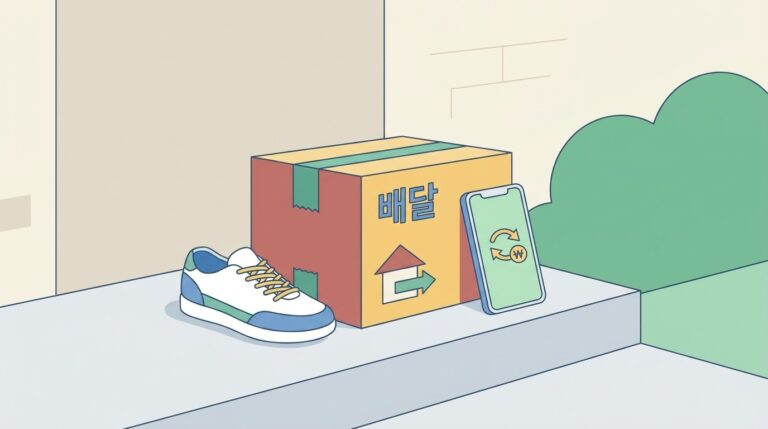
Phase 1: Empathy (Opening Story)
안녕하세요! 매일한글 에디터입니다. (Hello! I’m your Daily Hangul editor.)
Picture this: You finally tracked down that gorgeous oversized knit sweater your favorite K-drama lead wore in that cozy cafe scene. You ordered it on a Korean shopping app, waited excitedly for that lightning-fast Taekbae (courier delivery) message, and ripped open the box—only to realize you accidentally selected Size S instead of L. Or worse, the sleeve seam is torn! Your heart sinks. You want to ask for a replacement, but the shopping app is entirely in Korean, and the customer support chat window feels like an intimidating wall of honorifics. What if you say the wrong thing and get stuck paying return shipping fees twice?
Take a deep breath! You are not alone. As an editor who has guided hundreds of foreign learners through the maze of Korean e-commerce, I can tell you that exchanging an item in Korea is actually fast and customer-friendly once you know the exact key patterns. In this guide, we break down essential A2-level Korean expressions so you can confidently request an exchange, explain why, and get the perfect item delivered right to your doorstep.
Phase 2: 3 Core Expressions In-Depth
1. 교환하고 싶어요 (Gyo-hwan-ha-go sip-eo-yo)
- Pronunciation: [Gyo-hwan-ha-go sip-eo-yo] (Think: “Gyo” like Japanese gyoza + “hwan” like the name Juan with an H + ha-go sip-eo-yo)
- Meaning: Literal: “I want to do an exchange.” / Actual Nuance: “I’d like to exchange this item, please.”
- K-Culture Moment: You will hear this everywhere in modern lifestyle K-dramas when a character visits a boutique counter or types frantically into a 1:1 CS chatbot after buying the wrong gift.
- Editor’s Insight: The noun 교환 (gyo-hwan) means “exchange.” Pairing it with the beginner-friendly grammar
-고 싶어요(-go sip-eo-yo, “I want to”) creates a clear, polite statement without sounding demanding.- Situation Spectrum: Casual: ⚠️ (Use 교환할래 with close friends) | Semi-formal: ✅ (Perfect for app inquiries & store staff) | Formal: ✅ (교환 신청 드립니다)
- 🤔 Think About It: In English, we often say “Can I swap this?” asking for permission. In Korean customer service, stating your intent clearly with
~하고 싶어요is direct yet very courteous.2. 사이즈를 잘못 주문했어요 (Sai-jeu-reul jal-mot ju-mun-haess-eo-yo)
- Pronunciation: [Sai-jeu-reul jal-mot ju-mun-haess-eo-yo] (Think: “Sai-jeu” like size + “jal-mot” like ‘Jal’ + ‘mote’ meaning by mistake + ju-mun-haess-eo-yo)
- Meaning: Literal: “I incorrectly ordered the size.” / Actual Nuance: “I accidentally ordered the wrong size.”
- K-Culture Moment: Seen in comedy K-dramas where someone tries to secretly order couples’ clothing but mistakenly selects miniature pet clothing instead!
- Editor’s Insight: The adverb 잘못 (jal-mot) means “wrongly” or “by mistake.” Placing it right before the verb 주문하다 (to order) clearly explains that it was a simple sizing slip-up on your end.
- Situation Spectrum: Casual: ⚠️ | Semi-formal: ✅ | Formal: ✅
- 🤔 Think About It: Acknowledging a simple mistake with “잘못” immediately clarifies whether the exchange fee applies to the buyer or the seller under Korean consumer policy.
3. 제품에 하자가 있어요 (Je-pum-e ha-ja-ga iss-eo-yo)
- Pronunciation: [Je-pum-e ha-ja-ga iss-eo-yo] (Think: “Je-pum” like ‘product’ + “ha-ja” + ga iss-eo-yo)
- Meaning: Literal: “There is a flaw/defect in the product.” / Actual Nuance: “The item is defective / damaged.”
- K-Culture Moment: Frequent in unboxing vlog content on YouTube when an influencer notices a pulled thread or chipped phone case straight out of the bubble wrap.
- Editor’s Insight: If an item arrived ripped, scratched, or broken, use the word 하자 (ha-ja, defect) or 불량 (bul-lyang, faulty). When it is the seller’s fault, you do not pay for return shipping!
- Situation Spectrum: Casual: ⚠️ | Semi-formal: ✅ | Formal: ✅
- 🤔 Think About It: In Korean e-commerce, distinguishing between simple change of mind (변심) and item defect (하자) determines who pays the shipping cost.
Phase 3: Textbook Korean vs. Real Korean
Situation 1: Asking if an exchange is possible
- 📖 교과서 한국어: 이것을 다른 것으로 교환해 주실 수 있습니까? (I-geos-eul da-reun geos-eu-ro gyo-hwan-hae ju-sil su iss-seub-ni-kka?)
- 🗣️ 진짜 한국어: 혹시 다른 색상으로 교환 가능할까요? (Hok-si da-reun saek-sang-eu-ro gyo-hwan ga-neung-hal-kka-yo?)
- 💡 왜 다를까?: Textbook forms are overly formal and stiff. Real Koreans start with “혹시” (by any chance) and ask “교환 가능할까요?” (Is an exchange possible?), which sounds soft, humble, and polite.
Situation 2: Stating that an item has not been used
- 📖 교과서 한국어: 저는 이 물건을 사용하지 아니하였습니다. (Jeo-neun i mul-geon-eul sa-yong-ha-ji a-ni-ha-yeoss-seub-ni-da.)
- 🗣️ 진짜 한국어: 택도 안 뗐고 한 번 입어보기만 했어요. (Taek-do an ttet-go han beon ib-eo-bo-gi-man haess-eo-yo.)
- 💡 왜 다를까?: In real shopping disputes, the golden proof of non-use is keeping the price tag (택, taek) intact. Native speakers explicitly mention “택도 안 뗐어요” (I haven’t even removed the tag).
Phase 4: K-Culture Deep Dive & Non-Verbal Etiquette
4-1. 눈치 (Nunchi) & Digital Etiquette in CS Chats
When messaging Korean shopping platform agents on KakaoTalk or in-app 1:1 chat windows:
* Upload Photo Evidence First: Don’t just type “It’s broken.” Send a clear picture of the defect along with your order number (주문번호). It shows nunchi—you respect their time, which speeds up approval.
* Softening Endings: Koreans frequently add polite tildes or respectful particles in text: “교환 부탁드립니다~!” (Please process my exchange~!). Avoid stark, period-heavy single words like “교환.” which can look angry.
4-2. The “Ppalli-Ppalli” Coupang Culture & Doorstep Returns
Korea’s e-commerce is world-famous for 새벽배송 (dawn delivery). Exchanges are remarkably streamlined: you don’t even have to walk to the post office! You simply pack the item back into its box, tape it up, write “교환 반품” (Exchange Return) on it, and place it outside your apartment door. The delivery driver automatically picks it up the next morning while dropping off your new item.
Phase 5: Real-World Roleplay Scenario
- Setting: 1:1 In-App Customer Support Chat on a trendy Korean fashion app.
- Characters:
- 상담원 지우 (Ji-woo): Kind and efficient AI/Human CS representative.
- 나 (You): An international resident who ordered an oversized jacket in the wrong size.
Dialogue:
1. 상담원 지우: 안녕하세요, 고객님! 무엇을 도와드릴까요? (An-nyeong-ha-se-yo, go-gaek-nim! Mu-eos-eul do-wa-deu-ril-kka-yo?) — “Hello, valued customer! How can I help you?” 🎭 [공손하게 빠른 인사말 전송]
2. 나: 안녕하세요! 며칠 전에 받은 옷을 교환하고 싶어요. (An-nyeong-ha-se-yo! Myeo-chil jeon-e ba-deun os-eul gyo-hwan-ha-go sip-eo-yo.) — “Hello! I would like to exchange the clothes I received a few days ago.” 🎭 [정중하게 용건 전달]
3. 상담원 지우: 네, 고객님. 교환 원하시는 사유를 말씀해 주시겠어요? (Ne, go-gaek-nim. Gyo-hwan won-ha-si-neun sa-yu-reul mal-sseum-hae ju-si-gess-eo-yo?) — “Sure! Could you tell me the reason for the exchange?” 🎭 [사유 확인]
4. 나: 사이즈를 잘못 주문했어요. 라지(L)로 바꿀 수 있나요? (Sai-jeu-reul jal-mot ju-mun-haess-eo-yo. Ra-ji-ro ba-kkul su issn-a-yo?) — “I ordered the wrong size. Can I change it to a Large?” 🎭 [사이즈 변경 문의]
5. 상담원 지우: 네, 라지 재고 있습니다! 혹시 제품 택(Tag)은 그대로 달려 있나요? (Ne, ra-ji jae-go iss-seub-ni-da! Hok-si je-pum taek-eun geu-dae-ro dal-lyeo issn-a-yo?) — “Yes, Large is in stock! By any chance, is the product tag still attached?” 🎭 [제품 상태 확인]
6. 나: 네, 택도 안 뗐고 집에서 한 번 입어보기만 했어요. (Ne, taek-do an ttet-go jib-e-seo han beon ib-eo-bo-gi-man haess-eo-yo.) — “Yes, the tag is still on and I only tried it on once at home.” 🎭 [안심시키는 답변]
7. 상담원 지우: 확인 감사합니다! 내일 기사님이 문 앞으로 수거하러 가실 예정입니다. (Hwa-gin gam-sa-hap-ni-da! Nae-il gi-sa-nim-i mun ap-eu-ro su-geo-ha-reo ga-sil ye-jeong-im-ni-da.) — “Thank you for confirming! The courier will collect it from your front door tomorrow.” 🎭 [수거 일정 안내]
8. 나: 네! 문 앞에 박스 포장해서 둘게요. 감사합니다. (Ne! Mun ap-e bak-seu po-jang-hae-seo dul-ge-yo. Gam-sa-hap-ni-da.) — “Great! I will package it in a box and leave it in front of the door. Thank you!” 🎭 [깔끔한 마무리]
🔀 Interactive Decision Point
If the CS agent tells you: “고객님 변심 교환이라 왕복 배송비 6,000원이 발생합니다.” (Since it is a simple change of mind, a 6,000 KRW round-trip delivery fee applies), what should you reply?
- Option A: “왜 내가 내요? 무료 배송이었잖아요!” (Wae nae-ga nae-yo? Mu-ryo bae-song-i-eoss-janh-a-yo! – Why do I pay? It was free shipping!)
- Option B: “네, 확인했습니다. 어디로 입금하면 될까요?” (Ne, hwa-gin-haess-eub-ni-da. Eo-di-ro ip-geum-ha-myeon doel-kka-yo? – Understood. Where should I transfer the money?)
- Option C: “그럼 그냥 버려주세요.” (Geu-reom geu-nyang beo-ryeo-ju-se-yo. – Then just throw it away.)
-
Option Analysis:
- Choice A (Risk): Rude and uninformed. In Korea, free shipping usually only covers initial delivery; customer-fault exchanges require paying return + reship fees.
- Choice B (Best!): Professional and calm. In Korean shopping apps, you either transfer the fee to a virtual account or it is deducted automatically from your card.
- Choice C (Bad): Unrealistic and leaves your order in unresolved limbo.
Phase 6: 10-Second Emotion Shadowing Drill
Repeat these aloud with natural pauses (/) and matching emotions:
[🥺 아쉽고 공손하게 / Regretful & Polite]- 사이즈를 / 잘못 주문해서 / 교환하고 싶어요.
(Sai-jeu-reul / jal-mot ju-mun-hae-seo / gyo-hwan-ha-go sip-eo-yo.) - “I ordered the wrong size, / so I’d like to / exchange it, please.”
- 사이즈를 / 잘못 주문해서 / 교환하고 싶어요.
[🔍 걱정스럽고 조심스럽게 / Concerned & Inquiring]- 옷에 / 작은 얼룩이 있는데 / 새 제품으로 바꿀 수 있나요?
(Os-e / jag-eun eol-lug-i iss-neun-de / sae je-pum-eu-ro ba-kkul su issn-a-yo?) - “There is a small stain on the clothes; / could I swap it / for a new one?”
- 옷에 / 작은 얼룩이 있는데 / 새 제품으로 바꿀 수 있나요?
[😊 안도하며 친절하게 / Relieved & Cheerful]- 택 제거 안 했어요! / 문 앞에 포장해 둘게요.
(Taek je-geo an haess-eo-yo! / Mun ap-e po-jang-hae dul-ge-yo.) - “I didn’t remove the tag! / I’ll leave it packed / outside the door.”
- 택 제거 안 했어요! / 문 앞에 포장해 둘게요.
Phase 7: K-Culture Mini Dictionary
- 택배 (Taek-bae) | Door-to-door parcel delivery
- The lifeblood of Korean modern life. Delivery drivers are respectfully called 택배 기사님 (Taek-bae gi-sa-nim).
- 교환 (Gyo-hwan) | Exchange
- Exchanging an item for a different size, color, or a replacement for a defect.
- 반품 (Ban-pum) | Return / Refund
- Returning the item completely to get your money back rather than swapping items.
- 송장번호 (Song-jang-beon-ho) | Tracking / Waybill number
- The unique tracking code generated when courier pickups and returns are dispatched.
Phase 8: Traveler’s Survival Kit
Survival Expressions TOP 3
- 교환 배송비는 얼마인가요? (Gyo-hwan bae-song-bi-neun eol-ma-in-ga-yo?)
- Meaning: How much is the exchange shipping fee?
- Pro Tip: Keep this ready if you are exchanging due to your own change of mind.
- 문 앞에 놓아두었습니다. (Mun ap-e noh-a-du-eoss-seub-ni-da.)
- Meaning: I have placed it in front of the door.
- Pro Tip: Send this quick text to the delivery driver who messages you about parcel pickup.
- 언제쯤 다시 배송되나요? (Eon-je-jjeum da-si bae-song-doe-na-yo?)
- Meaning: Around when will the replacement be shipped?
- Pro Tip: Useful when checking the schedule for your incoming replacement package.
Editor’s Travel Note
- Convenience Store Parcel Return: If your Airbnb or guesthouse doesn’t support direct doorstep pickup, use a convenience store drop-off! Check out the CU 편의점 택배 예약 사이트 or GS25 Post box to print return labels in minutes.
- Tracking: Always download the official 카카오톡 앱 to receive automated courier arrival notifications via Kakao AlimTalk (알림톡).
Phase 9: “One Step Deeper” (Reflective Question)
In Korean commerce, customers are addressed with the elevated title 고객님 (Go-gaek-nim), reflecting a service standard deeply rooted in respect and harmony. At the same time, when requesting an exchange, Korean speakers rarely use aggressive commands like “바꿔줘” (Change this). Instead, they frame their requests with gentle hypothetical forms like ~가능할까요? (Would it be possible?). This mutual deference balances the high-pressure speed of the Korean market with warm interpersonal consideration.
💬 Your Turn: Have you ever experienced shopping online in another country? How do customer returns in your home culture differ from Korea’s doorstep pickup system? Let us know in the comments below!
Phase 10: FAQ & Common Mistakes
Q: Can I exchange an item if I cut off the tag?
A: In almost all Korean clothing stores, cutting off the product tag (택) or throwing away original brand shoe boxes counts as item damage, making exchange impossible unless the item itself is inherently defective.
Q: Who pays the exchange shipping fee in Korea?
A: If the exchange is due to your choice (wrong size, wrong color, change of mind), you pay the round-trip fee (usually 5,000~6,000 KRW). If the item is defective or wrongly sent by the seller, the seller pays 100%.
Q: Can I exchange food or cosmetics that have been opened?
A: No. Once cosmetic seals are broken or fresh food is unpacked, exchanges are restricted by Korean consumer protection laws for hygiene and safety reasons.
🚨 Common Mistakes Board
- ❌ Mistake 1: Saying “환불해 주세요” when you actually want a different size.
- 👉 Correct Action: Say “사이즈 교환해 주세요” (Please exchange the size). “환불” means refund/cancellation, which cancels your order completely.
- ❌ Mistake 2: Taping shipping tape directly onto the original shoe box.
- 👉 Correct Action: Place the shoe box inside an outer cardboard box or poly-mailer bag. Damaging the brand box voids exchanges!
- ❌ Mistake 3: Throwing away the courier box before checking the contents.
- 👉 Correct Action: Keep the outer package and shipping label for at least 24 hours until you verify there are no defects.
Phase 11: Action Missions & Engagement
- 🥉 Bronze Level (Solo Practice): Practice saying “사이즈를 잘못 주문했어요. 교환하고 싶어요.” three times in front of the mirror with an apologetic smile.
- 🥈 Silver Level (Social Practice): Find an unboxing post on Instagram or TikTok and leave a comment identifying the tag: “택도 안 뗀 새 상품이네요!” (It’s a brand new item with the tag still on!).
- 🥇 Gold Level (Real-World Challenge): The next time you shop online or at an offline clothing store in Korea, ask the staff politely: “혹시 사이즈 안 맞으면 교환 가능한가요?” (By any chance, if the size doesn’t fit, can I exchange it?).
🎮 K-Culture Mission: Watch an episode of a modern drama or an idol vlog unboxing gifts. Listen carefully for words like 택배 (delivery), 도착 (arrival), or 교환 (exchange)!
Phase 12: Interactive Quiz Challenge
1. Situation Decision: You received a white t-shirt, but there is a clear ink mark on the front from production. What should you write to the seller?
* A) 제가 마음이 바뀌어서 환불할게요.
* B) 제품에 하자가 있어서 교환하고 싶어요.
* C) 택배 기사님이 옷을 더럽혔어요.
2. Fill-in-the-Blank: Complete the sentence with the word meaning “by mistake”:
* 사이즈를 ______ 주문했어요. (I ordered the wrong size by mistake.)
3. True or False: In Korea, if the seller sent you the wrong color, you must pay the return shipping fee.
* [ True / False ]
👉 Click here to reveal the Answers & Explanations!
- Answer: B (제품에 하자가 있어서 교환하고 싶어요.)
- Explanation: Ink marks are a product defect (하자), so you should request an exchange based on defect, not personal change of mind.
- Answer: 잘못 (jal-mot)
- Explanation: 잘못 placed before a verb indicates doing something incorrectly or by mistake.
- Answer: False
- Explanation: If the seller sends the wrong item or wrong color, the seller is legally responsible for all round-trip delivery costs!
- Explanation: If the seller sends the wrong item or wrong color, the seller is legally responsible for all round-trip delivery costs!







