

Decoding the Solo Economy: Advanced Korean for Navigating Single-Person Households
Phase 1: Empathy & Story-Driven Opening
안녕하세요! 매일한글 에디터입니다. (Hello! This is your Daily Hangul editor.)
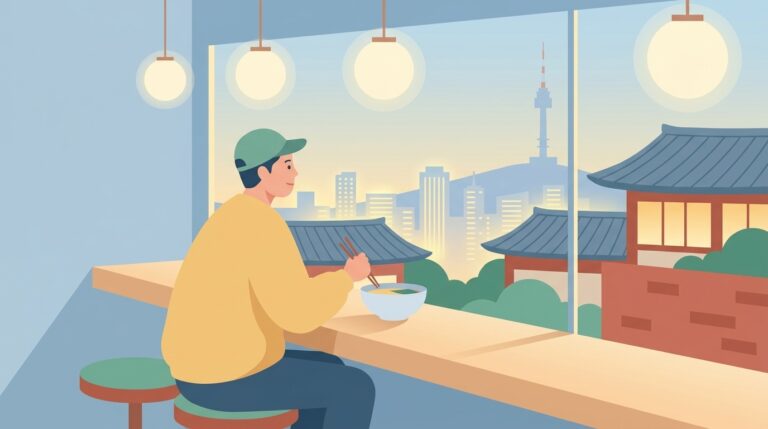
Picture this: You are walking down a neon-lit avenue in Euljiro or Sinnonhyeon on a bustling Friday evening. A decade ago, the dining scene was strictly a communal spectacle—giant grills sizzled with samgyeopsal surrounded by four-top tables clinking soju glasses under the banner of uri (우리 – we/us). Today, however, you see an entirely different urban choreography. Sleek ramen bars with acoustic privacy partitions, high-end butcher shops offering vacuum-sealed single-cut steaks, and modern residential towers full of smart “officetels” designed exclusively for one. Welcome to the ground zero of South Korea’s demographic revolution: the explosion of single-person households (1인 가구) and the hyper-sophisticated “Solo Economy” (혼코노미).
If you are operating at the CEFR C2 level, textbook phrases like “가족이 몇 명이에요?” (How many family members do you have?) simply won’t cut it anymore. When engaging with Korean business executives, policy makers, or culturally savvy locals, discussing demographics requires a masterclass in sociolinguistic nuance. You are no longer just ordering food; you are navigating the subtle tension between Korea’s historic collectivist ethos and the rapid ascent of hyper-individualized consumer autonomy.
Learners often tell me, “I know how to say I live alone, but I sound like a robotic census bureau agent when discussing societal trends!” That is precisely why this guide exists. Based on real feedback from advanced expats and corporate professionals in Seoul, we will examine the high-frequency discourse, sociopolitical lexicon, and cultural subtext necessary to analyze South Korea’s solo economy like a native cultural insider.
Phase 2: Core Expressions Deep Dive
1. 1인 가구 맞춤형 소비 트렌드 (1-in gagu matchumhyeong sobi teurendeu)
- Pronunciation: [Il-in ga-gu ma-chum-hyeong so-bi teu-ren-deu] (Think: “Eel-in” + “Gah-goo” + “Ma-choom-hyung” + “So-bee” + “Teu-ren-deu”)
- Meaning: Literal: “Single-person household tailored consumption trend” | Real Nuance: The holistic market pivot catering to solo urbanites—from micro-appliances to customized single-serving gourmet delivery.
- K-Culture Moment: Commonly heard in economic roundtables on SBS CNBC or YouTube business podcasts like Sampro TV when breaking down why retail conglomerates are abandoning mega-marts in favor of specialized urban distribution hubs.
- Editor’s Insight: At the C2 level, notice the affix -맞춤형 (-customized/tailored). Pairing it with demographic nouns immediately elevates your speech from conversational chatter to professional socioeconomic discourse.
- Situation Spectrum:
- Casual: ⚠️ (Slightly heavy for casual banter, though understood)
- Semi-formal: ✅ (Perfect for coffee chats about society or real estate)
- Formal: ✅ (Indispensable in business presentations, panel discussions, and essays)
- 🤔 Think About It: In English, we often use generic business jargon like “single market trends.” How does the Korean emphasis on “tailoring” (맞춤형) reflect a service culture obsessively engineered to eliminate solitary inconveniences?
2. 자발적 비혼과 혼삶의 정착 (Jabaljeok bihon-gwa honsalmui jeongchak)
- Pronunciation: [Ja-bal-jeok bi-hon-gwa hon-salm-ui jeong-chak] (Think: “Jah-bal-juck” + “Bee-hon-gwa” + “Hone-salm-wee” + “Jung-chock”)
- Meaning: Literal: “Voluntary non-marriage and the settling of solo life” | Real Nuance: The normalization of independent single living as an affirmative lifestyle choice, rather than a reluctant compromise or an unmarried failure.
- K-Culture Moment: Frequently dissected on cultural panel shows like Alssulsinjap (알쓸신잡) or lifestyle documentaries tracking young professionals who invest heavily in luxury interior decor, interior plants (반려식물), and pets instead of wedding dowries.
- Editor’s Insight: Note the distinction between 미혼 (mihon – “not yet married,” implying an eventual expectation) and 비혼 (bihon – “intentionally unmarried”). C2 mastery requires ditching outdated terminology to accurately capture modern sociolinguistic agency.
- Situation Spectrum:
- Casual: ✅ (Used among thoughtful peers discussing modern life paths)
- Semi-formal: ✅ (Cultural critiques, social media op-eds)
- Formal: ✅ (Academic papers, sociological keynote addresses)
- 🤔 Think About It: Does your native language distinguish between “unmarried” as an unfinished state versus an active philosophical stance?
3. 소포장 프리미엄화 (Sopojang peurimieomhwa)
- Pronunciation: [So-po-jang peu-ri-mi-eom-hwa] (Think: “So-po-jahng” + “Poo-ree-mee-um-hwah”)
- Meaning: Literal: “Small packaging premiumization” | Real Nuance: The market phenomenon where small portions are engineered as high-end, aesthetic, and nutritionally dense luxury goods, reversing the historical stigma that buying in small quantities is uneconomical.
- K-Culture Moment: A walk through a high-end food hall in Gangnam (such as The Hyundai Seoul or Shinsegae Gangnam’s Sweet Park) reveals half-cut melons wrapped in artisanal Japanese paper and single-portion aged Hanwoo beef steaks.
- Editor’s Insight: The suffix -화 (-ization) denotes transformative systemic shifts. When paired with 소포장 (small packaging) and 프리미엄 (premium), it highlights how the solo economy has shed its “cheap instant noodle” image to embrace affluent urban minimalism.
- Situation Spectrum:
- Casual: ⚠️ (Slightly analytical; peers might just say “소포장 비싸게 잘 나온다”)
- Semi-formal: ✅ (Market analysis, consumer product reviews)
- Formal: ✅ (Corporate strategy meetings, FMCG retail analysis)
- 🤔 Think About It: How does the visual dignity of packaging compensate for the psychological absence of a shared family table?
Phase 3: Textbook Korean vs. Real Native Korean
Situation 1: Explaining your grocery shopping habits as a single resident
- 📖 교과서 한국어 (Textbook):
“저는 혼자 살기 때문에 마트에서 대용량 음식을 사지 않고, 작은 크기의 제품을 구매합니다.”
(Jeoneun honja salgi ttaemune mateueseo daeyongnyang eumsigeul saji anko, jageun keugiui jepumeul gumaepamnida. / Because I live alone, I do not buy large-capacity foods at the supermarket and purchase small-sized products.) - 🗣️ 진짜 한국어 (Real Native C2):
“솔로 이코노미가 대세잖아요. 괜히 대용량 샀다가 버리는 게 반이라, 요즘엔 돈 좀 더 주더라도 마켓컬리나 편의점에서 프리미엄 소포장 위주로 쟁여두는 편이에요.”
(Solo ikonomiga daesejanh-ayo. Gwaenhi daeyongnyang satdagga beorineun ge ban-ira, yojeumen don jom deo judeorado Maketkeollina pyeon-uijeom-eseo peurimieom sopojang wijuro jaeng-yeoduneun pyeon-ieyo. / The solo economy is the dominant trend now. Buying in bulk usually ends up with half of it in the trash, so even if it costs a bit more, I tend to stock up on premium micro-portions from Market Kurly or convenience stores.) - 💡 왜 다를까? (Why the difference?):
Native C2 speakers avoid clumsy explanatory clauses (혼자 살기 때문에) in favor of idiomatic economic shorthand (대세잖아요), vivid colloquial verbs (쟁여두다 – to stockpile), and relatable cost-benefit analysis of food waste.
Situation 2: Analyzing the changing public perception of solitary life
- 📖 교과서 한국어 (Textbook):
“한국 사회에서 1인 가구가 늘어나면서 혼자 밥을 먹는 사람들을 불쌍하게 생각하지 않게 되었습니다.”
(Hanguk sahoe-eseo il-in gaguga neureonamyeonseo honja babeul meongneun saramdeureul bulssanghage saenggakhaji anke doe-eosseumnida. / As single-person households increase in Korean society, people have stopped considering those who eat alone as pitiful.) - 🗣️ 진짜 한국어 (Real Native C2):
“과거의 집단주의적 잣대로 혼삶을 동정하던 시대는 지났죠. 이제 혼밥은 어엿한 하나의 라이프스타일이자, 소비 권력으로 당당하게 대접받고 있으니까요.”
(Gwageoui jipdanjueuijeok jatdaero honsalmeul dongjeonghadeon sidaeneun jinatjyo. Ije honbabeun eoyeothan hana-ui ripeuseutair-ija, sobi gwonryeogeuro dangdanghage daejeopbatgo isseunikkayo. / The era of pitying solo living through the lens of past collectivism is long gone. Eating alone has become an established lifestyle in its own right, proudly treated as a formidable consumer power.) - 💡 왜 다를까? (Why the difference?):
The textbook version treats the change simplistically (pity vs. no pity). A C2-level speaker deploys sophisticated philosophical vocabulary like 집단주의적 잣대 (collectivist yardstick) and 소비 권력 (consumer sovereign power).
Phase 4: K-Culture Deep Dive & Non-Verbal Manners
4-1. 눈치 (Nunchi) & Gestures in the Era of Solo Living
Even as solo consumption accelerates, Korean non-verbal manners remain heavily grounded in mutual spatial consideration (배려).
* The Solo Dining Glance: When entering a casual gourmet dining establishment during the lunch rush (11:45 AM – 1:00 PM), do not monopolize a four-top table. Instead, execute a smooth scan for the 바 테이블 (bar counter seating) or 1인석 (dedicated solo booth). Direct a light nod toward the staff and raise a single index finger unobtrusively at chest height while making eye contact, signaling: “혼자입니다” (Party of one). This displays high-level 눈치 (nunchi) by reassuring the owner that you will not block table turnover for larger parties.
* Acoustic Restraint in “One-Room” (원룸) Culture: Residential density in Korean studio complexes (오피스텔 and 원룸텔) means acoustic privacy is a paramount ethical standard. High-level urbanites close doors with a muted click, wear soft indoor slippers, and avoid talking on speakerphone in common hallways. The cultural motto of modern solo living is 폐 끼치지 않기 (avoiding becoming a burden to others).
4-2. Cultural Code Analysis: From “Let’s Eat” to “I Live Alone”
South Korean media has mirrored this demographic seismic shift with astonishing clarity. In early 2010s dramas like Let’s Eat (식샤를 합시다), characters living alone were often portrayed as eccentric, isolated, or pathologically starved for family intimacy, finding solace primarily through eating feasts with neighbors.
Fast forward to today’s cultural flagship: MBC’s long-running reality variety show 나 혼자 산다 (I Live Alone). The narrative has completely inverted. Solitary life is no longer an interim waiting room for marriage; it is depicted as the ultimate aspirational aesthetic—featuring interior design showcases (홈카페, 플랜테리어), fine wine tastings, and mindful solitary rituals. Simultaneously, convenience stores (편의점) have evolved from utilitarian late-night pit stops into curated cultural lifestyle hubs offering sommelier-picked natural wines, restaurant-collab meal kits (RMR – Restaurant Meal Replacements), and dry-cleaning drop-offs. The modern single Korean is no longer alone; they are sovereign.
Phase 5: Real-World Roleplay Scenario
Setting: A chic specialty roastery in Seongsu-dong. You are consulting with Team Leader Jeong Min-woo (정민우 팀장), an FMCG brand strategist analyzing the launch of a new food-tech product line targeting Korea’s single-person households.
- 정민우 팀장: 이번 분기 1인 가구 타깃 신제품 기획안 보셨어요? 우리 부서에선 완전 파격적인 소포장 구독 서비스로 방향을 잡았거든요. (Ibeon bungi il-in gagu tagit sinjepum gihoegan bosyeosseoyo? Uri buseoe-seon wanjeon pagyeokjeogin sopojang gudok seobiseuro banghyang-eul jabatgeodeunyo. / Did you see the new product proposal targeting single-person households this quarter? Our department took a radical direction toward micro-packaged subscription services.)
🎭 Leaning back with a curious look, taking a sip of pour-over coffee. -
You: 네, 검토해 봤습니다. 단순히 양을 줄인 기존의 ‘소용량’ 접근법을 벗어나서, 품질과 디테일에 집중한 점이 아주 인상적이었습니다. (Ne, geomtohae bwasseumnida. Dansunhi yang-eul jurin gijonui ‘so-yongnyang’ jeopgeunbeobeul beoseonaseo, pumjilgwa diteire jipjunghan jeomi aju insangjeogieosseumnida. / Yes, I reviewed it. What impressed me most was that it broke away from the conventional ‘small-volume’ approach of merely reducing portion sizes, focusing instead on quality and detail.)
🎭 Nodding with deliberate professional composure, tapping the tablet screen. -
정민우 팀장: 맞아요! 솔직히 이전까진 1인 가구 소비를 ‘가성비’로만 해석했잖아요? 근데 요즘 혼삶러들은 취향과 편의성에 아낌없이 지갑을 열거든요. (Majayo! Soljikhi ijeonkkajin il-in gagu sobireul ‘gaseongbi’roman haeseokhaetjanh-ayo? Geunde yojeum honsalmeodeureun chwihyang-gwa pyeon-uiseong-e akkim-eopsi jigabeul yeolgeodeunyo. / Exactly! Honestly, haven’t we interpreted single-household consumption purely through ‘cost-effectiveness’ until now? But solo livers these days open their wallets generously for personal taste and convenience.)
🎭 Gesturing emphatically with both hands, eyes widening with enthusiasm. -
You: 정확한 지적이십니다. 이른바 ‘혼코노미’의 질적 고도화죠. 가격 민감도보다는 나의 시간과 자존감을 지켜주는 제품에 프리미엄을 기꺼이 지불하니까요. (Jeonghwakhan jijeogisimnida. Ireunba ‘honkonomi’ui jiljeok godohwajyo. Gagyeok mingamdobodaneun naui sigangwa jajongameul jikyeojuneun jepume peurimieomeul gikkeo-i jiburlhanikkayo. / That’s a pinpoint observation. It’s the qualitative sophistication of the so-called ‘honconomy.’ Rather than price sensitivity, they gladly pay a premium for products that safeguard their time and self-esteem.)
🎭 Making steady eye contact, smiling knowingly with quiet confidence. -
정민우 팀장: 그렇다면 유통 채널은 어떻게 보시나요? 아무래도 오프라인 매장보다는 새벽배송이나 편의점 플랫폼에 전력을 다해야겠죠? (Geureotamyeon yutong chaeneoreun eotteoke bosinayo? Amuraedo opeurain maejangbodaneun saebyeokbaesong-ina pyeon-uijeom peullaetpome jeonryeogeul dahaeyagetjyo? / How do you view the distribution channels then? Should we put all our weight behind early-morning delivery and convenience store platforms rather than traditional offline stores?)
🎭 Resting his chin on his intertwined fingers, anticipating your strategic take. -
You: 당연히 온·오프라인의 접점을 영리하게 설계해야 합니다. 새벽배송의 즉각성과 집 앞 편의점의 라스트마일 접근성을 상호보완적으로 엮어야 승산이 있습니다. (Dang-yeonhi on-opeurain-ui jeopjeomeul yeongrihage seolgyehaeya hamnida. Saebyeokbaesong-ui jeukgakseong-gwa jip ap pyeon-uijeom-ui raseutumail jeopgeunseong-eul sanghobo-wanjeogeuro yeokk-eoya seungsan-i isseumnida. / Naturally, we must cleverly design the touchpoints between online and offline. There is a viable chance of victory only if we interconnect the immediacy of dawn delivery with the last-mile accessibility of local convenience stores.)
🎭 Outlining two converging lines on the notebook using a stylus pen. -
정민우 팀장: 하하, 역시 핵심을 꿰뚫고 계시네요. 단순한 인구 통계학적 수치를 넘어서 소비자의 심리적 허기를 채워주는 게 관건이란 뜻이군요. (Haha, yeoksi haeksimeul kkwetulko gyesineyo. Dansunhan ingu tonggyehakjeok suchireul neomeoseo sobijaui simrijeok heogireul chaewojuneun ge gwangeon-iran tteus-igunyo. / Haha, you truly see straight through to the core. You mean the real key lies in satisfying the consumer’s psychological hunger beyond mere demographic statistics.)
🎭 Nodding briskly, writing down your exact phrase in his agenda notebook. -
You: 그렇습니다. 1인 가구 시장의 본질은 ‘고립’이 아닌 ‘주체적 웰빙’의 서사를 어떻게 브랜드에 녹여내느냐에 달려 있으니까요. (Geureoseumnida. Il-in gagu sijang-ui bonjireun ‘gorip’-i anin ‘juchejeok welbing’-ui seosareul eotteoke beuraendeue nogyeonaeneunyaye dallyeo isseunikkayo. / Exactly. The essence of the single-person household market hinges on how well a brand embeds the narrative of ‘autonomous well-being’ rather than ‘isolation.’)
🎭 Offering a crisp, affirmative closing nod.
🔀 Interactive Branching Decision Point
Suppose Team Leader Jeong poses this critical follow-up question:
“하지만 이런 솔로 이코노미 상품화가 사회적 고립감이나 저출생 현상을 더 부추긴다는 비판적 시각도 존재하는데, 우리 브랜드 메시지를 어떻게 잡아야 할까요?” (However, there is also critical pushback that commercializing the solo economy accelerates social isolation and the ultra-low birthrate. How should we calibrate our brand message?)
- Choice A: “사회 문제까지 신경 쓸 필요 있나요? 기업은 트렌드를 좇아 이윤만 극대화하면 그만입니다.” (Why care about social problems? Corporations just need to chase trends and maximize profits.)
- Outcome (Bad): ❌ Displays tone-deaf corporate arrogance. In Korea’s current demographic crisis, severe ESG indifference will alienate both corporate partners and Gen-MZ consumers.
- Choice B: “가족의 소중함을 일깨워주기 위해, 혼자 사는 사람들에게 결혼을 장려하는 캠페인을 전개해야 합니다.” (To remind people of the preciousness of family, we should run a campaign encouraging single people to get married.)
- Outcome (Risk): ⚠️ Extremely patronizing. Preaching marital norms instantly alienates your core single consumer base, exposing the brand to intense generational backlash (꼰대 논란).
- Choice C (Best): “고립을 조장하는 것이 아니라, 1인 가구의 일상을 존중하고 삶의 질을 제고하는 건강한 자립을 응원한다는 공감대 중심의 스토리텔링으로 가야 합니다.” (Instead of fostering isolation, we must anchor our storytelling in empathy—supporting healthy self-reliance that respects the daily routines of single households and elevates their quality of life.)
- Outcome (Best): ✅ Demonstrates high-altitude strategic insight, cultural empathy, and sophisticated corporate positioning. C2 perfection.
Phase 6: 10-Second Emotion Shadowing Drill
Master the dynamic rhythm, pauses (/), and emotional inflection of Korean demographic thought leaders.
Drill 1: [🧐 Analytical and Sharp]
“1인 가구의 증가는 / 단순한 통계적 변곡점을 넘어서, / 한국 사회의 소비 지각 변동을 일으키는 / 가장 강력한 동인입니다.”
(Il-in gagu-ui jeunggneun / dansunhan tonggyejeok byeon-gokjeomeul neomeoseo, / hanguk sahoe-ui sobi jigak byeondong-eul ireukineun / gajang gangnyeokhan dong-in-imnida.)
“The increase in single-person households / transcends a simple statistical inflection point; / it is the most formidable driver / triggering tectonic shifts in Korean consumption.”
Drill 2: [😌 Unapologetic and Confident]
“혼자 산다고 해서 / 대충 때우던 시절은 끝났어요. / 나만의 온전한 시공간을 위해 / 기꺼이 가치 소비를 하는 거죠.”
(Honja sandago haeseo / daechung ttae-udeon sijeoreun kkeutnasseoyo. / Namanui onjeonhan sigonggan-eul wihae / gikkeo-i gachi sobireul haneun geojyo.)
“The era of scraping by simply because one lives alone / is over. / For a complete temporal and spatial sanctuary of my own, / I gladly engage in value-driven consumption.”
Drill 3: [🤔 Reflective with Sociological Depth]
“결국 솔로 이코노미의 성패는, / 개인화된 편리함 속에 / 파편화된 인간관계를 어떻게 따뜻하게 보듬느냐에 / 달려 있지 않을까요?”
(Gyeolguk solo ikonomi-ui seongpaeneun, / gae-in-hwadoen pyeonriham soge / papyeonhwadoen in-gwan-gwan-gyereul eotteoke ttatteuthage bodeumneunyaye / dallyeo itji aneulkkayo?)
“In the end, doesn’t the success or failure of the solo economy / hinge on how warmly we can embrace fragmented human bonds / within the midst of individualized convenience?”
Phase 7: K-Culture Mini Dictionary
- 혼코노미 (Honconomy)
- Definition: A portmanteau of 혼자 (honja – alone) and 이코노미 (economy). Refers to the collective market generated by consumers acting independently.
- Usage: Highly prevalent in commercial media, consumer market research, and lifestyle journalism. 예: 혼코노미 열풍으로 소형 가전 매출이 급증했다. (The honconomy boom caused sales of small household appliances to surge.)
- 딩펫족 (Dinkpet-jok)
- Definition: A blend of DINK (Double Income, No Kids) and Pet. It denotes households (often dual-income couples or solo professionals) that bypass biological child-rearing in favor of pets treated as biological heirs.
- Usage: Essential for analyzing veterinary care, pet humanization markets, and apartment animal-welfare policies.
- 고독사 예방 안전망 (Godoksa yebang anjeonmang)
- Definition: “Solitary death prevention safety net.” Social policies and IoT monitoring systems designed to detect isolated single citizens (from elderly urban poor to isolated youth) who lack regular communal checks.
- Usage: Found in municipal administrative discourse, smart city governance debates, and social welfare programs.
- 시밀레 가구 / 비혼 공동체 (Simille gagu / Bihon gongdongche)
- Definition: Intentional non-marital households formed by long-time friends, creative peers, or roommates who share living costs and social protection without legal marriage ties.
- Usage: Frequently referenced in modern legislative debates surrounding the 생활동반자법 (Civil Partnership Act) and changing legal definitions of family.
Phase 8: Survival Kit for Travelers & Expats
Top 3 Survival Phrases for Navigating Solo Seoul
- “혹시 1인분 식사도 주문 가능한가요?”
- Romanization: Hoksi il-inbun siksado jumun ganeunghangayo?
- Pro Tip: Traditional Korean barbecue (고기구이) or stews (전골/찌개) historically required a minimum 2-person order (2인분 이상). Use this polite inquiry before sitting down; many places will accommodate solo diners if you offer to order 1.5 portions or eat slightly off-peak.
- “남은 음식 깔끔하게 소포장해 주실 수 있나요?”
- Romanization: Nameun eumsik kkalkkeumhage sopojanghae jusil su innayo?
- Pro Tip: Instead of asking for a crude “doggy bag,” asking for 소포장 (micro-packaging) signals you appreciate their culinary quality and intend to preserve it hygienically at home.
- “바(Bar) 좌석이나 1인석으로 안내해 주셔도 괜찮습니다.”
- Romanization: Ba jwaseogina il-inseogeuro annaehae jusyeodo gwaenchansumnida.
- Pro Tip: Saying this directly upon entry at busy modern bistros instantly demonstrates elite situational etiquette (눈치), delighting floor managers.
Editor’s Travel Note: Living Smart as a Solo Navigator
- Essential Mobile Ecosystem: If living in or navigating urban Korea alone, ditch foreign delivery apps. Set up an account via the 네이버 지도 앱 다운로드 to locate hyper-localized solo dining venues filtering for “혼밥하기 좋은 곳” (Great places to eat alone). To stock your solo kitchenette, master Korean food apps with the 배달의민족 앱 다운로드 to utilize B-Mart’s 30-minute hyper-micro grocery delivery.
- The “Honbap Level” Checklist (혼밥 레벨): Test your cultural comfort! Level 1: Convenience store solo dining (편의점 혼밥) -> Level 3: Fast casual food court or kimbap shop -> Level 5: Solo dining in an authentic noodle/gukbap restaurant -> Level 7: Solo dining at an open samgyeopsal BBQ grill house (혼자 고깃집 가기) -> Level 9: Solo dining at a high-end seafood raw fish market or celebratory family buffet.
Phase 9: A Step Deeper (Thinking Prompt)
For centuries, South Korean identity was inextricably forged inside the crucible of the collective—the Confucian lineage (가문), the village cooperative labor (두레), and the post-war corporate solidarity unit. The dramatic contraction into solitary micro-units within a single generation has sparked an unprecedented psychological paradox. While the solo economy unleashes radical consumer autonomy and emancipates individuals from stifling traditional patriarchal expectations, it simultaneously exposes a hyper-dense society to acute existential disconnection. Korea’s solo economy is not merely a retail trend; it is an ongoing cultural renegotiation of what it means to be human in a society rapidly transitioning from “Our Country” (우리나라) to “My Life” (나의 삶).
💬 Your Turn: Does your home culture view living alone as an active marker of success, a temporary developmental phase, or an unfortunate symptom of urban estrangement? Drop your thoughts below using at least one advanced Korean term from Phase 2!
Phase 10: FAQ & Avoiding Misunderstandings
Q: Is dining alone (혼밥) still stigmatized in South Korea?
A: Not in the slightest among urban centers and the younger population. While an older generation raised on communal village traditions might occasionally ask an elder relative why they are eating alone, the market has completely normalized solo dining. Dedicated counter partitions, digital self-order kiosks, and restaurant marketing celebrating 혼밥족 have made solo dining a completely mainstream practice.
Q: What is the difference between 1인 가구 and 독거노인?
A: 1인 가구 (single-person household) is a broad, neutral demographic and statistical category encompassing anyone who lives alone, including affluent corporate singles and college students. 독거노인 specifically denotes an elderly citizen living alone in precarious, often economically or socially vulnerable conditions. Conflating the two will cause severe misunderstandings in sociological and demographic discussions.
Q: Why do young Koreans prefer the term 비혼 over 미혼?
A: 미혼 (未婚) uses the Chinese character 미 (not yet), which embeds an implicit presumption that marriage is an inevitable social obligation one has simply not fulfilled yet. 비혼 (非婚) uses 비 (non/negation), declaring non-marriage as an intentional, valid, and permanent life choice.
🚨 Common Mistakes Alert (흔한 실수 TOP 3)
- Mistake: Using “혼자 살아요” (I live alone) in high-level business presentations.
- Correct Action: Use “현재 1인 가구로 생활하고 있습니다” (I am currently residing as a single-person household) to convey professional gravitas.
- Mistake: Calling single-portion groceries “작은 것” (small things).
- Correct Action: Refer to them as “소포장 제품” (micro-packaged products) or “1인 맞춤형 상품” (single-tailored goods).
- Mistake: Assuming “고독사” (lonely death) only applies to the elderly.
- Correct Action: Recognize that recent Korean public policy specifically highlights 청년 고독사 (youth solitary death caused by social isolation and employment despair). Be mindful of its broad demographic scope when analyzing social welfare issues.
Phase 11: Action Missions
- 🥉 Bronze Mission (Solo Mastery): Stand in front of a mirror and practice the 3 Shadowing Drills from Phase 6, focusing on maintaining vocal cadence and cutting pauses at the designated
/markers. - 🥈 Silver Mission (Social Application): The next time you post a photo of a single-serving meal or a solitary urban coffee moment on Instagram or Threads, write your caption in Korean using the terms:
#혼코노미,#소포장, and#혼삶. - 🥇 Gold Mission (Real-World Execution): Enter a restaurant in Korea or engage a Korean acquaintance in conversation. Use Phase 5’s phrasing to comment on contemporary solo culture: “한국도 이제 1인 가구가 전체의 40%를 넘어서면서 소비 패턴이 완전히 달라진 것 같아요.” (As single households surpass 40% in Korea, consumption patterns seem to have completely transformed.)
🎮 K-Culture Mission: Watch one episode of MBC’s variety show 나 혼자 산다 (I Live Alone) or a segment of SBS’s 골목식당 featuring kiosk transformations. Count how many times you hear the prefix 혼- (혼밥, 혼술, 혼영, 혼투어). Note the context and share your tally in the comments!
Phase 12: Interactive Quiz Challenge
1. Situational Judgment
You are attending a marketing seminar in Seoul. A Korean panelist states: “이제 1인 가구 시장을 저가 위주의 박리다매 전략으로 접근하면 필패합니다.” (Approaching the single-person household market with a low-cost, high-volume strategy is now a surefire failure.) How should you best respond to demonstrate advanced cultural and demographic comprehension?
* (A) “맞아요, 편의점 도시락은 싸구려 음식이라서 아무도 안 사 먹거든요.”
* (B) “전적으로 동감합니다. 현대 혼삶러들은 편의성과 심리적 만족을 위해서라면 기꺼이 프리미엄 소포장에 비용을 지불하니까요.”
* (C) “아닙니다, 1인 가구는 돈이 없기 때문에 무조건 제일 싼 음식만 찾습니다.”
2. Fill-in-the-Blank
Fill in the missing socioeconomic term:
“과거에는 ‘아직 결혼하지 않았다’는 의미의 ( )이라는 표현을 주로 썼지만, 최근에는 자신의 의지로 결혼을 선택하지 않는 ( )이라는 용어가 주체적인 삶의 방식으로 자리 잡았습니다.”
3. True / False Cultural Check
- Statement: In modern Korea, ordering a multi-portion barbecue dish (고기 2인분) while dining alone at an authentic BBQ restaurant is strictly illegal under commercial municipal codes.
- True or False?
👉 Click to view answers and explanations
-
Answer: (B)
Explanation: Option B accurately identifies the qualitative evolution of the solo economy (프리미엄 소포장 and value consumption). Option A is factually incorrect because convenience store meal kits are an enormous high-growth industry. Option C relies on an outdated, reductionist stereotype. -
Answer: 미혼 (Mihon) / 비혼 (Bihon)
Explanation: Moving from 미혼 (unmarried/not yet married) to 비혼 (intentionally non-married) is the quintessential linguistic marker of modern autonomy in Korean demographic discourse. -
Answer: False
Explanation: It is definitely not illegal! In traditional establishments with high table overhead, owners simply require a minimum order equivalent to two portions (2인분 기본 주문) to cover the gas, charcoal, and abundant side dishes (반찬). If a solo diner pays for two portions, they are more than welcome to feast alone.







