

Phase 1: Empathy (Storytelling Opening)
안녕하세요! 매일한글 에디터입니다. (Hello! It’s your Daily Hangul editor here.)
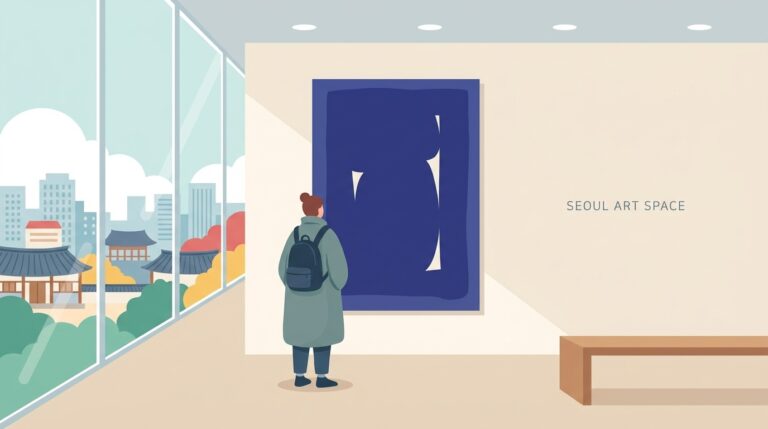
Picture this: You are standing in the quiet, sun-drenched minimalist pavilion of the Leeum Museum of Art in Hannam-dong or MMCA in Samcheong-dong. Standing next to you is a Korean friend, a design colleague, or even someone you really want to impress on an artsy weekend date. In front of you hangs a colossal canvas—perhaps a deep, indigo blue monochrome piece by Kim Whanki or an enigmatic textural composition by Park Seo-bo. There are no figures, no clear landscapes, just pure abstraction.
Your companion tilts their head, gazes at the piece for a lingering moment, and sighs softly: “이 작품, 볼수록 묘한 울림이 있네요. (I jakpum, bolsurok myohan ullimi innehyo.)” They turn to you with curious, expectant eyes: “어떻게 느껴지세요? (Eotteoke neukkyeojiseyo? – How does it feel to you?)”
In your head, your brain scrambles. You want to express something profound, but your vocabulary defaults to beginner phrases: “음… 예뻐요 (Um… it’s pretty)” or “파란색이 많아요 (There is a lot of blue)” or the brutally honest “이해 못 하겠어요 (I don’t understand it).” You immediately feel that awkward disconnect. In Western gallery culture, people love analyzing the artist’s conceptual thesis or debating technical theories. But in Korea’s vibrant contemporary art scene, aesthetic conversation is an elegant dance of emotional resonance, contemplative pauses, and poetic tact.
As advanced (C1) Korean learners, you don’t just need vocabulary to survive at a convenience store; you need the sophisticated linguistic toolkit to converse about art, mood, and abstract human emotion. Based on years of mentoring learners through cultural masterclasses, this guide is designed to transform you from a tongue-tied spectator into a poetic, culturally attuned art conversationalist.
Phase 2: Core 3 Expressions In-Depth
1. 여백의 미가 느껴지다 (한글)
- Pronunciation: [Yeo-bae-gui mi-ga neu-kkyeo-ji-da] (Sounds like “yaw-beck-ee mee-gah noo-kyeo-jee-dah” — roll the soft vowels smoothly like a brush dipping in water)
- Meaning:
- Literal: To feel the beauty of the empty margin/white space.
- Nuance: Finding aesthetic depth not in what is aggressively filled in, but in the restraint, silence, and open space deliberately left behind.
- K-Culture Moment: You will often hear this in modern lifestyle documentaries, architectural tours of Hanok homes, or when BTS’s RM discusses traditional ink paintings (Suhwa) and modern Korean minimalism (Dansaekhwa). When an idol or actor describes a minimalist interior or a sparse album cover, they praise its “여백의 미.”
- Editor’s Insight: Traditional Korean aesthetics celebrate what is absent just as much as what is present. Saying this demonstrates an innate understanding of East Asian spatial philosophy. It elevates your critique from “it looks empty” to “its emptiness holds profound grace.”
- Situation Spectrum: Casual (✅ with close friends) | Semi-formal (✅ colleagues/dates) | Formal (✅ gallery Q&A / reviews)
- 🤔 Think About It: In many Western modernist contexts, negative space is analyzed as a structural composition element. In Korean, calling it “미 (beauty)” turns absence into an emotional, spiritual presence. How does your native language treat empty space in creative works?
2. 직관적으로 와닿다 (한글)
- Pronunciation: [Jik-gwan-jeo-geu-ro wa-dat-da] (Sounds like “jeek-gwan-jeog-oo-row wah-daht-dah” — crisp initial consonants, ending with a grounded stop)
- Meaning:
- Literal: To intuitively arrive and touch (one’s heart).
- Nuance: To strike you instantly without the need for intellectual overthinking or rational deciphering.
- K-Culture Moment: Seen frequently in K-Dramas like Her Private Life (그녀의 사생활) where curators discuss why a modern artwork moves them, or in entertainment talk shows when songwriters explain why a demo track hit them on first listen.
- Editor’s Insight: Abstract art can intimidate anyone. Native speakers rarely pretend they understand every curatorial statement. Instead, they say “이론은 잘 모르겠지만, 직관적으로 확 와닿아요 (I may not know all the theory, but it hits me intuitively).” It sounds honest, mature, and deeply perceptive.
- Situation Spectrum: Casual (✅) | Semi-formal (✅) | Formal (✅)
- 🤔 Think About It: Notice the verb “와닿다” (to come and touch). In Korean, emotions often travel toward the listener rather than the listener “getting” the object. How does this shift the agency of feeling?
3. 작가의 의도를 곱씹어 보다 (한글)
- Pronunciation: [Jak-ga-ui ui-do-reul gop-ssi-beo bo-da] (Sounds like “jahk-gah-wee oo-ee-doh-reul gope-shee-baw boh-dah” — emphasize the tense 씹 like gently chewing)
- Meaning:
- Literal: To chew over and reflect on the artist’s intention.
- Nuance: To ruminate, contemplate, or slowly digest what the artist might have meant rather than rushing to a hasty judgment.
- K-Culture Moment: Used by seasoned critics, literary figures, and cinema lovers on popular podcasts like Movie Room (방구석 1열) when dissecting arthouse cinema or experimental gallery exhibitions.
- Editor’s Insight: The verb “곱씹다” comes from ruminating food (like a cow chewing cud). Applied to art or thoughts, it depicts patience and intellectual maturity. It signals that you are willing to let the artwork linger in your mind.
- Situation Spectrum: Casual (⚠️ slightly poetic for small talk, but okay) | Semi-formal (✅) | Formal (✅)
- 🤔 Think About It: Would you usually say “I’m analyzing the artist’s goal” in English? Notice how “chewing over” in Korean conveys sensory patience rather than sterile academic analysis.
Phase 3: Textbook Korean vs. Real Korean
Situation 1: Expressing that an abstract piece is difficult or ambiguous
- 📖 교과서 한국어 (Textbook Korean):
- “이 그림은 이해하기 매우 어렵습니다.” (I geurimeun iyehae-hagi maeu eoryeopseumnida. – This painting is very difficult to understand.)
- 🗣️ 진짜 한국어 (Real-World C1 Korean):
- “해석의 여지가 열려 있어서 더 묘한 매력이 있네요.” (Haeseog-ui yeojiga yeollyeo isseoseo deo myohan maeryeogi innehyo. – Because it leaves plenty of room for interpretation, it has this subtle, enigmatic charm.)
- 💡 왜 다를까? (Why the difference?):
Directly declaring “I don’t understand” can sound flat and can unintentionally kill the contemplative mood. Advanced Korean speakers frame ambiguity as an invitation for open thought, using “여지 (room/margin for)” and “묘하다 (subtle/peculiar/fascinating).”
Situation 2: Asking your companion for their perspective
- 📖 교과서 한국어 (Textbook Korean):
- “당신의 생각은 무엇입니까?” (Dangsin-ui saenggakeun mueos-imnikka? – What is your thought?)
- 🗣️ 진짜 한국어 (Real-World C1 Korean):
- “어떤 느낌이 먼저 와닿으세요?” (Eotteon neukkimi meonjeo wadateuseyo? – What sensation strikes you first?)
- 💡 왜 다를까? (Why the difference?):
The pronoun “당신 (dangsin)” is unnatural and confrontational in real-life spoken Korean. Moreover, asking for “thoughts (생각)” demands a logical defense, whereas asking for “sensations (느낌)” opens a warm, low-pressure shared aesthetic space.
Phase 4: K-Culture Deep-Dive & Non-Verbal Manners
4-1. 눈치 (Nunchi) & Gallery Etiquette
In Korean contemporary galleries (such as Kukje Gallery, PKM, or Arario), the atmosphere is often as hushed as a zen garden.
* The Visual Distance Ritual: Koreans rarely stand directly glued to an abstract canvas. They take three steps back, cross their arms loosely or clasp their hands behind their back (뒷짐 지기 / dwit-jjim ji-gi), tilt their head at about a 15-degree angle, and pause. Standing silently for 10-15 seconds before uttering a single word is considered the height of cultured etiquette.
* The Whispering Register (소곤소곤 / sogon-sogon): If you speak, lower your pitch and volume by half. Speak towards your companion’s shoulder, not across the room.
* The Open-Ended Agreement Nod: When a companion shares an observation, a soft “그러게요… (Geureogeyo… – Indeed…)” paired with a slow, contemplative nod validates their sensibility without turning the conversation into a debate.
4-2. Cultural Code: The Dansaekhwa Wave & The “RM Effect”
Abstract art in modern Korea is experiencing an unprecedented cultural renaissance. Historically, Korean monochrome painting (Dansaekhwa / 단색화) was an act of meditative, repetitive labor—artists applying layers of Hanji paper, scraping oil with knives, or drawing endless lines to merge spirit and material.
Today, figures like RM of BTS have democratized this high-brow world into a public cultural pilgrimage (often nicknamed the “RM Tour”). Young Koreans visit galleries not to pretend to be art historians, but for 쉼 (swim – restorative rest) and 물멍 (mul-meong – zoning out watching patterns). Abstract art is seen as an antidote to the hyper-stimulating, cut-throat pace of daily Korean city life.
Phase 5: Real-World Roleplay Scenario
Setting: A quiet weekday afternoon inside a sunlit exhibition hall at the Seoul Museum of Art (SeMA), Deoksugung branch. You are standing before a massive, textural abstract canvas featuring deep charcoal strokes on unbleached linen canvas.
Characters:
* 지원 (Ji-won): Your Korean friend who works in creative branding, possessing a keen eye for aesthetics.
* You: Advanced Korean speaker exploring modern art together.
지원: (천천히 캔버스 앞으로 다가가며 턱을 괸 채) “이 작품, 멀리서 볼 때랑 가까이서 볼 때 느낌이 확 다르지 않아요?”
(I jakpum, meolliseo bol ttaerang gakkai-seo bol ttae neukkimi hwak dareuji anayo?)
🎭 Leaning in slightly, resting chin on hand thoughtfully
“Doesn’t this piece feel completely different up close compared to from afar?”
You: “정말 그렇네요. 멀리서는 단순한 단색화인 줄 알았는데, 가까이서 보니 붓터치의 질감이 고스란히 살아있어요.”
(Jeongmal geureonneyo. Meolliseoneun dansunhan dansaekwain jul aranneunde, gakkai-seo boni but-teochi-ui jil-gami goseuranhi sara-isseoyo.)
🎭 Taking a step back and examining the textured brush marks
“You’re so right. From far away, I thought it was just a simple monochrome, but up close, the texture of the brushwork is so vividly alive.”
지원: “맞아요. 뭔가 인위적으로 꾸미지 않은 담백함이 있어서… 시선이 계속 머물게 되네요. 혹시 어떤 인상을 받으셨어요?”
(Majayo. Mweonga inwijeog-euro kkumiji aneun dambaek-hami isseoseo… siseoni gyesok meomulge doeneyo. Hoksi eotteon insang-eul badeusyeosseoyo?)
🎭 Speaking in a quiet, relaxed tone, smiling warmly
“Exactly. It has this unadorned, unpretentious purity… my gaze just keeps lingering on it. What kind of impression did it leave on you?”
You: “복잡한 형태가 없어서 오히려 마음이 차분해져요. 여백의 미가 자연스럽게 와닿는 것 같아요.”
(Bokjapan hyeongtaega eopseoseo ohi려 maeumi chabunhaejyeoyo. Yeobaeg-ui miga jayeonseureopge wadanneun geot gatayo.)
🎭 Nodding slowly, taking in the empty space of the canvas
“Because there are no complicated figures, it actually calms my mind. The beauty of the empty space naturally resonates with me.”
지원: “오, ‘여백의 미’라니! 표현이 너무 시적인데요? 사실 처음엔 현대 미술이 좀 난해하다고만 생각했는데, 듣고 보니 정말 그래요.”
(Oh, ‘yeobaeg-ui mi’-rani! Pyoheoni neomu sijeog-indeyo? Sasil cheoeumen hyeondae misuri jom nanhaehadago-man saenggak-haenneunde, deutgo boni jeongmal geuraeyo.)
🎭 Eyes lighting up in pleasant surprise, giving a soft laugh
“Oh, ‘the beauty of empty space’! That sounds so poetic! Honestly, I used to think contemporary art was just baffling, but hearing you say that, it really makes sense.”
You: “저도 예전엔 무조건 해석하려고만 애썼거든요. 그런데 이젠 작가의 의도를 억지로 풀기보다, 그냥 이 공간 자체를 감상하게 돼요.”
(Jeodo yejeonen mujogeon haeseok-haryeogo-man aesseot-geodeunyo. Geureonde ijen jakga-ui uido-reul eokjiro pulgi-boda, geunyang i gonggan jache-reul gamsang-hage dwaeyo.)
🎭 Looking around the airy gallery room comfortably
“I used to struggle just trying to decipher it, too. But now, instead of forcing myself to crack the artist’s code, I just enjoy this whole space as it is.”
지원: “그 관조하는 태도, 너무 멋져요. 저기 옆 방에 설치 미술도 크게 들어왔다던데, 마저 보러 갈까요?”
(Geu gwanjohaneun taedo, neomu meotjyeoyo. Jeogi yeop bang-e seolchi misuldo keuge deureowat-dadeon-de, majeo boreo galkkayo?)
🎭 Gesturing gently toward the connecting exhibition hall
“That contemplative mindset of yours is so cool. I heard there’s a large-scale installation in the next hall—shall we go check it out?”
You: “좋아요! 오늘은 시간에 쫓기지 말고 천천히 곱씹어 보면서 둘러봐요.”
(Joayo! Oneureun sigane jjokgiji malgo cheoncheonhi gopssip-eo bomyeonseo dulleobwayo.)
🎭 Smiling, matching footsteps at an unhurried pace
“Sounds wonderful! Let’s take our time without rushing today and savor every piece thoroughly.”
🔀 Interactive Decision Fork
Imagine Ji-won suddenly pauses in front of a completely blank white canvas with a single pencil scratch and asks: “이건 솔직히 낙서 같기도 한데… 어떻게 생각해요? (Honestly, this almost looks like a doodle… what do you think?)”
- Choice A: “맞아요, 솔직히 저도 이건 아무 의미 없는 돈 낭비 같아요.” (Yeah, honestly I think this is just a meaningless waste of money too.)
- Choice B: “언뜻 보면 단순해 보이지만, 최소한의 선으로 긴장감을 만들어낸 게 아닐까요? 작가의 의도를 곱씹어 볼 만해요.” (At a glance it seems simple, but don’t you think it creates tension with minimal lines? It’s worth chewing over the artist’s intent.)
- Choice C: “저는 서양 미술사 학위가 없어서 대답하기 곤란합니다.” (I don’t have a Western art history degree, so I cannot answer.)
Detailed Feedback:
* Choice A (Risk/Bad): While honest, calling it “돈 낭비” shuts down the creative discussion prematurely and feels overly cynical for an art gallery ambiance.
* Choice B (Best!): C1 Master Class! You acknowledge their initial hesitation (“언뜻 보면 단순해 보이지만”) while offering a subtle, balanced perspective using “곱씹어 보다” and “긴장감.”
* Choice C (Stiff/Awkward): Excessively literal and defensive. It creates social awkwardness and ruins the friendly rapport.
Phase 6: 10-Second Emotion Shadowing Drill
Read these aloud while honoring the natural pause markers (/) and feeling the marked emotional state.
[🤔 차분하게 사색하며 / Calmly contemplative]
“형태가 뚜렷하지 않아서 / 오히려 상상할 수 있는 여지가 / 많은 것 같아요.”
(Hyeongtaega tturyeot-haji anaseo / ohi려 sangsang-hal su inneun yeojiga / maneun geot gatayo.)
“Because the forms aren’t defined / it actually feels like there’s / so much room for imagination.”-
[✨ 잔잔한 감탄을 담아 / With subtle awe]
“캔버스 질감에서 느껴지는 물성이 / 묘하게 마음을 울리네요.”
(Kaenbeoseu jilgame-seo neukkyeojineun mulseongi / myohage maeumeul ullineyoh.)
“The sheer materiality felt in the canvas texture / resonates with my heart in such an enigmatic way.” -
[💬 다정하고 조심스럽게 / Warmly and tactfully]
“어떤 분들은 난해하다고 하겠지만, / 저는 직관적으로 확 와닿았어요.”
(Eotteon bundeureun nanhaehadago hagetjiman, / jeoneun jikgwanjeog-euro hwak wadadasseoyo.)
“Some people might call it perplexing, / but to me, it clicked intuitively in an instant.”
Phase 7: K-Culture Mini Dictionary
-
여백의 미 (Yeobaeg-ui mi) | Noun
- Definition: The aesthetic appreciation of negative space or absence.
- Usage: Not just for paintings! Koreans use this in fashion (minimalist, clean looks), home decor (spacious, uncrowded layouts), and even conversation (not filling every single quiet second with chatter).
- 물성 (Mulseong) | Noun (Advanced C1)
- Definition: Materiality; the physical and tactile qualities of an artistic medium.
- Usage: Essential when discussing contemporary installations or textured paintings. E.g., “이 조각은 돌의 거친 물성을 그대로 살렸어요. (This sculpture fully preserves the rough materiality of stone.)”
- 관조하다 (Gwanjohada) | Verb (Advanced C1)
- Definition: To quietly contemplate or view something with calm detachment.
- Usage: Used in literary essays, art reviews, or self-reflection. E.g., “작품을 한 걸음 물러서서 관조하다 보면 내면이 정돈됩니다. (When you step back and quietly contemplate the artwork, your inner thoughts settle.)”
- 와닿다 (Wadatta) | Verb
- Definition: To resonate emotionally; to hit home.
- Usage: Ubiquitous in modern Korean. E.g., “그 대사가 가슴에 깊이 와닿았어요 (That drama line really struck a chord in my heart).”
Phase 8: Traveler’s Survival Kit
Top 3 Survival Expressions for Art Lovers
- “혹시 사진 촬영 가능한 구역인가요?” (Hoksi sajin chwaryeong ganeung-han guyeog-ingayo?)
- Meaning: Excuse me, is photography permitted in this area?
- Pro Tip: Many Korean galleries allow phone photography without flash, but specific special exhibitions strictly prohibit it. Always ask before snapping.
- “오디오 도슨트나 해설 프로그램이 따로 있나요?” (Odio doseonteu-na haeseol peurogeuraemi ttaro innayo?)
- Meaning: Is there an audio docent guide or commentary program available?
- Pro Tip: Major institutions like Leeum, MMCA, and Seoul Museum of Craft Art offer slick smartphone-based audio guides in both Korean and English—frequently voiced by famous actors or musicians!
- “사전 예약 없이 현장 발권도 가능한가요?” (Sajeon yeyak eopsi hyeonjang balgwondo ganeung-hangayo?)
- Meaning: Is on-site ticketing possible without a prior reservation?
- Pro Tip: Post-pandemic, many Seoul marquee exhibitions require reservations. Knowing this line will save you a wasted trip to a sold-out blockbuster show.
Editor’s Travel Note
- Art District Hotspots: If you are visiting Seoul, don’t miss Samcheong-dong (home to MMCA Seoul, Kukje Gallery, and charming Hanok cafes) and Hannam-dong (Leeum Museum and hip boutique galleries).
- Seamless Navigation: Download the 네이버 지도 앱 (Naver Map App) to search for nearby galleries using the keyword
미술관(museum) or갤러리(gallery). Transit payment is effortless with a T-Money card or climate card, and modern gallery tickets are nearly 100% credit card or mobile-pay exclusive.
Phase 9: “한 발 더 깊이” (A Step Deeper)
In a metropolis as relentlessly hyper-efficient as Seoul, where the “빨리빨리 (Ppalli-ppalli – hurry, hurry)” ethos dictates delivery within hours and subways run like clockwork, the quiet floor of a contemporary art museum serves as an essential counter-cultural sanctuary. When Koreans linger in front of an abstract monochrome piece, they are not engaged in an academic quiz; they are reclaiming mental margin (여백). The art space offers permission to not produce, not judge, and not perform. Speaking about abstract art in Korean is therefore less about asserting “I know what this is” and more about extending a gentle invitation: “Let us breathe here together.”
💬 Your Turn: What is an artwork you have seen that felt completely baffling at first, but slowly resonated with you over time? Leave your thoughts in the comments below using the word “와닿다”!
Phase 10: FAQ & Common Mistakes
Q: Can I use the word “난해하다” (nanhaehada) when an artwork is confusing?
A: Yes! “난해하다” means “cryptic, recondite, or intricately hard to decipher.” It is far more sophisticated than “어려워요 (it’s hard).” However, pair it with a soften-er: “조금 난해하지만 매력 있네요 (It’s a bit cryptic, but intriguing)” rather than simply “너무 난해해서 싫어요 (It’s too cryptic, so I hate it).”
Q: What is the difference between “감상” (gamsang) and “해석” (haeseok)?
A: “감상 (gamsang)” refers to the holistic experience of appreciating and taking in the emotional tone of art, music, or scenery. “해석 (haeseok)” is the analytical breakdown or intellectual decoding of meaning. In Korean gallery culture, deep 감상 is valued just as much as rigorous 해석.
Q: Is it rude to disagree with someone’s interpretation of an abstract painting?
A: Koreans rarely say “아니요, 틀렸어요 (No, you’re wrong)” regarding art. Instead, they bridge opinions with: “그렇게 볼 수도 있겠네요! 저는 개인적으로 ~게 느껴졌어요 (I can see how you’d view it that way! Personally, I felt that…)”. This preserves harmony while sharing an alternate view.
🚨 Common Mistakes Alert!
- Mistake 1: Relying on “이해하다” (to understand) instead of “느끼다” / “와닿다”.
- Correction: Don’t say “이 그림을 이해할 수 없어요.” Say “이 작품은 조금 어렵지만, 독특한 분위기가 있네요.” Art is felt, not just comprehended.
- Mistake 2: Using the pronoun “당신” (Dangsin) to address your companion.
- Correction: Never ask “당신의 생각은 어때요?” Instead, use their title/name or omit the subject entirely: “지원 씨는 어떻게 보셨어요?”
- Mistake 3: Speaking with loud, declarative certainty.
- Correction: Soften your ending with consultative particles like
~는 것 같아요 (~it seems like)or~지 않나요? (~don't you think?). It opens room for conversation.
- Correction: Soften your ending with consultative particles like
Phase 11: Action Missions & Engagement
- 🥉 Bronze Mission (Solo Shadowing): Whisper sentence #1 from Phase 6 three times while looking at an abstract image on your phone. Focus on soft breathing and natural pauses.
- 🥈 Silver Mission (Social Practice): Find a photo of a modern painting on Instagram and leave a Korean comment: “단순한 구도 속에서 여백의 미가 깊게 와닿네요!”
- 🥇 Gold Mission (Real-World Challenge): The next time you visit a gallery or museum, spend a full 60 seconds viewing an abstract piece in silence before searching the audio docent commentary. Note your gut emotional impression in Korean.
🎮 K-Culture Mission: Search Instagram for the hashtag #전시회스타그램 or #리움미술관. Find one visitor post featuring an abstract piece, read their caption, and spot whether they use words like 울림 (resonance), 여백 (space), or 머물다 (to linger)!
Phase 12: Interactive Quiz Challenge
Test your aesthetic conversation instincts! Select your answers before unfolding the toggles.
1. Context Judgment
You are standing in front of an unpainted, raw linen canvas with a single blue circle. Your gallery date asks what you think. Which response sounds the most sophisticated and culturally nuanced?
* (A) “왜 다 그리다 만 것 같죠? 돈 아깝네요.”
* (B) “아무것도 안 그려져 있어서 이해하기가 불가능해요.”
* (C) “단순한 형태인데도 묘한 긴장감이 느껴져요. 여백의 미가 잘 살아있는 것 같아요.”
2. Fill-in-the-Blank
Fill in the missing word: “이 추상화는 머리로 분석하기보다 마음으로 ( ) 다가오는 작품이에요.”
* (A) 직관적으로 (Jikgwanjeog-euro)
* (B) 계산적으로 (Gyesanjeog-euro)
* (C) 기계적으로 (Gigyejeog-euro)
3. Cultural True or False
True or False: In Korean gallery culture, saying “작가의 의도를 곱씹어 보다” means you are criticizing the artist for making the artwork overly complicated.
👉 Click to reveal answers & explanations!
- Question 1 Answer: (C)
- Explanation: Choice (C) gracefully embraces the simplicity and tension of modern art while highlighting “여백의 미.” Choices (A) and (B) sound dismissive and culturally abrupt.
- Question 2 Answer: (A) 직관적으로 (Intuitively)
- Explanation: The contrast between “머리로 분석하기보다 (rather than analyzing with your head)” pairs naturally with “직관적으로 다가오다 (approaching/resonating intuitively).”
- Question 3 Answer: False
- Explanation: False! “곱씹어 보다” is a respectful, contemplative phrase meaning you are taking the time to slowly digest, ponder, and appreciate the underlying depths of the artist’s message.
- Explanation: False! “곱씹어 보다” is a respectful, contemplative phrase meaning you are taking the time to slowly digest, ponder, and appreciate the underlying depths of the artist’s message.







