

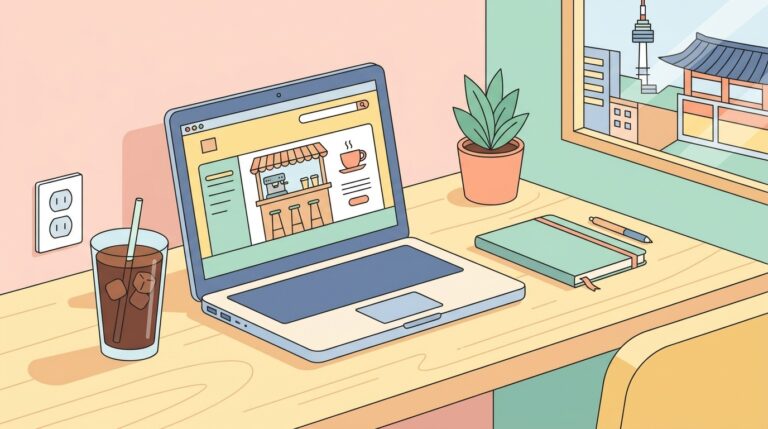
Mastering Kagongjok: The Ultimate Guide to Korean Cafe Study Culture
Phase 1: Empathy (Story-Immersive Opening)
안녕하세요! 매일한글 에디터입니다. (Hello! I am your Daily Hangul editor.)
Picture this: You step into a gorgeous, sunlit cafe in the bustling college district of Sinchon or Hongdae. Soft lo-fi indie music is playing, the rich aroma of roasted coffee fills the air, and nearly every table is occupied by college students and freelancers with glowing laptops, highlighters, and iced Americanos. This is the world of the 카공족 (Kagongjok)—a portmanteau of 카페 (cafe) and 공부하는 족 (study tribe).
You want to sit down, plug in your laptop, and get some work done. But suddenly, anxiety creeps in: Is it rude to take up a table for hours? Can I plug my charger here? What if the owner glares at me? As an intermediate Korean learner (B2 level), you already know how to order a latte, but navigating the subtle social landscape of Korean study cafes requires a whole new set of nuanced expressions and cultural awareness. Based on feedback from hundreds of our learners who froze up at cafe counters, this guide will transform you from an uncertain tourist into a confident, respectful local who can navigate any study session with flair.
Phase 2: Core Expressions Deep Dive
Here are three essential expressions every Kagongjok needs to know to navigate seating, power plugs, and cafe etiquette effortlessly.
1. 혹시 콘센트 있는 자리 있을까요? (Hoksi konsenteu inneun jari isseulkkayo?)
- Pronunciation: Hohk-shee kohn-sehn-teu eenn-neun jah-ree ee-sseul-kkah-yoh? (Sounds like the English word “cone” mixed with “sent”: cone-cent).
- Meaning: Literal: “By any chance, is there a seat with an outlet?” / Nuance: “Excuse me, could you point me to a seat where I can plug in my device?”
- K-Culture Moment: You will hear this everywhere in modern K-Dramas where startup founders or college students huddle in coffee shops. It politely tests whether the cafe welcomes laptops without sounding demanding.
- Editor’s Insight: Notice the softener 혹시 (hoksi – by any chance). In B2-level spoken Korean, omitting 혹시 makes the request sound too blunt or transactional. Adding 혹시 shows respect for the barista’s space.
- Situation Spectrum: Casual ⚠️ | Semi-formal ✅ | Formal ✅
- 🤔 Think About It: In English, we often ask “Do you have outlets?” In Korean, asking for the seat with an outlet (콘센트 있는 자리) puts the focus on physical space and communal sharing. Why do you think Korean phrases focus on space sharing rather than the fixture itself?
2. 작업 좀 하려고 하는데요… (Jageop jom haryeogo haneundeyo…)
- Pronunciation: Jah-geop johm hah-ryeo-goh hah-neun-deh-yoh (The ‘p’ at the end of jageop is unreleased, like stopping the word “cup” halfway).
- Meaning: Literal: “I intend to do a bit of work, so…” / Nuance: “I’m planning to work here for a while—is that okay?”
- K-Culture Moment: Used whenever a customer wants to gauge whether a trendy boutique cafe allows laptops or prefers conversation-only patrons.
- Editor’s Insight: Ending a sentence with -는데요 (-neundeyo) creates an intentional trailing pause. It invites the listener to complete the interaction by offering information (e.g., pointing you to the 2nd floor or informing you of a time limit) without putting them on the spot.
- Situation Spectrum: Casual ⚠️ | Semi-formal ✅ | Formal ⚠️
- 🤔 Think About It: Korean speakers rarely state their goals as absolute declarations. How does softening your purpose with “좀” (a little) change the interpersonal dynamic?
3. 오래 머물러서 한 잔 더 주문할게요 (Orae meomulleoseo han jan deo jumunhalkkeyo)
- Pronunciation: Oh-reh meo-mool-leo-seo hahn jahn deoh joo-moon-hahl-kkeh-yoh.
- Meaning: Literal: “Because I stayed a long time, I will order one more drink.” / Nuance: “I’ve been here a while, so I’d like to order another drink out of courtesy.”
- K-Culture Moment: This is the golden rule of Korean Kagongjok etiquette! Showing this level of consideration will instantly win over any cafe owner.
- Editor’s Insight: The connective particle -어서/-아서 (-eoseo/-aseo) indicates personal reason and accountability. Using this phrase turns a purely commercial transaction into a polite social pact.
- Situation Spectrum: Casual 🚫 | Semi-formal ✅ | Formal ✅
- 🤔 Think About It: Does cafe culture in your country expect you to keep buying items if you occupy a table for three or more hours, or is a single cup enough?
Phase 3: Textbook Korean vs. Real Korean
Let’s upgrade your intermediate Korean by replacing stiff textbook phrases with what locals actually say.
Situation A: Asking if laptop study is permitted
- 📖 교과서 한국어 (Textbook Korean): 여기서 공부해도 됩니까? (Yeogiseo gongbuhaedo doebnikka? – “May I study here?”)
- 🗣️ 진짜 한국어 (Real Korean): 혹시 여기 노트북 써도 괜찮을까요? (Hoksi yeogi noteubuk sseodo gwaenchaneulkkayo? – “By any chance, is it alright if I use my laptop here?”)
- 💡 왜 다를까? (Why is it different?): Asking “May I study?” sounds like a school pupil asking a teacher for permission. In real Korean cafes, asking specifically about using a laptop (노트북 쓰다) softens the inquiry and directly addresses power usage and noise.
Situation B: Inquiring about time restrictions
- 📖 교과서 한국어 (Textbook Korean): 얼마나 오래 머물 수 있습니까? (Eolmana orae meomul su issseumnikka? – “How long may I stay?”)
- 🗣️ 진짜 한국어 (Real Korean): 혹시 이용 시간제한이 따로 있나요? (Hoksi iyong siganjehani ttaro innayo? – “By any chance, is there a separate time limit for using the space?”)
- 💡 왜 다를까? (Why is it different?): Asking how long you can “stay” directly can sound defensive. Asking whether the venue has a policy (이용 시간제한) demonstrates that you are willing to follow their house rules.
Phase 4: K-Culture Deep Dive & Non-verbal Manners
4-1. 눈치 (Nunchi) & Gestures in Korean Cafes
- The Laptop Trust Phenomenon: In Korea, you will see patrons leave expensive MacBooks, iPads, and wallets on tables while going to the restroom for 15 minutes. While this highlights high public safety, 눈치 (nunchi – social awareness) dictates that you should not leave your items unattended for hours just to save a seat while dining elsewhere.
- Earphones are Mandatory: While typing is generally tolerated, mouse-clicking or keyboard tapping in dedicated quiet zones (like study floors) can draw side-eyes. Many Kagongjoks use silicone keyboard covers or silent mice.
- Floor Separation: Large chain cafes (Twosome Place, Hollys, Angel-in-us) often reserve the 1st floor for chatting and the 2nd or 3rd floor for quiet work. Observe the volume before opening your laptop.
4-2. Cultural Code: The Evolution of Kagong Culture
Why is studying in cafes so massive in South Korea? Urban living spaces in Seoul are notoriously compact (원룸, one-room studios), making prolonged study at home claustrophobic. Furthermore, Korea’s rigorous exam culture (for civil service, bar exams, and university entrance) has led to a boom in 스터디카페 (Study Cafes)—hybrid spaces between traditional library reading rooms (독서실) and ambient cafes providing 백색소음 (white noise). This blend of comfort and ambient bustle makes cafes the modern Korean library.
Phase 5: Real-World Roleplay Scenario
Setting: Cafe Haru, a two-story cafe near Ewha Womans University. You’re talking to Min-ho, a friendly yet busy barista.
- 손님 (You): 안녕하세요! 혹시 2층에서 노트북 작업 좀 해도 될까요?
(Annyeonghaseyo! Hoksi icheung-eseo noteubuk jageop jom haedo doelkkayo?)
“Hello! By any chance, would it be alright if I worked on my laptop on the second floor?”
🎭 Politely pointing toward the stairs with a welcoming smile. -
민호 (Barista): 네, 가능합니다! 다만 주말이라 3시간 이용 제한이 있어요.
(Ne, ganeunghamnida! Daman jumal-ira sesigan iyong jehani isseoyo.)
“Yes, that’s fine! However, since it’s the weekend, we have a 3-hour limit.” -
손님 (You): 아, 그렇군요. 혹시 콘센트 있는 자리가 남아 있을까요?
(A, geureokunyo. Hoksi konsenteu inneun jariga nama isseulkkayo?)
“Ah, I see. By any chance, are there any seats left with power outlets?”
🎭 Glancing slightly upstairs while waiting for his cue. -
민호 (Barista): 2층 안쪽 창가 자리에 콘센트 여유 있습니다.
(Icheung anjjok changga jarie konsenteu yeoyu issseumnida.)
“There are plenty of outlets near the inner window seats on the second floor.” -
손님 (You): 다행이네요! 아이스 아메리카노 한 잔이랑 바질 스콘 하나 주세요.
(Dahaeng-ineyo! A-i-seu a-me-ri-ka-no han jan-irang bajil seukon hana juseyo.)
“What a relief! An iced Americano and one basil scone, please.” -
민호 (Barista): 진동벨 울리면 픽업대로 와주세요. 와이파이 비밀번호는 영수증 하단에 있습니다.
(Jindongbel ullimyeon pikeopdaero wajuseyo. Wa-i-pa-i bimilbeonhoneun yeongsujeung hadane issseumnida.)
“Please come to the pickup counter when the buzzer rings. The Wi-Fi password is at the bottom of the receipt.”
(Three hours pass… you decide to stay an extra hour to finish an essay).
- 손님 (You): 저기요, 제가 오래 머물러서 음료 한 잔 더 주문할게요. 디카페인 라떼 부탁드려요!
(Jeogiyo, jega orae meomulleoseo eumryo han jan deo jumunhalkkeyo. Dika-pe-in ratte butakdeuryeoyo!)
“Excuse me, I’ve been staying for quite a while, so I’d like to order another drink. A decaf latte, please!”
🎭 Handing over your card with both hands respectfully. -
민호 (Barista): 어휴, 신경 써주셔서 감사합니다! 바로 준비해 드릴게요.
(Eohyu, singyeong sseojusyeoseo gamsahamnida! Baro junbihae deurilkkeyo.)
“Oh, thank you so much for being so thoughtful! I’ll prepare it right away.”
🔀 Interactive Branching Decision
You enter a busy, chic indie cafe in Seongsu-dong. There are only four small round tables, and people are waiting outside. What do you do?
- Option A: Pull out your laptop, plug in your charger, and order a single espresso.
Feedback: 🚫 Bad. Small boutique cafes with high foot traffic rely on fast customer turnover. Pulling out study gear here violates local 눈치 (nunchi) and will earn cold stares from both staff and waiting guests. - Option B: Ask: “노트북으로 세 시간 정도 회의해도 돼요?” (Can I have a 3-hour meeting on my laptop?)
Feedback: ⚠️ Risk. Asking is polite, but asking for a three-hour meeting in a tiny indie cafe will almost certainly result in refusal or discomfort for the staff. - Option C: Scan the space, observe that everyone is chatting without laptops, enjoy a coffee and pastry for 45 minutes, and move to a dedicated chain or study cafe for your work session.
Feedback: ✅ Best! You recognize the cafe’s atmosphere instinctively and save the deep focus work for a Kagong-friendly establishment.
Phase 6: 10-Second Emotion Shadowing Drill
Practice these natural rhythms. Focus on pausing at slashes (/) and channeling the tagged emotion!
[😊 정중하고 조심스럽게 / Polite & cautious]
혹시 / 2층에 / 콘센트 있는 자리 / 있을까요?
(Hoksi / icheung-e / konsenteu inneun jari / isseulkkayo?)-
[🤔 생각에 잠기며 양해를 구하듯 / Thoughtful & considerate]
제가 / 좀 오래 머물러서 그런데, / 차 한 잔 더 / 시킬게요.
(Jega / jom orae meomulleoseo geureonde, / cha han jan deo / sikilkkeyo.) -
[🤝 밝고 센스 있게 / Bright & cordial]
와이파이 비밀번호는 / 영수증에 / 적혀 있나요?
(Wa-i-pa-i bimilbeonhoneun / yeongsujeung-e / jeokhyeo innayo?)
Phase 7: K-Culture Mini Dictionary
- 카공족 (Kagongjok) | Cafe Study Tribe
A modern buzzword describing students and remote workers who frequent coffee shops for prolonged study or laptop work. - 노스터디존 (No-study Zone) | Designated Non-Study Area
A growing counter-trend among small boutique cafes that explicitly prohibit books, laptops, and paperwork to preserve conversation-centric vibes and customer turnover. - 백색소음 (Baeksaek soum) | White Noise
The gentle hum of espresso machines, milk frothing, and muted chatter that many Korean learners believe enhances concentration over eerie library silence. - 회전율 (Hoejeonyul) | Turnover Rate
The commercial rate at which tables empty and refill. Understanding this business metric is key to practicing polite cafe manners.
Phase 8: Traveler’s Survival Kit
Survival Expressions TOP 3
- 와이파이 비밀번호 뭐예요? (Wa-i-pa-i bimilbeonho mwoyeyo?) – “What is the Wi-Fi password?”
Pro Tip: Check your printed receipt or the bottom of the cup sleeve first before asking! - 여기 자리 비어 있나요? (Yeogi jari bieo innayo?) – “Is this seat unoccupied?”
Pro Tip: Use this when taking a chair from an adjacent table for your bag or coat. - 혹시 덜 단 음료 추천해 주실 수 있나요? (Hoksi deol dan eumryo chucheonhae jusil su innayo?) – “Could you recommend a less sweet drink?”
Pro Tip: Korean study sessions run long; skipping sugary syrups helps maintain energy.
Editor’s Travel Note
- Finding Laptop Cafes: Search on 네이버 지도 앱 다운로드 (Naver Map app) using keywords like 작업하기 좋은 카페 (cafes good for working) or 넓은 프랜차이즈 카페 (spacious franchise cafes).
- Power Standard: Korea uses 220V Type C and F plugs. Always carry an adapter with grounding pins so your laptop charger fits snugly into recessed floor outlets.
Phase 9: “A Step Deeper” (Reflective Prompt)
In Korean society, the tension surrounding Kagongjok mirrors broader socioeconomic conversations. On one hand, small business owners battle rising rents and electricity costs, needing high table turnover to survive. On the other hand, young Koreans, navigating cutthroat job markets from cramped studio apartments, seek semi-public sanctuaries where they can be productive without isolation. Choosing to buy a second drink or respecting time limits is not just about rules; it is a micro-negotiation of community empathy and mutual respect.
💬 Your Turn: How does your home country balance commercial cafe space with remote workers? Have you ever felt self-conscious while working in a public cafe? Share your stories below!
Phase 10: FAQ & Common Mistakes
Q: How long is it socially acceptable to stay at a Korean cafe with one drink?
A: As an unwritten rule among locals, 2 to 3 hours per drink is the sweet spot for large franchise cafes. If you plan to stay beyond 3 hours, ordering another beverage or a bakery item is strongly recommended.
Q: Can I leave my laptop on the table when I go to the bathroom?
A: Yes, in almost all Korean cafes, leaving your laptop, tablet, or notebook on the table while making a quick trip to the counter or restroom is completely safe. However, always take personal identification, credit cards, and passports with you.
Q: What is the difference between a 일반 카페 (General Cafe) and a 스터디카페 (Study Cafe)?
A: A regular cafe serves drinks and treats study as a secondary activity. A Study Cafe (스터디카페) is a paid workspace charged by the hour with individual desks, silent zones, office chairs, and free tea/coffee bars.
🚨 Common Mistakes Warning Board
- Plugging massive multi-tap power strips into a single wall outlet.
Correct Action: Use only one outlet per person; do not charge all your gear simultaneously unless permitted. - Holding Zoom calls or online tutoring sessions with your microphone on.
Correct Action: Keep voice calls to brief phone checks outside. Cafes welcome keyboard clatter, not one-sided loud speaking. - Throwing away your receipt before connecting to the internet.
Correct Action: Always keep your receipt until you verify the Wi-Fi SSID and password printed at the bottom.
Phase 11: Action Missions
- 🥉 Bronze Mission (Solo Practice): Stand in front of your mirror and practice saying: “혹시 콘센트 있는 자리 있을까요?” three times with natural intonation.
- 🥈 Silver Mission (Community Share): Take a photo of your current study setup (your notebook, drink, or laptop) and post it with the caption: “오늘의 카공 완료! (Today’s Kagong completed!)” tagging your Korean study buddies.
- 🥇 Gold Mission (Real-world Challenge): Next time you visit a cafe in Korea or an authentic Korean-run cafe abroad, ask the staff for the Wi-Fi password or outlet location entirely in Korean without switching to English!
🎮 K-Culture Mission: Watch an episode of a workplace or university K-Drama (such as Start-Up or Weightlifting Fairy Kim Bok-joo). Count how many times the characters meet in a cafe to discuss plans or study.
Phase 12: Interactive Quiz Challenge
Test your Kagong knowledge and language mastery with these 3 questions!
1. Situation Judgment
You enter a quiet, independent coffee shop and notice a small sign on the door saying “노스터디존” (No-Study Zone). What is the most appropriate action?
* A) Take a seat in the back corner and quietly code on your laptop.
* B) Ask for the Wi-Fi password and study for one hour only.
* C) Put away laptops and textbooks, and enjoy drinks and conversation, or choose another cafe.
2. Fill in the Blank
Complete the sentence with the most natural polite form:
* 저기요, 제가 오래 머물러서 음료 한 잔 더 ________. (Excuse me, since I’ve stayed a while, I will order one more drink.)
* (A) 먹을래요
* (B) 주문할게요
* (C) 가져와요
3. True / False Culture Check
- Statement: In South Korea, it is considered rude to sit at a 4-person table by yourself with a laptop when the cafe is crowded. (True / False)
👉 Click to reveal answers & explanations!
-
Answer: C
Explanation: A 노스터디존 (No-Study Zone) explicitly forbids using the venue for studying or work. Respecting the owner’s operational policy avoids uncomfortable confrontations. -
Answer: B (주문할게요)
Explanation: When ordering commercially at a counter, 주문할게요 (I will order) or 부탁드려요 (I request) are the most natural B2-level formulations. -
Answer: True
Explanation: Sitting alone at a large 4-person table during peak hours causes financial loss for the business and inconveniences groups. Good nunchi means moving to a single or 2-person table when available!







