

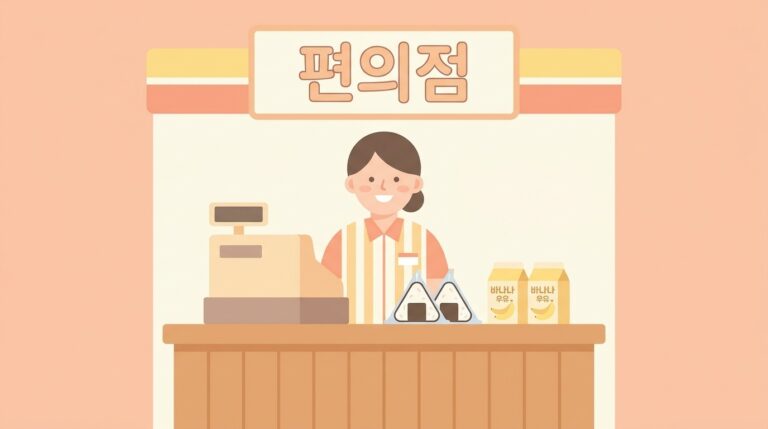
Master the Korean Convenience Store Checkout: How to Answer ‘Do You Need a Bag?’
안녕하세요! 매일한글 에디터입니다.
Picture this: It’s 11:45 PM in Seoul. You have walked 20,000 steps through the glowing alleys of Hongdae. Your hands are full of midnight treasures: fiery Buldak ramyeon, a sweet yellow bottle of banana milk, and a savory tuna-mayo samgak kimbap. You place your late-night bounty on the counter. The clerk scans the barcode with a crisp beep, looks directly into your eyes, and speaks a rapid-fire phrase that sounds like a secret password:
“Bong-tu pee-ryo-ha-se-yo?”
Your brain short-circuits. Do you smile? Do you hand over your credit card? Do you frantically nod?
If you’ve ever felt that sudden jolt of checkout anxiety in South Korea, you are not alone! Over the past decade of coaching foreign travelers and expats at Daily Hangul, this exact moment has been crowned the #1 “deer in the headlights” experience for beginners. But once you conquer this single exchange, entering any of Korea’s 50,000+ convenience stores transforms from a stress test into your favorite daily adventure. Let’s make sure you never freeze at the register again!
Phase 2: Core Expressions Breakdown
1. 봉투 필요하세요? (Bongtu piryohaseyo?)
- Pronunciation: Bong-too pee-ryo-ha-se-yo? (Think of a gentle bell ringing: bong, then too, followed by peer-yo-ha-say-yo with a rising musical pitch at the end).
- Meaning: Literal: “Is a bag needed?” | Real Nuance: “Would you like a shopping bag?”
- K-Culture Moment: Seen in nearly every slice-of-life K-Drama when characters drop by a store for comfort food after a rainy day or a breakup.
- Editor’s Insight: Notice that Korean sentences often drop “you” (dangsin). Instead of asking “Do you need…?”, the cashier neutrally asks if the bag itself is needed. This polite omission creates a humble, non-intrusive service tone.
- Situation Spectrum: Casual ⚠️ | Semi-formal ✅ | Formal ✅
- 🤔 Think About It: Why does Korean service culture prefer asking about the object’s necessity rather than pinpointing “you” directly?
2. 네, 주세요 (Ne, juseyo)
- Pronunciation: Ne, joo-say-yo (Sounds like “Neh” as in nest, and joo-say-yo like juice-say-yo).
- Meaning: Literal: “Yes, please give.” | Real Nuance: “Yes, please! I’d like one.”
- K-Culture Moment: The universal magic phrase in Korea. Whenever someone offers something delicious or helpful, this brings an immediate warm smile.
- Editor’s Insight: This is the ultimate A1 power tool. Juseyo (주세요) alone works for water, menus, napkins, or bags. Keep it handy in your linguistic front pocket!
- Situation Spectrum: Casual ⚠️ | Semi-formal ✅ | Formal ✅
- 🤔 Think About It: In English, we say “Yes, please.” In Korean, you say “Yes, give me (politely).” How does asking directly with honorifics feel compared to your native language?
3. 아니요, 괜찮아요 (Aniyo, gwaenchanayo)
- Pronunciation: Ah-nee-yo, gwen-chah-nah-yo (Flows like Ah-knee-yo, then Gwen-chah-nah-yo with a soft rhythmic bounce).
- Meaning: Literal: “No, it is okay.” | Real Nuance: “No thank you, I’m good without one.”
- K-Culture Moment: The polite decline heard across Seoul whenever friends offer an extra snack or cashiers offer a paper receipt.
- Editor’s Insight: Saying a blunt “아니요” (No) can sound harsh in Korean. Pairing it with 괜찮아요 (I’m okay / It’s fine) softens the refusal into warm etiquette.
- Situation Spectrum: Casual ⚠️ | Semi-formal ✅ | Formal ✅
- 🤔 Think About It: Why do many East Asian languages soften a direct “no” with expressions of comfort or safety?
Phase 3: Textbook Korean vs. Real Korean
Situation 1: Requesting a Plastic Bag
- 📖 Textbook Korean: 비닐봉지를 주시겠습니까? (Binilbongji-reul jusigesseumnikka? – Would you kindly grant me a plastic bag?)
- 🗣️ Real Korean: 봉투 하나 주세요. (Bongtu hana juseyo. – One bag, please.)
- 💡 Why is it different? Textbook phrases sound like you are petitioning a Joseon dynasty royal court. Real Korean is concise, friendly, and moves at the speed of Seoul!
Situation 2: Declining the Bag
- 📖 Textbook Korean: 아니요, 필요하지 않습니다. (Aniyo, piryohaji anseumnida. – No, it is not required.)
- 🗣️ Real Korean: 그냥 갈게요. (Geunyang galgeyo. – I’ll just carry it, thanks!)
- 💡 Why is it different? Native speakers explain their immediate next action (“I’ll just go as-is”) rather than reciting a formal negation statement.
Phase 4: K-Culture Deep Dive & Non-Verbal Manners
4-1. Nunchi (눈치) & Register Body Language
When the clerk asks “Bongtu piryohaseyo?”, your non-verbal cues speak volumes before words even leave your mouth:
* The Two-Hand Card Handoff: When paying or receiving your receipt, hold your payment card with both hands or rest your left hand gently under your right wrist. This tiny gesture of respect instantly marks you as culturally savvy.
* The Agreeable Head Nod: Saying “Ne, juseyo” with a slight 15-degree head bow communicates instant friendliness.
* The Gentle Hand Wave: If you don’t need a bag, softly raise your palm at chest level and wave it subtly side to side while saying “Gwaenchanayo.”
4-2. The 100-Won Eco Culture Code
Why do clerks ask this question every single time without fail? Since strict environmental laws were enacted across South Korea, single-use plastic bags cannot be handed out for free. They cost 50 to 100 KRW (about 5 to 10 cents).
If you buy several items, cashiers might offer you a 종량제 봉투 (Jongnyangje bongtu)—a government-approved official garbage bag for that specific district (Gu). Buying one is a brilliant local hack: you carry your snacks back to your hotel or Airbnb, and later use the exact same bag to throw away your room trash properly!
Phase 5: Real-Life Roleplay Scenario
Setting: A vibrant GS25 store near Hongik University Station. K-pop hits are playing gently overhead.
Character: Min-jun (민준), a friendly university student wearing the signature blue store vest.
- Min-jun (민준): 안녕하세요! 바코드 찍겠습니다. (Annyeonghaseyo! Bakodeu jikgetseumnida.)
🎭 Action: Scans your items rapidly with a friendly smile.
“Hello! I’ll scan your items.” - You (학습자): 네, 안녕하세요! (Ne, annyeonghaseyo!)
🎭 Action: Greets him with a light nod.
“Yes, hello!” - Min-jun (민준): 모두 4,800원입니다. 봉투 필요하세요? (Modu sabeck-palbaek-won-imnida. Bongtu piryohaseyo?)
🎭 Action: Pauses with his hand near the bag dispenser and makes friendly eye contact.
“That’s 4,800 won in total. Do you need a bag?” - You (학습자): 네, 봉투 하나 주세요. (Ne, bongtu hana juseyo.)
🎭 Action: Holds up one finger gently.
“Yes, please give me one bag.” - Min-jun (민준): 100원 추가되는데 괜찮으세요? (Baek-won chugadoeneunde gwaenchaneuseyo?)
🎭 Action: Points lightly to the bag fee notice.
“It’s an extra 100 won, is that okay?” - You (학습자): 네, 괜찮아요! (Ne, gwaenchanayo!
🎭 Action: Smiles comfortably.
“Yes, that’s fine!” - Min-jun (민준): 카드 꽂아주세요. (Kadeu kkoja-juseyo.)
🎭 Action: Points to the glowing chip reader on the IC terminal.
“Please insert your card.” - You (학습자): 여기요. 감사합니다! (Yeogiyo. Gamsahamnida!)
🎭 Action: Inserts card or hands it over using both hands.
“Here you go. Thank you!”
🔀 Interactive Decision Branch
What would you do if your hands were already full and you realized you forgot your reusable tote?
* Choice A: Say nothing, hand over your card, and look bewildered.
Feedback (Bad): The cashier might assume you don’t want a bag and finish the transaction without packaging your items.
* Choice B: Loudly shout “Plastic!” in English.
Feedback (Risk): The clerk might understand, but it feels abrupt and creates momentary awkwardness.
* Choice C (Best): Confidently smile and say: “네, 봉투 주세요!” (Ne, bongtu juseyo!)
Feedback (Best): Clear, polite, and immediate. The clerk will pack your goodies smoothly in two seconds flat!
Phase 6: 10-Second Emotional Shadowing Drill
Read these aloud while matching the emotional markers and natural pauses (/):
[😊 Cheerful & Clear]
네, / 봉투 / 하나 주세요!
(Ne, / bong-tu / ha-na joo-say-yo!)
“Yes, / a bag / please give me one!”-
[👋 Polite & Breezy]
아니요, / 괜찮아요! / 그냥 들고 갈게요.
(Ah-nee-yo, / gwen-chah-nah-yo! / geu-nyang deul-go gal-ge-yo.)
“No, / I’m good! / I’ll just carry it.” -
[🤝 Helpful & Natural]
종량제 봉투로 / 주세요!
(Jong-nyang-je bong-tu-ro / joo-say-yo!)
“Please give it to me / in a district trash bag!”
Phase 7: K-Culture Mini Dictionary
- 봉투 (Bongtu) | Shopping bag / Envelope. Used in stores to mean any carrier bag.
- 종량제 봉투 (Jongnyangje bongtu) | Government volume-rate waste disposal bag. Usable as a shopping bag and then legal for household trash disposal.
- 영수증 (Yeongsujeung) | Receipt. You’ll often hear: “Yeongsujeung piryohaseyo?” (Do you need a receipt?). Answer “Gwaenchanayo” to decline.
- 원 플러스 원 (Won peulleoseu won – 1+1) | Buy One Get One Free! The holy grail label displayed on shelves across Korean convenience stores.
Phase 8: Survival Kit for Travelers
Top 3 Register Survival Phrases
- 카드 돼요? (Kadeu dwaeyo?)
Pro Tip: Use this to ask “Can I pay by card?” (Credit cards and foreign travel cards are accepted almost everywhere in Korea!). - 전자레인지 어디 있어요? (Jeonjareinji eodi isseoyo?)
Pro Tip: If you buy lunchboxes (dosirak) or hot-bar sausages, heat them yourself using the microwave station inside the store. - 버려주세요 (Beoryeojuseyo)
Pro Tip: If you don’t need your paper receipt, say this with a nod (“Please discard it for me”).
Editor’s Travel Note
Before stepping onto the streets of Seoul or Busan, be sure to use the Naver Map app download for navigation because international apps often lack updated pedestrian routes in Korea. Remember that you can also recharge your physical T-money transit card right at the convenience store register using cash!
Phase 9: “One Step Deeper” (Editor’s Cultural Reflection)
In many Western cultures, asking for a bag is an assumed default. In South Korea, however, a nationwide consensus on environmental stewardship and community responsibility changed daily behavior overnight. The polite inquiry “봉투 필요하세요?” is not just a question about packaging—it reflects a society where shared resources, waste reduction, and civic duty are integrated into everyday transactions. When you answer thoughtfully, you aren’t merely shopping; you are participating in a living civic rhythm.
💬 Your Turn: What is the checkout routine like in your home country? Are single-use bags free, charged, or banned? Share your stories in the comments below!
Phase 10: FAQ & Avoiding Misunderstandings
Q: Can I pay for the 100-won bag with my credit card?
A: Absolutely! Everything scanned at the counter—including the 100-won bag fee—can be paid in a single card transaction. You do not need loose coins.
Q: What should I say if the cashier asks me something I don’t understand after the bag question?
A: 99% of the time, they are asking “영수증 드릴까요?” (Do you want your receipt?). Simply say “괜찮아요” (Gwaenchanayo – It’s okay) or “네, 주세요” (Ne, juseyo – Yes, please).
Q: What if I bring my own shopping bag?
A: Simply hold up your reusable tote and say: “가방 있어요” (Gabang isseoyo – I have a bag). The clerk will smile and immediately skip the bag prompt!
🚨 Common Mistakes Alert
- Mistake: Freezing in silence when asked “Bongtu piryohaseyo?”
Correct Action: Don’t freeze! Just nod and say “Ne!” or shake your head gently with “Aniyo.” - Mistake: Saying “Dangsin” (당신) for “you”.
Correct Action: Never address store employees as “dangsin”—it can sound aggressive. Use polite verbal endings instead of direct pronouns. - Mistake: Leaving purchased items sitting on the counter after paying.
Correct Action: Korean checkouts are high-efficiency zones. Pack your items promptly into your bag so the next customer can step up.
Phase 11: Action Missions
- 🥉 Bronze Mission (Solo Practice): Stand in front of your mirror. Look yourself in the eye and say “봉투 하나 주세요!” (Bongtu hana juseyo!) three times with a bright, confident smile.
- 🥈 Silver Mission (Social Share): Leave a comment below spelling out your favorite Korean convenience store snack and which phrase you will use when buying it.
- 🥇 Gold Mission (Real-Life Mastery): Walk into a convenience store in Korea (or your local H-Mart) and decline a bag smoothly using: “괜찮아요, 그냥 들고 갈게요!”
- 🎮 K-Culture Mission: Watch the hit drama Backstreet Rookie or any midnight convenience store scene in Crash Landing on You. Spot the exact moment someone hands over their card at the counter!
Phase 12: Interactive Quiz Challenge
Test your convenience store instincts below! Click on the dropdown toggles to reveal the answers.
Question 1: Situation Check
You bought 4 cans of Korean iced tea and chips. The cashier asks: “봉투 필요하세요?” You have no pockets and no backpack. What should you say?
👉 Click to view answer and explanation
Answer: “네, 주세요!” (Ne, juseyo!)
Explanation: Since your hands are full, accept the bag politely. Saying “Ne, juseyo” (Yes, please give me one) gets your items bagged right away for about 100 won.
Question 2: Fill-in-the-Blank
Fill in the missing syllable to decline politely:
“아니요, 괜찮___요.” (No, I’m okay.)
👉 Click to view answer and explanation
Answer: 아 (ah -> 완성형: 괜찮아요 / Gwaenchanayo)
Explanation: 괜찮아요 is the universal polite phrase for “I’m fine” or “No thank you.”
Question 3: True or False Culture Check
In South Korea, convenience stores are legally allowed to give away plastic bags for free if your purchase exceeds 30,000 KRW.
👉 Click to view answer and explanation
Answer: False!
Explanation: Under Korean environmental regulations, single-use bags cannot be provided for free regardless of the purchase amount. Everyone pays the nominal 50-100 won fee!







