

Master Buying Contact Lenses in Korea: Your Ultimate A1 Survival Guide
Phase 1: Empathy & Immersion Opening
안녕하세요! I am your Daily Hangul editor and local culture navigator. Imagine this: you have just landed in Seoul, ready to take Instagram-worthy photos in Hongdae or visit iconic K-drama film locations. Suddenly, your last pair of contact lenses rips. You walk into an optician in Myeongdong, dazzled by bright neon signs and shelves filled with eye-catching idol lenses. Panic sets in. Do you need a doctor’s prescription? How do you ask for daily disposable lenses in Korean without sounding awkward? Take a deep breath! Korea is arguably the easiest and fastest place in the world to buy contact lenses—no doctor appointment needed, walk-ins welcome, and tests take under five minutes. Based on feedback from hundreds of our beginner students, this guide will give you the exact words you need so you can shop with 100% confidence!
Phase 2: Top 3 Core Expressions In-Depth
1. 렌즈 주세요 (Len-jeu ju-se-yo)
- Pronunciation: [Len-jeu ju-se-yo] (Think of ‘lens’ ending with a soft ‘jeu’ sound like ‘measure’, followed by ‘juice-say-yo’)
- Meaning: “Please give me (contact) lenses.”
- K-Culture Moment: You will hear characters say this whenever they walk into an optician shop in dramas like True Beauty to grab everyday beauty items.
- Editor’s Insight: In Korean, the word ‘contact’ is dropped in casual speech. Just saying “렌즈” (len-jeu) automatically means contact lenses. Adding “주세요” (ju-se-yo) turns any request into a polite, natural sentence.
- Situation Spectrum: Casual ⚠️ | Semi-formal ✅ | Formal ✅
- 🤔 Think About It: In English, we usually ask “Can I get…?” as a question. In Korean, making a direct polite command with “주세요” is actually the standard polite way to order goods. How does this directness feel compared to your native language?
2. 원데이 렌즈 있어요? (Won-de-i len-jeu iss-eo-yo?)
- Pronunciation: [Won-de-i len-jeu i-sseo-yo] (Sounds like ‘one-day’ + ‘len-jeu’ + ‘it-saw-yo’)
- Meaning: “Do you have daily disposable lenses?”
- K-Culture Moment: Perfect for travelers who do not want to carry bulky saline solution bottles across Seoul and just want fresh single-day packs.
- Editor’s Insight: “원데이” (One-day) is Konglish (Korean-style English) universally understood by all opticians. “있어요?” simply means “Do you have…?” or “Is there…?”
- Situation Spectrum: Casual ⚠️ | Semi-formal ✅ | Formal ✅
- 🤔 Think About It: Notice how loanwords are integrated into Korean grammar. Why do you think Korea adopts English convenience words while maintaining Korean sentence endings?
3. 시력 검사 할 수 있어요? (Si-ryeok geom-sa hal su iss-eo-yo?)
- Pronunciation: [Si-ryeok geom-sa hal su i-sseo-yo] (Pronounce ‘she-ryuk gum-sa hal soo it-saw-yo’)
- Meaning: “Can I get an eye exam?”
- K-Culture Moment: When tourists forget their diopter numbers, opticians immediately guide them to modern digital auto-refractors for a 3-minute checkup.
- Editor’s Insight: “시력” (si-ryeok) means eyesight/vision, and “검사” (geom-sa) means test or inspection. Opticians in Korea perform this for free or for a tiny fee if you buy lenses right away.
- Situation Spectrum: Casual 🚫 | Semi-formal ✅ | Formal ✅
- 🤔 Think About It: In many Western countries, you must book an appointment with an optometrist weeks ahead. In Korea, eye exams are performed immediately on-site. What does this reveal about Korea’s service culture?
Phase 3: Textbook Korean vs. Real Korean
Situation 1: Telling the clerk you want to browse lenses
- 📖 Textbook Korean: 콘택트렌즈를 구매하고 싶습니다. (Kon-taek-teu-len-jeu-reul gu-mae-ha-go sip-seum-ni-da. / “I would like to purchase contact lenses.”)
- 🗣️ Real Korean: 렌즈 좀 보려고요. (Len-jeu jom bo-ryeo-go-yo. / “I am looking to browse some lenses.”)
- 💡 Why is it different? Nobody uses the full compound word “콘택트렌즈” or formal textbook verb “구매하다” in casual stores. Saying “보려고요” softens your intention naturally.
Situation 2: Stating your lens power/prescription
- 📖 Textbook Korean: 저의 시력은 마이너스 삼 디옵터입니다. (Jeo-ui si-ryeog-eun ma-i-neo-seu sam di-op-teo-im-ni-da. / “My eyesight is minus three diopters.”)
- 🗣️ Real Korean: 마이너스 3(삼)이에요. (Ma-i-neo-seu sam-i-e-yo. / “It’s minus three.”)
- 💡 Why is it different? Opticians deal with powers all day long. Dropping “디옵터” (diopter) and stating the number directly with “-이에요” is the real local shortcut.
Phase 4: K-Culture Deep Dive & Non-Verbal Manners
4-1. Nunchi & Gestures
When entering an optical store, opticians will bow slightly and say “어서 오세요!” (Eoseo oseyo! / Welcome!). Always use two hands (두 손으로 드리기) when handing over your current glasses, old lens blister pack, or credit card. It shows respect and polite manners. If you do not know your Korean numbers yet, simply holding up the outer foil packaging of your favorite lens box with both hands is a clear, non-verbal clue that any Korean optician will decode in one second.
4-2. Culture Code: The World of K-Pop Idol Circle Lenses
Korea is the global capital of cosmetic contact lenses. Walk through streets like Myeongdong, Gangnam, or Hongdae, and you will see dedicated lens boutiques like Olens (오렌즈) or Lens Town (렌즈타운). K-pop stars from groups like IVE, aespa, and NewJeans frequently front brand campaigns. Unlike transparent prescription lenses, Korean “컬러 렌즈” (color lenses) come with custom graphic diameters (직경) to achieve subtle, dewy natural looks or striking fantasy eyes.
Phase 5: Real-World Roleplay Scenario
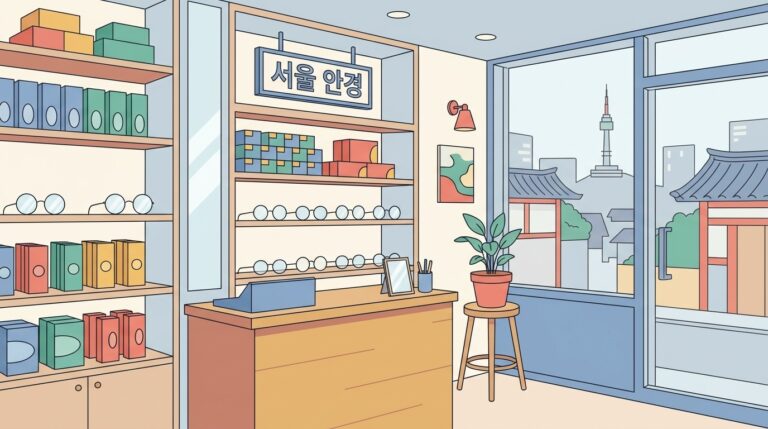
- Setting: A sleek, well-lit lens boutique near Hongik University Station. Glass display cases showcase colorful contact lens sample trays.
- Character: Min-ji (An energetic, friendly optician in a stylish beige apron holding a tablet catalog).
-
Turn 1 (Staff): 어서 오세요! 어떤 거 찾으세요? (Eoseo oseyo! Eotteon geo chajeuseyo? / “Welcome! What are you looking for?”)
🎭 Greets with a warm smile and a light bow behind the showcase -
Turn 2 (You): 안녕하세요! 원데이 렌즈 주세요. (Annyeonghaseyo! Won-de-i len-jeu ju-se-yo. / “Hello! Please give me daily disposable lenses.”)
🎭 Steps closer to the counter with a polite nod -
Turn 3 (Staff): 투명 렌즈 찾으세요, 컬러 렌즈 찾으세요? (Tu-myeong len-jeu chajeuseyo, keol-leo len-jeu chajeuseyo? / “Are you looking for clear lenses or color lenses?”)
🎭 Points gently toward two display sections -
Turn 4 (You): 투명 렌즈로 주세요. (Tu-myeong len-jeu-ro ju-se-yo. / “Clear lenses, please.”)
🎭 Points to the clear daily lens shelf -
Turn 5 (Staff): 네! 도수 아세요? (Ne! Do-su a-se-yo? / “Sure! Do you know your prescription?”)
🎭 Readies her tablet to record your details -
Turn 6 (You): 도수 잘 몰라요. 시력 검사 돼요? (Do-su jal mol-la-yo. Si-ryeok geom-sa dwae-yo? / “I don’t know my prescription. Can I get an eye exam?”)
🎭 Looks inquiringly and gestures toward the testing room -
Turn 7 (Staff): 네, 바로 가능해요. 이쪽으로 앉으세요! (Ne, ba-ro ga-neung-hae-yo. I-jjog-eu-ro an-jeu-se-yo! / “Yes, we can do it right away. Please sit over here!”)
🎭 Politely guides you to the modern testing chair with an open palm gesture -
Turn 8 (You): 네, 감사합니다! (Ne, gam-sa-ham-ni-da! / “Yes, thank you!”)
🎭 Smiles and takes a seat comfortably
🔀 Interactive Decision Point
How would you respond when the clerk asks: “도수 아세요?” (Do you know your prescription?)
- Option A: “마이너스 2.5예요. 이거 주세요.” (Ma-i-neo-seu i-jeom-o-ye-yo. I-geo ju-se-yo. / “It’s minus 2.5. Give me this one please.”)
Feedback: [Best Choice] Clear, exact, and confident. The staff will immediately fetch your boxes. - Option B: “안경 몰라요.” (An-gyeong mol-la-yo. / “I don’t know glasses.”)
Feedback: [Bad Choice] “Glasses” is not the same as prescription (“도수”). The clerk might look puzzled. - Option C: “그냥 아무거나 주세요.” (Geu-nyang a-mu-geo-na ju-se-yo. / “Just give me whatever.”)
Feedback: [Risk Choice] Lenses must match your eye power! Guessing can cause headaches or blurriness.
Phase 6: 10-Second Emotion Shadowing Drill
Practice these lines out loud, pausing where indicated by the slash (/):
[😊 Bright & Friendly]
안녕하세요! / 렌즈 주세요!
(An-nyeong-ha-se-yo! / Len-jeu ju-se-yo! / “Hello! / Please give me lenses!”)-
[🤔 Curious & Soft]
원데이 렌즈 / 있어요?
(Won-de-i len-jeu / iss-eo-yo? / “Do you have / daily lenses?”) -
[🥺 Shy but Polite]
도수 몰라요, / 검사 돼요?
(Do-su mol-la-yo, / geom-sa dwae-yo? / “I don’t know my power, / can I get tested?”)
Phase 7: K-Culture Mini Dictionary
- 렌즈 (Len-jeu) | Noun | Contact lenses
Usage: The universal short term for all contact lenses in Korea. Used everywhere instead of the long formal name. - 원데이 (Won-de-i) | Noun | Daily disposable lenses
Usage: Crucial keyword when you want hassle-free single-use lenses during your travels. - 도수 (Do-su) | Noun | Lens power / prescription
Usage: The clerk will ask “도수 어떻게 되세요?” (What is your prescription power?). - 직경 (Jik-gyeong) | Noun | Graphic diameter
Usage: Essential when shopping for color contact lenses. Standard natural diameter ranges between 13.0mm and 13.3mm.
Phase 8: Survival Kit for Travelers
Top 3 Survival Phrases
- 이걸로 주세요. (I-geol-lo ju-se-yo.)
Meaning: “Please give me this one.”
Pro Tip: Take a screenshot of the lens brand or photo on your phone and point directly while saying this phrase! - 얼마예요? (Eol-ma-ye-yo?)
Meaning: “How much is it?”
Pro Tip: Great for verifying promotional bundle discounts (like 1+1 event deals common in Korea). - 영수증 주세요. (Yeong-su-jeung ju-se-yo.)
Meaning: “Please give me the receipt.”
Pro Tip: Optical purchases over 15,000 KRW at registered stores qualify for immediate tax refunds at the airport!
Editor’s Travel Note
Before stepping out, download the [Naver Map App for fast local navigation] to locate nearby chain stores like Davich (다비치안경) or Olens. Unlike back home where you might wait a week for special orders, Korean optical shops stock vast inventories of standard diopters on-site, ready for instant carry-out.
Phase 9: A Step Deeper (Reflection)
Korean customer service embodies the famous “Ppalli-Ppalli” (빨리빨리 / hurry-hurry) culture paired with cutting-edge technology. In Korea, buying medical or visual aids isn’t gated behind bureaucratic delays; it is designed to be accessible, immediate, and customer-centered. This reflects an underlying social value: eliminating unnecessary friction so people can get back to their active lives immediately.
💬 Your Turn: How does buying contact lenses in your home country compare to Korea’s ultra-fast walk-in system? Let us know in the comments below!
Phase 10: FAQ & Common Mistakes
Q: Do I need a doctor’s prescription from an eye clinic to buy contact lenses in Korea?
A: No, you do not! In South Korea, licensed opticians working inside optical stores can perform eyesight tests directly and dispense prescription contact lenses immediately.
Q: Can I buy colored cosmetic lenses if I have astigmatism (난시)?
A: Yes, but custom toric color lenses for astigmatism (난시용 렌즈) often take 2 to 3 business days to order. Transparent astigmatism lenses, however, are usually stocked on the spot.
Q: Are eye examinations free at Korean opticians?
A: Generally, yes! If you purchase contact lenses or glasses at the shop, the computer eye examination is complimentary in almost all major Korean optical chains.
🚨 Common Mistakes Alert!
- Mistake: Trying to explain eye degrees using complex terms like ‘diopters’.
Correct Action: Just state the number with minus (e.g., “마이너스 2.0”) or show your previous lens box. - Mistake: Assuming all lenses are daily.
Correct Action: Always specify “원데이” (daily) or “한달용” (monthly), or you might accidentally buy a month-long pack. - Mistake: Paying without checking promotions.
Correct Action: Look for signs that say 1+1 (won-peul-won) to get two boxes for the price of one!
Phase 11: Action Missions
- 🥉 Bronze Mission (Solo Drill): Look in the mirror and practice saying: “원데이 렌즈 주세요!” 5 times until it rolls off your tongue smoothly.
- 🥈 Silver Mission (Social Share): Find a photo of your favorite K-pop star’s eye look and comment on our community board asking how to say that color in Korean!
- 🥇 Gold Mission (Real Action): Walk into an optical store in Korea (or an online Korean lens portal), look at the assistant, and say “렌즈 좀 보려고요!”
- 🎮 K-Culture Mission: Watch an episode of a modern school or workplace K-drama and spot how many times characters wear contact lenses versus stylish rimmed glasses!
Phase 12: Interactive Quiz Challenge
Test what you have learned today!
Question 1: Situational Judgment
You walk into a store and want daily disposable clear lenses. What is the most natural sentence to say?
A) 콘택트렌즈 구매를 요구합니다.
B) 원데이 투명 렌즈 주세요.
C) 안경 싫어요.
Question 2: Fill in the Blank
To ask for an eye exam politely, fill in the blank:
“시력 ______ 할 수 있어요?”
Question 3: True or False (Culture)
You must book an appointment with a hospital doctor weeks ahead to buy prescription lenses in Korea. (True / False)
👉 Click to view Answers & Explanations
- Answer 1: B) 원데이 투명 렌즈 주세요. (Direct, polite, and uses natural everyday vocabulary).
- Answer 2: 검사 (geom-sa). The full sentence is: “시력 검사 할 수 있어요?” (Can I get an eye exam?).
- Answer 3: False! Korean optical shops perform certified digital eye exams right on the spot for free when you purchase lenses.







