

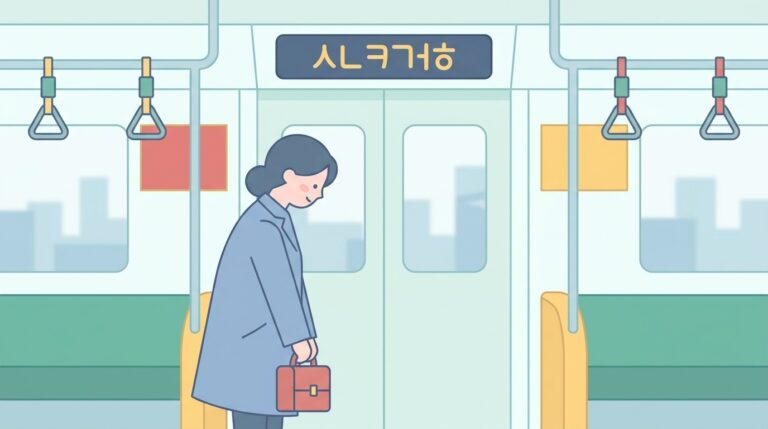
Master Korean Public Etiquette: Your Essential Beginner Guide to Everyday Manners
Phase 1: Empathy (Story Immersion Opening)
안녕하세요! (Annyeonghaseyo!) I am your Daily Hangul editor.
Picture this: You just landed at Incheon Airport, grabbed your T-Money card, and stepped onto a crowded Seoul Subway Line 2 train during morning rush hour. Suddenly, your bulky backpack accidentally bumps against an elderly passenger. You freeze. In K-Dramas like Extraordinary Attorney Woo or My Liberation Notes, Korean trains appear whisper-quiet, organized, and effortlessly coordinated. Standing there in real life, however, not knowing the local unwritten rules can make your heart race.
Many of our beginner students tell us: ‘I was so terrified of offending someone in public that I barely dared to move!’ Don’t worry at all—you are not alone. Public manners in Korea are rooted in communal care and consideration, not strict punishment. In this lesson, designed specifically for A2 elementary learners and verified by our tutoring alumni, you will master practical phrases and non-verbal cues that will make you feel confident, welcome, and naturally polite across Korea’s trains, cafes, and streets. Let’s dive in together!
Phase 2: Core Expressions In-Depth
1. 잠시만요 (Jamsimanyo)
- Pronunciation: [Jam-si-man-yo] (Sounds like “Chahm-she-mahn-yo”, rhyming with “mom” and “yo”)
- Meaning: Literal: “Just a moment” vs Real Nuance: “Excuse me / Pardon me, I am squeezing past you.”
- K-Culture Moment: In the hospital drama Hospital Playlist, doctors hurriedly squeeze through packed elevator doors while repeating “Jamsimanyo!” accompanied by a polite nod.
- Editor’s Insight: This is the undisputed champion of survival phrases. Rather than saying an intense apology, use Jamsimanyo when alighting from crowded buses or squeezing through tight convenience store aisles.
- Situation Spectrum: Casual: ⚠️ | Semi-formal: ✅ | Formal: ✅
- 🤔 Think About It: In English, we often say “Excuse me!” or “Pardon!”. Why do you think Korean polite culture asks for a listener’s time (“give me a moment”) rather than focusing on physical space?
2. 죄송합니다 (Joesonghamnida)
- Pronunciation: [Joe-song-ham-ni-da] (Sounds like “Jweh-song-hahm-nee-dah”)
- Meaning: Literal: “I feel uneasy/troubled” vs Real Nuance: “I am deeply sorry / My sincere apologies.”
- K-Culture Moment: In Crash Landing on You, characters lower their head and say “Joesonghamnida” whenever they make an unintentional public misstep.
- Editor’s Insight: While textbooks often introduce Mianhaeyo (미안해요), in public spaces among strangers, Joesonghamnida is the golden standard. It prevents misunderstandings and shows profound respect.
- Situation Spectrum: Casual: ⚠️ | Semi-formal: ✅ | Formal: ✅
- 🤔 Think About It: In your mother tongue, is an apology viewed as an admission of fault, or is it a social tool to keep community harmony peaceful?
3. 여기 자리 있어요? (Yeogi jari isseoyo?)
- Pronunciation: [Yeo-gi ja-ri i-sseo-yo?] (Sounds like “Yaw-ghee jah-ree ee-ssuh-yoh?”)
- Meaning: Literal: “Is there a seat here?” vs Real Nuance: “Is this seat taken? / May I sit here?”
- K-Culture Moment: In the romance drama Twenty-Five Twenty-One, students entering a buzzing cafe or university lounge cautiously ask this before pulling up an extra chair.
- Editor’s Insight: In busy Seoul cafes, people often leave jackets or tumblers to claim seats while ordering. Never move a chair or sit down without verifying first with this gentle phrase.
- Situation Spectrum: Casual: 🚫 | Semi-formal: ✅ | Formal: ✅
- 🤔 Think About It: How does your home culture handle claiming public seats? Is leaving a personal item considered safe or customary?
Phase 3: Textbook Korean vs Real Korean
Situation 1: Getting Off a Packed Subway Car
- 📖 교과서 한국어 (Textbook): 비켜 주세요. (Bikyeo juseyo.) — “Please move aside.”
- 🗣️ 진짜 한국어 (Real Native): 내릴게요, 잠시만요! (Naerilgeyo, jamsimanyo!) — “Getting off, excuse me for a moment!”
- 💡 왜 다를까?: Bikyeo juseyo sounds blunt and commanding, as if ordering strangers to get out of your way. Native speakers state their own intention (“I am getting off”) while asking for a brief second of patience, prompting crowds to part smoothly.
Situation 2: Asking Someone to Lower Loud Music / Phone Volume
- 📖 교과서 한국어 (Textbook): 조용히 하십시오. (Joyonghi hasipsio.) — “Be quiet.”
- 🗣️ 진짜 한국어 (Real Native): 조금만 조용히 해 주실 수 있나요? (Jogeumman joyonghi hae jusil su innayo?) — “Could you please be a little bit quiet?”
- 💡 왜 다를까?: Direct imperatives in public cause embarrassment (chaemyeon / loss of face). Adding soft qualifiers like jogeumman (just a little) softens the request into a collaborative favor.
Phase 4: K-Culture Deep Dive & Non-Verbal Manners
4-1. 눈치 (Nunchi) & Gestures
- The Karate Chop Hand Shield: When navigating through a dense crowd, place one open hand vertically near your chest and bow slightly forward. This body language universally translates to: “Excuse me, passing through!”
- Eye Contact & Soft Gaze: Avoid prolonged, direct eye contact with strangers or elders on public transit, as it can be interpreted as confrontational. Keep your gaze relaxed and neutral.
- Priority Seating Awareness (노약자석): The seats at the ends of subway cars are reserved for the elderly, disabled, and pregnant riders. Even if the entire train is standing and those seats are completely empty, locals usually leave them vacant!
4-2. Culture Code: The “Manner Mode” Culture
Korean transit is famous for its serene calm. The moment locals board trains, their phones switch to 매너 모드 (Maeneomodeu – Manner Mode / Vibrate). Phone calls are either declined or conducted in cupped whispers. This is why you rarely hear ringtones in Seoul transit—respecting auditory personal space is regarded as a top public virtue.
Phase 5: Real-Life Roleplay Scenario
- Setting: A bustling afternoon on Seoul Subway Line 2 pulling into Hongik University (Hongdae) Station.
- Characters: Alex (A2 Korean learner visiting Seoul) & Minho (A friendly local commuter).
- Alex: 🎭 Hesitantly taps Minho’s arm on the crowded train 저기요, 실례합니다. (Jeogiyo, sillyehamnida.) — “Excuse me, pardon me.”
- Minho: 🎭 Turns with a warm smile 네, 무슨 일이세요? (Ne, museun iriseyo?) — “Yes, what is the matter?”
- Alex: 🎭 Points politely towards the door 이번 역이 홍대입구역 맞아요? (Ibeon yeogi Hongdae-ipgu-yeok majayo?) — “Is this stop Hongik University Station?”
- Minho: 🎭 Nods approvingly 네, 맞아요! 지금 바로 내리셔야 해요. (Ne, majayo! Jigeum baro naerisyeoya haeyo.) — “Yes, that’s right! You need to get off right now.”
- Alex: 🎭 Notices passengers blocking the doorway 어떡하죠? 사람이 너무 많아요. (Eotteokhajyo? Sarami neomu manayo.) — “What should I do? There are too many people.”
- Minho: 🎭 Gently signals ahead with his hand ‘잠시만요’ 하면서 내리시면 길을 비켜 줄 거예요. (Jamsimanyo hamyeonseo naerisimyeon gireul bikyeo jul geoyeyo.) — “If you say ‘Jamsimanyo’ while stepping forward, they will clear the way for you.”
- Alex: 🎭 Places hand in front of chest and bows lightly 내릴게요, 잠시만요! (Naerilgeyo, jamsimanyo!) — “Getting off, excuse me a moment!”
- Minho: 🎭 Smiles as the crowd immediately parts 잘하셨어요! 조심히 가세요! (Jalhasyeosseoyo! Josimhi gaseyo!) — “Well done! Take care!”
🔀 Interactive Choice Point
You are trying to exit the train, but someone’s shopping bag is blocking your path. What do you do?
* Choice A: Loudly shout: 비키세요! (Bikiseyo! / Move!)
* Choice B: Gently tap their shoulder, bow lightly, and say: 잠시만 지나갈게요, 죄송합니다! (Jamsiman jinagalgeyo, joesonghamnida!)
* Choice C: Push the bag aside with your foot silently.
- Feedback:
- Choice A (Bad): Extremely rude! It will shock everyone in the car.
- Choice B (Best): Perfect 100-point response! Combining polite intent with an apology opens any path.
- Choice C (Risk): Using your foot to move someone’s belongings is considered offensive in Korean body language etiquette.
Phase 6: 10-Second Emotion Shadowing Drill
Practice reading these out loud. Pay attention to the pause markers (/) and adopt the indicated emotion!
[🤫 Polite & Clear]- 잠시만요, / 내릴게요! (Jamsimanyo, / naerilgeyo!)
- “Excuse me for a moment, / getting off!”
[🙇♂️ Apologetic & Humble]- 발을 밟아서 / 정말 죄송합니다. (Bareul balbaseo / jeongmal joesonghamnida.)
- “For stepping on your foot, / I am truly sorry.”
[😊 Friendly & Inquiring]- 실례지만, / 여기 앉아도 될까요? (Sillyejiman, / yeogi anjado doelkkayo?)
- “Excuse me, / may I sit here?”
Phase 7: K-Culture Mini Dictionary
- 노약자석 (Noyakjaseok) | Priority Seating
- Designated seating at both ends of subway cars and front of buses for senior citizens, injured persons, and expectant mothers.
- 눈치 (Nunchi) | Situational Awareness / Emotional Radar
- The intuitive art of reading the room and sensing social cues without needing explicit verbal instructions.
- 매너 모드 (Maeneomodeu) | Manner Mode / Silent Mode
- The setting on mobile devices turning off ringtones and notification sounds in public shared spaces.
- 자리 잡기 (Jari Japgi) | Seat Reservation / Claiming
- The widespread custom of leaving a small personal item (like a notebook or umbrella) on a cafe table before going to the counter to place your order.
Phase 8: Survival Kit for Travelers
Top 3 Survival Expressions
- 먼저 타세요. (Meonjeo taseyo.) — [Mun-juh tah-seh-yoh] | “Please board first / After you.”
- Pro Tip: Use this when standing by elevator doors or bus steps to show hospitality to elders.
- 와이파이 비밀번호가 뭐예요? (Waipai bimilbeonhoga mwoyeyo?) — [Wah-ee-pah-ee bee-meel-bun-ho-gah mwoh-yeh-yoh?] | “What is the Wi-Fi password?”
- Pro Tip: Look at the bottom of your cafe receipt before asking; 90% of Korean cafes print it there!
- 쓰레기통이 어디에 있어요? (Sseuregitongi eodie isseoyo?) — [Sseu-reh-ghee-tong-ee uh-dee-eh ee-ssuh-yoh?] | “Where is the trash can?”
- Pro Tip: Public street trash cans are rare in Seoul. Carry a small bag with you until you reach a subway station or convenience store.
Editor’s Travel Note
- Navigation Essential: Install the KakaoMetro subway navigation app and the Naver Map transit app before landing. They give real-time boarding car tips (e.g., “Board door 4-2 for quick transfer”).
- Escalator Rule: Stand on the right side if resting; keep the left lane open for passengers walking quickly.
Phase 9: One Step Deeper (Reflective Thought)
Korean public manners are shaped by the concept of 우리 (Woori – We/Our). In many Western cultures, public spaces are treated as empty voids where individuals navigate past one another. In Korea, however, a public bus or cafe is viewed as a shared collective living room. When you lower your voice or avoid occupying the elderly seat, you are not just obeying a rule; you are actively contributing to the community’s mutual comfort.
💬 Your Turn: How does your hometown handle public transit etiquette? Is it customary to chat with strangers, or is silence the norm? Share your thoughts in the comments below!
Phase 10: FAQ & Common Mistakes
Q: Can I drink my iced coffee while riding the Seoul bus?
A: No! Under Seoul transit regulations, passengers are strictly prohibited from boarding public city buses with open takeaway drink cups or food. Finish your drink before boarding, or use the subway where closed drinks are permitted.
Q: Is it okay to sit in the pink priority seats on the subway if no pregnant woman is nearby?
A: It is strongly recommended to keep the pink seats (임산부 배려석) open at all times. Early pregnancy is often invisible, and expectant mothers may feel uncomfortable asking someone to vacate the seat.
Q: What should I do if I accidentally brush or bump someone on a busy street?
A: A slight 15-degree head bow combined with a soft “Joesonghamnida” (죄송합니다) or “Jamsimanyo” (잠시만요) resolves 99% of accidental encounters instantly.
🚨 Common Mistakes Alert!
- Mistake: Throwing general trash, plastic cups, and food waste into a single bin.
- Correct Action: Korea enforces strict recycling (boonri-soogeo). Separate cups, plastic lids, and liquids before tossing.
- Mistake: Speaking on speakerphone or watching videos without earphones on public transit.
- Correct Action: Always connect headphones and keep your device switched to Manner Mode.
- Mistake: Sitting in the end-car elderly priority seats (Noyakjaseok) when tired.
- Correct Action: Stand or look for general middle seats, even if your legs are sore!
Phase 11: Action Missions
- 🥉 Bronze Mission: Practice whispering “내릴게요, 잠시만요!” (Naerilgeyo, jamsimanyo!) 5 times in front of your mirror with the hand shield gesture.
- 🥈 Silver Mission: Turn your smartphone sound profile to silent/vibrate today and note down how it changes your awareness of your surroundings.
- 🥇 Gold Mission: On your next trip to Korea (or at a local Korean grocery store/cafe), ask the cashier or patron: “여기 자리 있어요?” or use “잠시만요!” when passing through.
- 🎮 K-Culture Mission: Watch any episode of a contemporary K-Drama set in Seoul. Count how many times characters say “잠시만요” when moving through public crowds!
Phase 12: Interactive Quiz Challenge
Test your new skills! Check your answers below.
- Situational Judgment: You are boarding an elevator, and an elderly woman is approaching. What polite phrase can you say while holding the door?
- A) 비키세요 (Bikiseyo)
- B) 먼저 타세요 (Meonjeo taseyo)
- C) 조용히 하세요 (Joyonghi haseyo)
- Fill in the Blank: When squeezing past people to exit the subway train, you say:
- “내릴게요, ________!” (Naerilgeyo, ________!)
- True or False: It is acceptable to bring an open cup of iced Americano onto a Seoul city bus as long as you do not spill it.
- [True / False]
👉 Click to reveal answers & explanations!
- Answer: B) 먼저 타세요 (Meonjeo taseyo) — It means “Please ride first / After you,” showing gracious respect to elders.
- Answer: 잠시만요 (Jamsimanyo) — Meaning “Just a moment / Excuse me,” the essential transit phrase.
- Answer: False — Open takeaway cups are banned on Seoul metropolitan buses for safety and cleanliness.







