

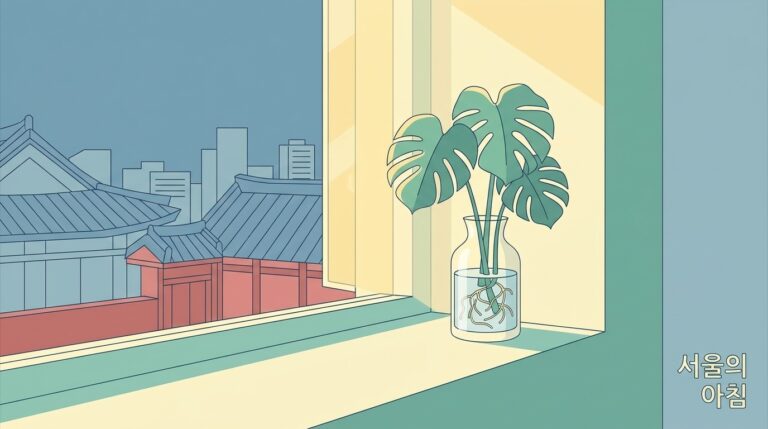
The Art of Living Clean: Mastering Hydroponic Plant Care and the Plant Butler Culture in Korea
Phase 1: 공감 (Story-Immersive Opening)
안녕하세요! 매일한글 에디터입니다. (Hello! I’m your Daily Hangul editor.)
Picture this: You are living in a chic yet compact studio apartment (원룸, wonrum) in Mapo-gu, Seoul. Outside, the city is a hyper-paced blur of neon signs, subway transfers, and rapid-fire deadlines. To carve out a tiny oasis of sanity, you visit a local plant shop and adopt a charming Monstera. You water it with devotion, but within two weeks, Seoul’s notorious seasonal indoor extremes hit. Either the dry radiant floor heating (보일러) desiccates the soil, or the humid summer monsoon causes the dreaded root rot (뿌리 무름, ppuri mureum). Your plant begins to droop.
A Korean friend visits, takes one perceptive look at the soggy potting mix, and remarks with seasoned casualness: “차라리 흙 다 털어내고 수경으로 전환해 봐. 물만 제때 갈아주면 과습 걱정 없잖아.” (Why not shake off the soil and switch to hydroponics? As long as you change the water on time, there is no fear of overwatering.)
Suddenly, you are introduced to the contemporary Korean phenomenon of the 식집사 (Sik-jipsa)—a portmanteau of plant (식물) and butler (집사). In Korea, taking care of houseplants is not just casual gardening; it is an intimate act of emotional grounding, aesthetic design (플랜테리어, planterior), and mindful companionship. Hydroponics (수경재배, sugyeongjaebae) is the pinnacle life hack for urban dwellers: no soil pests, clean glass containers, and visible root vitality.
Yet, discussing water quality, root aeration, and transplant shock in Korean requires sophisticated, nuanced vocabulary. If you are aiming for true CEFR C2 fluency, speaking like a textbook botanist sounds awkwardly stiff. Today, based on real feedback from advanced learners navigating Seoul’s urban gardening scene, we will equip you with natural, high-register Korean to discuss plant physiology, troubleshoot water care, and converse like an authentic Korean plant butler.
Phase 2: 핵심 표현 3선 심층 분석 (Top 3 Expressions In-Depth)
1. 물꽂이하다 (Mulkkoji-hada)
- Pronunciation: [Mool-kko-jee-ha-da] (Imagine pronouncing ‘mule’ without the ‘y’ sound: ‘mool’, followed by a snappy double-k ‘kko’, ending with a soft ‘jee-ha-da’.)
- Meaning: Literal: “To stick into water” | Nuanced Real Meaning: Water propagation; taking plant cuttings and rooting them directly in water rather than soil.
- K-Culture Moment: On the reality variety show I Live Alone (나 혼자 산다), when an idol methodically clips a thriving vine at the node and places it in an upcycled glass bottle, saying: “이거 잘라서 물꽂이해 두면 며칠 뒤에 하얗게 실뿌리 나와요.” (If you snip this and water-propagate it, fine white roots will emerge in a few days.)
- Editor’s Insight: While academic horticultural textbooks use formal Sino-Korean terms like 수경 번식 (hydroponic propagation) or 삽목 (cutting propagation), native plant lovers exclusively use the cozy, intuitive verb 물꽂이하다. It bridges domestic craft with botanical care.
- Situation Spectrum: Casual ✅ | Semi-formal ✅ | Formal ⚠️
- 🤔 Think About It: In English, we say “water propagation” or “rooting cuttings in water.” Notice how Korean attaches the physical movement -꽂이 (inserting/arranging, as in 꽃꽂이 – flower arrangement) directly to the element 물 (water). What does this action-oriented compound reveal about everyday Korean tactile resourcefulness?
2. 과습이 오다 (Gwasseubi oda)
- Pronunciation: [Gwa-seu-bi o-da] (Pronounce ‘gwa’ like guacamole, ‘seub’ like a short, tight ‘sub’, followed by ‘ee’ and ‘o-da’.)
- Meaning: Literal: “Excessive moisture comes” | Nuanced Real Meaning: The plant is experiencing overwatering distress, root suffocation, or damp rot.
- K-Culture Moment: Popular Korean YouTube plant vloggers inspecting discolored foliage will sigh: “장마철이라 통풍을 안 해줬더니 결국 과습이 왔네요.” (Because of monsoon season and poor air circulation, overwatering rot finally arrived.)
- Editor’s Insight: Notice that Koreans rarely say “I overwatered the plant” (내가 물을 너무 많이 줬다) when diagnosing severe symptoms. Instead, the physiological state itself is personified as an external visitor arriving (-이 오다), identical to catching a cold (감기가 오다) or hitting burnout (현타가 오다). It frames plant failure not as clumsy negligence, but as an environmental imbalance that has manifested.
- Situation Spectrum: Casual ✅ | Semi-formal ✅ | Formal ✅
- 🤔 Think About It: How does externalizing plant sickness as a condition that “arrives” relieve personal blame while cultivating holistic mindfulness about the ambient climate?
3. 환수하다 / 물갈이 주기 (Hwansuhada / Mulgari jugi)
- Pronunciation: [Hwan-soo-ha-da / Mool-ga-ri joo-gee] (Sharp and clean: ‘Hwan-soo’, and ‘Mool-ga-ri’ rolling off the tongue.)
- Meaning: Literal: “To exchange water / Water-change cycle” | Nuanced Real Meaning: Performing a complete water exchange to replenish dissolved oxygen (용존산소) and prevent anaerobic bacteria build-up.
- K-Culture Moment: Florists at the Yangjae Flower Market advising a customer buying glass containers: “수경재배는 물갈이 주기만 안 놓치면 반은 성공이에요.” (With hydroponics, as long as you don’t miss the water-change rhythm, you’re halfway to success.)
- Editor’s Insight: 물갈이 (mulgari) is pure Korean, commonly used in everyday domestic situations (including changing water for cut flowers or fish tanks). 환수 (換水, hwansu) is a high-register Sino-Korean term favored by passionate hobbyists and aquarists to indicate professional-grade water refreshing.
- Situation Spectrum: Casual ✅ | Semi-formal ✅ | Formal ✅
- 🤔 Think About It: Rhythmic consistency is a virtue in Korean domestic etiquette. How does viewing domestic duties through “cycles” (주기) reflect broader social expectations of predictability and attentiveness in Korean society?
Phase 3: 교과서 한국어 vs 진짜 한국어 (Textbook vs. Real Korean)
Situation 1: Inquiring if a plant can adapt to hydroponics without root shock
- 📖 교과서 한국어 (Textbook Korean):
“이 식물은 토양 없이 수중에 넣어도 정상적으로 생장할 수 있습니까?”
(I sikmureun toyang eopsi sujung-e neoeodo jeongsangjeogeuro saengjanghal su isseumnikka? / Can this plant grow normally even if placed in water without soil?) - 🗣️ 진짜 한국어 (Real Native C2 Korean):
“이 친구 흙 다 털어내고 수경으로 전환해도 몸살 안 앓을까요?”
(I chin-gu heuk da teoreonaego sugyeong-euro jeonhwanhaedo momsik an alheulkkayo? / If I shake off all the soil from this little guy and switch to hydroponics, won’t it suffer from transplant shock?) - 💡 왜 다를까? (Why is it different?):
C2 native speakers affectionately refer to companion plants as 이 친구 (this friend/guy) rather than the clinical “이 식물” (this plant). Furthermore, native speakers express transplant shock as 몸살을 앓다—the exact same idiom used when a human suffers from body aches, fever, or exhaustion caused by stress.
Situation 2: Advising on water refreshment before algae or bacteria form
- 📖 교과서 한국어 (Textbook Korean):
“정기적으로 용기 내부의 액체를 세척하고 액체 비료를 첨가하십시오.”
(Jeonggijeogeuro yonggi naebu-ui aekche-reul secheokhago aekche biryoreul cheomgahasipsio. / Periodically wash the liquid inside the container and add liquid fertilizer.) - 🗣️ 진짜 한국어 (Real Native C2 Korean):
“물때 끼거나 탁해지기 전에 주 1회 환수해 주시고, 액비는 아주 묽게 타주세요.”
(Multtae kkigeona takhaejigi jeone ju ilhoe hwan-suhae jusigo, aekbi-neun aju mulkke tajuseyo. / Exchange the water once a week before grime sets in or it gets murky, and dilute the liquid fertilizer very thinly.) - 💡 왜 다를까? (Why is it different?):
Real speakers use visceral physical descriptors like 물때 끼다 (water scale/slime forming) and contract 액체 비료 (liquid fertilizer) into the snappy industry standard 액비 (aekbi). Diluting solutions gently is expressed with the colloquial cooking/mixing verb 묽게 타다.
Phase 4: K-Culture 딥다이브 & 비언어적 매너 (Deep-Dive & Manners)
4-1. 눈치 (Nunchi) & Gestures in Korean Plant Boutiques and Swaps
When you enter an independent plant shop in Yeonnam-dong or visit a neighbor via Karrot Market (당근마켓) for a plant cutting exchange, non-verbal etiquette is crucial:
* Handling the Glassware: Never lift a hydroponic plant abruptly by the foliage or stem. This signals a lack of tactile respect. Instead, cup the bottom of the glass container with both hands, lifting it slightly to inspect root health against the light.
* The Tone of Diagnosis: If you notice a plant displaying yellowing leaves or root algae, avoid blurted criticism like “물 관리를 잘못하셨네요” (You managed the water poorly). Cultured Korean plant butlers employ subtle, indirect observation (돌려 말하기): “통풍이 조금 아쉬웠나 봐요” (It seems the ventilation was slightly wanting) or “뿌리가 숨을 쉬고 싶어 하는 것 같아요” (It seems the roots want to breathe).
4-2. Cultural Code: The Rise of “Sik-jipsa” (식집사) & Emotional Companion Plants
In high-density metropolises like Seoul where pet deposits can be exorbitant and single-person households (1인 가구) dominate the demographic landscape, house plants have evolved into true companions. They are legally and emotionally dubbed 반려식물 (companion plants, parallel to 반려견 for companion dogs).
Hydroponic cultivation, in particular, represents the aesthetic intersection of minimalist interior design and mindful therapy (식물 멍, ‘plant mung’—zoning out while peacefully gazing at green leaves and clear water). Watching transparent roots thrive in water provides urbanites with a tangible antidote to Seoul’s relentless competition (빨리빨리 문화). It is silent, bug-free, and profoundly therapeutic.
Phase 5: 실전 롤플레이 시나리오 (Real-Life Roleplay Scenario)
Setting: You are visiting Minji (민지), an experienced plant enthusiast in Seongsu-dong, to trade some rooted cuttings via a community neighborhood meetup.
- You: “민지 씨, 당근마켓에서 나눔해 주신 몬스테라, 뿌리가 아주 실하네요! 흙에서 키우시던 건가요?”
(Minji-ssi, danggeunmaketesoe nanumhae jusin monseutera, ppuriga aju silhaneyo! Heugeseo ki-usideon geon-gayo? / Minji, the Monstera cutting you shared on Karrot Market has exceptionally sturdy roots! Were you growing it in soil?)
🎭 [Gently supporting the bottom of the glass jar with both hands while smiling appreciatively] -
Minji: “아니요! 처음부터 물꽂이로 순화시킨 개체예요. 흙벌레 걱정이 없어서 원룸에서 키우기 딱 좋거든요.”
(Aniyo! Cheo-eumbuteo mulkkojiro sunhwasikin gaeche-yeyo. Heukbeolle geokjeong-i eopseoseo wonrumeseo ki-ugi ttak jokeodeunyo. / No! It’s a specimen I acclimatized in water from the very start. There’s no worry about soil gnats, so it’s perfect for a studio apartment.)
🎭 [Gesturing warmly toward the sunlit windowsill] -
You: “저도 수경재배를 시도해 봤는데, 물속에서도 가끔 뿌리 무름병이 와서 곤혹스럽더라고요.”
(Jeodo sugyeongjaebaereul sidohae bwanneunde, mulsogeseodo gakkeum ppuri mureumbyeong-i waseo gonhokseureopdeoragoyo. / I tried hydroponics too, but root rot sometimes set in even inside water, which was quite distressing.)
🎭 [Slightly lowering shoulders with self-deprecating empathy] -
Minji: “용존산소가 부족해지면 물속에서도 뿌리가 질식하거든요. 혹시 액비는 어떻게 챙겨주고 계세요?”
(Yongjonsansoga bujokhaejimyeon mulsogeseodo ppuriga jilsikhageodeunyo. Hoksi aekbi-neun eotteoke chaenggyeojugo gyeseyo? / If dissolved oxygen drops, roots suffocate even underwater. By the way, how have you been administering liquid fertilizer?)
🎭 [Tilting head curiously with an inquisitive gaze] -
You: “빨리 자라라고 정량대로 타줬는데, 오히려 잎끝이 갈색으로 타들어 가더라고요.”
(Ppalli jararago jeongnyangdaero tajwonneunde, ohiryeo ipkkeuti galsaeg-euro tadeureo gadeoragoyo. / I gave it the standard dosage hoping it would grow quickly, but the leaf tips scorched brown instead.)
🎭 [Lightly scratching cheek in mild embarrassment] -
Minji: “아, 수경은 흙과 달라서 완충작용이 안 돼요. 권장 희석 배율보다 서너 배는 더 묽게 타주셔야 안전해요!”
(A, sugyeong-eun heukgwa dallaseo wanchungjagyong-i an dwaeyo. Gwonjang hiseok baeyulboda seoneo bae-neun deo mulkke tajusyeoya anjeonhaeyo! / Ah, unlike soil, hydroponics has no buffering capacity. You must dilute it three to four times thinner than the recommended ratio to be safe!)
🎭 [Raising an index finger gently to emphasize the insider tip] -
You: “아하, 과유불급이었네요. 직사광선 피해서 반음지에 두고 주 1회 전체 환수를 해줘야겠어요.”
(Aha, gwayubulgeub-ieonneyo. Jiksagwangseon pihaeseo baneumjie dugo ju ilhoe jeonche hwansureul haejwoyagesseoyo. / Aha, it was a case of ‘too much is as bad as too little.’ I should avoid direct sunlight, place it in semi-shade, and do a complete water change once a week.)
🎭 [Nodding vigorously in enlightened realization] -
Minji: “완벽해요! 하이드로볼 몇 개 받쳐주면 지지력도 생기니까 나중에 한번 시도해 보세요.”
(Wanbyeokhaeyo! Haideurobol myeot gae batchyeojumyeon jijiryeokdo saengginikka najung-e hanbeon sidohae boseyo. / Perfect! If you support it with a few clay pebbles (hydroleca), it gives structural stability too, so give that a try later.)
🎭 [Clapping hands lightly with encouraging enthusiasm]
🔀 인터랙티브 분기점 (Interactive Branching)
What would you say next to sustain this high-level plant conversation?
- Option A: “뿌리가 이미 물러서 미끈거릴 때는 소독한 가위로 싹 정리하고 과산화수소를 희석한 물에 담가두는 게 맞나요?”
Feedback: [BEST CHOICE 🌟] Outstanding! You demonstrate practical problem-solving using technical terms (소독한 가위, 과산화수소 희석) while politely verifying maintenance techniques. - Option B: “식물이 힘들어 보이니까 비료 원액을 뿌리에 직접 바르면 회복이 빠르겠죠?”
Feedback: [BAD CHOICE ❌] Applying pure fertilizer directly to plant roots causes extreme osmotic burn (삼투압 현상) and immediate death. It also flags a lack of basic plant knowledge. - Option C: “솔직히 수경재배는 손이 너무 많이 가는데, 그냥 다 흙에 다시 심어버리는 게 편하지 않나요?”
Feedback: [RISK ⚠️] While honest, declaring that hydroponics is simply a hassle invalidates the shared hobby enthusiasm with your partner and halts an enriching cultural exchange abruptly.
Phase 6: 10초 감정 섀도잉 드릴 (10-Second Emotion Shadowing Drill)
Practice these natural rhythms with appropriate pause tags (/) and authentic emotional inflections:
- [🧐 진지하고 세심하게 / Serious and Meticulous]
“흙을 털어낼 땐 / 잔뿌리가 다치지 않도록 / 미온수에 살살 흔들어 씻어야 해요.”
(Heug-eul teoreonael ttaen / janppuriga dachiji antorok / mionsue salsal heundeureo ssiseoya haeyo. / When shaking off the soil, / to ensure the fine rootlets aren’t injured, / you must gently swish and wash them in lukewarm water.) -
[💡 깊은 깨달음과 감탄 / Enlightened and Impressed]
“과습을 피하려다 / 용존산소 부족으로 뿌리가 썩을 수 있다는 건 / 미처 몰랐네요!”
(Gwasseubeul piharyeoda / yongjonsanso bujog-euro ppuriga sseogeul su itdaneun geon / micheo mollanneyo! / That in trying to avoid overwatering / roots can still rot due to a lack of dissolved oxygen / is something I had not realized!) -
[🌿 평화롭고 애정 가득하게 / Warm and Gentle]
“유리병 속에서 / 새하얀 실뿌리가 뻗어나가는 걸 보면 / 지친 하루가 몽땅 치유되는 기분이에요.”
(Yuribyeong sog-eseo / saehayan silppuriga ppeodeonaganeun geol bomyeon / jichin haruga mongttang chiyudoeneun gibun-ieyo. / Watching fine white roots branch out / inside the glass vase, / I feel like my exhausting day is completely healed.)
Phase 7: K-Culture 미니 사전 (Mini Dictionary)
-
식집사 (Sik-jipsa) [Noun]
Literal: Plant Butler.
Usage: Refers to someone devoted to cultivating indoor plants with meticulous care, prioritizing the plant’s light, humidity, and airflow above their own leisure. -
물태기 (Multaegi) [Noun]
Literal: Water + Slump period (권태기).
Usage: A humorous term used by plant keepers or fish tank hobbyists describing sudden apathy or burnout toward cleaning glass vases and refreshing water. -
순화 (Sunhwa) [Noun/Verb]
Literal: Acclimatization / Naturalization.
Usage: In planting circles, specifically adapting a soil-grown plant to survive hydroponically, or helping a greenhouse plant adapt to indoor ambient room humidity. -
공중뿌리 (Gongjungppuri) [Noun]
Literal: Aerial roots.
Usage: Botanical nodes produced above soil/water level by climbers like Monsteras or Philodendrons; essential cutting spots for successful water propagation.
Phase 8: 여행자 & 거주자를 위한 생존 키트 (Survival Kit)
Top 3 On-Site Plant Expressions
- Expression 1: “이 식물은 흙 없이 수경재배로 키워도 무던하게 잘 자라는 편인가요?”
(I sikmureun heuk eopsi sugyeongjaebaero kiweodo mudeonhage jal jaraneun pyeon-in-gayo? / Does this plant grow relatively fuss-free even in hydroponics without soil?)
Pro Tip: Use 무던하다 (fuss-free/easy-going) to describe low-maintenance cultivars. - Expression 2: “수경재배용 액체 비료나 뿌리 발근제는 어디에 진열되어 있나요?”
(Sugyeongjaebaeyong aekche biryona ppuri balgeunje-neun eodie jinyeoldoeeo innayo? / Where are the hydroponic liquid fertilizers or root-stimulating hormones displayed?)
Pro Tip: Use 발근제 when looking for rooting stimulants at major plant hubs. - Expression 3: “유리병 바닥에 깔아둘 하이드로볼이나 맥반석도 함께 구매할 수 있을까요?”
(Yuribyeong badag-e kkaradul haideurobol-ina maekbanseokdo hamkke gumaenal su isseulkkayo? / Can I also purchase some clay pebbles or quartz porphyry stones to line the bottom of the glass vase?)
Pro Tip: Adding porous stones prevents root suffocation and prevents light from causing algae growth.
📍 Editor’s Travel Note: Visiting Seoul’s Botanical Havens
If you want to experience the epicenter of Korean plant culture, take Subway Line 3 or the Shinbundang Line to Yangjae Citizen’s Forest Station (양재시민의숲역) and head straight to the Yangjae Flower Complex (양재동 화훼공판장). It is South Korea’s largest horticultural wholesale and retail market.
Before you go, make sure to get the Naver Map app download on your phone. Search for “양재 꽃시장” or localized terms like “수경식물 화원”. Unlike traditional shopping malls, many family-run stalls here prefer cash transfers or local debit cards via 계좌이체 (bank transfer), though modern credit cards are widely accepted in the main building. When purchasing delicate glass plant setups, gently request: “대중교통 타고 가는데 흔들리지 않게 신문지로 단단히 포장해 주실 수 있나요?” (I am taking public transit, so could you please pack it firmly with newspaper so it doesn’t shake?).
Phase 9: “한 발 더 깊이” (One Step Deeper: Cultural Essay)
In modern Korean urban culture, the glass hydroponic container is more than an aesthetic interior decoration; it serves as a silent mirror of urban transparency and personal recovery. In a hyper-connected society where privacy is scarce and social performance is constant, looking through the transparent glass of a water vase offers an unfiltered view of raw biological vulnerability. The roots do not hide behind soil; their growth, their clean white stems, and their potential decay are fully exposed. Nurturing a plant hydroponically requires the caregiver to cultivate quiet, regular attentiveness without aggressive intervention. By swapping water and clearing murky debris, Korean Sik-jipsas quietly refresh their own mental clarity.
💬 Your Turn: Have you ever transitioned a beloved plant from soil to water? In your native culture, do people have nicknames like “plant butler” for devoted urban gardeners? Share your plant journey in the comments below!
Phase 10: FAQ & 오해 방지 (FAQ & Common Mistakes)
Q: Can any houseplant be instantly pulled from soil and switched to water?
A: Not immediately. Plants with thick, succulent fleshy leaves (like Sansevieria or ZZ plants) or plants with extremely delicate root structures often rot easily if submerged directly. Sturdy aroids like Pothos (스킨답서스), Monstera (몬스테라), and Table Palms (테이블야자) adapt to water acclimatization (수경 순화) with exceptional resilience.
Q: Why do roots turn brown and mushy in a water vase if there is no soil?
A: This is almost always caused by anoxia (용존산소 결핍)—the lack of dissolved oxygen in standing water. When water stagnates without regular water exchanges (환수), anaerobic bacteria thrive and suffocate the roots. Always exchange water weekly and wash away root slime under lukewarm running water.
Q: Should I leave hydroponic plants on a sun-drenched balcony?
A: Direct sunlight (직사광선) is hazardous for clear glass hydroponics. Sunlight heats the water, lowering oxygen capacity, and triggers explosive green algae growth (녹조 현상) that coats the roots. Keep them in bright, indirect light (반양지) or dappled shade (반음지).
🚨 Common Mistakes Alert (흔한 실수 TOP 3)
- Leaving Decaying Soil Residue:
Wrong: Shaking off only large clumps of dirt and tossing the plant into water with muddy root clumps.
Correct Action: Soak roots in lukewarm water and gently tease away every speck of potting soil before water submersion to prevent bacterial explosion. - Over-fertilizing Hydroponics:
Wrong: Using standard soil fertilizer dosages.
Correct Action: In water culture, there is no soil buffer. Dilute liquid fertilizer to 1/4th or 1/5th of the standard recommended bottle strength. - Submerging Foliage and Stems Too Deeply:
Wrong: Filling the glass vase to the brim, drowning the petioles (leaf stems).
Correct Action: Submerge only the root zone and basal growth nodes. Petioles submerged in water will rapidly rot and spoil the entire reservoir.
Phase 11: 액션 미션 & 참여 유도 (Action Missions)
- 🥉 Bronze Mission (Solo Practice): Stand in front of your mirror or phone recorder. Speak the Phase 6 shadowing sentences aloud twice, matching the rhythmic pauses (
/) and capturing the warmth of a true Korean Sik-jipsa. - 🥈 Silver Mission (Community Engagement): Go to Instagram or YouTube Shorts. Search the hashtag #수경재배 or #식집사. Leave a supportive Korean comment under a creator’s post, such as: “수경으로 이렇게 깔끔하게 키우시다니 대단해요! 환수 주기는 어떻게 되시나요?”
- 🥇 Gold Mission (Real-Life Execution): Visit a local flower shop or chat with a Korean acquaintance about plants. Intentionally incorporate the terms 물꽂이, 과습, and 환수 during natural dialogue.
Phase 12: 인터랙티브 퀴즈 챌린지 (Interactive Quiz Challenge)
1. Situational Judgment
Your friend’s Monstera cutting in a glass jar has water turning cloudy and green, and the roots feel slimy. Which advice in Korean demonstrates the most natural C2 mastery?
- (A) “그냥 비료를 듬뿍 넣어서 영양을 보충해 주면 식물이 스스로 이겨낼 거예요.”
- (B) “직사광선 때문에 녹조가 온 것 같으니, 병을 깨끗이 씻고 환수한 뒤 반양지로 옮겨보세요.”
- (C) “흙을 위에 부어서 물을 흡수시키면 뿌리가 다시 살아날 거예요.”
🔍 정답 및 해설 보기 (Click to reveal Answer & Explanation)
Correct Answer: (B)
Explanation: Option (B) correctly identifies light-induced algae (녹조) and recommends cleaning the container, exchanging water (환수), and relocating to indirect light (반양지). Option (A) causes catastrophic osmotic burn, while (C) makes an unsanitary mess!
2. Fill-in-the-Blank Test
Complete the sentence using the authentic idiomatic expression learned today:
“식물이 흙에서 물로 환경이 바뀔 때는 스트레스로 인해 ( ________ )을/를 앓을 수 있으니 안정을 취하게 해줘야 해요.”
🔍 정답 및 해설 보기 (Click to reveal Answer & Explanation)
Correct Answer: 몸살
Sentence: “…몸살을 앓을 수 있으니…”
Explanation: Koreans use 몸살을 앓다 to describe the shock, drooping, or sluggish adaptation a plant undergoes after transplanting or shifting environments.
3. Cultural True or False
Statement: In Korean plant culture, the term ‘식집사’ implies that the person views plants merely as disposable indoor aesthetic furniture (가구).
🔍 정답 및 해설 보기 (Click to reveal Answer & Explanation)
Correct Answer: FALSE
Explanation: 식집사 (Plant Butler) conveys devoted companionship, where the owner attends to the plant’s biological needs with the same respect and care a butler shows to nobility, viewing the plant as a genuine 반려식물 (companion plant).







