

Phase 1: Empathy & Story Opening
안녕하세요! 매일한글 에디터입니다. (Hello! This is your Daily Hangul editor.)
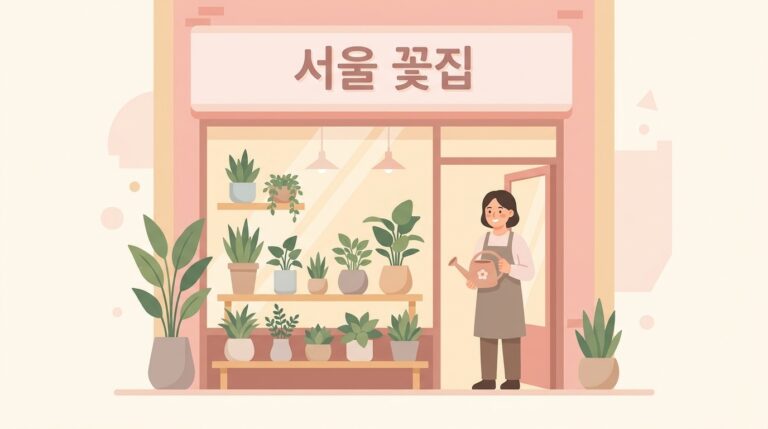
Have you ever walked along the quiet, sun-dappled alleys of Yeonnam-dong or Samcheong-dong, peered through the warm glass of a boutique Korean flower shop (꽃집 – kkot-jip), and instantly fallen in love with a tiny, potted succulent sitting in a handmade ceramic bowl? It looks like a scene straight out of a slice-of-life K-drama like Hometown Cha-Cha-Cha or Hospital Playlist. You muster the courage to step inside, greet the smiling florist, and buy the plant. But then, as you step outside into the brisk Seoul air, a sudden panic hits you: Wait, how often am I supposed to water this little buddy? Will the intense Korean summer humidity drown it, or will the dry winter Ondol (floor heating) crisp it to death?
Back when I first started gardening in my tiny Seoul studio apartment, I killed three different plants simply because I was too shy to ask the florist for proper watering instructions. I just nodded and said, “감사합니다 (Gamsahamnida)!” and ran away. Many of our Daily Hangul learners have shared this exact same frustration—they know how to say “Hello” and “Thank you,” but freeze when they need specific, practical care advice.
Don’t worry! Keeping a plant alive in Korea does not require advanced Korean fluency. In this guide, tailored specifically for A2 elementary learners, you will master the exact three phrases native speakers use to ask for watering advice, decode the secret plant vocabulary used in Korean flower shops, and unlock the cultural charm of Korea’s booming “companion plant” culture. Let’s make sure your green friend thrives!
Phase 2: Core 3 Expressions Deep Dive
1. 물은 얼마나 자주 줘야 해요? (한글)
- Pronunciation: Mul-eun eolmana jaju jwoya haeyo? (Sound analogy: Think of Mul like “mool” in pool, eolmana sounds like “all-mana” in an RPG game, and jwoya haeyo rhymes with “joy-a hey-yo”.)
- Meaning:
- Literal: “As for water, how often must I give it?”
- Real Nuance: “How often should I water this?”
- K-Culture Moment: In modern Korean web dramas about young single professionals living in one-room studios (원룸), characters often buy desk plants to combat loneliness. When holding a pot up to the florist, this is the exact, natural line they deliver with a curious tilt of the head.
- Editor’s Insight: Notice the verb 주다 (juda – to give). In English, we “water” a plant as an action verb. In Korean, you “give water” (물을 주다 – mul-eul juda) to the plant, treating the plant almost like a living being receiving nourishment.
- Situation Spectrum:
- Casual (to close friends): ⚠️ 물 얼마나 자주 줘? (Mul eolmana jaju jwo?)
- Semi-formal (Polite standard, perfect for shops): ✅ 물은 얼마나 자주 줘야 해요? (Mul-eun eolmana jaju jwoya haeyo?)
- Formal (Official presentation): ⚠️ 물을 얼마나 자주 주어야 합니까? (Mul-eul eolmana jaju jueoya hamnikka?)
- 🤔 Think About It: In your native language, do you use an active verb like “to water” or do you “give water”? How does viewing watering as an act of “giving” change how you care for plants?
2. 겉흙이 마르면 주면 되나요? (한글)
- Pronunciation: Geot-heulg-i mareumyeon jumyeon doenayo? (Sound analogy: Geot sounds like “gut”, heulg-i like “heul-gee” with a soft ‘h’, mareumyeon sounds like “mar-oo-myeon”, and jumyeon doenayo sounds like “joo-myeon dway-na-yo”.)
- Meaning:
- Literal: “If the surface soil dries, will it be okay if I give it?”
- Real Nuance: “Should I water it when the topsoil feels dry?”
- K-Culture Moment: When K-pop idols show their house tours on variety shows like I Live Alone (나 혼자 산다), you will frequently see them poking their fingers into a plant pot to check the soil moisture. This line is the quintessential green-thumb verification phrase.
- Editor’s Insight: The grammar pattern -(으)면 되나요? (-(eu)myeon doenayo?) translates to “Is it okay if I do [X]?” or “Should I just do [X]?” It is one of the friendliest, most useful A2 patterns you can master in Korean retail stores.
- Situation Spectrum:
- Casual: ⚠️ 겉흙 마르면 주면 돼? (Geot-heuk mareumyeon jumyeon dwae?)
- Semi-formal (Flower shop standard): ✅ 겉흙이 마르면 주면 되나요? (Geot-heulg-i mareumyeon jumyeon doenayo?)
- Formal: ⚠️ 겉흙이 마르면 주면 됩니까? (Geot-heulg-i mareumyeon doemnikka?)
- 🤔 Think About It: Why do you think Koreans specify 겉흙 (geot-heuk – topsoil/surface soil) instead of just “dirt”? What does this say about the level of detail valued in everyday Korean advice?
3. 물 줄 때 듬뿍 줘야 하나요? (한글)
- Pronunciation: Mul jul ttae deumpuk jwoya hanayo? (Sound analogy: Deumpuk has a punchy double ‘d’, sounding like “doom-pook” with a soft pop, and jwoya hanayo rhymes with “joy-a ha-na-yo”.)
- Meaning:
- Literal: “When giving water, must I give generously?”
- Real Nuance: “Should I soak it thoroughly when watering?”
- K-Culture Moment: In cozy healing dramas, a thoughtful grandma or senior florist often gently pats a younger lead’s shoulder, advising them: “물은 한 번 줄 때 듬뿍 줘야 뿌리까지 간단다” (When you water, give plenty so it reaches deep to the roots).
- Editor’s Insight: 듬뿍 (deumpuk) is a delicious Korean mimetic word (의태어) meaning “abundantly,” “heaping,” or “generously.” Florists use it to describe watering until moisture drains out of the bottom drainage hole (화분 밑으로 흐를 때까지).
- Situation Spectrum:
- Casual: ⚠️ 물 줄 때 듬뿍 줘? (Mul jul ttae deumpuk jwo?)
- Semi-formal (Polite standard): ✅ 물 줄 때 듬뿍 줘야 하나요? (Mul jul ttae deumpuk jwoya hanayo?)
- Formal: ⚠️ 물을 줄 때 듬뿍 주어야 합니까? (Mul-eul jul ttae deumpuk jueoya hamnikka?)
- 🤔 Think About It: Sound-symbolic words like deumpuk add rich sensory warmth to Korean communication. Do you have a word in your language that sounds like pouring a generous stream of water?
Phase 3: Textbook Korean vs. Real Korean
Situation 1: Asking how frequently to water
- 📖 Textbook Korean: 물을 언제 주어야 합니까? (Mul-eul eonje jueoya hamnikka? – When must one give water?)
- 🗣️ Real Korean: 물은 며칠에 한 번 줘요? (Mul-eun myeochil-e han beon jwoyo? – How many days between watering?)
- 💡 Why is it different? While textbooks teach formal interrogative forms like “언제 ~합니까?”, real people in modern Korean shops prefer everyday phrasing like “며칠에 한 번” (once every how many days?). It’s softer, polite, and invites a specific number like “일주일에 한 번” (once a week).
Situation 2: Asking if a plant is easy to maintain indoors
- 📖 Textbook Korean: 이 식물은 실내에서 생육하기 적합합니까? (I singmul-eun silnae-eseo saeng-yukhagi jeokhaphamnikka? – Is this plant suitable for growing indoors?)
- 🗣️ Real Korean: 이거 방에서 키우기 쉬워요? (Igeo bang-eseo kiugi swiwoyo? – Is this easy to raise in a room?)
- 💡 Why is it different? The verb 키우다 (kiuda – to raise/grow) is universally used for pets, kids, and plants alike. Using technical botanical terms like “생육하다” (saeng-yukhada) sounds like an academic thesis! Keep it friendly with “키우기 쉬워요?”.
Phase 4: K-Culture Deep Dive & Non-verbal Manners
4-1. 눈치 (Nunchi) & Polite Physical Gestures
When entering a cozy Korean flower shop, respect and spatial awareness (nunchi) will instantly win you the florist’s warm support:
1. Two-Handed Care Tag Reception: If the florist writes down a small plant care tag or hands you a business card with care instructions, receive it with both hands (or one hand supporting your forearm/wrist). Dropping it into a single hand while looking away breaks the mutual warmth.
2. The Open-Palm Gesture: When pointing to a delicate foliage plant or bonsai you want to discuss, avoid pointing aggressively with a single index finger directly at the leaves. Instead, gesture towards the pot with an open palm facing slightly upward. It conveys gentle respect toward both the plant and the shop owner’s display.
3. Tone of Voice: End your questions with a gentle upward inflection: “~되나요?⤴️” This conveys deference and shows you genuinely appreciate their botanical expertise.
4-2. The Cultural Phenomenon: “Planterior” and Companion Plants
In urban South Korea, especially among younger generations living in high-rise apartments and compact studio apartments (one-rooms), two huge cultural trends have intersected: 플랜테리어 (Planterior = Plant + Interior) and 반려식물 (Ban-ryeo-sing-mul = Companion Plant).
Just as dogs and cats are called 반려견 (ban-ryeo-gyeon) and 반려묘 (ban-ryeo-myo), the prefix 반려 (ban-ryeo) literally means “companion for life.” Koreans treat plants not merely as disposable decorations, but as green companions that relieve everyday city stress and purify indoor air during yellow dust seasons. Because people view their plants as living companions, asking detailed watering questions (“Will it be too cold near the window?”, “Does it get thirsty often?”) is seen by shop owners as proof that you will be a loving “plant parent” (식집사 – sik-jip-sa).
Phase 5: Real-Life Roleplay Scenario
- Setting: Sopung Flower (소풍 플라워), a sunlit boutique flower shop tucked away in a quiet alley near Mangwon Market, filled with the aroma of fresh soil and eucalyptus.
- Character: Minji (민지), a friendly, attentive florist wearing a beige linen apron holding a small watering can.
Dialogue:
- You: 안녕하세요! 저 식물 처음 키워보는데, 이거 예쁘네요.
(Annyeonghaseyo! Jeo singmul cheoeum kiwoboneunde, igeo yeppeuneyo.)
“Hello! I’m raising a plant for the first time, and this one is pretty.”
🎭 [Smile warmly while gesturing to a small potted Pilea Peperomioides with an open palm] -
Minji: 어서 오세요! 아, 그 친구 페페예요! 동글동글해서 인기가 정말 많아요.
(Eoseo oseyo! A, geu chingu pepeye-yo! Dong-geul-dong-geul-haeseo in-gi-ga jeongmal manayo.)
“Welcome! Ah, that friend is a Peperomia! It’s super popular because of its cute round leaves.” -
You: 방에서 키우기 쉬워요? 물은 얼마나 자주 줘야 해요?
(Bang-eseo kiugi swiwoyo? Mul-eun eolmana jaju jwoya haeyo?)
“Is it easy to grow in a room? How often should I water it?”
🎭 [Lean in slightly with an inquisitive, polite head tilt] -
Minji: 네, 초보자분들도 키우기 쉬워요. 보통 일주일에 한 번 정도 주시면 돼요.
(Ne, chobojabundeul-do kiugi swiwoyo. Botong il-ju-il-e han beon jeongdo jusimyeon dwaeyo.)
“Yes, even beginners can easily raise it. Usually, giving water about once a week is fine.” -
You: 겉흙이 마르면 주면 되나요?
(Geot-heulg-i mareumyeon jumyeon doenayo?)
“Should I water it when the topsoil is dry?”
🎭 [Point gently towards the surface of the soil with two fingers together] -
Minji: 맞아요! 손가락으로 흙을 살짝 만져보고, 바짝 말랐을 때 주시는 게 제일 좋아요.
(Maj-ayo! Songarag-euro heulg-eul saljjak manjyeobogo, bajjak mallasseul ttae jusineun ge jeil joayo.)
“Exactly! Touch the soil lightly with your finger, and watering when it’s completely dry is best.” -
You: 물 줄 때 듬뿍 줘야 하나요?
(Mul jul ttae deumpuk jwoya hanayo?)
“Should I give it a generous soak when watering?”
🎭 [Make a pouring motion with your hands and look for confirmation] -
Minji: 네! 화분 밑으로 물이 빠져나올 때까지 듬뿍 주시고, 받침대 물은 꼭 버려주세요!
(Ne! Hwabun mit-euro mul-i ppajyeo-na-ol ttae-kkaji deumpuk jusigo, batchimdae mul-eun kkok beoryeojuseyo!)
“Yes! Give plenty until water drains out under the pot, and be sure to empty the drainage tray saucer!”
🔀 Interactive Decision Point!
Now Minji asks you: “혹시 방에 햇빛이나 바람은 잘 들어요?” (Does your room get good sunlight and ventilation?)
- Choice A: “바람은 괜찮은데, 햇빛은 조금 부족해요.” (Wind/ventilation is okay, but sunlight is a bit lacking.)
- Outcome (Best): Minji praises your honest assessment! She suggests placing the Peperomia near indirect window light and recommends checking the soil less frequently. You leave confident!
- Choice B: “물 많이 주면 괜찮죠?” (If I give lots of water, it’s fine, right?)
- Outcome (Risk): Florist gasps playfully: “안 돼요! 햇빛이 없는데 물을 많이 주면 뿌리가 썩어요!” (No! Without sunlight, excessive water rots the roots!). You get a free lesson on root rot (과습).
- Choice C: “몰라요. 그냥 예뻐서 사요.” (I don’t know. I’m just buying it because it’s pretty.)
- Outcome (Bad): Breaks the polite rapport. The florist will politely sell it to you, but won’t offer bonus plant food or personalized advice.
Phase 6: 10-Second Emotion Shadowing Drill
Practice reading these lines aloud with the indicated pause breaks (/) and emotional tone!
[😊 호기심 가득하고 밝게 - Curious & Upbeat]
저 식물 처음 키워보는데, / 물은 얼마나 자주 줘야 해요?
(Jeo singmul cheoeum kiwoboneunde, / mul-eun eolmana jaju jwoya haeyo?)
“I’m raising a plant for the first time, / how often should I water it?”-
[🤔 진지하게 확인하듯 - Inquisitive & Double-checking]
일주일에 한 번이요? / 겉흙이 마르면 / 주면 되나요?
(Il-ju-il-e han beon-iyo? / Geot-heulg-i mareumyeon / jumyeon doenayo?)
“Once a week? / If the topsoil dries / should I give water?” -
[🌱 꼼꼼하고 열정적으로 - Attentive & Passionate]
물 줄 때 / 화분 밑으로 흐를 때까지 / 듬뿍 줘야 하나요?
(Mul jul ttae / hwabun mit-euro heureul ttae-kkaji / deumpuk jwoya hanayo?)
“When watering, / until it drains out underneath the pot, / should I give plenty?”
Phase 7: K-Culture Mini Dictionary
-
반려식물 (Ban-ryeo-sing-mul)
- Meaning: Companion Plant (Pet Plant).
- Usage: Combines 반려 (life companion) and 식물 (plant). Frequently used in Korean media and retail to describe personal house plants nurtured with emotional affection.
- 겉흙 (Geot-heuk)
- Meaning: Topsoil / Surface soil.
- Usage: Essential florist term. Usually contrasted with 속흙 (sok-heuk – deep inner soil). When florists tell you to water, they will 90% of the time refer to the state of the 겉흙.
- 듬뿍 (Deum-ppuk)
- Meaning: Generously, abundantly, thoroughly.
- Usage: Beyond plants (“물 듬뿍 주세요”), you’ll hear this in Korean restaurants: “고모, 반찬 듬뿍 주세요!” (Auntie, please give me plenty of side dishes!).
- 통풍 (Tong-pung)
- Meaning: Ventilation / Air circulation.
- Usage: In Korean plant culture, the holy trinity of plant keeping is 햇빛 (sunlight), 물 (water), and 통풍 (air circulation). Florists frequently remind buyers: “통풍 잘 시켜주세요!” (Make sure it gets good air flow!).
Phase 8: Traveler’s Survival Kit
Survival Expressions TOP 3
- 선물할 건데 추천해 주세요. (Seonmul-hal geonde chucheonhae juseyo.)
- Translation: “It’s a gift, could you recommend one?”
- Pro Tip: Florists will instantly guide you to low-maintenance, hardy plants like Sansevieria or Pothos.
- 식물 이름표 써 주실 수 있나요? (Singmul ireumpyo sseo jusil su innayo?)
- Translation: “Could you write the plant’s name tag for me?”
- Pro Tip: Great souvenir! They will write the Korean and botanical names on a wooden or paper stick.
- 쇼핑백에 넣어 주실 수 있어요? (Syopingbaek-e neoeo jusil su isseoyo?)
- Translation: “Can you put it in a shopping bag?”
- Pro Tip: Korean flower shops provide special clear vinyl totes with stable bases designed so your pot won’t topple on the subway.
Editor’s Travel Note
- Finding Boutique Flower Shops: Search “꽃집” or “플랜트샵” directly on the Naver Map app download for navigation. Neighborhoods like Yeonnam-dong (near Hongik Univ. Station Exit 3) and Seochon (near Gyeongbokgung Station) have lovely, English-friendly boutique florists.
- Subway & Ondol Caution: If buying during Seoul’s winter (December to February), never hold your plant naked to the freezing air; request a paper wrap (종이 포장해 주세요 – Jongi pojanghae juseyo). When you bring it home, never place the pot directly onto heated floors (Ondol); it boils the root system! Keep it elevated on a stool or table.
Phase 9: “한 발 더 깊이” (Cultural Reflection)
In Western languages, caring for flora is often described mechanistically: “I water the plants,” “I repot the shrub.” But in Korean, notice how the natural phrase is 물을 주다 (to give water), identical to how parents feed children or how you feed pets (밥을 주다).
This subtle linguistic choice highlights the deep Korean worldview of relational harmony and animism embedded in the language. Nothing in an indoor space is completely inanimate if it breathes; a leaf curling up isn’t merely an organic malfunction, but a silent signal asking for affection. When you walk into a Korean flower shop and ask how to “give” water, you are stepping out of a consumer transaction and stepping into a shared cultural understanding of nurturing life.
💬 Your Turn: In your home culture, are plants treated mostly as architectural decor, or do people view them as living housemates with personalities? Have you ever given a name to a plant? Share your thoughts below!
Phase 10: FAQ & Common Mistakes
Q: Can I just ask “몇 번 물 줘요?” (How many times do I water?)
A: While understood, it sounds slightly unnatural because it lacks a time frame. Native speakers naturally say “며칠에 한 번 줘요?” (Once every how many days?) or “일주일에 몇 번 줘요?” (How many times a week?). Adding the time unit makes you sound far more fluent!
Q: What if the florist says “과습 조심하세요”? What does that mean?
A: 과습 (gwa-seup) means “over-watering” or excessive moisture. It is the number one cause of houseplant death in Korea! If they say this, do not water on a strict calendar schedule; only water when the soil is completely bone-dry.
Q: Do Korean flower shops accept credit cards or foreign payment options for tiny plants?
A: Yes! Virtually all Korean boutique flower shops accept foreign Visa/Mastercard credit cards, Apple Pay (where available), and Samsung Pay. Cash is rarely necessary even for a 5,000 KRW mini cactus.
🚨 Common Mistakes Alert Board
- ❌ Mistake 1: Asking “물 언제 마셔요?” (When does it drink water?)
- Why: While cute, plants don’t “drink” (masida) in active polite Korean conversation. Use 물 주다 (mul juda – give water).
- ✅ Correction: 물은 언제 줘요? (Mul-eun eonje jwoyo?)
- ❌ Mistake 2: Leaving excess water sitting in the pot saucer (화분 받침대).
- Why: In Korea’s summer humidity, stagnant saucer water breeds root rot and fungus gnats.
- ✅ Correction: Remember Minji’s advice: 받침대 물은 버려주세요 (Empty the saucer water).
- ❌ Mistake 3: Using extreme formal speech “물을 주어야 하옵니까?” like a historical Joseon dynasty drama.
- Why: It sounds comically archaic. Stick to the standard polite -아/어야 해요? (-a/eoya haeyo?).
- ✅ Correction: 물은 얼마나 자주 줘야 해요? (Mul-eun eolmana jaju jwoya haeyo?)
Phase 11: Action Missions
- 🥉 Bronze Mission (Solo Practice): Stand in front of your bathroom mirror or a plant at home. Hold an imaginary watering can, look into the mirror, and say aloud three times with feeling: “물 줄 때 듬뿍 줘야 하나요?”
- 🥈 Silver Mission (Social/Media Practice): Watch an episode of a Korean lifestyle YouTube vlog (search:
식집사 브이로그or룸투어 식물) and spot whether they check the topsoil (겉흙) or use the word 반려식물! - 🥇 Gold Mission (Real Life / Immersion Challenge): Next time you step into a flower shop in Korea (or message a Korean florist on Instagram), ask: “물은 며칠에 한 번 줘요?” and note their exact recommendation!
- 🎮 K-Culture Mission: On Instagram, search the hashtag
#식집사(#PlantParent) or#반려식물(#CompanionPlant). Find your favorite aesthetic Korean plant shelf and leave a comment in Korean: “정말 예뻐요!” (It’s really pretty!).
Phase 12: Interactive Quiz Challenge
Test your knowledge before your next flower shop adventure!
1. Situation Judgement
You just bought a lovely succulent (다육이 – dayuk-i). You want to ask how often you should water it. Which sentence is the most natural, polite A2 choice?
* A) 물을 항상 마시게 해야 합니까?
* B) 물은 얼마나 자주 줘야 해요?
* C) 물을 빨리 주세요.
👉 Click to reveal Answer & Explanation
Correct Answer: B!
Explanation: B is the gold standard! Option A uses the wrong verb (masige hada – make it drink), and Option C means “Please give me water quickly,” which makes you sound like a thirsty customer asking for tap water!
2. Fill-in-the-Blank
Fill in the blank with the natural mimetic word that means “plenty / abundantly / soaking”:
“물 줄 때 ________ 줘야 하나요?” (Should I give water generously?)
👉 Click to reveal Answer & Explanation
Correct Answer: 듬뿍 (deumpuk)!
Explanation: 듬뿍 indicates pouring water generously until it runs through the bottom holes of the pot.
3. Cultural True or False
True or False: In Korea, referring to your houseplants as “반려식물” (Companion Plants) is considered overly formal and strange in modern conversational Korean.
👉 Click to reveal Answer & Explanation
Correct Answer: False!
Explanation: It is one of the trendiest and most affectionate terms in contemporary Korea! It reflects the widespread emotional attachment people form with indoor plants in single-person households.







